
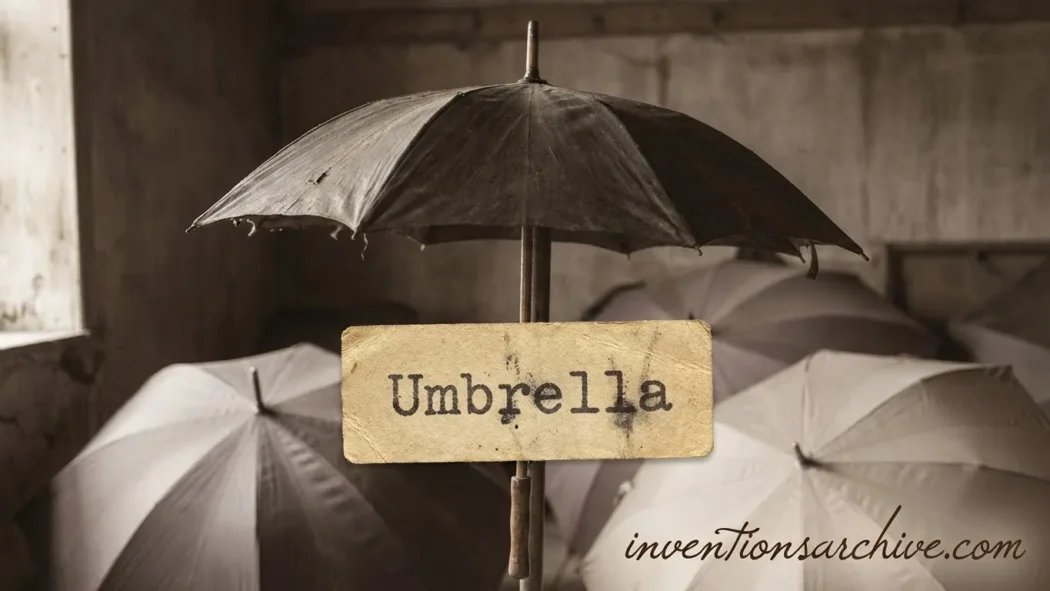
| Invention Name | Umbrella |
|---|---|
| Short Definition | A handheld canopy that opens on a ribbed frame to provide shade and/or rain protection. |
| Approximate Date / Period | At least 874 BCE (documented sunshade use) Details |
| Date Certainty | Documented evidence: Definite; earliest origin: Debated |
| Geography | Early: Mesopotamia (Neo-Assyrian); later: global adoption |
| Inventor / Source Culture | Anonymous / collective (multiple traditions) |
| Category | Everyday tools; materials; personal shelter; design & fashion |
| Importance |
|
| Need / Reason For Emergence | Shade in hot light; later dryness in rain; comfort during travel |
| How It Works | Runner + stretchers push ribs outward; canopy tension sheds water |
| Material / Technology Basis | Textiles; wood/bamboo; metal/fiberglass ribs; water-repellent finishes |
| Early Frame Materials | Baleen (“whalebone”) used for umbrella ribs in the 18th–19th centuries Details |
| First Common Uses | Shade/ceremonial cover; later everyday rain cover |
| Spread Route | Multiple regions; later trade + urban life accelerated adoption Approximate |
| Notable Milestone | “Marius-system” folding umbrella privilege (France), 1710 Details |
| Related Tradition | Oil-paper umbrellas (Dai craft; China, listed as national intangible cultural heritage) Details |
| Derived Developments | Compact folding frames; automatic runners; vented canopies; UV sun umbrellas |
| Impact Areas | Daily life; travel; outdoor work; fashion; product design |
| Debates / Differing Views | Earliest origin; transition from parasol to rain umbrella; regional “firsts” Debated |
| Precursors + Successors | Awnings & canopies → parasol → rain umbrella → compact & specialty umbrellas |
| Key Cultures / Eras | Neo-Assyrian art; early-modern Europe; industrial manufacturing; modern global design |
| Influenced Types | Parasol; stick; compact; golf; storm; bubble; beach/market umbrellas |
An umbrella feels effortless in the hand, yet it is a small feat of engineering. A sliding runner, a set of ribs, and a tensioned canopy turn open air into a calm pocket of cover. Long before it became everyday rain gear, the umbrella’s earliest role leaned toward shade and status, then expanded into comfort, mobility, and design.
Table Of Contents
What An Umbrella Is
An umbrella is a portable structure built around a radial frame. When opened, its ribs stretch the canopy into a shallow dome that deflects rain or blocks sun. The heart of the invention is not the fabric. It is the compact linkage that opens wide, holds steady, then folds into a narrow cylinder.
Core Parts
- Canopy: the fabric skin
- Ribs: radial supports
- Stretchers: push ribs outward
- Runner: the sliding collar that opens/closes
- Shaft: central spine
- Tips and ferrule: contact points, end cap
Umbrella vs. Parasol
A parasol is primarily for shade. A rain umbrella prioritizes water shedding, fast drying, and edge control. Many modern designs blur the line by pairing water resistance with UV-blocking fabrics.
Origins and Early Use
The umbrella’s oldest story is tied to shade. Early depictions show attendants holding sunshades above high-ranking figures, turning a simple canopy into a visible marker of protection and presence. A Neo-Assyrian gypsum relief dated 874 BCE describes an attendant holding a sunshade over a king, offering a clear, dated window into early use.
From that point, umbrella-like objects appear across regions in different materials and contexts. This is why a single “first inventor” stays out of reach. What can be tracked is the idea: a portable, overhead cover built on radial supports, designed to move with the person rather than remain fixed like an awning.
Why Early Umbrellas Look Different
- Shade-first design: lighter canopies, less focus on seams
- Symbolic use: carried by attendants in formal settings
- Materials at hand: plant fibers, cloth, wood, bamboo
Rain and Waterproofing
Moving from shade to rain demanded one thing: a canopy that does not soak through. Across time, makers used treatments and materials that repel water, from coated textiles to treated paper. The umbrella became a practical weather tool once fabrics could shed rain without becoming heavy and slow.
Related articles: Steam Digester (Papin) [Renaissance Inventions Series], Mechanical Organ [Medieval Inventions Series]
One enduring branch is the oil-paper umbrella, where paper is treated so it resists water while staying flexible. In China, oil-paper umbrellas are also preserved as a recognized craft tradition, with specific communities maintaining distinctive styles and methods across generations.
What “Water Resistance” Means
- Beading: water forms droplets and rolls off
- Delayed wetting: fabric resists soaking for a period
- Edge control: drip line stays predictable around the rim
Why Seams Matter
Rain does not only hit the fabric. It finds stitching holes and panel joins. That is why many rain umbrellas rely on tight weaves, careful seam placement, and finishes that help the surface tension stay smooth across panels.
Folding and Portable Umbrellas
Portability reshaped the umbrella more than any single fashion trend. A full-length stick umbrella offers reach and stability, yet a compact design fits modern movement. Early modern Europe saw notable progress toward folding forms, including a documented milestone in France in 1710 tied to a “Marius-system” folding umbrella. That moment matters because it treats folding not as a novelty, but as a distinct mechanical solution.
From there, the design space opened: multi-joint ribs, telescoping shafts, and runners that lock with less effort. Even without changing the basic geometry, folding umbrellas pushed makers toward lighter frames, tighter tolerances, and parts that can repeat a motion thousands of times.
Folding Mechanics In Plain Terms
- More joints = smaller closed size
- More parts = more places to reduce friction and wear
- Locking points keep the canopy stable when open
How The Umbrella Works
An umbrella opens because a sliding runner converts a straight motion into a spreading circle. As the runner moves up the shaft, the stretchers push the ribs outward. The canopy tightens, and the rim becomes the working edge that guides rain away from the user’s space.
In wind, the canopy behaves like a shallow sail. Better wind behavior usually comes from controlled airflow, flexible ribs, and small structural choices that keep the load from concentrating at one point. A vented canopy is a simple idea with a big effect: it allows some air to pass through layers rather than forcing the whole structure to fight the gust.
| Part | Job | Why It Matters |
|---|---|---|
| Runner | Slides and locks open/closed | Smooth motion reduces wear |
| Stretchers | Push ribs outward | Controls opening force and stability |
| Ribs | Support the canopy | Shape + wind resilience |
| Tips | Anchor the fabric at the rim | Protects edges; keeps canopy taut |
| Shaft | Central spine | Aligns forces through the middle |
| Ferrule | End cap | Protects the canopy tip and frame end |
Types and Variations
Umbrella types often look like style choices, yet each variation is a response to a practical constraint: wind, reach, portability, or coverage area. The same canopy-and-rib idea supports a wide set of designs, from strict sun parasols to rugged storm umbrellas.
By Structure
- Stick umbrella: single shaft, fewer joints, classic profile
- Compact umbrella: folding ribs and/or telescoping shaft
- Automatic: spring-assisted opening, sometimes closing
- Double-canopy: two layers for airflow control
By Purpose
- Rain umbrella: water shedding and drip control
- UV umbrella: sun-focused canopy fabrics
- Golf umbrella: wider canopy, longer shaft
- Wind-focused: flexible ribs + venting
- Beach/market umbrella: larger shade cover, often ground-mounted
| Type | Typical Strength | Common Trade-Off |
|---|---|---|
| Stick | Stable frame, fewer joints | Less portable |
| Compact | Easy to carry | More moving parts |
| Vented | Improved airflow in gusts | Slightly more weight/complexity |
| UV Parasol | Sun-blocking fabric focus | May prioritize shade over heavy rain |
| Bubble/Clear | Wraparound coverage | Can feel warmer under the canopy |