
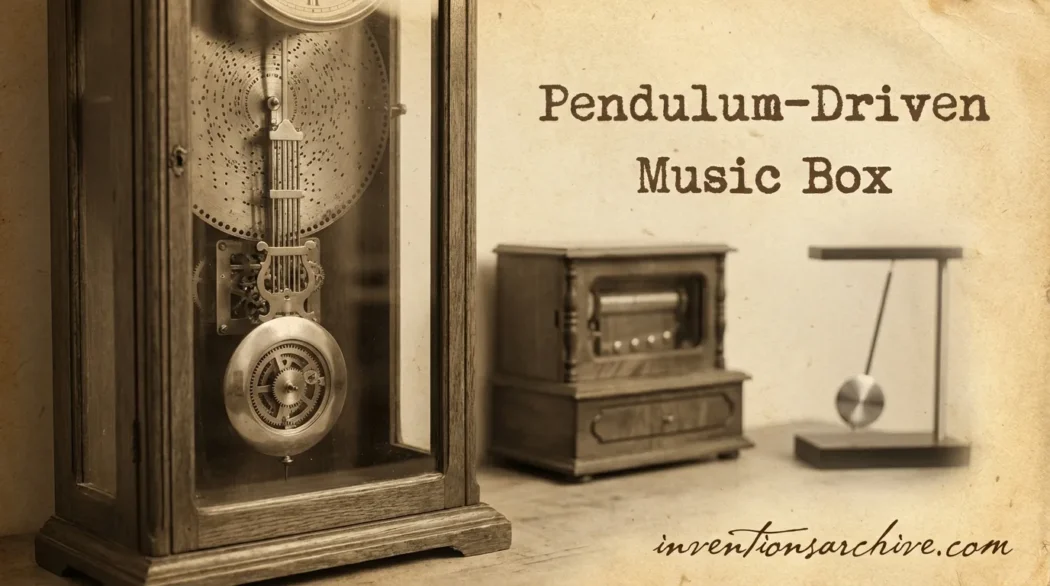
| Invention Name | Pendulum-Driven Music Box, more accurately a pendulum-controlled musical clock |
|---|---|
| Short Definition | A mechanical clock in which pendulum-regulated timekeeping is combined with an automatically triggered musical mechanism |
| Approximate Date or Period | From the later 17th century; related automatic musical clocks existed earlier |
| Geography | Europe, especially the Netherlands, England, Germany, France, and Switzerland |
| Inventor or Source Culture | No single inventor; European clockmaking and mechanical-music workshops |
| Category | Horology and automatic musical instruments |
| Importance | Joined improved pendulum timekeeping with pre-existing systems for mechanically programmed music |
| Evidence Status | Terminology requires qualification Surviving musical clocks and pendulum clocks are well documented, but “pendulum-driven music box” is not a precise historical invention name |
| Main Problem Solved | Allowed a clock to keep improved time while automatically releasing musical performances at predetermined intervals |
| Development Path | Pinned-barrel musical clocks → pendulum-regulated clocks after 1656 → integrated musical clocks → compact cylinder-and-comb musical boxes |
| System Principle | The pendulum regulates the time train; a separate musical train usually powers and controls the sounding mechanism |
| Musical Programming | Pins or pegs on a rotating barrel or cylinder mechanically encode the timing and order of notes |
| Typical Sound Producers | Bells, organ pipes, plucked or struck strings, and later tuned steel combs |
Why “Pendulum-Driven Music Box” Needs a Historical Qualification
The phrase pendulum-driven music box suggests that the pendulum itself powered a box that played music. Surviving mechanisms show a more complicated arrangement. In a mechanical clock, the pendulum normally acts as a time regulator. Energy comes from a falling weight or a wound spring, while an escapement releases that energy in controlled increments. When music was incorporated into the same clock, it commonly had its own gear train, spring or weight, triggering system, and speed regulator.
The distinction matters because automatic musical clocks are older than the pendulum clock. Elaborate clockmakers were already using pinned barrels to control bells, strings, organs, and moving figures decades before Christiaan Huygens introduced successful pendulum regulation in 1656. A historically accurate account therefore does not begin with someone inventing a single device called the “pendulum-driven music box.” It begins with two mechanical traditions that eventually met: programmable mechanical music and pendulum-regulated horology.
The Metropolitan Museum of Art preserves an especially revealing example from Augsburg, made about 1625 by Veit Langenbucher and Samuel Bidermann. Its automatic musical system combines a sixteen-note pipe organ, a sixteen-string spinet, moving figures, and an original pinned cylinder containing three airs.[a] This instrument predates Huygens’s successful pendulum clock by roughly three decades. It demonstrates that a rotating cylinder could already store a musical sequence inside sophisticated clockwork without a pendulum.
Mechanical Music Was Already Programmable Before Pendulum Timekeeping
A pinned barrel or cylinder is one of the central technologies behind early automatic music. Its surface carries pins positioned according to a predetermined musical sequence. As the barrel rotates, the pins encounter levers or other mechanical followers. Those movements can lift hammers, open organ valves, operate jacks, or later pluck the teeth of a steel comb.
The rotating barrel therefore acts as a form of physical musical programming. Its circumference represents the passage of musical time, while the position of each pin determines when a particular mechanical action occurs. Changing the arrangement of the pins changes the music that the machine performs.
This principle was used in Renaissance and early modern clocks long before the compact nineteenth-century music box became familiar. A musical wall clock made by Nicholas Vallin in London in 1598, now in the British Museum, incorporated a separate musical train and a barrel prepared to control several melodies.[b] The clock originally belonged to the pre-pendulum era. Museum documentation records later alterations involving pendulum regulation, illustrating how older clocks could be adapted as horological technology changed.
The Augsburg musical clock of about 1625 provides even clearer surviving evidence. Its original cylinder has brass pins arranged to operate an organ and spinet. The cylinder did not record sound in the later phonographic sense. Instead, it stored instructions for producing sound. The distinction is comparable to the difference between a written score and a sound recording: the mechanism mechanically performs the encoded sequence each time it runs.
Huygens Changed the Clock, Not the Basic Idea of Mechanical Music
The decisive development for the “pendulum” half of the story occurred in the Netherlands. Christiaan Huygens produced the first successful pendulum clock in December 1656. An early example made by the Hague clockmaker Salomon Coster in 1657–1659 survives in the Science Museum Group collection.[c]
Huygens did not create the energy that moved the clock by means of the pendulum. The surviving Coster mechanism is described as a spring-driven pendulum clock. The spring supplied stored energy. The pendulum, coupled to the escapement, controlled the rate at which the clockwork released it.
This was a major improvement over earlier balance-controlled clocks. A reasonably stable pendulum supplied a far more regular oscillating reference for stationary clocks. Clockmakers could therefore construct domestic and scientific timekeepers with substantially better rate control than the older verge-and-foliot tradition permitted.
Once pendulum regulation spread through European clockmaking, it could be incorporated into clocks that also struck bells, displayed astronomical information, animated figures, or played music. The resulting object might contain several mechanical systems sharing one case while performing quite different jobs.
One Case Could Contain Several Independent Machines
A sophisticated musical clock should not be imagined as one uninterrupted chain of gears running from pendulum to musical notes. Clockmakers often divided functions among distinct trains.
The going train maintained time. A striking train could count hours or quarters on a bell. A musical train could remain locked until a lever released it at a particular moment. In elaborate objects, additional gearing operated automata, astronomical displays, calendars, or other moving components.
This separation had practical advantages. The musical sequence required a relatively brief, controlled burst of motion, whereas the clock needed continuous operation over many hours or days. Giving the musical system its own stored energy and gearing allowed a tune to play at a suitable tempo without forcing the timekeeping train to perform the same task.
A musical movement also required its own method of controlling speed. Cylinder musical boxes of the later period commonly used a small centrifugal or air-resistance governor rather than a swinging clock pendulum. This is another reason the phrase “pendulum-driven music box” can be misleading when interpreted literally.
How the Clock Could Start the Music
The connection between timekeeping and music was often a trigger rather than a power transmission system. As the clock reached an hour or another programmed interval, a cam, pin, wheel, or lever released the musical train. The music then proceeded through its own mechanical cycle before being locked again.
Other musical clocks allowed the owner to start the music on demand. Some provided controls for silencing automatic performances, changing tunes, or selecting whether the music played at each hour. Such controls were useful in domestic settings, where an automatic melody that was entertaining during the day could be unwelcome at night.
The Pendulum Entered an Existing Culture of Musical Clocks
Seventeenth- and eighteenth-century European clockmaking produced objects that combined practical timekeeping with display, music, and mechanical spectacle. Court workshops and luxury makers treated the clock as a platform on which several kinds of precision craft could meet.
The surviving evidence also warns against placing every musical clock into a single evolutionary line. A clock might play bells through hammers, operate a small pipe organ, pluck strings, strike strings, or combine multiple sound sources. Pinned barrels were widely useful precisely because the same programming principle could control different instruments.
The British Museum preserves an astronomical musical clock whose eight-day movement is controlled by a pendulum and which also plays music.[d] One surviving melody is identified by the museum as “Air by Mudge,” associated with Richard Mudge. Such objects show the mature conjunction implied by the modern phrase: pendulum-regulated timekeeping and automatic music operating within the same machine.
There was no requirement, however, that the pendulum determine musical tempo. Its primary responsibility was accurate temporal regulation of the clock. The musical apparatus could be activated by that clock while remaining mechanically distinct.
A Pinned Cylinder Could Play More Than Bells
The development of musical clocks depended not merely on improved timekeeping but on increasingly varied ways of converting the movement of a pinned cylinder into sound.
In a carillon mechanism, pins could cause hammers to strike tuned bells. In an organ clock, the barrel could control valves that admitted air to particular pipes. In a string-playing mechanism, pins could operate hammers or plucking devices. The physical design changed according to the instrument, but the encoded-barrel principle remained recognizable.
A German musical clock dating to about 1800 in the Metropolitan Museum of Art shows another solution. The museum identifies it as a “dulcimer” or “harp clock.” A pinned cylinder activates sixteen small hammers that strike wire strings, and the clock can mark the hours with six tunes as well as a bell.[e]
This diversity is important when tracing the history of the music box. The familiar comb-and-cylinder box was not simply a pendulum clock reduced in size. It emerged from a broader field of automatic music in which clockmakers already understood how to store a melody mechanically, regulate moving parts, release mechanisms automatically, and manufacture small precision components.
From Musical Clock to the Familiar Cylinder Music Box
By the nineteenth century, the term musical box became particularly associated with mechanisms in which pins on a rotating cylinder plucked tuned steel teeth. This was a different sound-producing architecture from the bells, organs, and strings found in many earlier musical clocks.
The compact comb helped mechanical music become less dependent on large clock cases or assemblies of bells. A spring-driven musical movement could be installed inside a comparatively small wooden box and could operate independently of any timekeeping mechanism.
The Smithsonian’s National Museum of American History preserves a Charles Paillard & Cie. cylinder music box made in Sainte-Croix, Switzerland, around 1838–1842. It has a one-piece comb with fifty teeth and a key-wound metal spring.[f] Its operating principle makes the distinction from a pendulum musical clock especially clear: the stored spring energy turns the cylinder, the cylinder’s pins pluck the tuned comb, and no pendulum is required.
| Component | Mechanical Role | What It Does Not Necessarily Do |
|---|---|---|
| Spring or Falling Weight | Stores and supplies mechanical energy | Does not determine the musical sequence by itself |
| Pendulum and Escapement | Regulate the rate of the clock’s going train | Usually do not provide the musical movement’s energy |
| Clock Trigger | Releases music at an hour or other selected interval | Does not encode the melody |
| Pinned Barrel or Cylinder | Stores the sequence and timing of mechanical musical actions | Does not inherently require a pendulum |
| Bells, Pipes, Strings, or Steel Comb | Produce the audible notes | Do not normally regulate the clock |
| Musical Governor | Controls the running speed of the musical train | Need not be the clock’s pendulum |
Why the Two Technologies Were Natural Partners
Clockmaking and automatic music demanded many of the same workshop abilities. Both depended on accurately cut gears, controlled power transmission, pivots with low friction, precisely arranged levers, durable springs, and mechanisms capable of repeating an action consistently.
A clockmaker who could make a train run for hours and release a strike at the correct moment already possessed much of the technical vocabulary required for automatic music. Adding a pinned barrel extended that vocabulary from counting time to organizing a sequence of sound.
The relationship also worked in the opposite direction. Musical mechanisms created demand for compact regulators, reliable spring motors, refined gearing, interchangeable cylinders, and increasingly precise manufacture. The histories of horology and mechanical music consequently overlap even when the mechanisms are not mechanically identical.
In luxury clocks, music had another function: it demonstrated mechanical control. A clock that could indicate time, strike the hour, reproduce several melodies, and animate figures transformed invisible gearing into a visible and audible performance. The machine advertised the abilities of its maker each time it completed a cycle.
Why There Is No Single Inventor of the Combined Form
Assigning the pendulum-driven musical clock to one inventor would merge several separate developments. Pinned-barrel automatic music existed before pendulum timekeeping. Huygens supplied the breakthrough that made the successful pendulum clock possible in 1656, but he did not invent the earlier tradition of musical clocks. Later makers combined, altered, and miniaturized these technologies in many configurations.
The evidence is therefore better described as a development path rather than a single invention event. A late sixteenth- or early seventeenth-century musical clock could contain sophisticated automatic music without a pendulum. A later clock could receive pendulum regulation while retaining a separate musical train. By the nineteenth century, a cylinder music box could abandon the clock and pendulum entirely while preserving the principle of mechanically encoded music.
Even surviving objects can have complicated histories. Clock movements were repaired, updated, converted, fitted into new cases, or paired with musical mechanisms at later dates. A pendulum present on an object today does not by itself prove that the complete clock was originally built in that form. Museum records that distinguish original components from later modifications are therefore especially valuable when reconstructing this history.
The Lasting Mechanical Idea Was Encoded Motion
The most durable idea linking early musical clocks to later music boxes is not the pendulum. It is the ability to encode a sequence into a moving physical medium and have a machine perform it automatically.
On a pinned cylinder, information is embodied directly in hardware. A pin placed at one position produces an action at one moment; another pin placed elsewhere produces another note. Once the cylinder has been prepared, the machine can repeat the same sequence without a human performer controlling every note.
That concept outlived any single musical mechanism. Pinned barrels appeared in clocks and automatic organs; compact cylinders became central to Swiss musical boxes; interchangeable media expanded the number of available tunes; and later mechanical instruments developed more elaborate methods of storing musical instructions.
The pendulum contributed something different but equally important. It made the clock a much better regulator of time. When clockmakers coupled that regulated timekeeping to automatic release mechanisms, music could become part of a scheduled mechanical event: a melody at the hour, a sequence following a strike, or an animated performance initiated by the clock.
For that reason, the historically useful meaning of “pendulum-driven music box” is a pendulum-controlled musical clock or clock-integrated automatic musical mechanism, not a box whose pendulum directly powers its tune. Its history belongs at the intersection of horology, automatic musical instruments, pinned-barrel programming, spring and weight motors, escapements, and the precision workshops that brought those systems together.
Sources and Verification
- [a] Musical Clock with Spinet and Organ — The Metropolitan Museum of Art collection record documents the circa-1625 Augsburg clock, its sixteen-note organ, sixteen-string spinet, original pinned cylinder, makers, materials, and automatic musical mechanism.
- [b] carillon clock; chamber clock; musical clock; weight-driven clock; clock-case — The British Museum collection record documents Nicholas Vallin’s 1598 musical wall clock, its musical barrel and train, and evidence concerning later conversion of the clock’s regulating system.
- [c] Early pendulum clock by Salomon Coster, c.1657. — The Science Museum Group identifies the surviving Coster clock as one of the earliest pendulum clocks and explains Huygens’s successful 1656 design and the pendulum’s regulating relationship with a spring-driven clock movement.
- [d] astronomical clock; musical clock; eight-day clock; hour-striking clock; spring-driven clock; clock-case — The British Museum documents an eight-day astronomical clock controlled by a pendulum that also plays music, providing direct evidence for the combination of pendulum-regulated timekeeping and automatic musical performance.
- [e] Musical Clock — The Metropolitan Museum of Art records the circa-1800 German harp or dulcimer clock in which a pinned cylinder activates sixteen hammers to strike wire strings and provides a repertoire of six tunes.
- [f] Paillard & Cie. Cylinder Music Box — The Smithsonian Institution documents a Swiss cylinder music box made about 1838–1842 with a fifty-tooth one-piece comb and a key-wound metal spring, illustrating the mature standalone cylinder-and-comb form.