
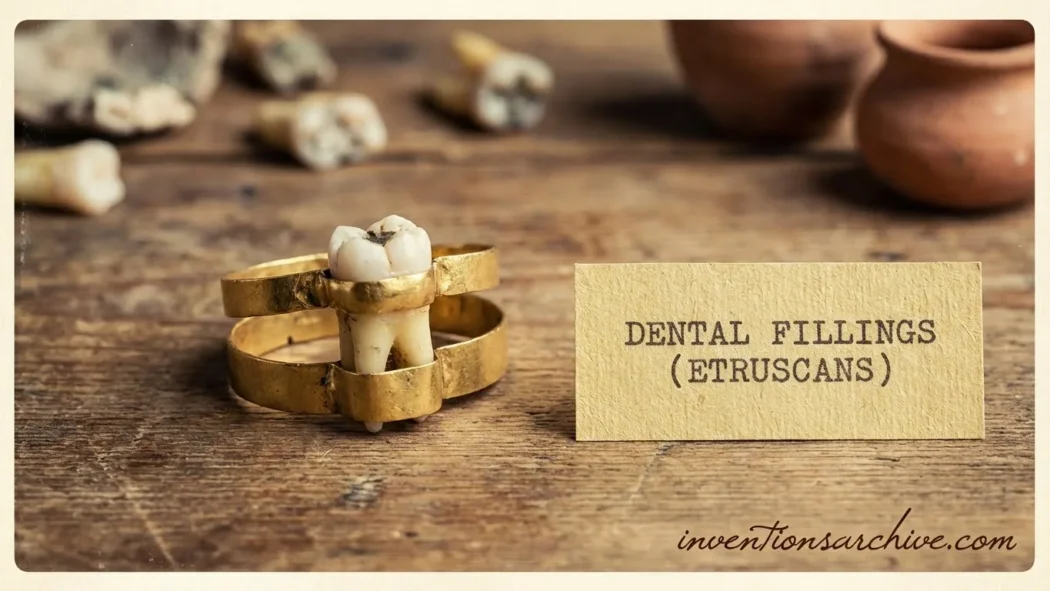
| Invention Name | Dental Fillings (Etruscan Gold Dental Bridges / Prosthetic Fillings) |
|---|---|
| Short Definition | A gold-band dental appliance used to replace missing front teeth or stabilize loose teeth; not a modern cavity filling. |
| Approximate Date / Period | 7th century BCE onward; strong early evidence around 630 BCE Based on surviving evidence |
| Geography | Etruria and nearby Italic areas of central Italy Approximate |
| Inventor / Source Culture | Anonymous Etruscan or Italic artisans, probably drawing on advanced goldworking skills Attribution varies |
| Category | Medicine, prosthetic dentistry, craft technology, material culture |
| Main Problem Solved | Visible missing anterior teeth, loose teeth, and elite cosmetic display |
| How It Worked | Thin gold bands encircled nearby teeth; replacement teeth were held by rivets, pins, or shaped mounts. |
| Material / Technology Base | Gold sheet, gold bands, soldered rings, rivets, human teeth, animal teeth, ivory in some examples |
| Evidence Status | Archaeological and museum evidence survives; written Etruscan treatment records do not Based on surviving evidence |
| Surviving Evidence | Dental appliances, museum objects, replicas, archaeological finds, scholarly catalogues |
| Development Path | Goldworking and tooth replacement → Etruscan dental appliance → dental bridge → partial denture and fixed prosthesis |
| Related Inventions | Dental bridge, denture, dental crown, gold soldering, riveted prosthesis, restorative filling |
| Modern Descendants | Dental bridges, removable partial dentures, fixed prosthodontics, cosmetic dental prostheses |
| Historical Importance | Early evidence of prosthetic dentistry; shows how medical need, ornament, and skilled metalwork could meet in one object. |
What Etruscan Dental Fillings Were
Etruscan dental “fillings” were early dental replacements made with thin gold bands and natural-looking tooth elements. In many cases, the better term is dental bridge or dental prosthesis. A bridge filled a visible gap in the mouth by anchoring a replacement tooth to neighboring teeth.
The Etruscans lived in central Italy, especially in the area later known as Etruria. Museum summaries place Etruscan culture roughly between 800 and 100 BCE, with strong technical skill in gold jewelry and metalwork.[a] That goldworking background matters because the dental appliance was not only a medical object. It was also a small, delicate metal artifact.
The surviving examples point to a craft that joined the mouth, the workshop, and the tomb. A replacement tooth could be human, animal, or shaped from another hard material. The gold did the holding. It wrapped around existing teeth and carried the replacement piece in the gap.
How the Origin Is Traced
The origin is traced through surviving objects, museum records, replicas, and dental archaeology. One Science Museum Group collection entry describes an Etruscan denture copy based on an original tomb find from Etruria. Its record explains that Etruscans made dentures and false teeth from around 700 BCE onward, using human or animal teeth inserted into a gold band and fixed with a metal pin.[b]
Academic work narrows the technical picture. A Springer chapter on Etruscan gold dental appliances states that by about 630 BCE, Etruscan metallurgists in central Italy were already applying goldworking skill to dental bridges. The same source describes hollow gold teeth, thin gold bands, riveted replacement teeth, and pontics anchored to healthy neighboring teeth.[c]
These details are strong, but they are not complete. Many appliances were found without full archaeological context, and some are preserved as copies or later-recorded museum pieces. That means the broad invention is well supported, while some individual dates, makers, and uses remain open to careful interpretation.
The Problem It Answered
The clearest problem was not only pain or chewing. It was the visible absence or instability of front teeth. Etruscan appliances often focused on anterior teeth, especially upper incisors. These are highly visible when a person speaks, eats, or appears in public.
Several needs may have overlapped:
- Replacement: filling a visible gap left by a missing front tooth.
- Stabilization: holding loose teeth in place with a gold support.
- Appearance: creating a controlled, visible display of gold and dental craft.
- Status: showing access to skilled artisans and costly material.
The invention answered a practical need, but it also reflected social life. Gold in the mouth was not a hidden repair. It could be seen, and in some contexts that visibility may have been part of its value.
How It Worked in Simple Terms
An Etruscan dental appliance worked by using nearby teeth as supports. The gold band or ring system fitted around existing teeth. A replacement tooth, sometimes called a pontic, sat in the empty space. Small rivets or pins could hold that pontic in place.
The object did not bond to tooth enamel the way modern dental materials do. It depended on physical fit, careful shaping, and the softness and workability of gold. Gold could be hammered into thin strips, formed into bands, and adjusted more easily than many harder metals.
Main Working Parts
- Gold band: the main support that wrapped around natural teeth.
- Abutment teeth: the living teeth beside the gap that helped hold the appliance.
- Pontic: the replacement tooth placed in the gap.
- Rivet or pin: a small connector used in some examples to secure the replacement tooth.
- Soldered ring structure: a design made from joined gold rings rather than a single band.
Before and After
Before this appliance, a missing or loose front tooth could remain untreated, be handled with simpler binding methods, or be accepted as part of ordinary wear and aging. After the Etruscan gold appliance appeared, tooth replacement became a visible craft object with a more stable structure.
| Before | After |
|---|---|
| Missing front teeth were often left as visible gaps. | A replacement tooth could be held in the gap with a gold band. |
| Loose teeth had limited support options. | Gold bands or rings could help stabilize selected teeth. |
| Tooth replacement was less structurally refined. | Rivets, pontics, and shaped gold supports created a more planned appliance. |
| Dental repair and ornament were usually separate ideas. | The Etruscan appliance joined function, appearance, and elite display. |
| Earlier dental care often focused on hygiene, extraction, or pain relief. | Dental prosthesis became a recognizable crafted object. |
Materials and Technical Principle
The main material was gold. This choice was not accidental. Gold was workable, resistant to corrosion, and familiar to skilled Etruscan metalworkers. The same culture that produced fine jewelry could also form small bands and rings for the mouth.
The replacement tooth could be a trimmed human tooth, an animal tooth such as ox tooth, or another shaped material. The surviving evidence does not always show exactly where a tooth came from. In some examples, the root was trimmed so the replacement could fit into the appliance.
The technical principle was simple but demanding: use a stable metal support to hold a shaped tooth substitute. The difficulty lay in the small scale, the curve of the dental arch, and the need to place the appliance in a living mouth without modern adhesives, imaging, anesthesia, or standardized dental tools.
Development Path
Etruscan dental appliances did not appear from nothing. They depended on several earlier skills: tooth handling, gold jewelry, soldering, riveting, and a practical understanding of how teeth sit in the mouth.
| Stage | Form | What Changed |
|---|---|---|
| Earlier Tool or Practice | Toothpicks, tooth cleaning, tooth extraction, dental ornament, gold jewelry | People already cared about teeth, appearance, and small metal objects. |
| Etruscan Appliance | Gold band or ring with replacement tooth | Tooth replacement became a fitted, crafted object. |
| Improved Form | Riveted pontics, multiple rings, wider bridges | More than one missing tooth could be replaced or supported. |
| Later Forms | Roman-era appliances, early dentures, gold ligatures, dental bridges | The idea of anchoring artificial teeth to existing structures continued. |
| Modern Descendant | Fixed bridge, partial denture, prosthodontic restoration | Modern dentistry uses safer materials, clinical standards, and biological knowledge. |
Main Types and Variations
Surviving examples do not all look the same. Some were made from a long band. Others used joined rings. Some held replacement teeth, while others may have stabilized loose natural teeth. A recent review in the British Dental Journal notes that Etruscan dental appliances are generally dated between the seventh and first centuries BCE, with about twenty devices known, mainly associated with elite women and used to replace missing anterior teeth, stabilize loose teeth, or serve a cosmetic function.[d]
| Type or Variation | Basic Form | Likely Purpose |
|---|---|---|
| Gold Band Bridge | One thin band wrapped around several teeth | Replace one or more visible front teeth |
| Gold Ring Appliance | Series of joined rings fitted around individual teeth | Hold replacement teeth or support unstable teeth |
| Riveted Pontic | Replacement tooth fixed to gold with rivets or pins | Keep the false tooth aligned in the dental row |
| Natural-Tooth Replacement | Human or animal tooth trimmed for fitting | Create a tooth-like appearance |
| Decorative or Status Appliance | Gold appliance placed in a visible part of the mouth | Display access to wealth, skilled craft, and social identity |
Early Uses in Daily and Social Life
The strongest evidence points to elite contexts. These appliances were expensive, small, and technically demanding. They also appear in a zone of the mouth that could be seen by other people. That makes them different from a hidden repair inside a molar.
In daily life, such an appliance may have helped a person speak, appear in public, and maintain a controlled dental appearance. It may not have worked like a modern durable bridge designed for long-term chewing pressure. Some examples look too delicate for heavy biting. Appearance and social meaning likely mattered as much as ordinary function.
Why the Etruscans Could Make It
The invention fits Etruscan society because it required both material access and craft knowledge. Etruria was known for metalwork, trade, and luxury goods. A dental appliance made from gold belongs naturally beside jewelry, ornament, and small high-skill objects.
The dental object also required a kind of practical anatomical awareness. The maker had to understand that a replacement could not simply be placed in the gap. It had to be anchored. The neighboring teeth became part of the device. That idea remains central to the bridge: support comes from structure around the gap.
What Changed Because of It
The Etruscan appliance did not create modern dentistry, but it preserved a very early idea: a missing tooth could be replaced by a crafted object shaped for the human mouth.
Its long-term importance can be seen in several areas:
- Prosthetic thinking: a lost body part could be replaced by an artificial support.
- Material choice: gold became a dental material because it could be shaped and resisted corrosion.
- Bridge logic: neighboring teeth could serve as anchors for a replacement.
- Dental appearance: the front teeth were treated as socially meaningful, not merely functional.
- Medical craft crossover: goldsmithing skills entered a dental context.
The effect was not mass access. These appliances were likely rare. Their importance is that they show what skilled ancient artisans could do when dental need, wealth, and metalworking met.
Common Misunderstandings
“They Were Modern Fillings”
No. The strongest evidence shows gold-band bridges and prosthetic appliances. Modern cavity fillings repair damaged tooth structure from inside the tooth. Etruscan examples usually filled a missing-tooth space.
“One Inventor Created Them”
No single Etruscan inventor is known. The invention is better understood as the work of anonymous artisans within a culture skilled in goldwork and small luxury objects.
“The Earliest Evidence Means the Absolute First Use”
Not always. The oldest surviving object only marks the earliest evidence currently known. Earlier attempts may have existed but failed to survive archaeologically.
“Etruscans Invented All Dental Fillings”
The oldest direct evidence for a therapeutic-palliative dental filling is often linked to a 6,500-year-old beeswax-treated tooth from Slovenia, not to Etruscan gold appliances. That study identified beeswax on a cracked and worn canine and treated the finding cautiously because the timing of application remains partly uncertain.[e]
Why the Word Filling Still Appears
The phrase survives because it is simple, familiar, and easy to search. Yet historical accuracy matters. If filling means “a material inserted into a dental cavity,” the Etruscan attribution is weak. If it means “a crafted replacement that fills a missing tooth space,” the term can be explained, but it should not be left unclear.
This distinction helps readers place the invention correctly. Etruscan dental work is best remembered as an early form of gold dental bridgework, not as the beginning of the modern restorative filling used for cavities.
Related Inventions
- Dental Bridge: the closest later descendant of the Etruscan gold-band appliance.
- Denture: a broader tooth-replacement technology that later became removable and more standardized.
- Dental Crown: a related restoration that covers or replaces the visible part of a tooth.
- Gold Soldering: the craft technique that helped make small joined gold structures possible.
- Riveted Prosthesis: a mechanical fastening idea visible in several ancient replacement devices.
- Dental Filling: a different restorative idea focused on repairing damaged tooth structure rather than replacing a missing tooth.
Frequently Asked Questions
Did the Etruscans invent dental fillings?
They are better credited with early gold dental bridges or prosthetic appliances. The surviving evidence does not show ordinary cavity fillings in the modern sense.
What were Etruscan dental appliances made from?
They were mainly made from gold bands, rings, rivets, and replacement teeth. The replacement teeth could be human, animal, or shaped from other hard material depending on the example.
How old are Etruscan dental bridges?
Surviving evidence is generally placed from the seventh century BCE onward, with some scholarly discussions pointing to strong early evidence around 630 BCE.
Were Etruscan dental appliances used for chewing?
Some may have had limited practical use, but many were probably linked to appearance, status, or stabilization of visible front teeth. Their delicate construction suggests they were not equivalent to modern chewing restorations.
Sources and Verification
- [a] Etruscan Italy — Used to verify the Etruscan cultural and geographical background, including the central Italian context and metalworking culture. (Reliable because it is an official museum educational page from the Penn Museum.)
- [b] Copy of an Etruscan denture, Europe, 1901-1930 | Science Museum Group Collection — Used to verify the museum description of Etruscan dentures, gold bands, human or animal teeth, metal pins, and the 700 BCE onward dating. (Reliable because it is an official Science Museum Group collection record.)
- [c] Etruscan Gold Dental Appliances | SpringerLink — Used to verify the scholarly description of Etruscan gold dental appliances, the approximate 630 BCE evidence, gold bands, pontics, and riveted replacement teeth. (Reliable because it is an academic publisher page for a cited conference paper.)
- [d] Dentistry and dental care in antiquity: part 1 – prehistory, Mesopotamia, Israel, Etruria and the Far East | British Dental Journal — Used to verify the range of Etruscan dental appliances, estimated number of known devices, likely uses, and association with elite women. (Reliable because it is an open-access article in the British Dental Journal published by Springer Nature.)
- [e] Beeswax as Dental Filling on a Neolithic Human Tooth | PLOS One — Used to verify the separate evidence for an early beeswax dental filling and to clarify why Etruscan dental appliances should not be treated as the earliest modern-style fillings. (Reliable because it is a peer-reviewed open-access research article.)