
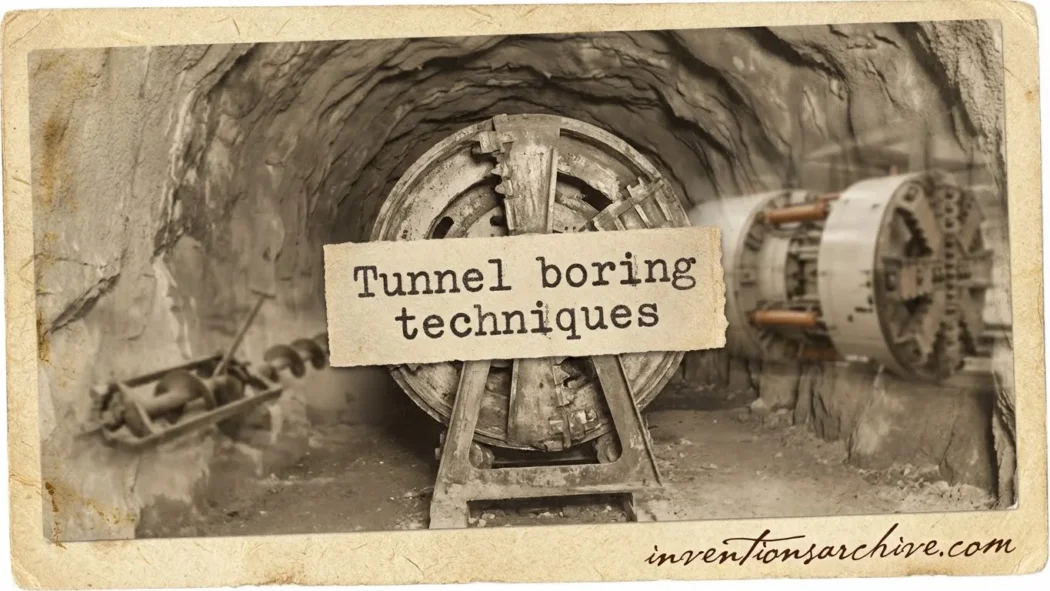
| Invention Name | Tunnel boring techniques |
|---|---|
| Short Definition | Methods and machines used to excavate underground passages while supporting the surrounding ground. |
| Approximate Date / Period | 1818 patent for Brunel’s tunnelling shield; Thames Tunnel begun 1825 and opened 1843 Based on surviving evidence [a] |
| Geography | London, Britain for the early shield method; later global use in metro, railway, road, water, and utility tunnels. |
| Inventor / Source Culture | Marc Isambard Brunel for the tunnelling shield; later development by engineers including William Henry Barlow and James Henry Greathead Attribution varies |
| Category | Transport, civil engineering, infrastructure, mining technology, urban construction. |
| Main Problem Solved | Excavating tunnels in unstable ground, soft soil, hard rock, and water-bearing strata with better face support. |
| How It Works | A cutting or shielded front advances through ground while spoil is removed and support or lining follows behind. |
| Material / Technology Base | Iron and steel shields, rotating cutterheads, hydraulic jacks, cast-iron or concrete lining, pressure control, survey guidance. |
| Early Use | Under-river tunnelling and urban passage construction, especially the Thames Tunnel. |
| Development Path | Manual excavation → shield tunnelling → circular shields → mechanical boring machines → EPB, slurry, and hard-rock TBMs. |
| Surviving Evidence | Listed Thames Tunnel structure, museum collection records, engineering institution histories, technical manuals. |
| Modern Descendants | Metro TBMs, rock TBMs, earth pressure balance TBMs, slurry shields, microtunnelling, pipe jacking, precast segment lining systems. |
| Why It Matters | It made long, deep, and low-disruption underground infrastructure more practical in crowded cities and difficult ground. |
Tunnel boring techniques are not one single machine. They are a family of underground excavation methods built around one careful idea: the ground in front of a tunnel must be cut, supported, measured, and lined in a controlled way. Early tunnels could be dug by hand or mined through rock, but soft ground, riverbeds, and crowded cities demanded a safer and more predictable method. That is where shield tunnelling, mechanical boring, and later tunnel boring machines changed underground construction.
What Tunnel Boring Techniques Are
Tunnel boring techniques describe the controlled creation of a tunnel through soil or rock without opening the whole surface above it. The phrase can include hand shield tunnelling, mechanical tunnel boring machines, pipe jacking, microtunnelling, hard-rock boring, slurry shields, and earth pressure balance systems.
The shared principle is simple. The excavation face is advanced in a controlled line, loosened material is removed, and the tunnel is supported by a temporary shield, permanent lining, sprayed concrete, rock bolts, precast segments, or another engineered support system. In modern boring, cutting, steering, spoil removal, and lining installation often happen as connected parts of the same operation.
This is why tunnel boring is different from merely digging a hole. A tunnel is a long underground structure. Its shape, alignment, pressure, groundwater conditions, ventilation, and lining all matter. Boring techniques grew because builders needed tunnels that could pass under streets, rivers, railways, hills, and buildings with less surface disruption than open-cut excavation.
How The Origin Is Traced
The modern history of tunnel boring is strongly linked to Marc Isambard Brunel’s tunnelling shield and the Thames Tunnel between Rotherhithe and Wapping. Royal Museums Greenwich records describe the Thames Tunnel as the first underwater tunnel in the world and note that Brunel patented a tunnelling shield in 1818 before Parliament later authorised the plan. The same record explains the shield’s basic protective role: it exposed only a small part of the excavation face at a time, reducing the chance of collapse without removing the risk entirely. [b]
That early shield was not a modern rotating tunnel boring machine. It was closer to a protective iron working frame. Miners still used hand tools, but the shield gave them a safer front from which to work. This distinction matters because the invention was not just “a machine that dug”; it was a way to manage ground support during excavation.
Later engineers improved the concept. Circular shields, screw jacks, compressed-air work, segmental lining, mechanical cutters, and eventually full-face TBMs moved the technology away from hand excavation toward large, integrated machines. The Institution of Civil Engineers places Brunel’s shield, the Barlow-Greathead shield, later mechanical machines, the bentonite tunnelling concept, and hard-rock TBMs within the same long development line. [c]
The Problem Tunnel Boring Answered
Before shield and machine boring, tunnel builders had several options, but each had limits. They could cut from the surface, mine through stable ground, blast through rock, or drive small passages by hand. These methods could work, yet they were difficult in soft soils, below water, or under busy urban areas.
The hard problem was not only removing ground. It was keeping the tunnel face, roof, and surrounding earth stable while the passage advanced. In soft or wet ground, the soil could move, water could enter, and the surface above could settle. In hard rock, progress depended on the ability to break and remove material without losing alignment.
Tunnel boring techniques answered this by combining three ideas:
- Controlled excavation: the face is cut in a planned shape and direction.
- Immediate support: the ground is held by a shield, lining, rock support, or pressure-control system.
- Continuous measurement: alignment, ground movement, pressure, and machine performance are checked as the tunnel advances.
How Tunnel Boring Works in Simple Terms
A tunnel boring method begins with a planned underground line. Engineers study the ground, choose a method, and design a support system. In a shield or TBM tunnel, the front of the system works at the excavation face. Behind it, the tunnel lining or support is installed so the new opening does not remain unsupported for long.
In hard rock, a TBM may use a rotating cutterhead fitted with disc cutters that press against the rock and cause chips to break away. In soft ground, the main challenge is often not breaking the soil but controlling it. Earth pressure balance and slurry shield machines use a pressure-controlled chamber at the face to help manage soil and groundwater conditions.
Modern systems may also include conveyors or pipelines for spoil removal, segment erectors for lining, guidance systems, and sensors. The National Academies describes modern TBMs as computer-controlled machines using laser guidance and sensors, while also noting that slurry shield and earth pressure balance technologies help support the face in saturated soils and reduce settlement-related risk. [d]
Earlier Ideas Before Mechanized Boring
Tunnel boring techniques did not appear from nowhere. They grew out of older underground work: mining, quarrying, aqueduct construction, military passages, drainage tunnels, and canal tunnels. These earlier methods proved that people could move through rock and soil, but they did not solve every modern urban problem.
Three earlier traditions shaped later boring:
- Mining practice: taught builders how to advance underground headings, remove spoil, ventilate passages, and support rock.
- Surveying and alignment: allowed tunnels to follow a planned route rather than wander through the ground.
- Structural lining: brick, masonry, cast iron, and later concrete helped turn a temporary excavation into a durable passage.
The tunnel shield added a new layer. It protected the working face while the tunnel moved forward. Later machines added mechanical cutting, pressure control, and more precise guidance.
Main Materials, Mechanisms, and Technical Principles
Different tunnel boring techniques use different tools, but several principles repeat across the field.
Face Support
The excavation face must remain stable. Early shields gave physical protection. Modern soft-ground TBMs may use earth pressure or slurry pressure to balance conditions at the face. The goal is not speed alone; it is controlled progress through uncertain ground.
Cutting and Excavation
Hard-rock boring relies on tools that fracture rock at the face. Soft-ground boring may cut, loosen, condition, and remove soil while maintaining support. Roadheaders and some mined methods cut smaller sections rather than the whole circular face at once.
Lining and Ground Support
The tunnel needs support after excavation. This may be brick, cast iron, precast concrete segments, sprayed concrete, steel ribs, rock bolts, or other engineered systems. The choice depends on ground, water, use, diameter, and expected service life.
Guidance and Monitoring
Modern tunnel boring depends on alignment control and monitoring. Sensors, survey systems, and laser guidance help the machine stay on line and give engineers information about machine behavior and ground response.
| Before Tunnel Boring Techniques | What Changed After Them |
|---|---|
| Many tunnels depended on hand mining, open cuts, or slow excavation in stable ground. | Shield and machine boring allowed deeper and more controlled tunnelling in harder urban and subaqueous conditions. |
| Soft, wet, or flowing ground could make tunnel faces unstable. | Shield, slurry, and earth pressure systems helped support the face while excavation advanced. |
| Surface disruption was often high when a trench or open cut was needed. | Bored tunnels could pass below streets, rivers, buildings, and railways with less surface opening. |
| Alignment and progress were slower and more dependent on manual work. | Mechanical cutting, guidance, and monitoring made long tunnel drives more predictable. |
| Permanent lining often followed after difficult excavation stages. | Modern TBM systems can install segmental lining close behind the cutting face. |
Development Path of Tunnel Boring
The development of tunnel boring is better understood as a chain of improvements than as a single moment. Each stage answered a specific limitation in earlier underground work.
| Stage | Form | What Changed |
|---|---|---|
| Earlier Tool | Hand mining, rock cutting, timber support, masonry lining | Allowed underground passages but struggled in unstable soil, water-bearing ground, and busy urban settings. |
| Early Shield | Brunel tunnelling shield | Protected small working areas at the face while the tunnel advanced. |
| Improved Shield | Barlow-Greathead circular shield | Made smaller circular tunnel drives and segmental lining more practical. |
| Mechanical Boring | Rotary excavation machines and early full-face boring systems | Shifted more excavation work from hand tools to machine cutting. |
| Modern Forms | Hard-rock TBM, earth pressure balance TBM, slurry shield TBM | Matched machine type to ground conditions, water pressure, and settlement limits. |
| Modern Descendant | Microtunnelling, pipe jacking, sensor-guided TBMs | Extended boring principles to utility tunnels, long urban drives, and tightly controlled alignments. |
Main Types and Variations
Tunnel boring techniques are chosen according to ground type, tunnel size, water conditions, surface sensitivity, and the final use of the tunnel. A metro tunnel under a dense city does not face the same problems as a water tunnel through hard mountain rock.
| Type or Variation | Typical Ground or Use | Main Technical Idea |
|---|---|---|
| Open Hard-Rock TBM | Competent rock tunnels | Uses a rotating cutterhead and disc cutters to fracture rock while support is added as needed. |
| Shielded Hard-Rock TBM | Rock with weaker zones or water concerns | Combines rock cutting with a protective shield and lining system. |
| Earth Pressure Balance TBM | Soft ground, often urban and water-sensitive areas | Uses controlled excavated material in the chamber to help balance pressure at the face. |
| Slurry Shield TBM | Loose or water-bearing ground | Uses slurry pressure to support the face and transport excavated material. |
| Microtunnelling | Utility lines and small-diameter tunnels | Uses remote-controlled boring, often with pipe jacking, for precise underground utility installation. |
| Roadheader Excavation | Soft rock, mixed ground, station caverns, non-circular shapes | Uses a cutting head on a boom, usually with staged excavation and support. |
| Sequential Excavation Method | Variable ground and larger openings | Excavates in controlled stages and uses the surrounding ground as part of the support system. |
| Pipe Jacking | Shorter utility or crossing tunnels | Pushes pipe sections from a shaft while the ground is excavated at the front. |
The FHWA technical manual records a broad set of road tunnel construction categories, including mined, bored, cut-and-cover, immersed, and jacked box tunnels. This matters because “tunnel boring” is only one part of tunnel engineering, even when it receives the most public attention. [e]
Early Uses and How They Spread
The Thames Tunnel showed that shield tunnelling could answer a problem that earlier efforts had not solved well: an under-river passage through difficult ground. It was slow, expensive, and hazardous by modern standards, but it gave later engineers a working model.
As cities grew, tunnel boring techniques became useful for railway tunnels, underground railways, water supply, sewers, road tunnels, utility passages, and later high-capacity metro systems. Urban tunnelling created a strong reason to improve machines: surface streets were crowded, buildings were dense, and open-cut work could disrupt daily life.
Hard-rock boring developed along a slightly different path. The main problem was not soft ground collapse but efficient rock cutting, tool wear, and spoil removal. Soft-ground boring focused more on pressure, settlement, and water. This is why modern TBMs are not interchangeable machines. They are selected for the geology and the job.
What Changed Because of Tunnel Boring Techniques
Tunnel boring changed underground construction in practical ways. It did not remove risk, and it did not make every tunnel easy. It gave engineers a better toolset for matching excavation method to ground conditions.
- Urban transport expanded underground: metro and rail tunnels could be built below dense streets with less surface opening.
- Subaqueous crossings became more practical: rivers and harbors could be crossed below the bed rather than only by bridge or ferry.
- Utility corridors moved below streets: water, sewer, cable, and service tunnels could be placed with less open trenching.
- Longer tunnel drives became possible: machine boring helped projects maintain shape, alignment, and steady progress through suitable ground.
- Ground control became more measurable: modern systems use monitoring, guidance, and pressure control instead of relying only on visual judgment.
Common Misunderstandings
It Was Not Invented All at Once
Modern tunnel boring grew through many improvements. Brunel’s shield, Greathead’s circular shield, mechanical cutters, pressure systems, and modern sensors belong to the same long line.
A Shield Is Not The Same as a Modern TBM
Early shields protected workers and supported the face. Modern TBMs can cut, steer, remove spoil, and help install lining as part of a larger machine system.
One Machine Does Not Fit Every Ground
Hard rock, clay, sand, mixed ground, and water-bearing soils need different boring approaches. The ground often decides the method.
Speed Is Not The Only Goal
Progress matters, but safe ground support, settlement control, alignment, and ventilation are just as important in a tunnel project.
Safety, Regulation, and Professional Control
Modern tunnel boring takes place inside a regulated construction environment. In the United States, OSHA’s underground construction standard applies to tunnels, shafts, chambers, and passageways, and it defines “rapid excavation machine” to include tunnel boring machines, shields, roadheaders, and similar excavation machines. The same standard includes requirements related to underground access, monitoring, and safety conditions. [f]
This safety context is part of the invention’s real history. As the machines became larger and more capable, underground work also required stronger systems for ventilation, communication, monitoring, emergency planning, and worker protection. A tunnel boring technique is never only about the cutting face; it belongs to a managed underground construction system.
Related Inventions and Later Developments
- Tunnelling shield: the protective ancestor of many bored tunnel systems.
- Tunnel boring machine: the large mechanical descendant used in many modern tunnels.
- Precast concrete segment lining: a major support system behind many modern TBMs.
- Pipe jacking: a related trenchless method for pushing pipe sections through the ground.
- Microtunnelling: a smaller, often remote-controlled form of boring for utilities.
- Roadheader: a mechanical cutting machine useful where full-face circular boring is not ideal.
- Compressed-air tunnelling: historically used to manage water-bearing ground, though modern pressure-balanced machines reduced reliance on it in many settings.
- Laser-guided survey systems: modern alignment tools that help keep long tunnel drives on course.
Frequently Asked Questions
Who invented tunnel boring techniques?
No single person invented every tunnel boring technique. Marc Isambard Brunel is strongly linked with the early tunnelling shield patented in 1818, while later engineers developed circular shields, mechanical boring machines, and modern pressure-balanced TBMs.
Is a tunnel boring machine the same as a tunnelling shield?
Not exactly. A tunnelling shield mainly protects and supports the excavation area. A modern tunnel boring machine can also cut the ground, remove spoil, steer, monitor performance, and support lining installation.
Why are there different types of tunnel boring machines?
Ground conditions vary. Hard rock, soft clay, sand, mixed ground, and water-bearing soil require different cutting, support, pressure-control, and lining systems.
What was the early importance of the Thames Tunnel?
The Thames Tunnel showed that a shield-based method could help build an under-river tunnel through difficult ground. It became a major reference point in the history of shield tunnelling.
Did tunnel boring replace all other tunnel methods?
No. Cut-and-cover, mined tunnels, immersed tunnels, roadheaders, drill-and-blast methods, and sequential excavation still have uses. Tunnel boring is one major method within a wider field of tunnel engineering.
Sources and Verification
- [a] Thames Tunnel, Non Civil Parish – 1242119 | Historic England — Used to verify the Thames Tunnel dates, Brunel attribution, tunnelling shield patent context, and later railway conversion. (Reliable because it is an official heritage listing record.)
- [b] Thames Tunnel Plan and Elevation | Royal Museums Greenwich — Used to verify surviving museum evidence, the 1843 Thames Tunnel record, and the shield’s face-support principle. (Reliable because it is an official museum collection record.)
- [c] Tunnel Boring Machines | Institution of Civil Engineers — Used to verify the development line from Brunel’s shield to the Barlow-Greathead shield, mechanical machines, bentonite tunnelling, and hard-rock TBMs. (Reliable because it is published by a professional civil engineering institution.)
- [d] Innovative Underground Technology and Engineering for Sustainable Development | National Academies Press — Used to verify modern TBM concepts including EPB, slurry shield, hard-rock TBMs, laser guidance, sensors, and pressure-related ground control. (Reliable because it is an institutional National Academies publication.)
- [e] Technical Manual for Design and Construction of Road Tunnels – Civil Elements — Used to verify the formal classification of tunnel construction types including mined, bored, cut-and-cover, immersed, and jacked box tunnels. (Reliable because it is a USDOT/FHWA technical report record.)
- [f] 1926.800 – Underground Construction | Occupational Safety and Health Administration — Used to verify the safety-regulation context for underground construction and the definition of rapid excavation machines. (Reliable because it is an official U.S. occupational safety standard.)