
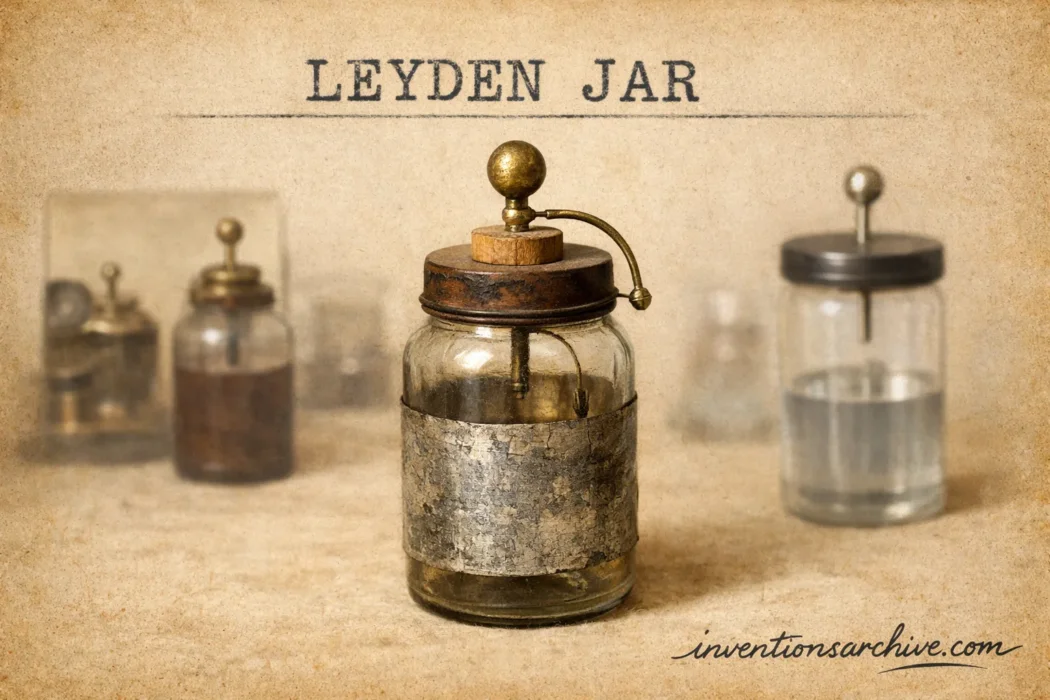
| Invention Name | Leyden Jar (Leiden Jar) |
|---|---|
| Short Definition | Early capacitor that stores static electric charge (Details-2) |
| Approximate Date / Period | 1745–1746 Disputed |
| Geography | Leiden (Dutch Republic); Pomerania (Central Europe) |
| Inventor / Source Culture | Pieter van Musschenbroek; Ewald Georg von Kleist Independent (Details-1) |
| Category | Electricity; Electrostatics; Scientific Instruments |
| Importance | Charge storage; Repeatable electrical experiments |
| Need / Motivation | Hold sparks from friction machines; controlled discharge |
| How It Works | Two conductors separated by glass dielectric; opposite charges |
| Material / Technology Basis | Glass; metal foil or water; rod/terminal; stopper |
| First Use Context | Electrostatic research; lecture demonstrations |
| Spread Route | European scientific correspondence; lecture culture; transatlantic interest |
| Derived Developments | Capacitors; “Leyden battery” arrays; electrical measurement habits |
| Impact Areas | Physics; education; instrumentation; early communications |
| Debates / Different Views | Priority and naming; parallel discoveries; “first” claims vary |
| Precursors + Successors | Friction machines → plate condensers → modern capacitors |
| Key People / Institutions | Musschenbroek; Cunaeus; Nollet; Franklin; Watson |
| Variants Influenced | Water-filled jar; foil-lined jar; dissectible jar; multi-jar battery |
Table of Contents
The Leyden jar is a milestone in the history of electricity: a compact way to hold a large static charge for a short time. Its real value is not spectacle, but control. A single device turned fleeting sparks into a repeatable subject of study, and it did so with a simple idea: separate charge across glass.
What It Is
A Leyden jar is an early form of capacitor, once called a condenser. In plain terms, it is a container where electrical charge can be held on two conductors with an insulator between them. The classic form uses a glass jar with conducting material on the inside and outside, plus a metal terminal that connects to the inner conductor.
It is easy to confuse a capacitor with a battery. A battery delivers a sustained push; a Leyden jar stores charge and releases it quickly. That short release is the point. It enabled early researchers to compare outcomes, refine apparatus, and talk about electricity with a new level of precision.
Core Idea
The Leyden jar made stored electrostatic charge practical. The jar itself is not “the electricity.” It is the arrangement that matters: two conductive surfaces kept apart by glass.
Early Evidence and Timeline
The Leyden jar entered science through fast-moving correspondence and demonstrations. Two figures are tied to the breakthrough, and the historical record often treats it as parallel discovery. The result spread quickly because it solved a problem that many experimenters already felt: static electricity was visible, yet hard to hold.
A Short Timeline
- Mid-1740s: Experiments show that a jar-and-terminal setup can store a strong charge.
- 1746: Reports and demonstrations make the device widely known in Europe.
- Late 1740s: Conductive coatings (foil) improve reliability and capacity.
- 19th–20th centuries: The underlying idea matures into the modern capacitor family.
Why It Spread So Fast
- It turned brief sparks into a repeatable event.
- It made demonstrations vivid, so students and patrons remembered it.
- It encouraged a shared vocabulary for charge, discharge, and capacity.
- It invited refinement: coatings, terminals, and multi-jar setups.
How It Works
A Leyden jar stores charge by separating it. When one conductor becomes more positively charged and the other more negatively charged, the glass in between prevents immediate equalization. That “blocked shortcut” is the essence of capacitance. The jar’s glass acts as a dielectric, a material that does not conduct well but still responds to an electric field.
Early versions relied on a hand as part of the outer conducting surface, which is one reason the effect surprised people. Later designs replaced the hand with foil on the outside, making the device more stable and easier to compare from one setup to another (Details-4).
Charge Separation
Think of two “skins” of charge: one on the inner conductor, one on the outer conductor. They remain apart because the glass dielectric blocks direct flow. The stronger the separation, the higher the electrical pressure (voltage) across the glass.
Why Glass Matters
Glass is an insulator, yet it can be polarized. That subtle response lets the jar hold more charge than an exposed conductor could. In practical terms, glass makes the storage denser while keeping the conductors apart.
A Useful Distinction
A Leyden jar can deliver a sharp discharge, yet it does not behave like a modern battery. It stores electric charge, not a continuous chemical supply. This difference shaped how scientists began to classify electrical devices.
Key Parts and Materials
Across many designs, the same functional parts appear. Names vary, and the jar may be a bottle, a tube, or even a glass plate. The logic stays consistent: two conductors, one insulator, and a connection point.
- Glass body: the main insulator; it defines the dielectric barrier.
- Inner conductor: water, metal foil, or a metal cup; the “inside plate.”
- Outer conductor: foil, metal coating, or an external metal shell; the “outside plate.”
- Terminal and rod: a metal path to the inner conductor; often topped with a smooth knob to reduce loss.
- Stopper/insulator: keeps the terminal supported while limiting leakage paths.
What Changes the Capacity
- Surface area of the conductors.
- Thickness of the glass layer.
- Type and condition of the glass (clean, dry, stable).
- How well the outer conductor connects to its reference potential.
What Changes the Behavior
- Terminal shape and smoothness.
- Distance between coated regions near the rim.
- Humidity and surface contamination (they influence leakage).
- Mechanical layout that affects stray discharge paths.
Types and Variations
The name “Leyden jar” covers a family of designs. Some are early, some are refined teaching instruments, and some are assembled into larger units. The common thread is electrostatic storage using a dielectric barrier.
Water-Filled and Liquid Variants
Many early descriptions involve a glass container that is partly filled with a conductive liquid. In these variants, the liquid acts as the inner conductor, while the outside is provided by a hand or by an external conductor. These forms highlight a key idea: it is not the liquid that “creates” storage, it is the separation across glass.
Foil-Coated and Metal-Lined Jars
Foil coatings on the inside and outside became the classic look because they made performance more consistent. A coated jar is easier to handle in a controlled way, and it turns the Leyden jar into a clearer ancestor of later capacitors.
Related articles: Battery (Voltaic pile) [Industrial Age Inventions Series]
Dissectible and Demonstration Jars
Some teaching models are built so the conductive parts can be separated from the glass. They are designed to make the concept visible: plates, dielectric, and field. This style helps explain why the jar stores charge even when the metal parts are not touching.
Leyden Battery Arrays
Multiple jars can be linked as a set, often mounted in a box or frame. This arrangement is widely known as a Leyden battery, built to increase the total stored charge and make large demonstrations possible (Details-5).
Scientific and Cultural Impact
The Leyden jar did more than store charge. It changed what questions felt answerable. Once charge could be accumulated, researchers could compare discharges, explore materials, and build instruments around measurable effects. It also became a staple of public demonstrations, making electricity feel tangible.
- Electrostatics gained repeatable experiments with clear outcomes.
- Teaching moved from stories to apparatus-based lessons.
- Instrument design improved: better terminals, coatings, and insulation habits.
- New language emerged around capacity, discharge, and stored charge.
It also influenced how people described collections of devices. Connected jars were called a “battery,” and Leyden jars appeared in famous natural philosophy demonstrations, including early lightning investigations (Details-3).
Why It Matters in One Line
The Leyden jar made electrical charge storable, and that single shift opened the door to systematic thinking about capacitance.
Modern Legacy
The Leyden jar survives as an idea more than a product. Modern capacitors use different materials and packaging, yet the principle is recognizably the same: conductors separated by a dielectric. In classrooms and museums, the jar remains a clean way to show what “stored charge” means, without heavy mathematics.
Its legacy also sits in engineering habits. The jar pushed experimenters to respect insulation, surface cleanliness, and geometry. Small details became meaningful. A smoother terminal, a better stopper, a cleaner glass surface—each could change performance. That mindset is still visible in the way modern electronics treats leakage, dielectric properties, and high-voltage spacing.
FAQ
Is a Leyden jar the same thing as a capacitor?
Yes in function. A Leyden jar is an early capacitor design. It stores charge on two conductors separated by an insulator, usually glass.
Why is it called “Leyden” or “Leiden” jar?
The name is linked to Leiden in the Netherlands, where the device became widely known through early reports and demonstrations. Both spellings appear in English-language history and collections.
What did early Leyden jars use as conductors?
Early forms often used a conductive liquid inside the glass container, later shifting to metal foil or metal linings for more consistent behavior. The important part is the two-conductor arrangement across a dielectric.
What is a “Leyden battery”?
It is a set of multiple Leyden jars connected together to increase total stored charge. It is still based on the same capacitor principle, just scaled by quantity.
Does a Leyden jar store charge in the glass or on the metal?
The charge is associated with the conductive surfaces, while the glass (the dielectric) enables that separation and supports the electric field. The jar’s behavior reflects both conductor geometry and dielectric response.
Are Leyden jars still used today?
They appear mainly in education, collections, and historical demonstrations. Modern electronics uses compact capacitors, yet the Leyden jar remains a clear illustration of stored charge and capacitance.