
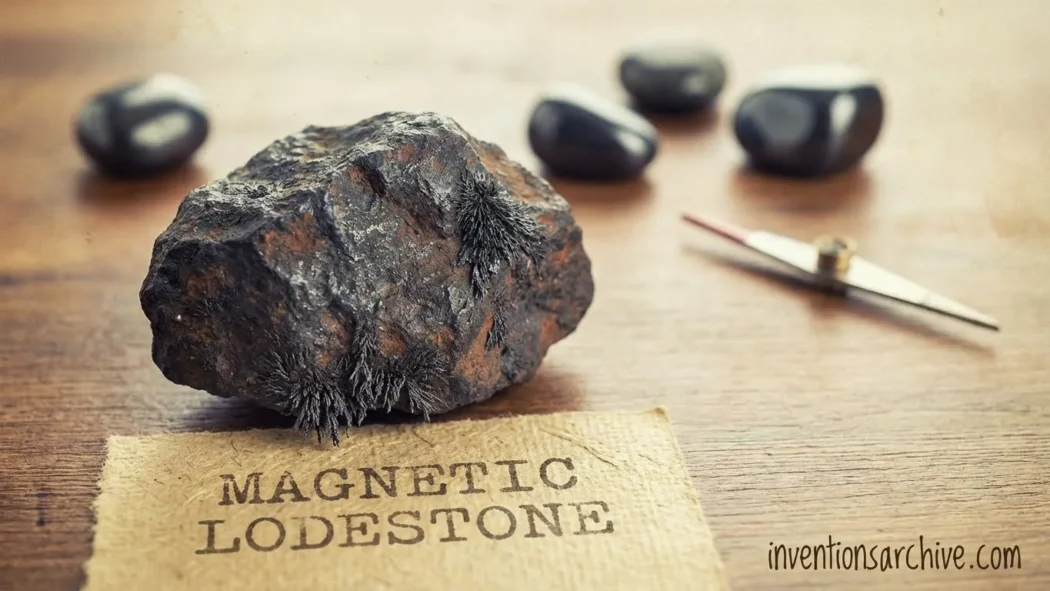
| Invention Name | Magnetic lodestone |
|---|---|
| Short Definition | A naturally magnetized form of magnetite that attracts iron and can align with Earth’s magnetic field. |
| Approximate Date / Period | Known in antiquity; practical directional use developed over many centuries Approximate |
| Geography | Known in the Mediterranean world and China; later used in European and maritime navigation contexts |
| Inventor / Source Culture | Anonymous / collective; lodestone is a natural material, not a single-person invention |
| Category | Science, navigation, measurement, materials |
| Material Basis | Magnetite, an iron oxide mineral; lodestone is the naturally magnetized variety [a] |
| Main Problem Solved | Finding direction, magnetizing compass needles, and studying magnetic attraction |
| How It Works | Its magnetic field attracts iron and can orient a freely moving magnetic object north-south |
| Early Use Areas | Observation of attraction, geomancy, direction finding, compass maintenance, scientific demonstration |
| Evidence Status | Based on surviving evidence for museum objects; Attribution varies for earliest directional use |
| Development Path | Magnetite observation → lodestone directional use → magnetized needle → compass → engineered permanent magnets |
| Surviving Evidence | Museum lodestones, early written descriptions, scientific treatises, navigational instrument collections |
| Modern Descendants | Compass needles, bar magnets, horseshoe magnets, electromagnets, rare-earth permanent magnets |
| Why It Matters | It linked natural minerals, direction finding, navigation and the later science of magnetism |
Magnetic lodestone is one of the rare “inventions” where the main object came from nature, but its importance came from human observation. A dark piece of magnetized magnetite could attract iron. When shaped, suspended, floated or paired with a needle, it could also reveal direction. That made it more than a mineral. It became a bridge between geology, navigation and physics.
What Magnetic Lodestone Is
A lodestone is a naturally magnetized piece of magnetite. Magnetite itself is an iron oxide mineral, but not every piece of magnetite behaves as a useful lodestone. The special value of lodestone is its natural magnetism: it can attract iron and can transfer magnetic behavior to suitable iron or steel objects.
This is why lodestone became so important before manufactured magnets were reliable. It was not only a stone that pulled small iron objects toward it. It was also a practical source of magnetism. For navigators, experimenters and instrument makers, that difference mattered.
The word “lodestone” also carries a clue about its use. “Lode” is linked with path or course, and the name reflects the stone’s connection with direction and travel. In a history of permanent magnets, the Science Museum explains that pieces of magnetite came to be called lodestones and were used in compasses, while Chinese magnetic devices around 1000 CE used lodestones or magnetized iron bars that aligned north-south. [c]
Why Its Origin Is Hard to Attribute
Magnetic lodestone does not fit the usual question, “Who invented it?” No single person discovered all of its uses at once. People in different places noticed different features: attraction, alignment, polarity, and the ability to magnetize needles.
This creates three separate origin questions:
- When did people first notice magnetic attraction? This belongs to early natural philosophy and mineral observation.
- When did people first use lodestone for direction? This is tied closely to Chinese south-pointing devices and later compass forms.
- When did lodestone become a scientific object? This becomes clearer in medieval and early modern texts on magnetism.
Those are not the same event. Treating them as one “invention date” makes the history look simpler than it is. The safer view is that lodestone became an invention-related tool through a long chain of practical discoveries, not through one dramatic moment.
The Problem It Answered
Before magnetic direction tools, people relied on the Sun, stars, coastlines, winds, landmarks, memory and written route knowledge. These methods could be highly skilled, but they had limits. Clouds, darkness, unfamiliar land, underground work and open water all made direction harder.
Lodestone answered a simple but powerful need: it gave people a material that could show a consistent directional tendency when allowed to move freely. It did not remove the need for experience. It gave experienced people another reference point.
| Before Magnetic Lodestone Use | What Changed After It Became Useful |
|---|---|
| Direction depended mainly on sky observation, landmarks and route memory. | A freely moving magnetic object could help indicate a north-south line. |
| Travel and navigation were harder in poor visibility or unfamiliar settings. | Magnetic direction tools added a portable reference for orientation. |
| Early compass needles could lose magnetism over time. | Lodestones could be used to refresh or restore needle magnetism. |
| Magnetic attraction was mostly a curious natural effect. | It became an object of experiment, classification and instrument design. |
| Permanent magnetism was limited to natural or weakly magnetized materials. | Later makers developed stronger artificial magnets and, much later, engineered magnetic alloys. |
How It Worked in Simple Terms
Lodestone works because it has a natural magnetic field. That field can attract iron-rich materials. If a lodestone or a magnetized piece of iron can move with little friction, it may settle into a north-south orientation because it responds to Earth’s magnetic field.
The early principle was simple to observe, even if the physics was not yet understood. A stone attracted iron. A magnetized needle could point in a stable direction. A compass needle that had weakened could be touched or stroked with lodestone to regain useful magnetism.
Earlier Ideas and Tools Before Lodestone Direction Finding
Lodestone did not replace older direction methods. It joined them. Before magnetic tools became practical, people already used many kinds of environmental knowledge.
- Stars and constellations: useful for night navigation when the sky was clear.
- Sun position: useful for broad orientation during daylight.
- Landmarks and coastlines: important for travel, trade and coastal sailing.
- Route memory and oral instruction: vital for experienced travelers and navigators.
- Maps and written route records: useful where geographic knowledge had been recorded.
Magnetic lodestone added a different kind of evidence. It did not depend on weather, daylight or visible landmarks in the same way. That made it especially useful as the knowledge behind compasses became more portable.
Development Path From Natural Stone to Later Magnets
| Stage | Form | What Changed |
|---|---|---|
| Earlier Observation | Natural magnetite attracting iron | People noticed a rare mineral effect before they had a full theory of magnetism. |
| Directional Use | Lodestone spoon, floating magnetic object or suspended magnetic piece | Magnetism became useful for orientation and direction. |
| Improved Form | Magnetized iron or steel needle | The directional element became smaller, lighter and easier to place in a compass. |
| Instrument Pairing | Compass needle kept with a lodestone | Needles could be re-magnetized when their magnetism weakened. |
| Scientific Study | Medieval and early modern treatises on magnetism | Writers described poles, attraction, orientation and experimental behavior. |
| Modern Descendant | Manufactured permanent magnets and electromagnets | Magnetism became engineered rather than dependent on naturally magnetized stone. |
Early Uses of Magnetic Lodestone
Direction and Geomancy
In early Chinese contexts, lodestone is often linked with south-pointing devices and geomantic direction finding. These tools were not only navigational in the later maritime sense. They also belonged to traditions that cared about correct orientation, ordered space and directional symbolism.
This is why the early history of lodestone should not be reduced to “the first compass for ships.” The earliest directional uses appear to have been broader. Navigation became one of the most important later uses, but it was not the only setting in which magnetic direction mattered.
Compass Maintenance
In maritime instrument collections, lodestone appears as a practical support tool for compasses. Royal Museums Greenwich notes that lodestones made from magnetite were important in early navigation because compass needles could lose magnetism and had to be re-magnetized by stroking a lodestone along the needle. Some lodestones were mounted in brass, bronze or silver and fitted with steel pieces to strengthen their magnetic action. [d]
This use explains why a lodestone could be valuable even after the compass needle itself became the more visible instrument. The needle pointed the way, but the lodestone helped keep the needle useful.
Scientific Study
By the medieval period, lodestone had become more than a practical aid. It was also a subject of written study. Petrus Peregrinus of Maricourt’s 1269 letter on the magnet is one of the best-known medieval texts on magnetic behavior, discussing properties such as poles and attraction in a more systematic way than earlier casual reports. [e]
Related articles: Compass [Ancient Inventions Series]
Later, William Gilbert’s De Magnete, printed in 1600, treated magnetism through repeated observation and experiment. The Smithsonian Libraries copy describes the work as covering magnetic powers, orientation to Earth’s poles, variation, declination and the use of magnetism in navigation. [f]
Main Types and Variations
Because lodestone is a natural material, its “types” are better understood as forms of use and preparation rather than factory-made models. Different settings required different handling.
| Type or Variation | Typical Form | Main Use |
|---|---|---|
| Natural Lodestone | Unshaped or lightly shaped magnetized magnetite | Observation of attraction, collection, demonstration and study |
| Directional Lodestone | Shaped piece, spoon-like form, suspended form or floating arrangement | Orientation and early direction finding |
| Mounted Lodestone | Stone set in metal frame, sometimes with keeper or pole pieces | Instrument care, display, storage and strengthening of magnetic effect |
| Compass Pair Lodestone | Lodestone kept with compass equipment | Re-magnetizing weak compass needles |
| Experimental Lodestone | Stone used with iron, steel or demonstration apparatus | Study of attraction, poles, magnetic strength and magnetic behavior |
What Changed Because of Lodestone
Lodestone changed several fields in quiet but durable ways. It made magnetic direction more than a curiosity. It gave craft workers, navigators and scholars a physical object they could test, carry, mount and compare.
Its effect was strongest in four areas:
- Navigation: lodestone supported the rise and maintenance of magnetic compass use.
- Scientific method: it offered a repeatable natural effect that could be studied through experiment.
- Instrument making: it encouraged better handling of needles, mounts, keepers and pole pieces.
- Material science: it helped start a long path from natural magnets to manufactured permanent magnets.
The long-term shift was not that lodestone alone made travel safe or science modern. That would be too simple. The real change was that a natural mineral became a controlled reference tool. That is a much more precise way to understand its importance.
Common Misunderstandings
Lodestone Was Not Invented in the Usual Sense
Lodestone is a naturally magnetized mineral. The invention story belongs to how people identified, shaped, mounted and used it. Calling one person the inventor of lodestone would be misleading.
The Earliest Evidence Is Not Always the First Use
Surviving texts, objects and reconstructions show what can be verified. They do not prove that nobody used lodestone earlier in ways that left no trace.
The Compass Was Not One Single Object From the Start
Early magnetic direction tools included spoon-like, floating, suspended and needle-based forms. The familiar pocket compass is a later stage in a longer line of development.
Magnetism Was Useful Before It Was Fully Explained
People could use lodestone successfully without a modern theory of magnetic fields. Practical knowledge often came before mathematical explanation.
Related Inventions and Later Developments
Magnetic lodestone connects to a wider family of tools and ideas in invention history. The closest related developments include:
- Magnetic compass
- Magnetized needle
- Mariner’s compass
- Miner’s compass
- Bar magnet
- Horseshoe magnet
- Electromagnet
- Rare-earth permanent magnet
Frequently Asked Questions
Is magnetic lodestone an invention or a natural material?
Magnetic lodestone is a natural material. Its place in invention history comes from the way people used it for direction finding, compass maintenance and the study of magnetism.
Who invented magnetic lodestone?
No single inventor is known because lodestone is naturally occurring. Its practical uses developed across cultures and periods through observation, craft and instrument making.
How did lodestone help early compasses?
Lodestone could magnetize or re-magnetize iron and steel needles. It also helped people understand that magnetic objects could align with Earth’s magnetic field when allowed to move freely.
Was the earliest lodestone compass used for sea navigation?
Not necessarily. Early Chinese south-pointing devices are often linked with orientation and geomancy. Maritime navigation became one of the major later uses of magnetic compass technology.
What replaced lodestone in later technology?
Lodestone was gradually replaced by stronger and more predictable artificial magnets, including steel magnets, electromagnets and modern permanent magnets made from engineered materials.
Sources and Verification
- [a] Magnetite: Mineral information, data and localities. — Used to verify that lodestone is a naturally magnetized variety of magnetite and to support the mineral basis of the invention. (Reliable because it is a specialist mineralogical database with structured mineral records.)
- [b] 司南 — Used to verify the reconstructed Han-period south-pointing device with bronze plate and magnetic spoon, and the evidence limits noted through textual reconstruction. (Reliable because it is an official China Science and Technology Museum exhibit page.)
- [c] Let’s Stick Together: A history of permanent magnets — Used to verify the historical use of lodestones in compasses, the north-south alignment of early magnetic devices, and the wider permanent magnet development line. (Reliable because it is an official Science Museum educational article.)
- [d] Lodestone | Royal Museums Greenwich — Used to verify maritime lodestone use, re-magnetizing compass needles, mounted frames, steel armatures and object dating. (Reliable because it is an official museum collection record from Royal Museums Greenwich.)
- [e] Letter of Petrus Peregrinus on the Magnet A.D. 1269 — Used to verify the medieval written tradition on the magnet and the 1269 text associated with Petrus Peregrinus. (Reliable because it is a digitized public-domain historical text hosted by Project Gutenberg.)
- [f] Guilielmi Gilberti Colcestrensis, medici londinensis, De magnete — Used to verify Gilbert’s 1600 work on magnetism, magnetic powers, Earth’s magnetism and navigation-related magnetic study. (Reliable because it is a Smithsonian Libraries digital record for a historic scientific work.)