
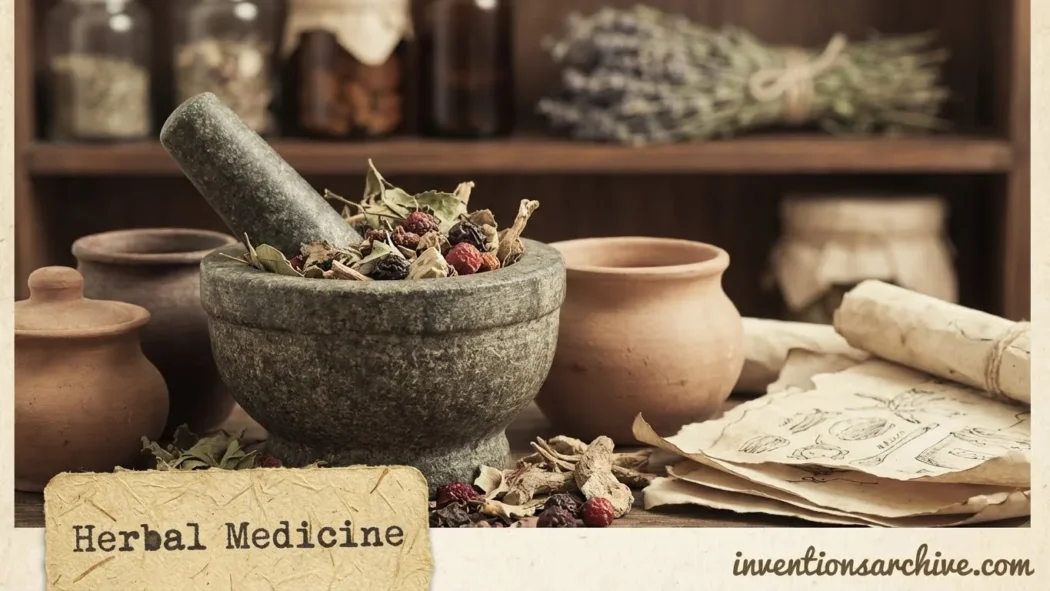
| Invention Name | Herbal Medicine |
|---|---|
| Short Definition | The organized use of plants, plant parts, and plant-derived preparations for health-related purposes. |
| Approximate Date / Period | Prehistoric practice; written evidence from c. 2100 BCE and later Based on surviving evidence |
| Geography | Multi-regional: Mesopotamia, Egypt, India, China, the Mediterranean, and many other regions |
| Inventor / Source Culture | Anonymous / collective knowledge traditions Attribution varies |
| Category | Medicine, botany, pharmacology, material knowledge |
| Evidence Status | Confirmed as an ancient recorded practice; exact first origin is not known |
| Main Problem Solved | Need for accessible remedies, symptom care, wound care, and plant-based health knowledge before modern pharmacy |
| Basic Principle | Identifying useful plants, naming them, preserving plant material, and recording observed effects |
| Main Materials | Leaves, roots, bark, seeds, flowers, resins, gums, fruits, and plant extracts |
| Early Use Areas | Household care, temple medicine, learned medical texts, pharmacy, midwifery, wound care, and community healing |
| Development Path | Plant observation → recorded remedies → herbals and materia medica → pharmacopoeias → botanical drugs and supplements |
| Related Inventions | Mortar and pestle, papyrus medical texts, herbals, pharmacopoeia, pharmacy, botanical nomenclature |
| Modern Descendants | Pharmacognosy, phytochemistry, botanical drug regulation, herbal supplements, ethnobotany, medicinal plant databases |
| Long-Term Importance | Helped preserve plant knowledge; shaped early pharmacy, botany, materia medica, and later drug discovery |
What Herbal Medicine Is
Herbal medicine is the practice of using plants and plant-derived materials in health traditions. It includes fresh or dried plant parts, plant extracts, resins, barks, roots, seeds, and mixtures recorded in household knowledge, medical manuscripts, pharmacy manuals, and later regulatory systems.
As an invention, it is not a single tool like a wheel or a compass. It is a knowledge system. Its useful parts are observation, classification, preservation, measurement by experience, written memory, and transmission from one generation to another.
Modern organizations often place herbal medicine inside the wider field of traditional, complementary, and integrative medicine. WHO describes traditional medicine as knowledge, skills, practices, and philosophies from different historical and cultural settings, distinct from and older than modern biomedicine. WHO also reports that traditional, complementary, and integrative medicine is used in 170 countries, which shows how widely these systems still exist in public health discussions.[d]
Why Herbal Medicine Appeared
People needed practical ways to respond to pain, fever, wounds, digestive problems, childbirth, skin conditions, infection risk, fatigue, and other everyday health concerns. Before laboratories and industrial pharmacy, plants were among the most available materials.
Several features made plants especially important:
- Availability: many plants grew near homes, fields, forests, rivers, and trade routes.
- Variety: leaves, roots, bark, flowers, seeds, and resins offered different textures, smells, tastes, and effects.
- Storage: drying and preserving made some plant materials usable beyond harvest season.
- Transmission: plant names and uses could be taught orally, written in lists, or copied into medical books.
- Trade value: aromatic resins, spices, gums, and dried herbs could move between regions.
The invention answered a simple human problem: how to remember, prepare, and share useful plant knowledge without losing it.
Before and After Herbal Medicine Became Organized
| Before Organized Herbal Medicine | What Changed After It |
|---|---|
| Plant use depended mostly on memory, family teaching, and local trial experience. | Useful plant knowledge could be recorded, copied, compared, and taught across generations. |
| Plant names could differ from village to village, creating confusion. | Herbals, materia medica texts, and later botanical naming systems made identification more stable. |
| Remedies were often tied to one household, temple, healer, or region. | Written records allowed plant knowledge to travel through schools, libraries, trade networks, and pharmacies. |
| Useful and unsafe plants could be mixed up more easily. | Descriptions, illustrations, plant parts, and warnings helped separate similar-looking materials. |
| Medical knowledge was harder to compare across cultures. | Later scholars could compare Egyptian, Greek, Arabic, Indian, Chinese, European, and local traditions. |
Early Written Evidence
Some of the strongest evidence for early herbal medicine comes from medical papyri and materia medica manuscripts. The Ebers Papyrus, dated around 1500 BCE, is one of the best-known surviving Egyptian medical texts. The National Library of Medicine identifies it as one of the earliest surviving medical texts and notes its reference to willow bark in relation to general aches and pains; that historical point is often discussed because willow later became connected with the development of aspirin-related chemistry.[b]
The Ebers Papyrus does not prove that Egypt invented herbal medicine first. It proves something more careful: Egypt preserved one of the earliest large written windows into medicinal plant knowledge.
Later, Greco-Roman medicine organized plant knowledge in a different way. Pedanius Dioscorides wrote De materia medica in the first century CE. The Library of Congress describes the work as a major medical manual and pharmacopoeia of ancient Greece and Rome, covering natural substances from the animal, vegetable, and mineral kingdoms. The surviving illustrated codex tradition shows how medicinal plants were described, copied, and studied for many centuries.[c]
How Herbal Medicine Worked in Simple Terms
Herbal medicine worked through a chain of observation and memory. People noticed that certain plants had strong smells, bitter tastes, soothing textures, drying effects, warming effects, or other noticeable qualities. Over time, these observations were tied to names, plant parts, seasons, places of growth, and repeated uses.
The practical system usually included:
- Identification: recognizing the plant and separating it from similar species.
- Selection: choosing a specific part, such as bark, leaf, root, flower, seed, resin, or fruit.
- Preservation: drying, storing, or carrying plant material.
- Documentation: recording names, descriptions, and historical uses.
- Transmission: teaching the knowledge through families, healers, temples, medical schools, pharmacies, and books.
This article keeps the subject in a historical and educational frame. It does not give preparation steps, dosage instructions, or personal health advice.
Development Path From Plant Knowledge to Modern Systems
| Stage | Form | What Changed |
|---|---|---|
| Earlier Practice | Local plant observation and oral teaching | Useful plant knowledge stayed close to families, specialists, and communities. |
| Recorded Medicine | Clay tablets, papyri, and manuscript lists | Plant knowledge became easier to preserve, copy, and compare. |
| Classical Herbals | Materia medica texts and illustrated herbals | Plants were grouped with names, descriptions, habitats, and historical uses. |
| Pharmacy Tradition | Apothecaries, dispensatories, pharmacopoeias | Plant materials entered more formal systems of preparation, sale, and professional knowledge. |
| Scientific Study | Botany, chemistry, pharmacognosy, phytochemistry | Researchers began isolating compounds, comparing evidence, and testing safety and quality. |
| Modern Regulation | Botanical drugs, herbal supplements, quality standards | Plant products became subject to naming, testing, labeling, safety, and regulatory questions. |
Main Types and Variations
Herbal medicine developed in many forms because cultures used different plants, climates, languages, medical theories, and preservation methods. The main difference is not only the plant itself. It is also the system around the plant: naming, harvest knowledge, record keeping, preparation tradition, and safety control.
| Variation | Typical Form | Historical or Technical Role |
|---|---|---|
| Household Herbal Knowledge | Local herbs, family memory, seasonal use | Preserved practical plant knowledge before formal texts were common. |
| Temple and Scribal Medicine | Papyri, tablets, ritual-medical records | Connected plant materials with written medical and religious traditions. |
| Materia Medica | Lists of substances, descriptions, uses, and plant parts | Organized natural materials for physicians, apothecaries, and students. |
| Illustrated Herbals | Plant drawings with descriptions | Helped readers identify plants and compare names across regions. |
| Traditional Medical Systems | Ayurvedic, Chinese, Indigenous, Greco-Arabic, and local traditions | Placed plants inside wider theories of body, environment, diet, and balance. |
| Botanical Drugs | Regulated plant-derived drug products | Modern system for evaluating certain plant-based products as medicines. |
| Herbal Supplements | Capsules, powders, tablets, liquids, teas, extracts | Modern consumer products whose evidence, quality, and safety can vary. |
What Changed Because of Herbal Medicine
The long-term effect of herbal medicine was not only medical. It also changed writing, trade, education, gardening, pharmacy, and plant science.
Several fields grew around it:
- Botany: plants needed names, descriptions, habitats, and identifying features.
- Pharmacy: plant materials had to be collected, stored, prepared, and sold with some consistency.
- Trade: resins, spices, aromatic plants, and dried materials moved across long routes.
- Libraries: medical papyri, herbals, and later printed books preserved practical plant knowledge.
- Chemistry: modern study of plant compounds created a bridge between historical plant use and laboratory science.
- Regulation: governments and health agencies later had to define, label, test, and monitor plant-based products.
From Herbal Medicine to Botanical Drugs
Modern botanical drugs are not the same thing as every traditional herb or every herbal supplement. In the United States, the FDA defines a botanical drug product as one intended for diagnosis, cure, mitigation, treatment, or prevention of disease in humans. Such products consist of vegetable materials, which may include plant materials, algae, macroscopic fungi, or combinations of these. The FDA also notes that botanical drugs often have special features, such as complex mixtures, prior human use, and sometimes the lack of one distinct active ingredient.[f]
This modern category shows how an ancient invention entered a more formal world of evidence, quality control, labeling, and review. It also explains why historical use and modern approval are different things.
Why Naming Became So Important
One of the easiest mistakes in herbal history is assuming that one common name always means one plant. It does not. The same herb name can refer to different species in different languages, regions, or trade traditions. One plant can also carry many names.
Modern medicinal plant databases were created partly to solve this problem. Kew’s Medicinal Plant Names Services records pharmaceutical, herbal drug, common, and scientific plant names from medicinal plant and regulatory literature. Its Version 15 includes records drawn from 422 medicinal plant publications and covers 41,878 plants from 397 families of angiosperms or gymnosperms.[g]
This is a quiet but major descendant of herbal medicine: the move from local plant names to verified botanical identity.
Common Misunderstandings
It Was Not Invented by One Person
Herbal medicine developed through repeated observation across many communities. Named physicians, scribes, and authors preserved parts of the tradition, but they did not create the whole system alone.
The Oldest Record Is Not the First Use
A clay tablet, papyrus, or manuscript shows the oldest surviving evidence known today. It does not prove that no one used plants medicinally before that record was written.
Traditional Use Is Not the Same as Modern Proof
Historical use can be important evidence for cultural history and research leads. Modern safety and effectiveness require different kinds of testing, quality checks, and monitoring.
A Plant Name Can Be Ambiguous
Common names shift between languages and regions. Accurate identification often needs scientific naming, plant part information, and source context.
Related Inventions and Later Developments
Herbal medicine sits inside a wider history of tools, records, and sciences. Related inventions and developments include:
- Mortar and pestle — a basic tool for grinding plant and mineral materials.
- Papyrus medical texts — writing surfaces that preserved Egyptian medical knowledge.
- Materia medica — organized lists of natural substances used in medicine.
- Illustrated herbals — plant books that linked images, names, habitats, and recorded uses.
- Pharmacopoeia — formal reference works for medicinal substances and standards.
- Botanical nomenclature — naming systems that helped reduce confusion between plants.
- Pharmacognosy — the study of medicinal substances from natural sources.
- Botanical drug regulation — modern review systems for selected plant-derived drug products.
Frequently Asked Questions
Who invented herbal medicine?
Herbal medicine does not have one known inventor. It developed collectively in many regions as people observed plants, preserved useful knowledge, and later recorded it in medical texts and herbals.
What is the earliest evidence of herbal medicine?
The earliest secure evidence comes from surviving records such as ancient Mesopotamian plant prescriptions and Egyptian medical papyri. These records show early written herbal knowledge, but the practice itself is probably older.
Is herbal medicine the same as a botanical drug?
No. Herbal medicine is a broad historical and cultural practice. A botanical drug is a modern regulatory category for certain plant-derived drug products intended for medical use and reviewed under specific rules.
Why are old herbal texts important?
Old herbal texts preserve plant names, descriptions, cultural practices, medical ideas, and trade knowledge. They help historians understand how plant-based medicine was recorded and transmitted.
Does ancient use prove that an herb is safe or effective today?
No. Ancient use is useful historical evidence, but modern safety and effectiveness depend on plant identity, product quality, dose, contamination risk, interactions, and scientific study.
Sources and Verification
- [a] Herbals: The Connection Between Horticulture and Medicine — Used to verify early medicobotanical records, including references to ancient Mesopotamian, Chinese, Egyptian, and Greek herbal traditions. (Reliable because it is a peer-reviewed horticultural science journal page.)
- [b] Ebers Papyrus, 1500 BCE — Used to verify the Ebers Papyrus as an early surviving medical text and its historical reference to willow bark. (Reliable because it is a National Library of Medicine exhibition page.)
- [c] Of Medical Substances. De materia medica — Used to verify Dioscorides, the Greco-Roman materia medica tradition, and the role of illustrated medicinal plant manuscripts. (Reliable because it is a Library of Congress primary-source collection page.)
- [d] Traditional medicine — Used to verify WHO definitions, global use context, and the 170-country traditional medicine reference. (Reliable because it is an official World Health Organization page.)
- [e] Dietary and Herbal Supplements — Used to verify modern supplement definitions, evidence variation, labeling concerns, and safety cautions. (Reliable because it is an NIH/NCCIH health information page.)
- [f] What is a Botanical Drug? — Used to verify the FDA definition of botanical drug products and their special regulatory features. (Reliable because it is an official U.S. Food and Drug Administration page.)
- [g] Version page – Medicinal Plant Names Services — Used to verify medicinal plant naming data, reference coverage, and modern botanical identity work. (Reliable because it is maintained by Royal Botanic Gardens, Kew.)