
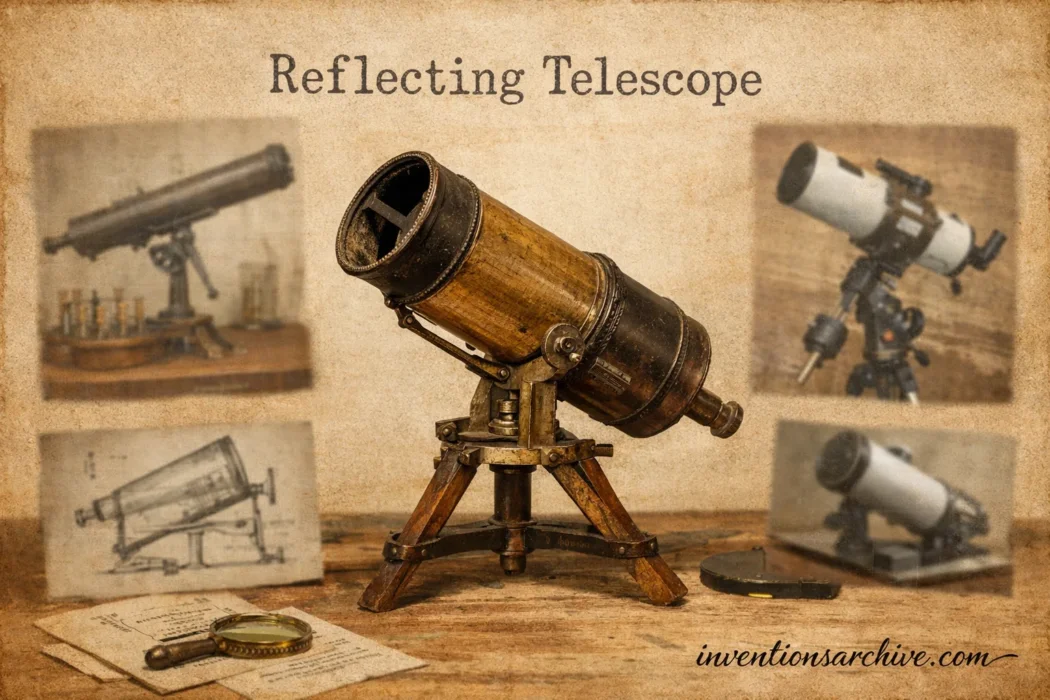
| Invention Name | Reflecting Telescope |
| Short Definition | Optical telescope that gathers and focuses light with mirrors (not a primary lens) |
| Approximate Date / Period | 1668 Exact |
| Geography | Europe (Britain, France) |
| Inventor / Source Culture | Isaac Newton (first working); James Gregory (design); Laurent Cassegrain (variant) |
| Category | Optics, Astronomy, Scientific Instruments |
| Need / Reason | Reduce color fringing; enable larger light-collecting apertures |
| How It Works | Concave primary mirror collects light; secondary mirror redirects it to a focus |
| Material / Tech Basis | Precision mirror figure; reflective coating; stable tube; aligned optical axis |
| First Main Use | Astronomical observation |
| Spread | 17th–18th c. Europe → global observatories |
| Derived Developments | Folded optical paths; large observatory mirrors; space telescopes |
| Impact Areas | Science, education, imaging technology |
| Predecessors → Successors | Long refractors → reflector families → modern segmented-mirror systems |
| Major Variants | Newtonian; Gregorian; Cassegrain; Ritchey-Chrétien; Schmidt-Cassegrain; Maksutov-Cassegrain |
Table Of Contents
A reflecting telescope replaces the big front lens of early instruments with a carefully shaped mirror. That single swap changed what telescopes could become: larger apertures, cleaner color, and optical layouts that fold long paths into compact tubes. From backyard astronomy to flagship observatories, the reflector’s core idea remains the same—use reflection, not refraction, to bring faint light to a sharp focus.
What It Is
A reflecting telescope is built around a concave primary mirror that gathers incoming light and forms an image. A smaller secondary mirror redirects that light to a place where an eyepiece or camera can use it.
- Primary mirror: the main light collector
- Secondary mirror: steering element that “folds” the beam
- Focus: the point where rays meet to form a usable image
- Tube and mount: keep geometry stable and motion smooth
The defining advantage is simple: mirrors do not separate white light into color in the way lenses can. That keeps chromatic aberration out of the primary image formation, which is one reason large professional instruments are usually reflectors.
Most reflector families are named after their optical layout—Newtonian, Gregorian, Cassegrain—rather than by size.
Why It Mattered
The reflector’s impact comes from a few practical truths. A mirror can be supported from behind, scaled up, and re-coated when its surface ages. That combination made large apertures realistic. More aperture means more light, and more light turns dim points into measurable data.
- Scale: mirrors can grow far beyond the practical limits of big lenses
- Color fidelity: mirrors avoid lens-driven color fringing at the objective
- Flexibility: folded designs place cameras and instruments where engineers want them
- Maintainability: reflective coatings can be renewed instead of replacing a giant lens
A Note On “Bigger”
Doubling mirror diameter does not double capability—it multiplies light-collecting power by four. That’s why the reflector became a gateway to deep-sky astronomy and high-precision measurement.
Key Milestones And Early Designs
Several reflector ideas appeared close together in the 1600s, each addressing the same need: avoid lens-based color fringing while gathering more light.
| 1663 | James Gregory designs the Gregorian reflecting telescope (Details-2) |
| 1668 | Isaac Newton builds the first working reflecting telescope (Details-1) |
| 1672 | Laurent Cassegrain introduces the Cassegrain variation; reflectors later serve observation beyond visible light as well (Details-3) |
| 1700s | Improved mirror figuring and larger instruments push reflectors into wider scientific use |
| Modern Era | High-precision glass mirrors, advanced coatings, and computer-aided alignment set today’s standard |
How It Works
In a reflector, the primary mirror is shaped so that incoming rays converge toward a focus. The secondary mirror’s job is not to “add power” so much as to redirect the converging beam to a convenient location.
Core Light Path
- Light enters the tube and strikes the primary mirror.
- The mirror reflects and concentrates the beam.
- A secondary mirror intercepts the beam and changes its direction.
- The redirected beam reaches the focus for an eyepiece or sensor.
Why Folding Helps
- Places the focal point near the side or back of the telescope.
- Keeps the instrument compact while preserving focal length.
- Supports heavier cameras without hanging them at the front.
- Enables multiple focus stations in some designs.
A Well Known Example
NASA describes Hubble’s optical telescope as a Cassegrain layout with a Ritchey-Chrétien variation, using a 2.4 m primary mirror and reflective coatings that include aluminum plus a protective layer; the observatory was launched in 1990 (Details-4).
Main Designs And Variations
Reflecting telescopes share the same foundation, then branch into layouts that trade field of view, physical length, and ease of alignment. The names below describe where the light goes after it hits the primary mirror.
| Newtonian | Flat secondary sends light to the side | Simple, bright, widely used | Side focus can affect balance; coma at fast focal ratios |
| Gregorian | Concave secondary sends light back through a hole in the primary | Upright image possible with added optics; classic folded design | Longer tube than many folded systems |
| Cassegrain | Convex secondary sends light back through a hole in the primary | Compact for its focal length; common in research | Central obstruction; alignment sensitivity |
| Ritchey-Chrétien | Cassegrain family with specialized mirror shapes | Sharper images over a wider field | More complex fabrication |
| Schmidt-Cassegrain | Uses a corrector plate plus folded mirrors | Very compact; popular for multipurpose observing | More optical elements; cooldown and dewing considerations |
| Maksutov-Cassegrain | Uses a thick meniscus corrector plus folded mirrors | High contrast and crisp planetary views | Heavier corrector; longer thermal stabilization |
Focus Locations You May See
- Prime focus: detector sits where the primary forms the image
- Secondary focus: detector sits after a folding secondary (common in Cassegrain types)
- Side focus: typical of Newtonian layouts
- Instrument platforms: some observatories route light to fixed rooms for stability
Mirror Materials And Coatings
The mirror is the telescope. Its surface must be shaped to a precise curve, then kept reflective. Early reflectors used polished metal mirrors; modern instruments typically use glass or glass-ceramic substrates with a thin reflective layer.
Related articles: Reflecting mirror design [Renaissance Inventions Series], Telescope [Renaissance Inventions Series]
- Mirror figure: the exact curve (often parabolic or more complex)
- Surface smoothness: reduces scattered light and preserves contrast
- Coating: the reflective film that does the optical work
- Support system: prevents sagging that would distort the figure
Coating Renewal In Practice
Large mirrors are commonly re-coated because real surfaces age. Ohio State describes a system that deposits a thin layer of reflective aluminum on the Large Binocular Telescope’s 8.4 m primary mirrors, with recoating carried out repeatedly since 2005 (Details-5).
Image Quality And Limitations
A reflector’s performance is shaped by its optical design and by alignment. Even with a perfect mirror, geometry matters. A few concepts explain most real-world behavior.
Common Optical Effects
- Coma: off-axis stars stretch into “comet” shapes in some layouts
- Field curvature: the best focus lies on a curved surface, not a flat sensor
- Central obstruction: the secondary mirror can slightly reduce contrast
- Diffraction: spider vanes can create spikes around bright stars
Alignment And Stability
- Collimation: keeping mirrors centered on the same optical axis
- Mechanical stiffness: small shifts can soften fine detail
- Thermal behavior: temperature differences can blur images
- Vibration control: essential for long exposures and high magnification
A Practical Reading Of Specs
If two telescopes share the same aperture, image sharpness often comes down to optical quality, alignment, and local conditions—not only to the headline design name.
FAQ
What makes a reflecting telescope different from a refracting telescope?
A refractor forms the main image with a lens. A reflector forms the main image with a mirror, which avoids lens-driven color fringing at the objective and scales to larger apertures more easily.
Why do many large observatories use mirrors?
Large lenses become heavy, hard to support, and difficult to manufacture without distortion. Mirrors can be supported from behind, made larger, and re-coated when their surface ages.
What does the secondary mirror do?
It redirects the converging beam from the primary mirror to a useful focus location. In folded systems, this makes the telescope far more compact for a given focal length.
Does every reflector have a central obstruction?
Many common designs do, because the secondary mirror sits in the light path. Some specialized layouts reduce or avoid obstruction, yet they tend to add complexity elsewhere.
Why do mirrors need recoating?
Reflective films can slowly degrade through oxidation, contamination, or routine cleaning. Renewing the coating restores reflectivity and keeps measurements consistent over time.
What is collimation?
Collimation is the alignment of mirrors along a shared optical axis. Good collimation preserves sharp stars and fine planetary detail, especially at higher magnification.