
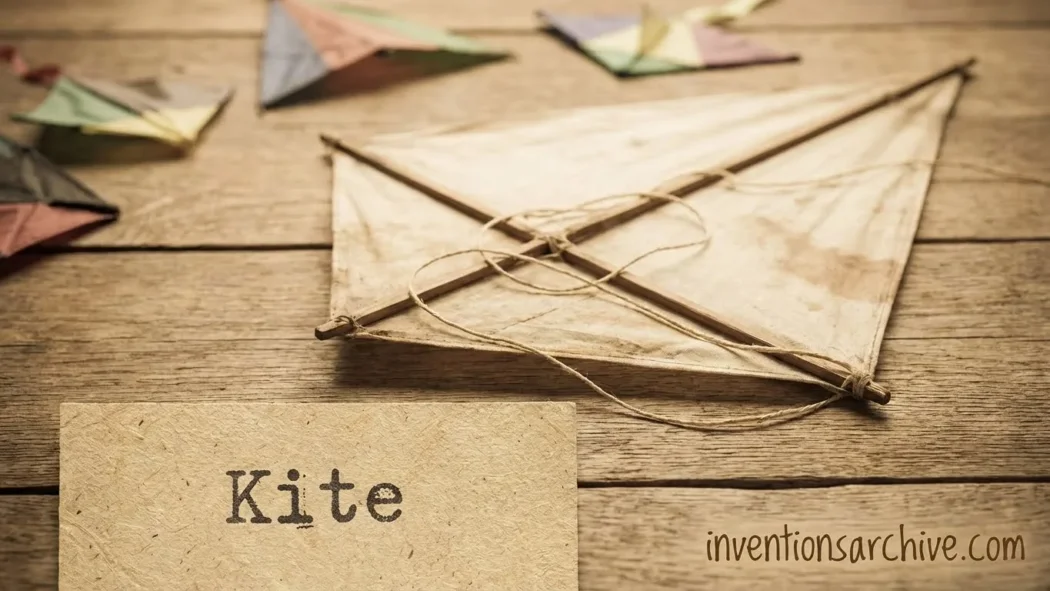
| Invention Name | Kite |
|---|---|
| Short Definition | A tethered flying object that uses wind, a surface, and a line to stay in controlled flight. |
| Approximate Period | 5th century BCE to Warring States period China Approximate [a] |
| Geography | Early China; later East Asia, South Asia, Southeast Asia, the Middle East, Europe, and global use |
| Inventor or Source Culture | Anonymous / collective early Chinese craft tradition Attribution varies |
| Category | Aeronautics, communication, measurement, education, cultural craft |
| Evidence Status | Based on historical accounts, later surviving objects, and museum records Based on surviving evidence |
| Main Problem Solved | Raising a visible, controllable object into the wind for signaling, measuring, testing wind, study, and display |
| Basic Working Principle | Lift, drag, weight, and line tension balance around a tethered surface |
| Material Base | Wood; later silk and bamboo; then paper and bamboo; modern cloth, nylon, plastic film, carbon rods, and synthetic lines |
| Early Use Areas | Wind testing, visible signaling, distance measurement, ceremony, teaching, recreation, and later scientific experiments |
| Development Path | Bird-like wooden forms → silk and bamboo kites → paper and bamboo kites → box and cellular kites → modern sport, research, and energy kites |
| Related Inventions | Paper, silk line, bamboo frame, box kite, glider, airplane, weather kite, parafoil kite |
| Surviving Evidence | Later museum kites, printed images, written histories, aeronautical collections; very early organic examples rarely survive |
| Modern Descendants | Sport kites, scientific kites, weather kites, parafoil systems, kite aerial photography, airborne wind-energy systems |
The kite is one of the earliest known human-made objects designed for controlled flight. It looks simple because it has only a body, a line, and air moving across it. Yet that simplicity is exactly what made the invention useful. A kite could rise above a field, a town, a coast, or a festival space without an engine, a tower, or a permanent structure. It turned wind into a tool people could see, measure, study, and enjoy.
What the Kite Is
A kite is a flying structure held by one or more lines. It is heavier than air, but it can stay aloft when air moves across its surface and creates lift. The line matters as much as the flying surface. Without a tether, the object would not hold a stable position in the wind in the same way.
The early kite was not only a toy. It was a practical wind object. It could show wind direction, carry a visible signal, test the idea of lift, mark distance, and support cultural display. Later, the same principle helped people think about gliders, wings, air pressure, and controlled flight.
How Its Origin Is Traced
The safest historical wording is this: the kite is strongly associated with early China, but its earliest maker is not securely known. Several later traditions connect early kites with Chinese craft, observation, and bird-shaped flying forms. Museum writing on Chinese kite conservation notes traditions that place early kites in China between 475 BCE and 221 BCE, first with wooden bird-like forms, then lighter silk-and-bamboo and paper-and-bamboo versions in later centuries. [b]
This distinction matters. A surviving later kite proves that a kite-making tradition existed at that later date. A written account may preserve an older memory. Neither always proves the first moment of invention. For that reason, the kite is best understood as a collective invention shaped by craft knowledge, materials, wind experience, and observation of birds.
The Problem It Answered
Before the kite, people could observe wind through flags, smoke, leaves, dust, sails, and moving cloth. These methods showed air movement, but they stayed close to the ground or depended on fixed structures.
The kite answered a different need. It put a visible object into the air while keeping it connected to a person on the ground. That made it useful for several simple but valuable purposes:
- Seeing wind behavior above ground level.
- Showing a signal over a wider distance than a hand-held marker.
- Testing lift with a repeatable object.
- Measuring or estimating distance when a line and position could be compared.
- Creating shared cultural display in open public spaces.
The kite did not replace every earlier wind marker. It added a new ability: controlled height.
How It Worked in Simple Terms
A kite flies because moving air acts on its surface. The kite’s body meets the wind at an angle, and the air pressure around it creates lift. Gravity pulls the kite down. Drag pushes with the wind. The line creates tension and keeps the kite from simply drifting away. NASA explains these four forces on a kite as weight, lift, drag, and tension; the balance between them determines the kite’s motion and stable position. [c]
The line is not a minor part. It gives the kite a fixed relationship to the ground. That is why a kite can remain in one area of the sky instead of behaving like loose paper in the wind.
Main Technical Parts
- Frame: gives the kite shape and stiffness.
- Sail or surface: catches moving air and helps create lift.
- Bridle: connects the flying surface to the main line and helps set the angle.
- Line: keeps tension and links the kite to the ground.
- Tail or stabilizing form: used in many designs to reduce spinning or wobbling.
Not every kite has a tail. Not every kite has the same frame. The invention is better defined by the tethered flight principle than by one single shape.
Earlier Tools and Ideas Before the Kite
The kite grew from older knowledge rather than appearing from nothing. People already understood cloth, cord, wind, sails, banners, poles, and flexible plant materials. They also watched birds and flying leaves. The early kite joined these observations into a controllable object.
| Stage | Form | What Changed |
|---|---|---|
| Earlier Wind Markers | Flags, streamers, smoke, sails, moving cloth | Showed wind direction, but usually near the ground or fixed to a structure |
| Early Kite Forms | Wooden or bird-like tethered flying forms | Raised a visible object into the air while keeping ground control |
| Light Craft Kites | Silk, bamboo, paper, cord, pasted surfaces | Made flight easier with lighter materials and more flexible structures |
| Scientific Kites | Box, cellular, weather, and experimental kites | Turned the kite into a tool for aeronautics and atmosphere study |
| Later Descendants | Gliders, aircraft testing, parafoil systems, kite energy concepts | Used the kite’s lessons about lift, control, stability, and tethered power |
Materials and Technical Principles
The kite depended on a rare mix of lightness and strength. A heavy object could not rise easily. A weak object could break in wind. That is why bamboo, silk, paper, and later synthetic materials became so useful.
Traditional East Asian kites often used bamboo because it could be split into thin, springy strips. Paper or silk gave a broad surface without too much weight. Cord held the flying body from the ground. In later centuries, cotton, nylon, plastic film, fiberglass, carbon rods, and synthetic lines changed the size, durability, and shape of kites.
Main Material Roles
- Bamboo or wood: frame strength, curve, and spring.
- Silk or paper: light flying surface.
- Cord or line: control and tension.
- Binding and adhesive: joints and frame stability.
- Modern synthetic fabric: stronger surfaces for sport, research, and power kites.
The material story is part of the invention. A kite is not only an idea. It is a material solution to wind.
Early Uses in Real Life
Early kites had many uses because they were light, visible, and portable. They could be carried to open ground, raised in moving air, and pulled down again without a tower or permanent machine.
Historical use includes signaling, distance estimation, wind testing, ceremony, and entertainment. Later visual evidence also shows kite flying as a social and cultural activity. A British Museum record for a 1747 Qing dynasty woodblock print describes a garden scene in which a boy flies a kite among other children’s activities, showing how kite flying became part of everyday imagery and seasonal life. [d]
This is one reason the kite lasted so long. It could serve careful observation and public enjoyment at the same time. Few early flying inventions crossed those settings so easily.
How It Spread and Changed Over Time
As kite traditions moved across regions, the basic invention stayed recognizable, but the shapes changed. Some kites became flat and rectangular. Some became bowed, diamond-shaped, bird-shaped, fish-shaped, box-shaped, or cellular. Some were made for steady flight. Others were made for motion, sound, festival display, or sport.
Trade, craft exchange, migration, local festivals, teaching, and later scientific research all helped the kite spread. Each region adapted the idea to local materials and customs. A kite made for a festival did not have to look like a kite made for measuring wind. A kite used for aeronautical testing did not have to carry painted symbols or seasonal meanings.
Related articles: Electricity: Who Invented Electricity? [Renaissance Inventions Series], Hot Air Balloon [Industrial Age Inventions Series]
The invention survived because it was adaptable. The same general principle could support a child’s paper kite, a scientific box kite, a camera-lifting kite, or a modern power kite.
Main Types and Variations
Kite types are usually grouped by shape, structure, and purpose. The categories below are not a single historical sequence. They show how the invention expanded into different forms.
| Type or Variation | Common Form | What It Changed |
|---|---|---|
| Flat Kite | Flat sail with a frame | Simple form for display, recreation, and early experimentation |
| Bowed Kite | Curved or bowed crosspiece | Improved stability in many tailless or short-tail designs |
| Diamond Kite | Four-sided frame with a central spine | Became a widely recognized recreational form |
| Fighter Kite | Small, agile, usually flat or bowed | Favored fast steering and competitive handling in several Asian traditions |
| Box Kite | Open cellular structure | Improved stability and influenced early aeronautical thinking |
| Tetrahedral or Cellular Kite | Many small structural cells | Explored strength, lift, and scale in experimental flight |
| Parafoil Kite | Soft air-filled wing without a rigid frame | Made compact, flexible, powerful lifting surfaces possible |
| Cultural and Festival Kite | Paper, bamboo, cloth, printed or painted forms | Linked flight with craft, symbols, seasons, and public display |
Museum objects show how varied these forms became. One British Museum kite record describes a small kite made with thick printed paper, thin wooden sticks, cord, cotton, paper, plastic, and bamboo. That kind of object is modern, but it shows the long life of the same invention across craft, souvenir, and display contexts. [e]
Before and After the Kite
The kite did not change one single industry overnight. Its impact was slower and wider. It changed how people could use wind above ground level, and it gave later experimenters a low-cost way to study lift and control before powered aircraft existed.
| Before the Kite | What Changed After It |
|---|---|
| Wind was read mainly through smoke, flags, sails, leaves, or moving cloth. | A tethered object could be raised higher and kept visible in the air. |
| Signals and markers usually stayed near people, buildings, poles, or hills. | A kite could create a high visible point without a permanent structure. |
| Flight was mostly observed in birds, insects, falling leaves, and myths. | People had a repeatable human-made object for studying lift and stability. |
| Air movement was hard to test above ground without large structures. | Kites helped later scientific and weather-related observations reach into the air. |
| Early aviation had few safe ways to test wing ideas at small scale. | Experimental kites helped prepare ideas later used in gliders and aircraft. |
Why the Kite Mattered for Later Flight
The kite became an important bridge between observation and aeronautics. Long before engines could lift aircraft, kites showed that a shaped surface could generate lift when air moved across it. This lesson was simple enough to demonstrate, but deep enough to influence later experiments.
Nineteenth-century researchers used kites to test structures, stability, and control. The box kite, developed by Lawrence Hargrave in 1893, became especially important because its braced cellular form helped later thinkers understand stable lifting surfaces and biplane-like structures.
The kite also supported teaching. It gave students and experimenters a way to see forces in action without needing a full aircraft. That educational role still exists.
Common Misunderstandings
The Kite Was Not Just a Toy
Recreation became one of its most familiar uses, but the invention also served observation, signaling, measurement, scientific study, and cultural display.
The Earliest Known Evidence Is Not the First Moment
Surviving objects and written references show what is currently known. They do not always prove when the very first kite was made.
One Shape Does Not Define All Kites
The diamond kite is familiar in many places, but kites can be rectangular, bowed, cellular, fish-shaped, bird-shaped, soft-winged, or built from many repeated cells.
A Famous Later Form May Not Be the Original Form
Modern paper, plastic, nylon, and parafoil kites are descendants of older tethered flight ideas. They should not be mistaken for the earliest materials or shapes.
Related Inventions
- Paper: made light, broad kite surfaces easier to produce in later traditions.
- Silk Thread and Cord: helped early flying lines combine strength with low weight.
- Bamboo Frame: gave many traditional kites a strong and flexible structure.
- Box Kite: connected kite design with early aeronautical testing.
- Glider: used related ideas about lift, balance, and control.
- Weather Kite: raised instruments or observation tools into the atmosphere before modern remote sensing.
- Kite Aerial Photography: used tethered lift to raise cameras before drones.
- Parafoil Kite: turned the kite into a soft wing used in sport, pulling systems, and research.
Frequently Asked Questions
Who invented the kite?
The kite is usually traced to early China, but no single inventor can be confirmed with strong surviving evidence. It is better described as a collective invention from an early craft tradition.
When was the kite invented?
Institutional histories commonly place the kite in early China around the fifth century BCE or within the Warring States period. The date is approximate because the earliest materials were perishable.
How does a kite stay in the air?
A kite stays in the air when lift from moving air balances against weight, drag, and line tension. The tether helps hold the kite at a stable angle to the wind.
Were early kites made of paper?
Not always. Some historical accounts describe very early wooden forms. Later Chinese kites used lighter combinations such as silk and bamboo, then paper and bamboo.
Why is the kite important in the history of invention?
The kite gave people a controllable way to use wind for flight, signaling, observation, and later aeronautical study. It helped connect craft knowledge with the science of lift and stability.
Sources and Verification
- [a] Flight Before the Airplane | National Air and Space Museum — Used to verify the fifth-century BCE China attribution, the kite as an early sustained-flight invention, and its later role in aeronautical experimentation. (Reliable because it is an official Smithsonian National Air and Space Museum source.)
- [b] Conserving the Museum’s Chinese Kites | National Air and Space Museum — Used to verify the Warring States period dating range, the shift from wood to silk, bamboo, paper, and bamboo, and material evidence from museum conservation. (Reliable because it is an official museum conservation source.)
- [c] Four Forces on a Kite | Glenn Research Center | NASA — Used to verify the basic aerodynamic forces on a kite: lift, drag, weight, and tension. (Reliable because it is an official NASA Glenn Research Center educational source.)
- [d] print | British Museum — Used to verify a 1747 Qing dynasty woodblock print that includes a boy flying a kite, supporting the cultural and social use context. (Reliable because it is an official British Museum collection record.)
- [e] kite | British Museum — Used to verify a museum-recorded kite object with paper, wooden sticks, cord, cotton, paper, plastic, and bamboo, supporting material and craft variation details. (Reliable because it is an official British Museum collection record.)