
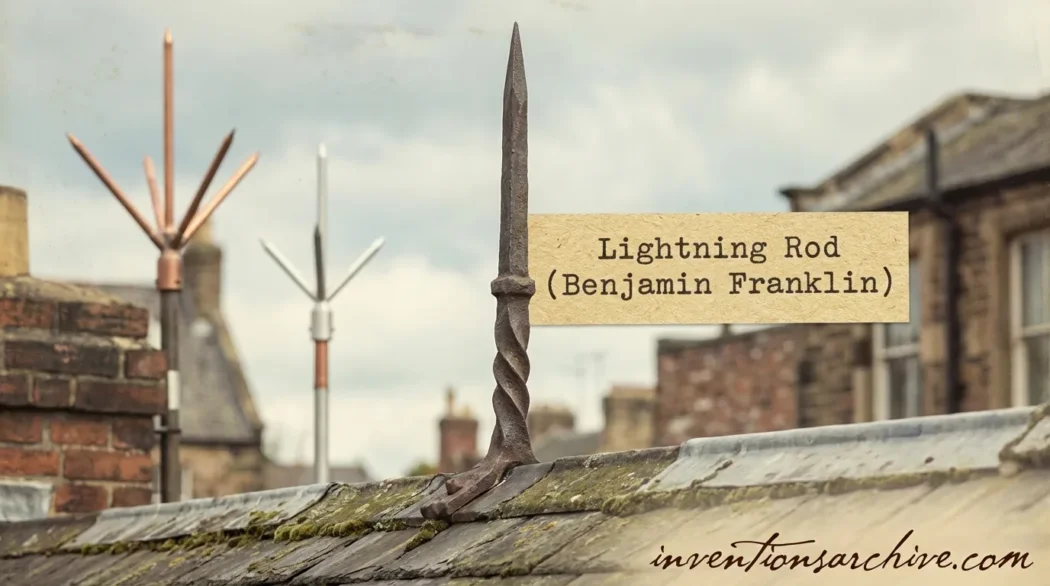
| Invention Name | Lightning Rod (Franklin Rod) |
|---|---|
| Short Definition | Metal air terminal that helps route lightning current safely into the ground |
| Approximate Date / Period | Mid-18th century (1750–1753) Approximate |
| Geography | Philadelphia; then wider Atlantic world |
| Inventor / Source Culture | Benjamin Franklin (widely credited); early modern electrical research community |
| Category | Safety engineering; electricity; architecture |
| Importance | Fire risk reduction; foundation for modern lightning protection standards |
| Need / Reason It Emerged | Frequent lightning damage and fires in tall, flammable structures |
| How It Works | Intercepts a strike; provides a preferred conductive path; disperses energy into ground |
| Material / Technology Base | Conductive metals; bonding; grounding network |
| First Typical Uses | Public buildings; homes; industrial and storage structures |
| Spread Path | Urban centers → ports → broader residential and civic adoption |
| Derived Developments | Whole-building protection systems; surge protection; standardized components |
| Impact Areas | Public safety; construction practice; insurance; electrical engineering |
| Debates / Different Views | Pointed vs rounded tips; “prevention” vs “controlled interception” framing |
| Precursors + Successors | Precursors: grounding intuition, metal conductors; Successors: integrated roof networks, bonding, SPDs |
| Influenced Variants | Air terminals, catenary wires, mesh systems, modern strike termination devices |
A lightning rod is simple at first glance, yet its real value comes from a bigger idea: giving lightning a safer path than the materials inside a building. The classic “Franklin rod” sits at the top, but the modern story includes grounding, bonding, and surge control—details that turn a metal tip into a reliable protection system rather than a symbol. In this article, the focus stays on clear, verifiable facts and practical understanding that remains true year after year.
Table Of Contents
What The Lightning Rod Is
A lightning rod is an air terminal: a conductive point intended to be the preferred attachment point for a lightning strike. Its job is not “magic protection.” Its job is controlled conduction, so the electrical current is guided away from vulnerable materials.
- Intercept a strike at a metal point
- Carry current through a continuous conductor
- Disperse energy into the earth through grounding
What It Is Not
- Not a device that stops lightning from occurring
- Not a guarantee against all electrical damage
- Not a single-part solution when modern wiring and data lines are involved
Why It Was Needed
Before lightning protection became common, a strike on a tall structure could trigger devastating fires and structural damage. The risk was practical, frequent, and expensive, especially where buildings relied heavily on wood and where tall rooflines and towers stood over dense neighborhoods.
The Core Problem
- Lightning delivers energy quickly; heat and sparks can ignite materials.
- Current searches for conductive paths; that path can pass through a building.
- Metal systems, if continuous and grounded, can keep that current outside the structure’s vulnerable interior.
In short, the lightning rod belongs to the history of public safety as much as it belongs to the history of electricity.
Early Evidence And Timeline
The lightning rod’s origin sits inside a broader shift: electricity moved from curiosity to tool. Franklin’s writings emphasized the “power of points” and the idea that a sharp conductor could help protect buildings by offering a controlled path for electrical discharge. ((Details-1))
| 1750 (Approx.) | Idea formalized in writing: pointed conductors suggested for protection |
| June 1752 | Franklin’s famous atmospheric electricity work is associated with this month, as described in public historical records (date is well known; exact site details vary by account) |
| Early 1750s | Lightning rods begin appearing on buildings in growing numbers |
| Later 18th century | Lightning protection ideas spread and evolve into broader systems |
A widely circulated visual record connects “June 1752” with demonstrating that lightning and electricity are the same kind of phenomenon, and notes that this work led to the invention of the lightning rod. ((Details-5))
The early debate about tip shape became famous: pointed vs blunt. Today, the emphasis is less about symbolism and more about the system’s continuity, bonding, and grounding—what happens after a strike connects.
How Lightning Protection Works
A lightning protection system does not “turn lightning away.” It works by intercepting a strike and guiding current along a preferred route. That route must stay continuous, conductive, and connected to earth so the energy can disperse. The National Weather Service summarizes the key point clearly: systems do not prevent strikes, they provide a conductive path and grounding, and they also recognize the role of surge protection for lines entering a structure. ((Details-3))
A Simple Mental Model
- Attachment: the strike connects to a preferred point
- Transport: current flows through a low-impedance metal path
- Dispersion: energy spreads into the ground through the grounding network
Core Parts Of A Protection System
The rod itself is only the visible tip of a larger design. Modern systems are built around three connected ideas: a strike termination point, a conductor network, and a grounding network. When buildings include electrical, data, and metal piping networks, bonding and surge protection become part of the overall picture, because energy can enter along connected lines. Continuity matters more than appearance.
Strike Termination
- Air terminals (often called lightning rods)
- Conductive roof elements in some designs
- Specialized terminals on certain structures
Down Conductors And Bonding
- Continuous metal conductors that carry current downward
- Bonding that reduces dangerous side flashes between metal parts
- Connections designed to remain stable over time
Grounding Network
- Ground electrodes and earth contact paths
- Integration with building grounding where appropriate
- Long-term corrosion awareness and material choices
Lightning currents can reach very high levels, so protection systems are designed to provide a continuous conductive path rather than rely on minor discharge effects. A university physics demonstration note explains that the “silent discharge” idea alone is insufficient and emphasizes the need for a path capable of carrying large currents, commonly described as “tens of kiloamperes” on average. ((Details-4))
Design Variations And Types
People often say “lightning rod” as if there is only one form. In reality, many systems use different strike termination layouts depending on roof shape, footprint, and connected metalwork. The shared purpose stays the same: controlled interception, continuous conduction, and grounding. The differences show up in coverage approach, not in the basic physics. Context drives design choices.
| Type | What Changes | Where It Is Common |
| Single Air Terminal | One prominent strike point with conductors and grounding | Smaller rooflines, simple structures |
| Multiple Air Terminals | Several strike points connected by a conductor network | Larger roofs, complex outlines |
| Mesh Or Network | Roof-level conductive network acting as a strike termination area | Wide roof surfaces, industrial buildings |
| Catenary Wire Approach | Suspended conductors that create preferred attachment points | Open areas, certain critical outdoor assets |
Pointed And Rounded Tips
The early conversation around tip shape became famous. Franklin promoted sharp points, while others preferred blunt ends. Over time, practical experience pushed attention toward system integrity: secure connections, conductive continuity, and grounding quality. The tip is visible; the network is decisive.
Where It Changed Everyday Life
The lightning rod’s impact is easy to overlook because success looks like “nothing happened.” Yet it reshaped expectations. Buildings could be taller and denser with less fear of lightning-triggered fire. Insurers, builders, and civic planners gained a new tool that felt measurable rather than superstitious.
- Urban safety: reduced risk of fire spread from a single strike
- Construction confidence: more willingness to use metal elements openly
- Engineering culture: a shift toward standards, repeatable parts, and inspections
This is why the lightning rod remains an evergreen invention. It is not only a device. It is a template for modern safety engineering: observe the hazard, understand the mechanism, then build a practical system around that knowledge.
Common Misunderstandings
“It Attracts Lightning”
A rod provides a preferred attachment point. That can feel like “attraction,” but the purpose is control: if a strike occurs, it is directed into a planned conductive route instead of random paths through materials.
“One Rod Is Enough”
Many structures rely on a broader network: conductors, bonding, grounding, and often surge protection. A single visible rod without an integrated system can leave gaps. Systems thinking is the real lesson.
Another common mistake is thinking the rod “drains” storm clouds. The historic “silent discharge” idea is part of the story, but real lightning involves large currents and fast-changing conditions. Reliable protection is engineered for the strike, not for wishful prevention.
FAQ
Did Benjamin Franklin invent the lightning rod?
Franklin is widely credited with proposing and promoting the lightning rod concept in the mid-18th century. Historical accounts connect his atmospheric electricity work to the invention’s early adoption and public understanding.
Does a lightning rod stop lightning from striking?
No. Lightning protection is generally framed as interception and safe conduction. The goal is to provide a preferred path for current and reduce damage risk, not to eliminate lightning.
Why is grounding so important?
Lightning energy needs a path to disperse into the earth. Grounding is the part of the system that connects conductors to the ground so energy can spread out rather than concentrate in building materials.
What is the difference between a “lightning rod” and a “lightning protection system”?
A lightning rod is typically one air terminal. A lightning protection system includes air terminals, conductors, bonding, grounding, and often surge protection for incoming power and data lines.
Are pointed tips required?
The famous early debate about tip shape is real history. In modern practice, the overall system design, conductor continuity, bonding, and grounding integrity are central to performance.
Why do lightning rods still matter in the age of electronics?
Modern buildings contain sensitive electronics and connected networks. Lightning energy can couple into wiring and metal lines. That is why modern protection discussions include both external strike interception and internal surge control.
Key historical and technical references used for specific claims: (Details-2)