
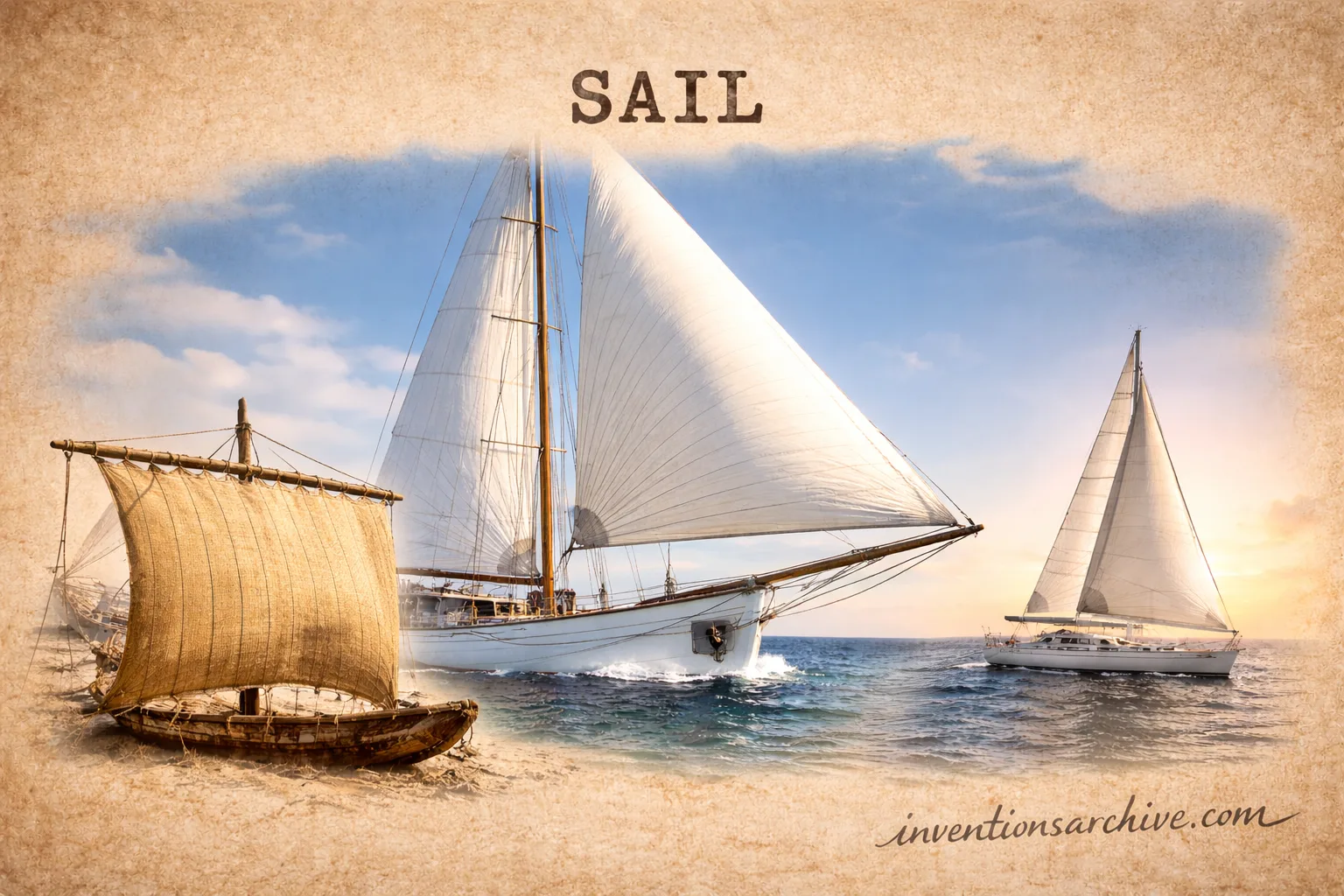
| Invention Name | Sail |
|---|---|
| Short Definition | A shaped sheet of textile, matting, skin, or later engineered material used to capture wind and help move a vessel. |
| Approximate Date / Period | Late 4th millennium BCE for early Egyptian visual evidence Based on surviving evidence |
| Geography | Nile Valley and wider eastern Mediterranean / Near Eastern water routes Attribution varies |
| Inventor / Source Culture | Anonymous / collective; no single named inventor is known |
| Category | Transport; navigation; maritime technology; energy use |
| Main Problem Solved | Reduced dependence on paddling, rowing, towing, and river current for moving boats. |
| How It Works | Wind pushes or flows across a sail, producing force that can move a hull through water when balanced by steering and hull resistance. |
| Material / Technical Base | Early organic materials are poorly preserved; later evidence includes wood, linen fabric, linen twine, rigging, yards, masts, and steering oars. |
| Early Use | River travel, transport, trade, ritual journeys, and later seagoing movement. |
| Evidence Status | Approximate Physical objects and images survive, but the first practical use is not directly recoverable. |
| Surviving Evidence | Naqada II pottery with a ship under sail; Middle Kingdom boat models; later historical images and ship records. |
| Development Path | Paddled and poled boats → simple square sails → rigged sailing boats → lateen and fore-and-aft forms → modern sails and wind-assisted propulsion. |
| Related Inventions | Mast, rope, steering oar, rudder, sailcloth, keel, rigging, compass. |
| Modern Descendants | Yacht sails, wing sails, rotor sails, wind-assisted cargo ship systems, kites for marine propulsion. |
| Why It Matters | It turned wind into a usable transport force and expanded the range, speed, and carrying capacity of water travel. |
The sail is one of the clearest examples of an invention that changed transport without having a single discoverable inventor. It took a natural force that people could feel every day and turned it into movement across water. A sail did not replace every paddle or oar. Early boats still needed steering, handling, and human skill. Yet the sail added something new: wind could become useful work.
In simple terms, a sail is a controlled surface. It is raised on a mast or spar, held by ropes or rigging, and set at an angle to the wind. On early river craft, a broad square sail could help a boat move with a favorable wind. In later sailing craft, more refined sail shapes allowed vessels to cross, turn, and work with the wind in more flexible ways.
The invention matters because it joined several older technologies into one working system: boatbuilding, textile or mat-making, rope, woodwork, steering, and knowledge of wind and water. The sail was not just a sheet. It was part of a maritime system.
What The Sail Is
A sail is a wind-catching surface attached to a boat, ship, raft, or other craft. Its shape, position, and tension affect how wind force is transferred to the vessel. Early sails were probably simple compared with later rigs, but even a simple sail required several parts to work together:
- Mast: a vertical or leaning support that holds the sail above the hull.
- Yard or spar: a pole that spreads the sail and helps control its shape.
- Ropes and rigging: lines used to raise, lower, brace, or steady the sail.
- Hull: the floating body that receives the force and moves through water.
- Steering device: an oar, rudder, or similar tool used to guide the vessel.
A sail is often treated as a single invention, but it is better understood as a practical combination of materials and techniques. Without rope, mast support, a stable hull, and steering, the fabric or mat alone would not have been very useful.
How Its Origin Is Traced
The origin of the sail is traced through surviving evidence, not through a written invention record. Organic sails made from plant fiber, linen, woven mats, hide, or other early materials rarely survive for thousands of years. What survives more often is indirect evidence: painted pottery, carved scenes, boat models, tomb objects, and later written or scholarly descriptions.
The British Museum’s Naqada II jar is one of the strongest museum objects for early sail imagery because it is a physical object with a visible ship under sail. Its exact interpretation has still been discussed by specialists, which is why careful articles should not state that it proves the first sail ever made.
Middle Kingdom Egyptian boat models give a later but more detailed view of sailing technology. The Metropolitan Museum of Art’s model sailboat from the reign of Amenemhat I includes wood, paint, plaster, linen twine, and linen fabric, and its description notes a missing sail being hoisted by men in the center of the boat.[c]
The Problem It Answered
Before sails, water movement depended mainly on drifting, paddling, rowing, poling, towing from the bank, or using the natural current. These methods worked, but each had limits.
Paddling and rowing required steady human effort. Poling worked only in shallow water. River current helped in one direction but not the other. Towing needed people or animals on shore and was limited by banks, terrain, and obstacles. A sail offered another option: use wind when conditions allowed.
On the Nile, this was especially useful because the river current flows north while prevailing winds could help movement south. That combination made sail power practical for return movement in a river environment. It did not make travel effortless, but it gave boat operators a powerful extra tool.
| Before The Sail | What Changed After It |
|---|---|
| Boats depended mainly on paddles, oars, poles, towing, or current. | Wind became a usable source of movement when direction and conditions allowed. |
| Long journeys required more human effort and larger rowing crews. | Some journeys could cover greater distance with less continuous physical labor. |
| Travel against current was harder and slower. | Favorable wind could help return trips or upstream movement in some river systems. |
| Cargo movement was limited by crew effort and boat handling methods. | Wind-assisted boats could support wider trade, transport, and ritual movement. |
| Boat design did not need to manage large wind loads. | Masts, stays, yards, rigging, and stronger hull structures became more important. |
How It Worked In Simple Terms
A sail works by receiving wind force and passing that force into the boat through the mast, ropes, spars, and hull. In the simplest downwind use, the wind pushes the sail and the boat moves in the same general direction. This is the easiest form to understand.
Later sailing became more refined. When a sail is set at an angle, air can move around it and create a force that is not only simple pushing. The underwater shape of the hull, keel, centerboard, or steering system resists sideways slipping. The result is controlled forward motion. MIT’s explanation of how a sailboat sails into the wind describes lift, drag, sail angle, and the balancing role of the hull and keel in this process.[d]
This does not mean early sails worked like modern racing sails. Early square sails were better for favorable winds and river settings. Later rigs made sailing more flexible by changing sail shape, angle, and the way force moved through the vessel.
Earlier Ideas and Tools Before It
The sail grew from older water technologies. Long before a sail could be useful, people needed floating craft that could carry weight. Royal Museums Greenwich notes that early water travel probably began with floating logs, reed bundles, rafts, and hollowed logs, while Egyptian boat images are among the oldest known boat pictures.[e]
The most likely predecessors and supporting technologies include:
- Rafts and reed boats: simple floating platforms or bundled craft.
- Paddles and poles: tools for human-powered movement and handling.
- Rope and lashings: needed to bind reeds, wood, masts, and rigging.
- Textiles or woven mats: flexible surfaces that could catch wind.
- Steering oars: essential for controlling direction under wind force.
- Hull shaping: needed for stability, load carrying, and better movement through water.
The sail answered a problem, but it also created new design needs. A boat under sail must handle sideways force, mast pressure, and shifting wind. That pushed boatbuilding toward stronger structures and more deliberate rigging.
Main Materials and Mechanism
Early sails were likely made from organic materials that do not preserve well. Linen, woven plant fiber, matting, skins, and later canvas-like textiles belong to the wider material history of sails, but exact early examples are rare. This is why museum boat models and images are so valuable: they show how masts, yards, ropes, and steering devices were understood.
The mechanism can be explained without turning it into a construction guide:
- The sail presents a surface to the wind.
- The mast and yard hold the surface open.
- Ropes control height, tension, and angle.
- The hull receives the force and moves through water.
- The steering oar, rudder, or hull shape helps control direction.
In early use, the sail was not a stand-alone machine. It worked because sailors learned how to balance wind, current, hull shape, cargo, and steering.
Early Uses
Early sails were useful in river and coastal settings. They helped move people, goods, and ceremonial objects. In Egypt, boats were not only practical tools; they also appeared in funerary and ritual contexts. The Met’s Middle Kingdom model sailboat, for example, is tied to the “pilgrimage to Abydos” tradition in its museum description.
Practical uses likely included:
- moving cargo along rivers;
- transporting people between settlements;
- supporting trade in grain, timber, stone, textiles, and other goods;
- carrying ritual or funerary objects;
- expanding coastal movement where weather and hull design allowed it.
The sail did not remove the need for human skill. Sailors still had to read wind direction, trim the sail, avoid dangerous conditions, and combine sail power with rowing or poling when needed.
Related articles: Mechanical Sawmill [Medieval Inventions Series], Caravel [Medieval Inventions Series]
How The Sail Changed Over Time
The earliest useful sails were probably simple. Over time, sail forms became more varied because boats worked in different waters and for different tasks. A river cargo boat did not need the same rig as a Mediterranean trading vessel, a fishing craft, or a later ocean ship.
| Stage | Form | What Changed |
|---|---|---|
| Earlier Tool | Rafts, reed boats, paddled boats, poled craft | Movement depended mostly on people, current, or towing. |
| Early Sail | Broad square or rectangular sail on a simple mast | Wind could assist movement, especially with favorable direction. |
| Improved Rig | Masts, yards, stays, halyards, steering oars | Handling became more controlled and boat structure became more specialized. |
| Later Form | Lateen, lug, gaff, fore-and-aft, and mixed rigs | Sails could be adapted to more routes, vessel sizes, and wind angles. |
| Modern Descendant | Engineered yacht sails, wing sails, rotor sails, wind-assisted systems | Wind power remains useful in sport, research, and fuel-saving maritime design. |
One long-lived example is the lateen sail, a triangular or sharply angled sail associated with many Mediterranean and Nile vessels. A Royal Museums Greenwich record of a felucca and gaiassa on the Nile describes a single-masted felucca with a lateen sail and a second vessel with a fore lateen yard, showing the continued regional use of this sail type in the 20th century.[f]
Main Types and Variations
Sails changed because vessels changed. Some boats needed simple downwind power. Others needed better handling near coasts, in narrow rivers, or across longer sea routes. The main types below are broad categories, not a complete technical catalog.
| Sail Type | General Form and Use |
|---|---|
| Square Sail | Broad sail hung from a yard; useful with following or favorable winds; common in early and later large sailing traditions. |
| Lateen Sail | Triangular sail set on a long angled yard; associated with Mediterranean, Nile, and related regional craft. |
| Lug Sail | Four-sided sail set from a yard; used on smaller working boats in several regions. |
| Gaff Sail | Fore-and-aft sail supported by a gaff spar; common on many later working and leisure vessels. |
| Junk Rig | Battened sail associated with East Asian sailing craft; valued for controllable sail area and handling. |
| Crab-Claw and Oceanic Rigs | Distinctive sail forms linked with Austronesian and Pacific voyaging traditions. |
| Wing Sail | Rigid or semi-rigid aerodynamic surface used in modern racing and experimental craft. |
| Rotor Sail | Mechanical wind-assisted system that uses a rotating cylinder rather than cloth. |
What Changed Because of The Sail
The sail changed water transport by widening what boats could do. It allowed wind to share the work with human crews. That made longer journeys more practical when weather and vessel design were suitable.
The effects were not instant. Sailing skill, boat design, route knowledge, and harbor systems all had to develop. Over time, sail technology supported trade networks, fishing, migration, cultural contact, naval travel, mapping, and later global sea routes.
Several changes stand out:
- Energy use: wind became a practical transport force.
- Range: boats could travel farther when conditions allowed.
- Cargo: some vessels could move heavier loads with less constant rowing.
- Design: hulls, masts, rigging, and steering systems became more specialized.
- Navigation: sailors paid closer attention to wind patterns, seasons, coasts, and currents.
- Later invention: sails encouraged improvements in rope-making, sailcloth, shipbuilding, steering, and navigational tools.
The sail also shaped language and measurement. Many later maritime terms, from rigging names to points of sail, grew from the need to describe wind, angle, movement, and control with precision.
Common Misunderstandings
“The Sail Had One Inventor”
No known record names a single inventor. The sail was almost certainly a collective development shaped by boat users, textile makers, and river or coastal communities.
“The Earliest Image Proves The First Use”
The earliest surviving image proves only that the idea was known by that time. Earlier uses may have existed without leaving clear evidence.
“A Sail Is Just Cloth”
The cloth or mat is only one part. A working sail also depends on mast support, rope, steering, hull stability, and knowledge of wind.
“Sailing Replaced Rowing Immediately”
Rowing, paddling, and poling stayed useful. Many vessels combined human power and sail power for centuries.
Related Inventions
The sail sits inside a larger history of transport and navigation. These related inventions and technologies help explain its place in maritime development:
- Mast: the support that allowed a sail to be raised and controlled.
- Rope and rigging: the control system for raising, bracing, and adjusting sails.
- Steering oar and rudder: tools that made wind-powered movement more controllable.
- Keel and hull design: structural forms that improved tracking, stability, and resistance to sideways drift.
- Sailcloth: specialized textile material shaped for strength, flexibility, and wind handling.
- Compass: a later navigation tool that helped sailors travel beyond close visual routes.
- Marine chronometer: a later timekeeping invention that improved longitude calculation at sea.
- Wind-assisted propulsion: modern systems that reuse wind power on commercial vessels.
Modern Descendants
The sail did not disappear when engines became dominant. It remained central in sport sailing, training, traditional vessels, small craft, and research. It also returned in a new form through wind-assisted commercial shipping.
Modern wind systems may use flexible sails, rigid wings, suction sails, kites, or rotor sails. The IMO-linked GreenVoyage2050 technology portal describes fixed sails or wings as installations that can use wind to replace some propulsion power, with results depending on ship type, trade, size, and wind conditions.[g]
This modern use shows the long life of the original idea. The materials and engineering have changed, but the central principle is still recognizable: use the wind as a source of movement.
Frequently Asked Questions
Who invented the sail?
No single inventor is known. The sail appears to have developed through anonymous and collective experimentation in early water-travel cultures. Surviving evidence points strongly to early Egypt, but it does not prove that every earlier use is known.
What is the earliest evidence for sails?
One important piece of evidence is a Naqada II pottery jar in the British Museum that shows a ship under sail. Scholars also discuss Egyptian boat images, hieroglyphs, and later model boats. The evidence is strong for early use, but the exact first use remains uncertain.
What problem did the sail solve?
The sail helped boats use wind instead of relying only on paddles, oars, poles, towing, or current. This made some journeys less dependent on constant human effort and supported longer travel, trade, and transport.
Were early sails the same as modern sails?
No. Early sails were likely simpler and better suited to favorable wind directions. Modern sails use refined shapes, synthetic materials, and detailed aerodynamic design. The basic idea is the same, but the form and control systems changed greatly.
Is sail technology still used today?
Yes. Sails remain common in sport, training, traditional craft, and leisure boating. Wind-assisted systems, including rigid sails and rotor sails, are also being studied and installed on some commercial vessels to reduce engine load under suitable conditions.
Sources and Verification
- [a] jar | British Museum — Used to verify the Naqada II pottery jar described as showing a ship under sail. (Reliable because it is an official museum collection record.)
- [b] Egypt’s Earliest Sailing Ships | Antiquity | Cambridge Core — Used to verify the academic context and uncertainty around Egypt’s early sailing evidence. (Reliable because it is an academic journal article page from Cambridge University Press.)
- [c] Model Sailboat – Middle Kingdom – The Metropolitan Museum of Art — Used to verify the Middle Kingdom model sailboat, its date, materials, and museum interpretation. (Reliable because it is an official museum collection record.)
- [d] 2.972 How A Sail Boat Sails Into The Wind — Used to verify the basic explanation of lift, drag, and hull resistance in sailing. (Reliable because it is an educational page hosted by MIT.)
- [e] Shipbuilding: The earliest vessels | Royal Museums Greenwich — Used to verify broad early boatbuilding context and early Egyptian boat imagery. (Reliable because it is an institutional maritime history resource from Royal Museums Greenwich.)
- [f] A felucca and a gaiassa under sail on the River Nile, Egypt. | Royal Museums Greenwich — Used to verify a documented Nile example of lateen sails in use. (Reliable because it is an official museum collection record.)
- [g] Fixed sails or wings – GreenVoyage2050 — Used to verify modern wind-assisted propulsion as a descendant of sail technology. (Reliable because it is an IMO-linked institutional technology resource.)