
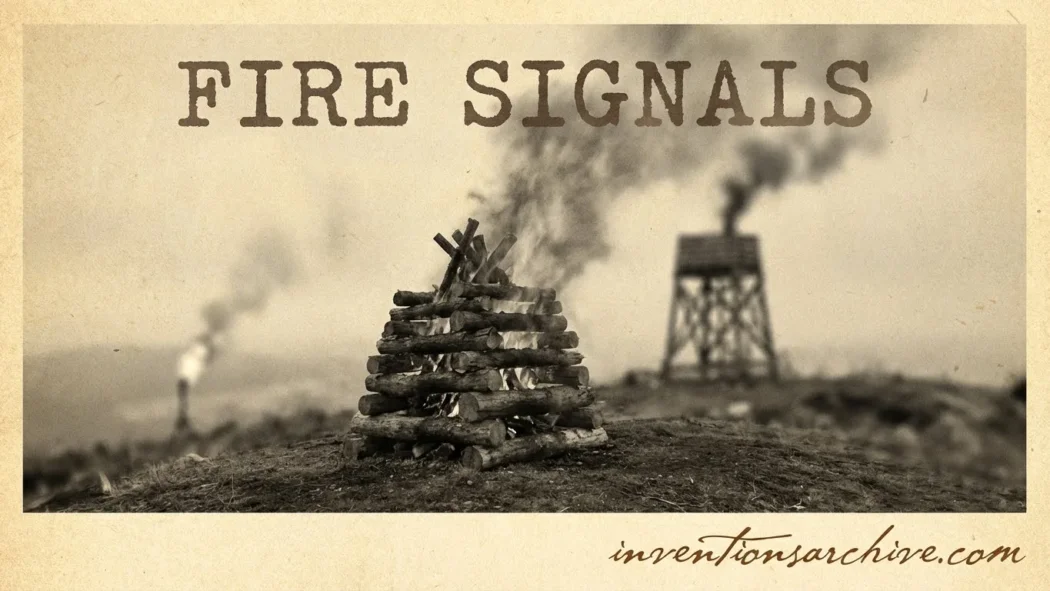
| Invention Name | Fire signals |
|---|---|
| Short Definition | Long-distance visual communication using visible flame, torchlight, lantern light, or smoke. |
| Approximate Date / Period | Very ancient; organized systems are documented in antiquity Based on surviving evidence |
| Geography | Multiple regions, including the eastern Mediterranean, Aegean islands, China, and later medieval frontier networks |
| Inventor / Source Culture | Anonymous / collective; later coded forms are linked with named Greek writers and engineers |
| Category | Communication, navigation, defense signaling, visual telegraphy |
| Main Problem Solved | Sending urgent information faster than a runner, rider, or boat could physically carry it |
| How It Worked | Observers used visible light or smoke from a high point; meaning depended on a pre-agreed signal, timing, location, or code |
| Material / Technical Basis | Fire, smoke, torches, lamps, watchtowers, hilltops, line-of-sight visibility |
| Evidence Status | Early origin is uncertain; documented systems are confirmed by literary, historical, and architectural evidence Attribution varies |
| Surviving Evidence | Ancient texts, tower remains, historical descriptions, museum and heritage records |
| Development Path | Simple warning fire → beacon chain → coded torch system → optical telegraph → electric telegraph |
| Related Inventions | Signal tower, lighthouse, hydraulic telegraph, semaphore telegraph, heliograph, electric telegraph |
| Modern Descendants | Emergency beacons, visual warning lights, coded signaling systems, long-distance communication networks |
| Importance |
|
Fire signals were one of the earliest ways people turned fire into a communication tool. A flame on a hill, smoke rising from a tower, or a row of torches seen across a valley could carry information faster than a person could travel. The idea was simple, but the history is not. Fire signals were not one single invention made in one place. They were a family of visual signaling methods that appeared wherever people needed to send urgent messages across open land, sea routes, mountain passes, island chains, or defended borders.
In their simplest form, fire signals meant “pay attention,” “danger,” “victory,” “arrival,” or another message agreed in advance. In more developed systems, the number, position, or timing of fires could carry more specific information. This is why fire signals belong not only to the history of fire use, but also to the early history of telecommunication: communication across distance without physically carrying the message.
What Fire Signals Were
A fire signal was a visible message created by flame, torchlight, lantern light, or smoke. The sender did not need to move toward the receiver. The message moved by sight. That made fire signals useful on high ground, on towers, across islands, along defensive walls, and in places where roads were slow or unsafe.
The system depended on three conditions:
- Visibility: the receiver had to see the flame or smoke clearly.
- Agreement: both sides had to know what the signal meant.
- Position: the signal station had to be placed where it could be watched from another station.
This is why fire signals were often tied to watchtowers, hilltops, coastal points, mountain ridges, fortifications, and border posts. A single fire could warn nearby observers. A chain of stations could pass the same message farther, one visible point at a time.
How the Origin Is Traced
The origin of fire signals cannot be pinned to a named inventor. The basic idea may have appeared many times because it answered a common human need: how to send urgent information farther than the voice can carry. The evidence becomes clearer when societies left written records or built signal stations that can still be studied.
One famous literary example appears in Aeschylus’s Agamemnon, where a watchman waits for a signal flame bringing news from Troy. This is not a patent, a technical manual, or proof that the event happened exactly as told. It is valuable because it shows that Greek audiences could understand the idea of a long-distance beacon message by the fifth century BCE.[b]
Later Greek and Hellenistic writers discussed more technical systems. Polybius described fire signaling as useful for urgent information and explained both its limits and later attempts to make it more precise. His discussion matters because it shows a shift from simple warning signals toward coded visual communication.[c]
The Problem Fire Signals Answered
Before organized fire signaling, long-distance messages usually moved through people or animals. A runner, rider, boat, or messenger relay could carry detail, but speed depended on distance, terrain, weather, and safety. A visible fire could not carry as much information as a written letter, yet it could send a short warning very quickly.
The practical value was strongest when the message was urgent and simple:
- a border watch detected movement;
- a coastal station needed to warn inland observers;
- a town or fortress needed early notice;
- an island or mountain station had to pass news to the next visible point;
- a known event had to be confirmed quickly.
Fire signals were not a replacement for messengers. They worked best as an early alert layer. After a signal, messengers could still bring names, numbers, documents, orders, or detailed explanation.
Before and After Fire Signals
| Before Fire Signals | What Changed After Fire Signals |
|---|---|
| Messages depended mostly on runners, riders, boats, shouted warnings, bells, horns, or local observation. | Short warnings could move across visible distance without moving a person between the two points. |
| Remote observers might see danger but could not alert distant settlements quickly. | Hilltop and tower signals allowed watchers to pass an alarm from one station to another. |
| Simple local signs were useful only nearby. | Beacon chains made a message visible across valleys, coasts, islands, walls, and mountain routes. |
| Messages carried by people could include detail but took more time. | Fire signals traded detail for speed, making them useful for known urgent meanings. |
| Each settlement or post reacted mostly to what it could directly observe. | Connected watchpoints created an early communication network based on line of sight. |
How Fire Signals Worked in Simple Terms
The basic principle was line-of-sight communication. A sender created a visible sign. A receiver watched for it. If the system had several stations, the receiver could repeat the signal so that the message moved along a chain.
Simple fire signals usually had a limited meaning. One flame might mean “warning,” while smoke by day and flame by night could serve the same alert function under different light conditions. More developed systems used number, position, timing, direction, or sequence to add meaning.
Polybius described the weakness of simple pre-agreed signals: they could only express events that had already been planned in the code. If an unexpected event occurred, a simple beacon could not explain it. His account of improved torch signaling divided letters into groups and used torches on different sides to indicate a letter’s position. That was a major step toward coded visual messaging, even though it still required trained observers and clear visibility.
Earlier Ideas and Tools Before Fire Signals
Fire signals did not appear in isolation. They grew out of older and parallel signaling habits. People had long used sound, light, smoke, flags, raised objects, and visible landmarks to attract attention. Fire was special because it could be seen at night, while smoke could be seen in daylight.
Several earlier or related tools helped shape fire signaling:
- Campfires and watch fires: ordinary fires became visible points of attention.
- High places: hills, ridges, towers, and rooftops extended the visible range.
- Lookouts: trained watchers gave the system human judgment.
- Pre-arranged meanings: without shared meaning, a flame was only a flame.
- Relay stations: one visible point could pass the signal to another.
In the Aegean, UNESCO’s World Heritage Centre describes ancient towers that sometimes worked as parts of beacon networks, transmitting light signals between towers in direct line of sight over large areas. This kind of evidence is important because it connects the idea of fire signals to real built landscapes, not only to written stories.[d]
Main Materials and Technical Principle
The materials could be simple, but the system itself was not careless. A working fire-signal network needed the right placement, reliable watchers, shared meanings, and repeatable signal forms. The technical principle was visibility controlled by agreement.
Main Elements
- Signal medium: flame, torchlight, lantern light, or smoke.
- Signal platform: hill, tower, wall, roof, coast, ridge, or watch station.
- Receiver: a person or station assigned to watch a known direction.
- Code: a simple meaning, repeated pattern, number of signals, or later alphabetic system.
- Relay: a second station repeating the message onward.
Early Uses
Fire signals were most useful where speed mattered more than detail. They appear in contexts of watchkeeping, border defense, coastal warning, island communication, and urgent public notice. A watchman did not need to know every detail to start a response. Seeing a known beacon could be enough to alert the next station or prepare a settlement.
Early uses included:
- Warning systems: alerting a guarded area to danger or movement.
- Victory or event notice: confirming a known event from a distance.
- Navigation and location marking: helping people identify prominent points at night.
- Frontier communication: linking remote watch posts with central authority.
- Island and coastal communication: passing visible signals across water where direct travel took time.
These uses show why fire signals survived for so long. They were limited, but they were cheap compared with roads, ships, permanent messenger forces, or later mechanical telegraphs.
Related articles: Telegraph [Industrial Age Inventions Series], Metal Bell Casting [Medieval Inventions Series]
How Fire Signals Spread and Changed Over Time
Fire signals spread because the idea was adaptable. A community did not need advanced machinery to understand that a visible fire could carry meaning. Yet organized systems required planning. Stations had to be placed in a chain, watchers had to know what to watch for, and the message had to be clear enough to avoid confusion.
In China, Great Wall signal towers used night beacons or lanterns and daytime smoke signals as part of military communication. Britannica notes that these towers were often built on hilltops for visibility and could also use other methods such as banners, clappers, or guns. This shows that fire and smoke signals often worked as one part of a larger visual and sound signaling system.[e]
By the medieval period, beacon chains could become more formal. Some Byzantine and Venetian tower networks are known through a mixture of texts, topography, inscriptions, and archaeological evidence, although the surviving evidence is uneven. A 2022 study in the Annual of the British School at Athens notes that little evidence has survived for many medieval long-distance communication networks, while also identifying large numbers of tower and beacon sites in Greece through modern study methods.[f]
Development Path
| Stage | Form | What Changed |
|---|---|---|
| Earlier Signaling | Shouts, horns, drums, visible gestures, local fires | Signals could attract attention, but range and meaning were limited. |
| Simple Fire Signal | Single flame, torch, or smoke column | A known message could be sent across visible distance. |
| Beacon Chain | Stations on hills, towers, walls, or islands | A short message could travel farther by relay. |
| Coded Torch System | Grouped torches, positions, timing, or letter-based codes | Messages could become more specific, but required training and clear visibility. |
| Optical Telegraph | Mechanical arms, shutters, towers, telescopes | Visual signals became more standardized and capable of carrying text-like messages. |
| Electric Telegraph | Electrical signals over wire | Messages no longer depended on daylight, weather, or line of sight in the same way. |
Main Types and Variations
Fire signals were not all the same. The term covers several related forms, from simple warning fires to coded torch systems. Some were meant only to warn. Others were closer to early telegraphy.
| Type | Typical Form | Main Meaning System |
|---|---|---|
| Beacon Fire | Large visible flame on high ground or tower | Usually a pre-agreed warning or event notice |
| Smoke Signal | Visible smoke by day | Attention, warning, or coded meaning depending on local agreement |
| Torch Signal | Handheld or station-based torches | Position, number, timing, or sequence |
| Beacon Chain | Series of visible stations | Relay of one message across a long route |
| Coded Fire Telegraph | Multiple torches arranged by count or side | Letters, groups, or more specific pre-arranged messages |
| Lantern or Light Beacon | Controlled artificial light at night | Warning, location marking, or repeated signal pattern |
What Changed Because of Fire Signals
Fire signals changed the relation between distance and warning. A message no longer had to travel only at the speed of a person. If stations could see one another, the message could move from point to point much faster than a physical messenger.
The practical changes were concrete:
- Settlements gained earlier warning from towers, hills, or border stations.
- Watch posts became part of a network rather than isolated observation points.
- Simple messages could travel across difficult terrain such as mountains, coasts, islands, and walls.
- Later inventors inherited the relay idea: one station reads a signal and passes it to the next.
- Code became more important because the signal itself carried meaning only when both sides understood the system.
This is the lasting importance of fire signals. They did not create full written communication at a distance by themselves, but they helped establish the core logic of remote signaling: sender, receiver, code, station, relay, and verification.
From Fire Signals to Visual Telegraphy
Later optical telegraphs turned the same basic idea into a more mechanical system. Instead of flame or smoke, they used arms, shutters, coded positions, and telescopes. IEEE REACH describes the semaphore telegraph as an optical system of tower stations used to convey textual information through visual signals, with towers often spaced about 10–15 kilometers apart.[g]
The link is not that a semaphore arm is the same object as a fire beacon. The link is deeper: both use visible signs across distance. Both require stations. Both depend on a shared code. Both become more powerful when relayed through a chain.
Common Misunderstandings
Fire Signals Were Not Invented by One Named Person
The basic practice was too old and widespread for a single inventor claim. Named figures belong mainly to later coded systems and written descriptions.
The Earliest Record Is Not the First Use
A surviving text or tower shows that a system existed by that time. It does not prove nobody used similar signals earlier.
Smoke Signals and Fire Signals Are Related, Not Identical
Smoke was mainly useful by day. Flame, torchlight, or lantern light was more visible at night. Many systems used both depending on conditions.
A Beacon Did Not Always Carry a Detailed Message
Many fire signals meant only one known thing. More detailed communication required codes, trained observers, and agreed procedures.
Related Inventions
Fire signals sit inside a larger history of communication tools. These related inventions and systems help show where they belong:
- Signal tower: a fixed observation point used to watch and transmit visible signs.
- Lighthouse: a light-based navigation aid that also depends on visibility over distance.
- Hydraulic telegraph: an ancient message system that used torches to coordinate a water-based indicator.
- Pyrseia / coded torch signaling: a Greek alphabetic torch system linked with Polybius’s account.
- Semaphore telegraph: a later mechanical visual telegraph using movable arms or shutters.
- Heliograph: a mirror-based visual signal system using reflected sunlight.
- Electric telegraph: a later system that moved coded messages by electrical signal rather than visible light.
Frequently Asked Questions
Were fire signals invented by one person?
No single inventor can be confirmed. Fire signals are best understood as a collective invention that developed in many places where people needed fast visual communication.
What is the difference between fire signals and smoke signals?
Fire signals usually refer to visible flame, torchlight, lantern light, or beacon fires, especially at night. Smoke signals use visible smoke, usually in daylight. Many historical systems used both.
Could fire signals send detailed messages?
Simple fire signals usually sent short pre-agreed messages. More detailed messages became possible only when people used coded systems, such as counted torches or arranged torch positions.
Why were fire signals useful before the telegraph?
They moved urgent information across visible distance without waiting for a messenger to travel the whole route. This made them useful for warnings, frontier watch systems, coastal alerts, and beacon chains.
Are modern emergency beacons related to fire signals?
They are related in purpose rather than material. Both use a recognizable signal to draw attention across distance, but modern beacons may use electric lights, radio, satellite systems, or digital transmitters.
Sources and Verification
- [a] Britannica: beacon — Used to verify the general meaning of a beacon as a visible signaling object, light, or signal station. (Reliable because it is an edited institutional reference source.)
- [b] Perseus Digital Library: Aeschylus, Agamemnon — Used to verify the ancient literary example of a signal flame bringing news from Troy. (Reliable because it is a university-hosted classical text collection.)
- [c] Perseus Digital Library: Polybius, Histories, Book 10 — Used to verify Polybius’s discussion of fire signaling, its limits, and the improved coded torch method. (Reliable because it is a university-hosted classical source.)
- [d] UNESCO World Heritage Centre: Ancient Towers of the Aegean Sea — Used to verify the role of Aegean towers in beacon networks and line-of-sight light signaling. (Reliable because it is an official UNESCO heritage record.)
- [e] Britannica: Great Wall of China, Signal Towers — Used to verify Great Wall signal towers using night beacons or lanterns and daytime smoke signals. (Reliable because it is an edited institutional reference source.)
- [f] Cambridge Core: Communication and the Role of the Medieval Tower in Greece — Used to verify the caution that evidence for medieval beacon networks is uneven and often reconstructed from several kinds of evidence. (Reliable because it is an academic journal article hosted by Cambridge University Press.)
- [g] IEEE REACH: Semaphore Telegraph — Used to verify the later semaphore telegraph as an optical tower-based communication system using coded visual signs. (Reliable because it is an educational resource from IEEE.)