
| Invention Name | Eyeglasses / spectacles |
|---|---|
| Short Definition | Wearable lenses held before the eyes to improve focus and make vision clearer. |
| Approximate Date / Period | Late 13th century Approximate |
| Geography | Northern Italy, with exact city attribution still uncertain |
| Inventor / Source Culture | Anonymous / collective optical craft tradition Attribution varies |
| Category | Medicine, optical technology, reading, craft, science |
| Evidence Status | Based on surviving records, later museum objects, and visual evidence Based on surviving evidence |
| Main Problem Solved | Age-related difficulty seeing close text and fine detail |
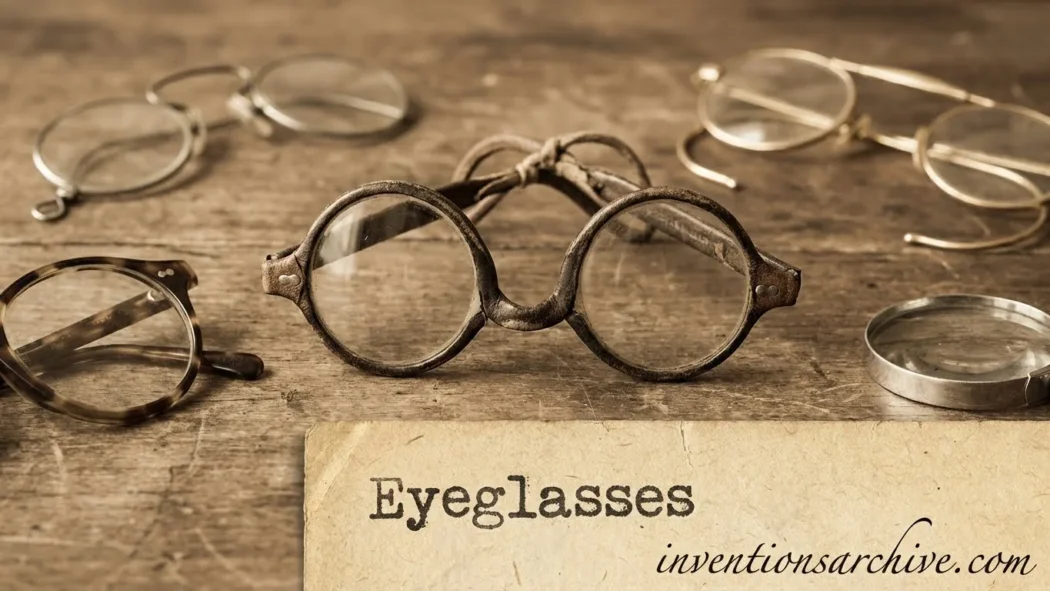
| Early Form | Two convex lenses joined as rivet spectacles |
| How It Works | Curved lenses bend light before it enters the eye, helping the image focus more clearly. |
| Material / Technical Base | Glass, rock crystal, transparent minerals, metal, horn, leather, later plastics |
| Early Use | Reading, manuscript work, close inspection, scholarly and clerical tasks |
| Development Path | Reading stones → rivet spectacles → nose spectacles → temple spectacles → prescription eyewear |
| Related Inventions | Magnifying lens, bifocal lens, monocle, microscope, telescope, contact lens |
| Modern Descendants | Prescription glasses, multifocal lenses, safety eyewear, sunglasses, contact lenses, smart glasses |
| Historical Importance |
|
| Origin Summary | The earliest form of spectacles is generally placed in 13th-century Northern Italy.[a] |
Eyeglasses are a quiet invention, but their effect is easy to understand. They placed a worked lens in front of the eye and made close reading, fine craft, study, record keeping, and later many kinds of professional work more practical. The early versions were not stylish modern frames. They were small optical tools, often awkward to hold on the nose, yet they changed what people could keep doing with their eyes as they aged.
What Eyeglasses Are
Eyeglasses are a pair of lenses mounted in a frame so the lenses sit in front of the eyes. Their purpose is not to make the eye stronger. They change the path of incoming light so the eye can focus an image more clearly.
Invention history often treats eyeglasses as a single object, but they are better understood as a family of optical aids. Early spectacles helped with near vision. Later lenses helped with short sight, astigmatism, distance correction, glare reduction, eye protection, and mixed vision needs.
The invention combines three ideas:
- a transparent material shaped into a lens,
- a frame that holds the lens in a stable place,
- an understanding, practical or scientific, that lens shape changes focus.
The Problem Eyeglasses Answered
Before eyeglasses, people with weakening near vision had limited choices. They could hold text farther away, use larger writing, rely on brighter light, ask someone else to read, or reduce close work. These methods helped only a little.
The early need was especially clear among people who worked with text and detail:
- scribes copying manuscripts,
- clerics reading religious and administrative texts,
- scholars studying small writing,
- merchants checking accounts,
- craft workers inspecting fine surfaces or small parts.
The first spectacles were mainly associated with presbyopia, the age-related loss of near focusing ability. This matters because early eyeglasses did not begin as a universal cure for all blurred vision. They began as a practical tool for close work.
How Eyeglasses Work in Simple Terms
Eyeglasses work by bending light before it reaches the eye. When the shape of the eye prevents light from focusing correctly on the retina, the result is blurred vision. Modern eye care describes common refractive errors such as myopia, hyperopia, astigmatism, and presbyopia; eyeglasses and contact lenses can be prescribed to improve clear vision in these cases.[d]
The lens shape matters. A convex lens is thicker in the middle and helps with near focusing in conditions such as presbyopia or farsightedness. A concave lens is thinner in the middle and helps correct nearsightedness. Cylindrical or toric lens forms later became important for astigmatism.
Earlier Tools and Ideas Before Eyeglasses
Eyeglasses did not appear from nothing. Their deeper background includes magnifying stones, polished crystal, glassmaking, medieval optical writing, and the needs of a literate culture that used manuscripts, ledgers, and small written marks.
A reading stone was usually a convex piece of glass or crystal placed directly over text. It enlarged the letters but stayed on the page. Eyeglasses took the next step: they moved the lens from the text to the face.
That shift looks small. It was not. Once the lens could travel with the wearer, it became useful for more than one page, one desk, or one type of work.
Development Path
| Stage | Form | What Changed |
|---|---|---|
| Earlier Tool | Reading stones and handheld magnifiers | Magnification existed, but the tool was held or placed on the page. |
| Early Eyeglasses | Rivet spectacles | Two lenses were joined and held before both eyes. |
| Improved Holding | Nose spectacles and flexible bridges | Frames became easier to position, though still often unstable. |
| Wearable Form | Temple glasses | Side arms allowed longer wear and better stability. |
| Mixed Vision Correction | Bifocals | Benjamin Franklin described combining two lens powers in one pair of “double spectacles,” a design now associated with bifocals.[e] |
| Modern Descendant | Prescription and multifocal eyewear | Lens power, frame fit, materials, coatings, and use cases became more specialized. |
Before and After Eyeglasses
| Before Eyeglasses | What Changed After Eyeglasses |
|---|---|
| Older readers often struggled with small text and close detail. | Convex lenses helped many people continue reading and close work later in life. |
| Magnifying stones helped only when placed on a surface. | Wearable lenses could move with the person and the task. |
| Fine manuscript work, accounts, and inspection could become harder with age. | Scholars, clerks, merchants, and artisans gained a practical visual aid. |
| Early optical aids were often single-purpose and handheld. | Eyeglasses led to stable frames, lens prescriptions, bifocals, and later protective eyewear. |
| Vision correction was limited by craft knowledge and available materials. | Optical craft became linked with medicine, physics, manufacturing, and design. |
Main Types and Variations
| Type or Variation | Main Period or Use | What Made It Different |
|---|---|---|
| Rivet Spectacles | Late medieval period | Two round lens holders joined by a rivet; usually balanced or gripped at the nose. |
| Nose Spectacles | Early modern period | A bridge helped the frame sit on the nose more naturally. |
| Temple Glasses | 18th century onward | Side arms made spectacles more wearable for movement and longer tasks. |
| Pince-Nez | 19th century | A spring bridge gripped the nose without side arms. |
| Lorgnette | 18th–19th centuries | Eyeglasses with a handle, often used for brief viewing rather than continuous wear. |
| Bifocals | Late 18th century onward | Two optical powers helped with both near and distance vision. |
| Martin’s Margins | Second half of the 18th century | Benjamin Martin’s dark-rimmed spectacle style was intended to reduce excessive light and improve vision comfort.[f] |
| Modern Prescription Glasses | 19th–21st centuries | Lens power, lens shape, bridge fit, arm length, coatings, and frame material became more precise. |
Materials and Mechanism Over Time
The lens was the heart of the invention, but the frame decided how useful the lens could be. Early lenses could be made from glass, rock crystal, or other transparent materials. These materials could magnify, but they could also break, scratch, or sit poorly on the face.
Frames changed because wearers needed stability. A lens that helps only while the user stays still is useful for reading at a desk. A lens that stays in place while the user walks, writes, inspects goods, or works with tools is far more useful.
Materials also changed the social meaning of eyeglasses. Metal frames, horn, tortoiseshell, leather, steel, silver, and later plastics gave makers more ways to balance strength, weight, cost, comfort, and appearance. Eyeglasses became both optical instruments and personal objects.
How Eyeglasses Spread and Changed
Eyeglasses spread because they solved a common problem in a direct way. They were useful wherever people read, wrote, copied, calculated, traded, studied, or inspected small details. The spread was helped by urban craft networks, glassmaking skill, literacy, manuscript culture, and later printed books.
The earliest forms did not correct every vision problem. As optical knowledge improved, lenses were shaped for more specific needs. By the early modern period, the difference between lenses for near vision and lenses for distance vision became more practical in use. Later, optometry and ophthalmic optics turned spectacle making from a craft into a measured clinical and manufacturing field.
Related articles: Spectacles Grinding Technique [Medieval Inventions Series], Glass [Ancient Inventions Series]
What Changed Because of Eyeglasses
Eyeglasses changed how long people could keep doing detailed visual work. That may sound modest, but it had real effects in education, trade, administration, craft, and science.
For a manuscript copyist, clearer near vision meant longer useful work. For a merchant, it meant reading figures more reliably. For a scholar, it meant continued access to small writing. For an artisan, it meant better inspection of fine details. In each case, the invention did not replace human skill. It extended it.
Eyeglasses also helped normalize the idea that a wearable device could correct a body limitation without surgery or complex machinery. In that sense, they belong not only to the history of optics, but also to the history of assistive technology.
Common Misunderstandings
A Named Inventor Is Not Securely Proven
Eyeglasses are often linked to famous or legendary names. The stronger historical view is more cautious: early spectacles came from a working craft tradition, and attribution varies.
The Earliest Image Is Not the First Pair
A surviving image shows that spectacles were known by that date. It does not prove the first pair was made that same year or by the person shown in the artwork.
Early Glasses Were Not Like Modern Frames
The first known forms had no comfortable side arms. Many early spectacles had to be balanced, pinched, or supported by hand during use.
Bifocals Were a Later Step
Benjamin Franklin is associated with bifocals, not with the original invention of eyeglasses. Bifocals solved a different problem: switching between near and distance vision.
Related Inventions and Later Developments
- Reading Stone: a direct predecessor that magnified text before lenses became wearable.
- Magnifying Glass: a handheld optical tool closely tied to the same lens principle.
- Microscope: used lens combinations to see details smaller than unaided sight could resolve.
- Telescope: used lenses to extend vision over distance rather than improve close reading.
- Bifocal Lens: combined near and distance correction in one wearable form.
- Contact Lens: a later vision-correcting lens placed on the cornea; early functional versions appeared at the end of the 1880s and were made from blown glass.[g]
- Safety Eyewear: adapted frame and lens ideas for eye protection in work, sport, and specialized environments.
Frequently Asked Questions
Who invented eyeglasses?
The original inventor is not securely known. The best-supported view is that eyeglasses developed through a late medieval optical craft tradition, probably in Northern Italy, rather than through one fully documented inventor.
When were eyeglasses invented?
Eyeglasses are generally placed in the late 13th century. The date is approximate because the earliest use is known through limited documentary and visual evidence, not through a complete inventor record.
What problem did early eyeglasses solve?
Early eyeglasses mainly helped people with near-vision difficulty, especially older readers and close workers. They made reading, copying, accounting, and fine inspection easier.
Were early eyeglasses the same as modern glasses?
No. Early spectacles were often riveted or balanced on the nose and had no modern side arms. Modern eyeglasses use fitted frames, measured prescriptions, specialized lens designs, and lighter materials.
Did Benjamin Franklin invent eyeglasses?
No. Eyeglasses existed centuries before Franklin. He is associated with bifocal glasses, which combined two lens powers for near and distance vision.
Sources and Verification
- [a] The history of spectacles – College of Optometrists — Used to verify the broad 13th-century Northern Italian origin, early rivet spectacles, later nose spectacles, temple glasses, and development timeline. (Reliable because it is an institutional museum resource from the College of Optometrists and the British Optical Association Museum.)
- [b] Some ever-present themes in spectacle frame design – College of Optometrists — Used to verify the cautious attribution of early spectacles as an evolving late-13th-century technology and the uncertainty around legendary inventors. (Reliable because it is a professional optometry journal article published by an institutional body.)
- [c] MusEYEum Online Catalogue — Used to verify the 1352 Tommaso da Modena visual evidence showing rivet spectacles. (Reliable because it is an online catalogue record from the British Optical Association Museum collection.)
- [d] Refractive Errors | National Eye Institute — Used to verify the basic modern explanation of refractive errors and the role of eyeglasses and contact lenses in clearer vision. (Reliable because it is a U.S. National Eye Institute medical information page.)
- [e] Scientist and Inventor – Benjamin Franklin: In His Own Words | Exhibitions – Library of Congress — Used to verify Franklin’s described “double spectacles” design and its connection with bifocal glasses. (Reliable because it is a Library of Congress exhibition page based on manuscript material.)
- [f] Spectacles | National Museum of American History — Used to verify the description of Martin’s Margins as an 18th-century spectacle variation associated with Benjamin Martin. (Reliable because it is a Smithsonian National Museum of American History object record.)
- [g] The history of contact lenses – College of Optometrists — Used to verify the late-1880s introduction of early functional contact lenses and their blown-glass form. (Reliable because it is an institutional museum resource from the College of Optometrists and the British Optical Association Museum.)