
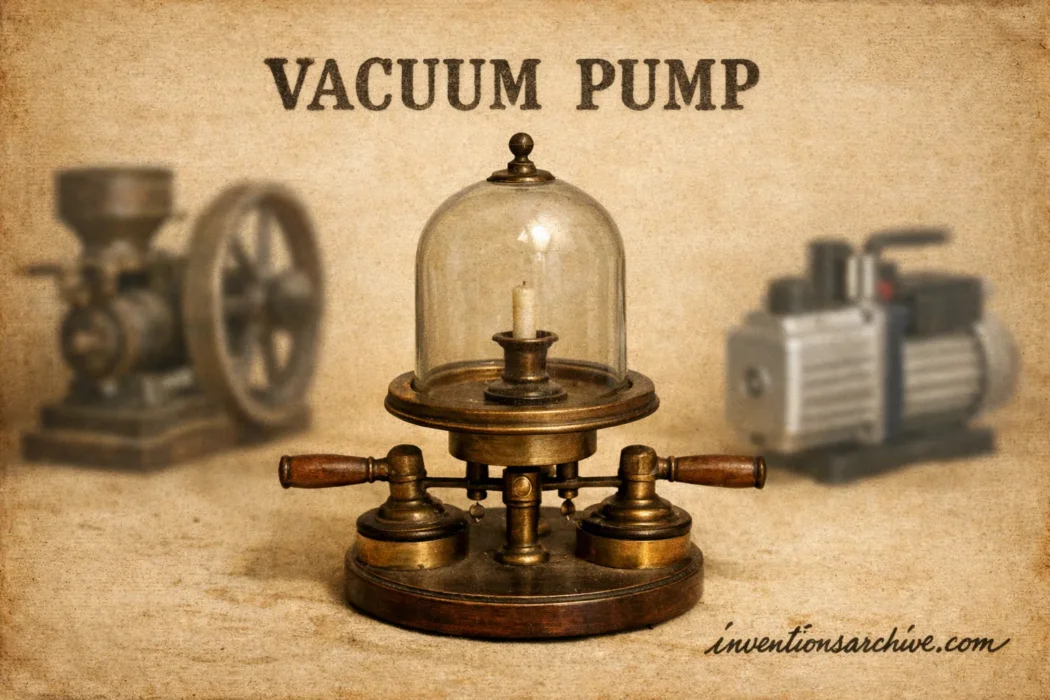
| Invention Name | Vacuum Pump |
|---|---|
| Short Definition | Device that removes gas from a sealed space to create a partial vacuum. |
| Approximate Date / Period | 1650 (Certain); early prototype work c. 1647 (Approximate) |
| Geography | Magdeburg, Holy Roman Empire (present-day Germany) |
| Inventor / Source Culture | Otto von Guericke |
| Category | Scientific instrument; pneumatics; industrial process equipment |
| Why It Matters | Controlled low-pressure environments; foundation for vacuum science and modern manufacturing |
| Need / Reason It Emerged | Test whether a vacuum can exist; study air pressure and gas behavior |
| How It Works | Moves gas out of a chamber; pressure falls; one-way flow control prevents backflow |
| Core Technology | Piston/rotor motion; valves; seals; staged pumping |
| Earliest Use | Natural philosophy experiments; public demonstrations; laboratory research |
| Spread Route | Central Europe → scientific societies → universities → industry worldwide |
| Developments It Enabled | Gas laws, vacuum gauges, vacuum tubes, thin-film coating, electron microscopy, semiconductor fabrication |
| Impact Areas | Science, manufacturing, food, medicine, space, energy |
| Debates / Alternate Views | “First” credit centers on Guericke; earlier suction devices existed but were not purpose-built air pumps |
| Precursors + Successors | Suction pumps → air pumps → rotary vane/scroll → turbomolecular/diffusion → ion/cryopumps |
| Key People and Institutions | Guericke; Boyle & Hooke (improvements); modern research labs and aerospace test facilities |
| Notable Variations Influenced | Laboratory vacuum systems; vacuum packaging lines; vacuum furnaces; coating and deposition tools |
Table of Contents
Jump to the parts you need. Each section keeps the focus on clear, practical knowledge and avoids filler.
A vacuum pump is one of those inventions that quietly reshaped modern life. It makes clean, controlled emptiness possible—on demand. That “emptiness” is never absolute. Still, when pressure drops, physics changes in useful ways: gases flow differently, materials behave differently, and processes become far more precise. That is the real breakthrough.
What a Vacuum Pump Is
Core idea: the pump reduces the number of gas molecules inside a sealed space.
- Pressure falls, so gas density falls.
- Flow direction changes: leaks move in, not out.
- Many reactions and contaminations slow down.
What a vacuum pump is not: a “suction” machine that pulls like a magnet.
It works because the surrounding higher pressure pushes gas toward the lower-pressure space. Pressure difference does the heavy lifting.
In everyday systems, a pump is often paired with valves, tubing, and a chamber. The pump’s job is simple to state and hard to perfect: remove gas fast, do it cleanly, and keep the vacuum stable.
Early Evidence and Timeline
Vacuum technology has a clear turning point: the moment an air pump turned vacuum from an idea into a repeatable laboratory condition. Otto von Guericke is widely credited with inventing the air pump in 1650 and using it for landmark demonstrations, including the famous Magdeburg hemispheres experiment shown publicly in 1654 (Details-1)
Before Purpose-Built Air Pumps
- Early suction devices moved liquids.
- Experiments with air pressure prepared the ground for true vacuum work.
- The missing piece was control.
From Water Removal to Air Removal
Guericke’s early work included producing a vacuum by drawing water out of a sealed vessel around c. 1647, then progressing to piston-style pumps that evacuated air more directly (Details-2)
Why the Magdeburg Hemispheres Mattered
The hemispheres made one point unforgettable: atmospheric pressure is powerful. When air was removed from inside, the outside air pressed the halves together so strongly that separation became extremely difficult. Museo Galileo preserves a multimedia presentation of this historic demonstration (Details-5)
How Vacuum Pumps Grew Up
- 18th–19th centuries: better seals, metalwork, gauges, and reliable laboratory pumps.
- 20th century: higher vacuums became routine for electronics, coatings, and research instruments.
- Today: pumps are engineered for clean processes, high speed, low vibration, and stable operation.
How a Vacuum Pump Works
A vacuum pump lowers pressure by removing gas molecules faster than they are added by leaks, outgassing, or deliberate inputs. In practice, that means three questions always matter: how fast it pumps, how low it can go, and how steady it stays once it arrives.
The Three Performance Ideas
Pumping Speed
How quickly gas is removed at a given pressure range.
Ultimate Pressure
The lowest pressure the system can reach in real conditions.
Gas Load
Everything adding gas back: tiny leaks, materials releasing gas, and process gases.
If a system needs “high vacuum,” it is rarely achieved by one pump alone. A common setup uses a first-stage pump to reach low pressure, then a second-stage pump designed for deeper vacuum. That pairing is one reason vacuum engineering feels so modular.
Vacuum Levels and What They Enable
“Vacuum” is a wide spectrum. For many applications, the practical question is not “how empty,” but what changes at each step down in pressure.
| Vacuum Range (Plain Language) | What Typically Improves | Common Examples |
|---|---|---|
| Low vacuum | Less air resistance; basic degassing | Packaging, simple lab filtration, vacuum forming |
| Medium vacuum | Faster drying; fewer bubbles; cleaner surfaces | Resin degassing, vacuum ovens, lab systems |
| High vacuum | Long mean free path; controlled film growth | Thin-film coating, electron microscopes, research chambers |
| Ultra-high vacuum | Very low contamination; stable surface science | Surface analysis, advanced physics experiments |
A useful mental model: as pressure falls, gas stops acting like a thick crowd and starts acting like scattered travelers.
Related articles: Hot air engine (Amontons) [Renaissance Inventions Series], Air Pump [Renaissance Inventions Series]
That shift is why high-vacuum tools can deposit uniform coatings and why surface-sensitive instruments become possible. The environment becomes predictable.
Large aerospace chambers show how wide the pressure range can be in a single controlled facility—down to about 1×10^-6 torr and up to atmospheric pressure, depending on test needs (Details-4)
Vacuum Pump Types and Variations
Vacuum pumps are not one family. They are several, each optimized for a range of pressure, cleanliness, and gas flow. A clear high-level split is common in vacuum education: momentum transfer pumps and capture pumps (Details-3)
Positive Displacement Pumps
These pumps trap a volume of gas and move it out of the chamber in repeated cycles. They are often used as first-stage pumps because they work well near atmospheric pressure.
- Rotary vane (oil-sealed): widely used; strong performance; oil helps sealing and lubrication.
- Dry scroll: cleaner for many processes; fewer hydrocarbons; often quieter in operation.
- Diaphragm: oil-free and gentle; common for chemical labs when low contamination matters.
- Piston: classic mechanism; durable; still used in specific industrial contexts.
- Liquid ring: tolerant of wet gases; popular in process industries.
Momentum Transfer Pumps
These pumps do not “trap” gas in the same way. Instead, they impart momentum to gas molecules, pushing them toward an outlet where another pump can remove them. This is where high-vacuum performance becomes practical.
- Turbomolecular: fast-spinning blades direct molecules downward; valued for clean high vacuum.
- Molecular drag: uses moving surfaces to drag molecules along; useful across specific ranges.
- Diffusion: uses vapor jets to sweep molecules; effective, though contamination control is a key consideration.
Capture Pumps
Capture pumps remove molecules by holding them—freezing them, binding them, or burying them. They shine when clean vacuum is a priority and the process benefits from extremely low gas densities.
- Cryopumps: condense or adsorb gases on cold surfaces.
- Ion pumps: ionize gas and capture it in reactive surfaces; common in ultra-high vacuum.
- Getter pumps: chemically bind reactive gases; often used to maintain very clean environments.
A Simple Selection Logic
When contamination must be minimal
- Dry pumps
- Turbomolecular pumps
- Capture pumps (cryogenic/ion/getter)
When robustness matters most
- Oil-sealed rotary vane
- Liquid ring
- Systems designed for high throughput
Key Design Trade-Offs
Every vacuum pump design is a bundle of choices. Engineers often balance cleanliness, cost, and performance in a way that fits the process rather than chasing an abstract “best” pump.
- Oil-sealed vs dry: oil can improve sealing and longevity, while dry designs reduce hydrocarbon exposure.
- Speed vs stability: fast pumping is valuable, yet stable pressure and low vibration may matter more.
- Noise and vibration: critical for precision tools and measurement instruments.
- Materials and seals: elastomers are convenient; metal seals excel when cleanliness and low leak rates are essential.
- Energy and heat: deeper vacuums can mean higher energy use and more heat management.
Clean vacuum is usually a system decision.
Materials inside the chamber, surface condition, and sealing quality can matter as much as the pump itself. Vacuum is maintained, not simply created.
Where Vacuum Pumps Are Used
Vacuum pumps appear anywhere a process benefits from reduced gas density, reduced contamination, or controlled gas flow. The applications are broad, yet they share a common thread: repeatable conditions.
Manufacturing and Materials
- Thin-film deposition and coating
- Vacuum furnaces and controlled atmospheres
- Composite and resin degassing
- Vacuum forming of plastics
Science and Instruments
- Electron microscopy
- Surface analysis tools
- Particle and beamline systems
- Metrology and calibration environments
Food and Packaging
- Vacuum sealing and shelf-life improvement
- Modified-atmosphere workflows (as part of broader systems)
- Deaeration in some processing lines
Medicine and Care Contexts
In clinical settings, vacuum can support suction-based devices and laboratory tools. The core point remains the same: controlled pressure difference, applied with precision and appropriate safeguards.
Space and Environmental Testing
Space hardware often needs verification under vacuum conditions. Thermal-vacuum chambers and related systems recreate low-pressure environments so materials, electronics, and assemblies can be evaluated under demanding conditions without leaving Earth.
FAQ About Vacuum Pumps
Can a vacuum pump create a perfect vacuum?
No. Real systems always have remaining molecules, plus tiny leaks and gases released from surfaces. What matters is reaching a vacuum level that matches the application.
Why do many systems use more than one pump?
Different pump designs excel in different pressure ranges. A first-stage pump reduces pressure from near-atmospheric levels, then a second-stage pump can efficiently reach deeper vacuum.
What is the difference between “clean” vacuum and “deep” vacuum?
“Deep” refers to very low pressure. “Clean” refers to low contamination (especially low hydrocarbons or particles). A system can be deep without being clean, and clean without being extremely deep.
What usually limits how low the pressure can go?
Common limits include leaks, outgassing from materials, seal performance, and whether the pump type is suitable for the target vacuum range.
How did the vacuum pump change science?
It made low-pressure conditions repeatable. That enabled controlled experiments on gases and pressure, and it later became essential for instruments and manufacturing methods that require stable, clean environments.
Are vacuum pumps only for laboratories?
No. They are used across industry—from packaging and forming to advanced coating and electronics—whenever a controlled low-pressure environment improves quality or consistency.