
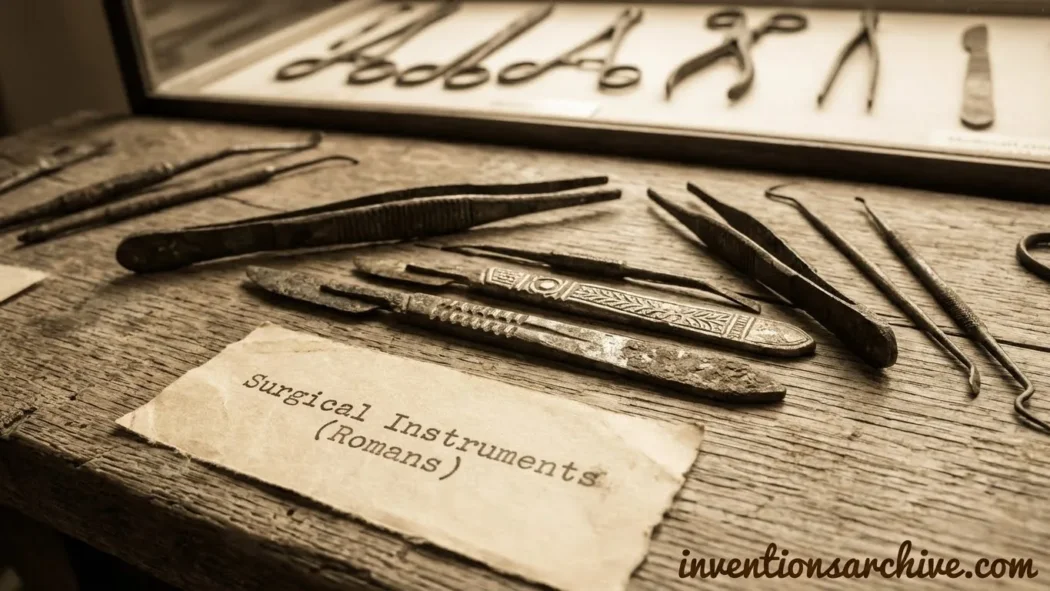
| Invention Name | Roman surgical instruments |
|---|---|
| Short Definition | Specialized medical tools used by Roman physicians and surgeons for examination, cutting, gripping, probing, cautery, extraction, and treatment preparation. |
| Approximate Date / Period | Late Republic to Imperial Roman period; especially 1st century BCE–5th century CE Approximate |
| Geography | Roman Empire, with strong evidence from Italy, Pompeii, Rimini, and wider Roman provinces |
| Inventor / Source Culture | Anonymous / collective medical and metalworking tradition; shaped by Greek medical knowledge and Roman craft production Attribution varies |
| Category | Medicine; science; material technology; precision tools |
| Evidence Status | Based on surviving museum objects, excavated instrument sets, and ancient medical texts Based on surviving evidence |
| Main Problem Solved | The need for small, durable, purpose-made tools for controlled medical examination and surgical work |
| Main Materials | Bronze, copper alloy, iron, steel blades, bone, ivory, and wooden or metal storage cases |
| How It Worked | Different tips, blades, hooks, bowls, jaws, and handles gave the physician better reach, grip, cutting control, or access to a narrow body area. |
| Early Use Areas | Trauma care, eye treatment, dental work, wound cleaning, extraction, pharmacy preparation, and clinical examination |
| Development Path | Greek and earlier Mediterranean medical tools → Roman professional instrument sets → medieval and early modern surgical kits → modern stainless-steel surgical tools |
| Related Inventions | Scalpel, forceps, probe, speculum, cupping vessel, cautery, dental forceps, medicine box |
| Modern Descendants | Surgical scalpels, tweezers, retractors, probes, clamps, specula, orthopedic tools, and operating-room instrument trays |
| Why It Matters |
|
Roman surgical instruments show how far practical medicine had moved beyond simple household knives, splinters, and improvised hooks. A Roman surgeon’s kit could include bronze scalpel handles, iron blades, probes, forceps, shears, spoons, needles, cupping vessels, and containers for medicines. Some tools look familiar because their shapes solved lasting problems: holding small tissue, opening a narrow space, reaching a wound, scraping, cutting, lifting, or applying a prepared substance. The invention was not a dramatic machine. It was a careful set of small precision tools made for medical work.
What Roman Surgical Instruments Were
Roman surgical instruments were purpose-made tools used by trained medical practitioners. They were part of a wider medical culture that included diagnosis, pharmacy, wound care, bone treatment, eye work, dental treatment, and patient examination. Many were small enough to fit inside a portable case.
A useful example is the Roman bronze scalpel. Museum records describe a 1st–2nd century CE bronze scalpel as a principal surgical instrument used by Roman doctors and surgeons.[b] The blade itself was not always preserved, but the handle shows a designed grip and a working end shaped for medical use.
These tools also show a practical division of labor. A physician did not need one universal tool for every task. The kit could include cutting tools, gripping tools, probing tools, spreading tools, and preparation tools. That separation is one of the reasons Roman medical equipment is important in invention history.
The Problem It Answered
Before specialized surgical instruments became common in Roman medical practice, a healer often had to rely on simpler knives, household metal objects, improvised probes, or tools adapted from craft work. Those objects could cut or hold, but they did not always offer the reach, grip, narrow shape, or balanced handle needed for precise medical work.
The Roman instrument set answered a practical problem: medicine needed tools shaped for the body, not tools borrowed from the workshop. The change was gradual, but it mattered. A fine probe could explore a small opening more carefully than a rough metal pin. Forceps could grip a small object more securely than fingers. A scalpel handle could hold a replaceable or specialized blade with better control.
| Before | After |
|---|---|
| General knives, craft tools, simple hooks, and improvised implements could be adapted for treatment. | Purpose-made medical tools gave physicians smaller working ends, better handles, and more task-specific shapes. |
| Some procedures depended heavily on the practitioner’s manual skill and whatever tool was available. | Instrument sets made repeated medical tasks easier to organize, teach, carry, and perform with more control. |
| Material quality varied, and tools were not always designed for cleaning, storage, or repeated medical work. | Bronze, iron, and steel parts supported durable, reusable tools that could be stored in cases or medical rooms. |
| Medical care was harder to separate from household treatment, pharmacy, and craft practice. | Specialized tools made the professional identity of the physician or surgeon more visible in the Roman world. |
Materials and Technical Principle
The main technical idea behind Roman surgical instruments was simple: choose a durable material, shape the working end for one medical task, and give the user a handle that allowed controlled movement. The most common surviving material is bronze or copper alloy, though iron and steel were also used, especially where a sharper edge was needed.
Science Museum Group records for Roman surgical shears note that bronze was a common material for medical instruments in the Roman period because it was strong, durable, and could be fashioned into effective surgical tools.[c] Bronze also survives well enough for museums to identify many Roman examples today.
The technical principle was not complex machinery. It was controlled form. A narrow probe could enter where fingers could not. A hook could lift or hold. Forceps could grip. A spoon-shaped end could scoop, apply, or remove material. A scalpel handle could carry a cutting edge. In a medical setting, a difference of a few millimeters could change how useful a tool was.
How Earlier Ideas Shaped the Roman Kit
Roman surgery did not appear in isolation. Greek medicine had a strong influence on Roman medical practice. Museo Galileo notes that early Roman medicine drew directly on mature Greek medical knowledge, and that Roman practice culminated in the medical writing associated with Celsus.[d]
This matters because the “Roman” kit was often a Roman-period expression of a wider Mediterranean tradition. Greek medical writing, Roman metalwork, urban demand, military experience, and trade in tools all helped shape the instrument set. The result was not a single breakthrough. It was a practical system of tools.
| Stage | Form | What Changed |
|---|---|---|
| Earlier Tool | Greek and earlier Mediterranean medical implements | Medical tools existed, but many were fewer, simpler, or less standardized in surviving evidence. |
| Roman Instrument Set | Scalpels, probes, hooks, forceps, shears, cupping vessels, needles, and containers | Tool forms became more specialized and more visible in archaeological collections. |
| Improved Form | Portable medical kits and room-based surgical-pharmaceutical equipment | Tools could be organized as a professional set for examination, operation, and medicine preparation. |
| Modern Descendant | Sterile surgical trays, stainless-steel instruments, clamps, retractors, probes, and scalpels | Modern materials, sterilization, anesthesia, and medical science changed the setting, while many basic tool shapes remained recognizable. |
Main Types and Variations
Roman surgical instruments were varied because medical work was varied. The same medical kit could contain tools for cutting, gripping, measuring, applying medicines, and examining the body. Some tools also had mixed functions, so modern labels must be used carefully.
The Metropolitan Museum of Art describes a Roman bronze forceps or tweezers from about the 1st century CE with long arms, noting that it may have been used by a doctor for minor surgical operations and that similar objects have been found in medical instrument sets.[e] That careful wording is important: the same shape could sometimes serve medical, cosmetic, or pharmacy work.
| Instrument Type | Common Form | Likely Role |
|---|---|---|
| Scalpel | Bronze or metal handle with a cutting blade | Controlled cutting in surgical work |
| Probe | Thin rod, sometimes with a spoon or spatula end | Examining, applying substances, or working in small spaces |
| Forceps / Tweezers | Two long arms that meet at the tips | Gripping small objects or tissue during medical work |
| Hook | Curved or angled metal end | Lifting, holding, or moving small areas during treatment |
| Shears | Paired blades with a spring or pivot form | Cutting soft material or tissue in a medical setting |
| Speculum | Expanding or spreading instrument | Opening a narrow area for examination |
| Cupping Vessel | Small cup-shaped medical object | Used in ancient medical therapy based on period ideas about the body |
| Medicine Tools | Mortars, pestles, containers, spoons, and palettes | Preparing, storing, mixing, or applying medicines |
Evidence from Working Medical Spaces
One of the strongest bodies of evidence comes from places where many tools were found together. A single scalpel is useful, but a complete or near-complete group tells more about how medical work was organized.
The Surgeon’s House at Rimini is especially important. The official Rimini material describes a large surgical-pharmaceutical group with more than 150 surgical instruments, along with mortars, balances, containers, and other medical equipment; the site also connects the tools with a domestic medical room where the surgeon examined, treated, and hosted patients.[f]
This kind of find shows that Roman surgical instruments were not only isolated objects. They could belong to a working medical environment. A physician needed tools, but also storage, medicine containers, measuring equipment, and a space where treatment could take place.
What Changed Because of These Instruments
The main change was not that surgery suddenly became modern. It did not. Roman medicine lacked many later developments, including modern anatomy, germ theory, anesthesia, antisepsis, imaging, and sterile operating rooms. The change was more specific: medical work gained a more precise material toolkit.
Ralph Jackson’s study summary in Medicina nei Secoli notes that by the beginning of the 1st century AD, Roman medical instruments had begun to acquire distinctive forms that remained broadly stable for about the next half millennium.[g] That stability suggests the tools were not random curiosities. Their shapes worked well enough to be repeated.
Roman surgical instruments also affected how medical practice could be recognized. A kit of scalpels, probes, forceps, hooks, and containers identified a professional role. In a household, grave, museum collection, or archaeological room, such tools can signal a physician’s work more clearly than text alone.
Common Misunderstandings
They Were Not Invented by One Known Roman
The evidence does not support one named inventor. Roman surgical instruments developed through medical practice, metal craft, Greek influence, and repeated use across the Roman world.
Modern-Looking Shape Does Not Mean Modern Medicine
Some tools look familiar, but the medical setting was very different. Modern surgery depends on sterilization, anesthesia, imaging, laboratory science, and regulated training.
A Tool Name Can Be Uncertain
Some objects may have served more than one role. A probe could also apply medicine. Tweezers could be medical or cosmetic unless context shows otherwise.
Earliest Surviving Evidence Is Not Always First Use
The oldest preserved object only shows what has survived. Similar tools may have existed earlier but left no clear archaeological record.
Why the Roman Version Became So Visible
Roman surgical instruments are visible in the record for several reasons. The Roman world had large cities, active trade, professional craftspeople, military medical needs, and many contexts where metal objects could be lost, buried, or preserved. Bronze and iron tools also survive better than organic materials such as wood, leather, cloth, or plant-based medicines.
Another reason is standardization. The same broad tool forms appear in different contexts: scalpels, probes, forceps, hooks, and containers. That repetition suggests shared medical habits and shared craft solutions. The instruments were not mass-produced in the modern factory sense, but they were part of a recognizable medical culture.
This is where the invention’s value lies. Roman surgical instruments turned medical skill into a portable and repeatable toolkit. They did not make medicine safe by modern standards, but they gave ancient practitioners better physical control over small, difficult tasks.
Related Inventions and Later Developments
- Scalpel: a lasting cutting-tool form that continued into later surgical traditions.
- Forceps: gripping tools that influenced later medical tweezers, clamps, and extraction tools.
- Speculum: an examination tool whose basic idea continued in later medical instruments.
- Cupping Vessel: a medical vessel linked to ancient theories of treatment and body balance.
- Medicine Box: portable storage for tools, medicines, and small medical materials.
- Mortar and Pestle: preparation tools for mixing medicines, ointments, and mineral or plant substances.
- Cautery Tool: a heat-based medical instrument known in ancient surgical practice.
- Modern Surgical Tray: the later organized set of sterile instruments used in operating rooms.
Frequently Asked Questions
Who invented Roman surgical instruments?
No single inventor is known. Roman surgical instruments developed through a collective tradition of medical practice and metalworking, with strong influence from Greek medicine.
What were Roman surgical instruments made from?
Many surviving examples are bronze or copper alloy. Some tools also used iron or steel parts, especially where sharper cutting edges were needed.
Were Roman surgical instruments similar to modern ones?
Some shapes are recognizable, such as scalpels, forceps, probes, and specula. The medical setting was not modern, though, because later surgery added sterilization, anesthesia, imaging, and scientific anatomy.
Where have Roman surgical instruments been found?
Important finds come from places such as Pompeii, Rimini, Rome, and other parts of the Roman world. Some are preserved as individual museum objects, while others were found in larger medical sets.
Why are Roman surgical instruments important in invention history?
They show how ancient medicine used specialized, durable, task-specific tools. Their forms connect medical knowledge, metal craft, professional practice, and the later history of surgical equipment.
Sources and Verification
- [a] Greco-Roman Surgical Instruments: The Tools of the Trade | Oxford Academic — Used to verify the broader date range, tool categories, and Greek-to-Roman development of surgical instruments. (Reliable because it is an academic publisher chapter by a specialist scholar.)
- [b] Bronze scalpel – Roman – Imperial – The Metropolitan Museum of Art — Used to verify a Roman bronze scalpel dated to the 1st–2nd century CE and its role as a principal surgical instrument. (Reliable because it is an official museum object record.)
- [c] Surgical shears, Roman, 199 BCE-500 CE | Science Museum Group Collection — Used to verify bronze as a common Roman surgical instrument material and the existence of Roman surgical shears. (Reliable because it is an official museum collection record.)
- [d] 3. Medicine and surgery | Museo Galileo — Used to verify Greek influence on Roman medical practice and the presence of bronze and copper surgical instruments at Pompeii. (Reliable because it is an institutional museum education source.)
- [e] Bronze forceps or tweezers – Roman – Early Imperial – The Metropolitan Museum of Art — Used to verify Roman forceps or tweezers and the careful museum interpretation of their possible surgical use. (Reliable because it is an official museum object record.)
- [f] The Finds, The Surgeon’s House in Rimini — Used to verify the large Rimini surgical-pharmaceutical instrument group and its connection with a working medical setting. (Reliable because it is a dedicated institutional site for the archaeological complex.)
- [g] Medical Instruments in the Roman World | Medicina nei Secoli — Used to verify the scholarly claim that Roman medical instruments had distinctive forms by the beginning of the 1st century AD and retained them for about half a millennium. (Reliable because it is an academic journal page from Sapienza University of Rome.)