
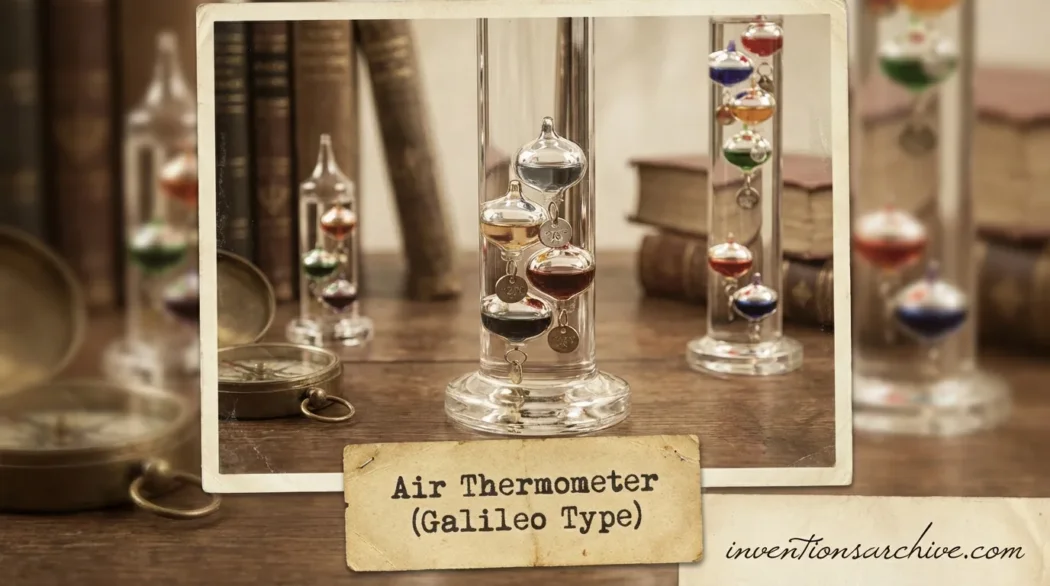
| Invention Name | Air Thermometer (Galileo-Type Thermoscope) |
| Short Definition | An open air-expansion device where a liquid column shifts to show temperature change |
| Approximate Date / Period | 1590s (often cited 1592–1597) Debated (Details-1) (Details-2) |
| Geography | Padua / Northern Italy |
| Inventor / Source Culture | Galileo Galilei Debated |
| Category | Measurement • Thermometry • Scientific Instruments |
| Importance | Visible heat change • Early step toward standard temperature scales |
| Need / Reason It Appeared | Compare “hotter vs colder” without relying on touch |
| How It Works | Air expands/contracts • Liquid level moves in a narrow tube |
| Materials / Technology Basis | Glassblowing • Trapped air • Water (sometimes wine) |
| Early Uses | Natural philosophy demos • Early medicine & weather notes |
| Spread Route | Italy → wider Europe (17th century) |
| Derived Developments | Scaled thermoscopes • Sealed liquid-in-glass thermometers |
| Impact Areas | Science • Medicine • Meteorology • Education |
| Debates / Different Views | Priority often discussed among early makers and circles |
| Precursors + Successors | Ancient thermoscope ideas → sealed spirit thermometers → modern thermometry |
| Key People / Communities | Galileo’s circle • Early instrument makers • Later standardizers |
| Influenced Variants | Scaled air thermometers • Differential air thermometers • “Galilean” floating-bulb thermometers |
An air thermometer in the Galileo tradition is best understood as a thermoscope: a device that makes temperature change visible before “temperature” had a universal scale. Its signature look is simple and elegant, yet the science inside is subtle. The instrument links thermal expansion to a moving liquid column, turning an invisible shift in air volume into a readable signal.
Table of Contents
What It Is
The Galileo-type air thermometer is an early temperature indicator that belongs to the broader family of thermoscopes. It does not begin with a numbered scale. It begins with a clear idea: warm air takes up more space than cool air.
When the trapped air inside the bulb expands or contracts, the liquid in the connected tube moves. That motion is the “reading.” It is direct, visual, and surprisingly sensitive to small changes.
A Clear Naming Note
The phrase “Galileo thermometer” is used for two different things. The Galileo-type air instrument described here is a thermoscope-style device. The well-known decorative thermometer with floating glass bulbs is a liquid-based design inspired by related principles.
Early Evidence and Timeline
The story of the Galileo-type air thermometer sits in a busy period of instrument-making. In the late 1500s and early 1600s, scholars and craftsmen were turning natural effects into repeatable signs. A thermoscope was a perfect candidate because air responds quickly to heat. The result was an instrument that could compare conditions across time, and sometimes across places, using a shared visual.
- Late 16th century: Early air thermoscope designs appear in scientific circles, often attributed to Galileo’s environment in Italy.
- Early 17th century: Attempts to add markings and reference points begin; the device moves from “shows change” toward “measures change.”
- 1630s–1650s: Sealed liquid-in-glass thermometers emerge and reduce sensitivity to air pressure, a key weakness of open air designs.
Why Early Dating Can Look “Fuzzy”
Early instruments often spread through letters, workshops, and personal demonstrations. That pattern leaves room for overlapping claims and parallel versions. In practice, the key achievement was not a single moment, but the growing habit of tracking measurable change.
How It Works
The Galileo-type air thermometer relies on gas expansion. When the air inside the bulb warms, it expands. That changes the pressure balance between the trapped air and the outside atmosphere. The liquid in the tube responds by moving to a new level. When the air cools, it contracts, and the liquid level shifts back. The reading is a relative signal, not an absolute number, unless a consistent scale is added. Small temperature changes can produce visible motion because gases expand noticeably compared with many liquids and solids.
One major limitation is built into the design: the liquid level is influenced by atmospheric pressure as well as temperature. A change in weather pressure can mimic a temperature change. That is one reason later thermometer designs favored sealed systems and carefully defined reference points. (Details-3)
Main Parts
- Glass bulb: the air reservoir
- Narrow tube: the column where movement is visible
- Liquid reservoir: often water in historical descriptions
- Optional marks or scale: for comparison over time
What the Motion Really Shows
- Thermal change in the trapped air
- Pressure balance between trapped air and the atmosphere
- Short-term trends are often clearer than absolute values
- Comparison is strongest when conditions are controlled
Scaling and Calibration
A thermoscope becomes more “thermometer-like” when it gains consistent reference points. Early users tried to mark the tube so that the same physical state could be compared over days, seasons, or different rooms. Those marks were not yet a universal standard, but they moved the instrument from pure demonstration toward measurement. Standardizing a scale was the hard part, not building the glasswork.
Early Attempts to Anchor a Scale
Accounts connected to Galileo’s circle describe efforts to attach measuring units and to relate readings to recognizable conditions such as snow or hot summer days. These are not modern fixed points, yet they show a clear push toward comparability. Giovanni Sagredo and Santorio Santorio are often mentioned in this context. (Details-4)
- Goal: repeatable readings across time
- Method: marks on the stem and shared reference conditions
- Outcome: improved comparison, still not pressure-independent
Design Variations and Related Instruments
| Instrument Type | Sensing Principle | Main Strength | Main Limitation |
|---|---|---|---|
| Galileo-Type Air Thermoscope | Air expansion moves liquid column | Very sensitive to small changes | Affected by air pressure |
| Scaled Air Thermometer | Same as above + marked stem | Better comparison over time | Still pressure-sensitive |
| Sealed Liquid-in-Glass Thermometer | Liquid expansion in sealed tube | More stable, pressure-independent | Needs careful calibration points |
| “Galilean” Floating-Bulb Thermometer | Buoyancy changes with liquid density | Readable with a built-in scale | Limited range; slow to equilibrate |
From Air to Sealed Thermometry
Once instrument makers adopted sealed designs, thermometry gained a new kind of reliability. Sealing reduced the influence of weather pressure and made readings easier to compare between places. The remaining challenge was choosing reference points so different thermometers could agree. Historical accounts of early thermometer scales highlight how much effort went into uniformity and shared standards. That push shaped the future of scientific measurement. (Details-5)
Legacy and Influence
The Galileo-type air thermometer matters because it helped normalize the idea that heat change could be tracked, compared, and recorded. It encouraged a new discipline: treating sensation as something that could be checked by an instrument. That shift supported laboratory practice, early meteorological observation, and the slow march toward shared scales. It also taught a lesson: measurement improves when the signal is isolated from unwanted influences, like changing atmospheric pressure.
Where Its Influence Shows Up Today
- Instrument thinking: “show the effect” before “define the unit”
- Teaching physics: gas expansion, pressure balance, and fluid columns
- Measurement culture: repeatability becomes a goal, not a luxury
FAQ
What is a Galileo-type air thermometer?
It is an early thermoscope-style instrument where a trapped volume of air changes size with temperature, causing a liquid level to rise or fall in a narrow tube.
Is it the same as the floating-bulb “Galileo thermometer”?
No. The air instrument uses gas expansion and a liquid column. The floating-bulb device uses buoyancy in a liquid where density changes with temperature.
Does it measure temperature accurately?
It is best at showing relative change. Without a stable scale and controlled conditions, it is not a modern precision thermometer, though it can be very sensitive to small shifts.
Why does air pressure affect the reading?
Because the classic design is an open system. Changes in atmospheric pressure alter the balance that sets the liquid level, so the column can move even if temperature is steady.
What made later thermometers more reliable?
Sealed designs reduced pressure effects, and fixed reference points made scales more comparable. Over time, that combination created the foundation for standard temperature measurement.
Why is it still worth studying?
It captures a turning point: moving from feeling heat to recording change. That mindset, as much as the glasswork, is a lasting scientific legacy.