
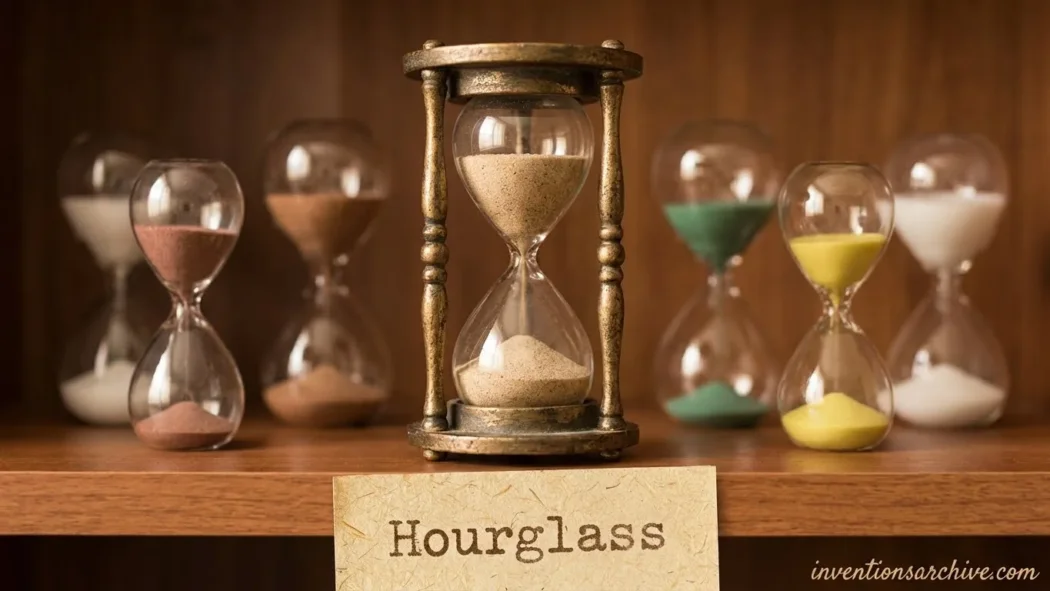
| Invention Name | Hourglass; also called a sandglass, sand timer, or sand clock |
|---|---|
| Short Definition | A reversible device that measures a fixed interval as dry grains fall through a narrow opening between two bulbs |
| Approximate Date | Early 14th century or slightly earlier Based on surviving evidence |
| Geography | Late medieval Europe; the earliest clear visual evidence survives in Siena, Italy |
| Inventor or Source Culture | Unknown; probably developed by glassworkers and instrument makers rather than one named inventor Attribution varies |
| Category | Time measurement; navigation; household and institutional timing |
| Evidence Status | Approximate Based on surviving evidence |
| Main Problem Solved | Measuring repeatable short intervals without sunlight, a water supply, or clockwork |
| How It Works | Gravity draws calibrated grains through a narrow neck; the run ends when the upper bulb empties |
| Material and Technology Base | Blown glass, dry granular fill, a controlled opening, seals, and a wood or metal frame |
| Early Recorded Contexts | Religious timing, fixed work intervals, shipboard watches, and maritime speed measurement |
| Importance |
|
| Development Path | Water clocks and marked candles → medieval sandglass → marine and multi-glass forms → kitchen, game, laboratory, and digital countdown timers |
| Surviving Evidence | 14th-century art, dated museum objects, shipwreck material, collection records, and historical research |
| Main Variations | Single-interval glass, half-hour glass, watch glass, log glass, multi-glass frame, short sand timer, decorative hourglass |
| Impacted Fields | Measurement, navigation, religious practice, education, household work, games, science, and visual culture |
| Related Inventions | Water clock, sundial, candle clock, mechanical clock, log line, marine chronometer, stopwatch |
| Modern Descendants | Mechanical timers, digital countdowns, classroom timers, game timers, and waiting-status symbols |
| Origin Debate | No confirmed maker or patent; older attributions lack firm evidence Debated |
Hourglass Function and Main Parts
An hourglass measures an interval, not the time of day. Once turned upright, it runs for the duration set by its fill, opening, bulb shape, and calibration. It cannot tell whether the current time is ten in the morning or four in the afternoon.
This distinction explains its long use beside clocks rather than only before them. A clock answers “What time is it?” An hourglass answers “Has this set period ended?”
A Fixed-Interval Timer
The device has two chambers connected by a narrow passage. Dry grains leave the upper chamber, pass through the neck, and collect below. Turning the instrument over resets it without replacing the fill.
Main Components
Glass Bulbs
The bulbs store the granular material and make the remaining amount visible. Their paired shape also lets the same instrument work in either direction.
Neck and Opening
The narrow opening controls discharge. A larger opening usually allows a faster run, while a smaller opening slows it and raises the chance of blockage.
Granular Fill
The fill must be dry, fine, and reasonably uniform. Free movement matters more than the familiar word “sand.” Makers selected material that would pass through the opening with as little clumping as possible.
Frame and Seal
A wood or metal frame protects the bulbs and holds them upright. Seals at the waist help keep the fill inside and moisture outside. Poor sealing can change the run time.
Origin and Earliest Evidence
Research on medieval sand clocks finds no firm evidence before the early 1300s and links their growth to late medieval needs, especially shipboard timekeeping. The device appears to have emerged from a group of practical skills: glassmaking, fine-grain preparation, sealing, and calibration. That pattern fits a workshop invention better than a single dramatic discovery. [a]
A well-known visual record appears in Ambrogio Lorenzetti’s Allegory of Good Government, painted in 1338–1339 in Siena. The figure of Temperance holds an hourglass, showing that the object and its meaning were recognizable to a contemporary audience. [b]
Why The Device Appeared
Several conditions came together in late medieval Europe. Glass workshops could make paired vessels. Maritime work demanded repeated intervals. Religious and civic routines also needed practical timing away from direct sunlight. The hourglass joined these needs with materials already understood by skilled makers.
The Problem It Answered
Earlier timekeepers each had limits. Sundials needed a visible sun and a fixed orientation. Water clocks depended on liquid flow, could leak, and were awkward on a moving vessel. Marked candles consumed their measuring material and responded to drafts and fuel quality. Bells announced an agreed moment but did not measure a fresh interval by themselves.
The hourglass offered a portable, reversible measure of elapsed time. It worked indoors, in darkness, and on ships. A user could start a new interval by turning it over, then attend to another task until the upper chamber emptied.
Before and After
| Before The Hourglass | After The Hourglass Became Available |
|---|---|
| Short intervals often relied on observation, bells, candles, or water flow | A prepared device could mark the same interval repeatedly |
| Sundials failed indoors, at night, or under cloud | Granular timing did not require sunlight |
| Water clocks were less convenient on a moving ship | A framed sandglass was easier to use during shipboard routines |
| Consumed timers such as candles needed replacement | Turning the glass over reset the interval |
| Task timing could depend heavily on personal judgment | Prayer, watches, speeches, games, and work periods could use a visible endpoint |
| Ship speed estimates lacked a compact fixed-duration partner | Short log glasses worked with log lines to estimate speed through water |
Sand Flow and Time Measurement
Gravity starts the flow, but the neck and grains set the pace. Unlike water in an open vessel, granular material transfers much of its load to the chamber walls. For most of a run, this helps the discharge remain fairly steady rather than slowing in direct proportion to the falling level.
The flow is still not perfect. Grain size, grain shape, dust, humidity, static charge, wear around the opening, tilt, vibration, and the movement of air between the bulbs can all alter the period. Calibration belongs to one device in one condition; two hourglasses that look alike may not keep the same interval.
Why The Last Grains Matter
Experiments show that the final stage can behave differently from the middle of the run. As the upper pile becomes shallow, the discharge may speed up slightly under some conditions. The familiar claim that an hourglass always empties at a perfectly constant rate is therefore an approximation, not a law without exceptions. [c]
Materials and Construction
Historical makers had to solve four linked problems: shape the bulbs, create a controlled passage, prepare a free-flowing fill, and protect the joint. A small change at the waist could change the entire run time.
A German half-hour sandglass dated about 1500–1525 combines glass and sand with gilded silver and gilded bronze. The Metropolitan Museum of Art notes that Nuremberg became a production center where glass technology, metalworking, and a local supply of fine reddish sand came together. The object was probably used for timed prayer or meditation. [d]
A different object recovered from the wreck of HMS Stirling Castle, lost in 1703, preserves greenish glass bulbs and a wooden stand. Its missing diaphragm and joint binding show that the narrow connection could include separate parts that regulated flow and held the assembly together. [e]
Calibration and Maintenance
Makers could adjust a timer by changing the amount of fill, the size of the opening, or the properties of the grains. Once sealed, the instrument needed to stay dry and upright. A damaged seal, contaminated fill, or worn opening could shift its period. Unlike a geared clock, it had few moving parts, but simplicity did not remove the need for careful preparation.
Early Uses and Geographic Spread
The hourglass spread because it served many fixed-duration tasks. Its value did not depend on high precision over days. It depended on reliable repetition over minutes or an hour.
Related articles: Water Clock [Ancient Inventions Series]
Devotional and Indoor Timing
Small sandglasses could measure prayer, meditation, sermons, lessons, meetings, and work periods. The half-hour German example in The Met shows that an object could be both a functional timer and a carefully made devotional possession.
Maritime Timing
At sea, sandglasses marked watches and supported navigation routines. A short log glass worked with a log and line: the line ran out for a fixed interval, and the number of marked lengths paid out helped estimate the ship’s speed. A Royal Museums Greenwich example dated about 1850 runs for 28 seconds and carries that number on both ends. [f]
This did not make the hourglass a longitude instrument. It helped measure elapsed time for speed and dead-reckoning work, while other observations and instruments handled position.
Specialist Production
Production drew on glassworkers, metalworkers, turners, and merchants who supplied suitable grains. As demand grew, makers produced plain work tools, decorated household pieces, shipboard instruments, and sets with several separate timers.
Development Path
The hourglass belongs to a family of interval-measuring devices. Later timers often replaced its function rather than copying its physical form.
| Stage | Form | What Changed |
|---|---|---|
| Earlier Tools | Sundials, water clocks, marked candles, and bells | Time was inferred from shadow, liquid flow, consumption, or scheduled sound |
| Medieval Invention | Reversible two-bulb sandglass | Dry grains created a portable, repeatable fixed interval |
| Improved Forms | Protected frames, tuned openings, half-hour glasses, watch glasses, and log glasses | Timers were adapted to prayer, shipboard routines, and speed measurement |
| Combined Forms | Several sandglasses mounted in one frame | One object could offer a choice of preset intervals |
| Mechanical Successors | Spring timers, stopwatches, and chronometers | Dials and mechanisms allowed longer runs and easier intermediate readings |
| Modern Descendants | Digital countdowns, game clocks, laboratory timers, and progress symbols | Electronic systems preserved the idea of a visible period moving toward an endpoint |
Main Types and Variations
“Hourglass” is a shape name as much as a duration name. Many examples never measured a full hour. Their period followed the task they were built to serve.
| Type | Typical Timing Role | Defining Feature |
|---|---|---|
| Single-Interval Sandglass | One preset period | Two bulbs and one calibrated flow path |
| Half-Hour Glass | Thirty-minute tasks, watches, prayer, or meetings | Calibrated to one half-hour rather than a full hour |
| Watch Glass | Repeated shipboard duty periods | Sturdy framed form intended for regular turning |
| Log Glass | Short interval for measuring ship speed with a log line | Often runs for only a few tens of seconds |
| Multi-Glass Frame | Choice of several preset intervals | Several separate sandglasses mounted together |
| Short Sand Timer | Cooking, games, teaching, tests, and demonstrations | Compact body with a period measured in minutes or seconds |
| Decorative Hourglass | Display or symbolism | May prioritize appearance over verified timing accuracy |
A 17th-century object in the Science Museum Group collection mounts four sandglasses in a brass frame. Its unknown maker and broad date range are typical of surviving workshop objects whose use is clearer than their authorship. [g]
Practical Effects
The hourglass made a measured interval visible. A person did not need to count continuously or watch a shadow move. The falling material acted as both mechanism and display.
- Religious and civic routines: fixed speaking, prayer, meeting, or duty periods became easier to regulate.
- Maritime work: watchkeeping and log-line speed estimates gained a compact timing partner.
- Household and workshop tasks: short processes could be repeated with a consistent endpoint.
- Education and games: a visible countdown made limited turns and timed exercises easy to understand.
- Design language: the narrowing waist and falling grains became a durable image for limited time.
The device did not replace mechanical clocks. The two served different jobs. Mechanical clocks displayed continuing time; hourglasses divided activity into bounded periods.
Common Misunderstandings
“A Named Monk Invented It”
The often-repeated Liutprand story lacks firm supporting evidence. The inventor remains unknown. The surviving record points to gradual development among skilled makers.
“It Came From Ancient Egypt”
Ancient Egyptian water clocks are well known, but a water clock is not an hourglass. Similar shape or purpose does not prove the same mechanism or origin.
“Every Hourglass Measures One Hour”
Many measure half an hour, a few minutes, or only seconds. The name describes the device family, not a guaranteed duration.
“The Sand Level Is A Precise Scale”
The surface forms an uneven slope and may settle differently after each turn. An hourglass is more reliable at its endpoint than at guessed intermediate marks.
“It Solved Longitude At Sea”
Marine sandglasses supported watches, speed estimates, and dead reckoning. They were not accurate enough to serve as precision longitude clocks.
Symbolic and Modern Uses
The visible movement from a full upper bulb to an empty one made the hourglass easy to read as a symbol. In medieval and later art it could represent measure, patience, limited duration, or passing time. Lorenzetti’s Temperance uses the object as an attribute of controlled measure rather than as workshop equipment.
Modern uses preserve both the mechanism and the symbol. Physical sand timers appear in kitchens, classrooms, board games, demonstrations, and desk objects. Digital systems use hourglass-shaped waiting symbols or animated countdowns to show that a process has started but is not finished.
These electronic forms are functional and visual descendants, not mechanical copies. No sand falls inside a computer icon, but the same message remains: a period is passing, and the user is waiting for an endpoint.
Related Inventions
The hourglass sits between flow-based timekeepers and later mechanical timers. Closely connected inventions include:
- Water clock: an earlier flow timer using liquid rather than grains
- Sundial: a daylight instrument that reads time from a shadow
- Candle clock: a consumed-material timer marked by burning length
- Mechanical clock: a geared system for displaying continuing time
- Log line: a maritime speed-measuring system paired with a short log glass
- Marine chronometer: a precision shipboard clock developed for accurate timekeeping at sea
- Stopwatch: a mechanical or electronic instrument for measured elapsed time
- Digital countdown timer: an electronic successor for fixed-duration tasks
Frequently Asked Questions
Who Invented The Hourglass?
No inventor has been confirmed. Clear evidence appears in Europe by the early 14th century, but the device was probably developed through workshop practice involving glassmaking, sealing, granular fill, and calibration.
When Was The Hourglass Invented?
Its exact invention date is unknown. Historical research places its emergence near the end of the Middle Ages, and a clear painted example survives from Siena in 1338–1339.
How Does An Hourglass Measure Time?
Dry grains fall through a narrow opening under gravity. The amount and properties of the fill, the opening, the bulb shape, and the calibration determine how long the upper chamber takes to empty.
Are Hourglasses Accurate?
A well-made hourglass can repeat a fixed interval reasonably well, but it is not a precision clock. Moisture, dust, grain shape, wear, tilt, vibration, and air movement can change the run time.
Why Were Hourglasses Used On Ships?
They were compact, reversible, and suited to repeated intervals. Sailors used them for watches and with log lines, where a short timed run helped estimate speed through the water.
Does Every Hourglass Run For One Hour?
No. Historical and modern examples measure many intervals, including half an hour, several minutes, or only a few seconds. The duration depends on the device’s design and intended task.
Sources and Verification
- [a] The Operation of Sand Clocks and Their Medieval Development — Used to verify the late medieval evidence range and the connection between sand-clock development and shipboard technology. (Reliable because it is a peer-reviewed history-of-technology article preserved by JSTOR.)
- [b] Allegory of Good Government — Used to verify the 1338–1339 fresco and the figure of Temperance holding an hourglass. (Reliable because the record is supplied through Google Arts & Culture by Fondazione Musei Senesi and identifies the municipal museum object.)
- [c] The sands of time run faster near the end — Used to verify experimental findings about granular discharge and the change in flow near the end of an hourglass run. (Reliable because it is a peer-reviewed research article preserved in PubMed Central.)
- [d] Half-hour sandglass — Used to verify the date, materials, devotional use, and Nuremberg production context of a German sandglass. (Reliable because it is a catalogued object record from The Metropolitan Museum of Art.)
- [e] Hour-glass — Used to verify the circa 1703 shipwreck object, its glass and wood construction, and the evidence for a diaphragm and joint binding. (Reliable because it is an official Royal Museums Greenwich collection record.)
- [f] Log glass — Used to verify the 28-second marine timer and its use with a log and line to estimate ship speed. (Reliable because it is an official National Maritime Museum collection record published by Royal Museums Greenwich.)
- [g] A set of four sandglasses in a brass frame, probably 17th century. — Used to verify the multi-glass form, date range, materials, and unknown maker. (Reliable because it is an official Science Museum Group collection record.)