
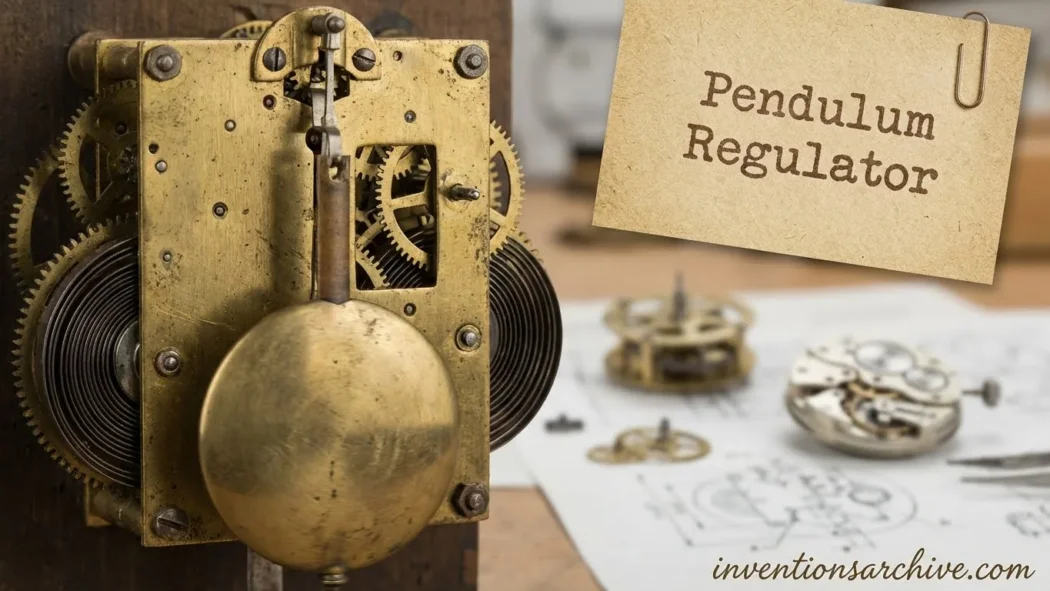
| Invention Name | Pendulum Regulator |
| Short Definition | Pendulum-controlled time regulator for mechanical clocks |
| Approximate Date / Period | 1656 1 Confirmed |
| Geography | Europe (early modern clockmaking centers) |
| Inventor / Source Culture | Christiaan Huygens (first practical design); earlier concepts in Galileo-era studies |
| Category | Timekeeping / Measurement |
| Importance |
|
| Need / Reason It Emerged | Better rate stability than foliot-controlled clocks |
| How It Works (Simple) | Pendulum period paces an escapement that advances the gear train |
| Material / Tech Basis | Pendulum rod + bob, escapement, gears, low-friction pivots |
| Early Use Context | Domestic clocks, then observatory regulators |
| Spread Route | Workshops → scientific institutions → wider craft adoption |
| Derived Developments | Regulator clocks, temperature compensation, improved escapements |
| Impact Areas | Science, education, commerce, navigation support, surveying |
| Debates / Different Views | “First” credit: concept vs working clock; early deadbeat ideas discussed by 1675 4 |
| Precursors + Successors | Verge & foliot → pendulum regulation → balance-spring, quartz, atomic |
| Key People / Institutions | Huygens; precision clockmakers; observatories |
| Notable Variants It Shaped | Seconds pendulum, mercury pendulum 2, gridiron pendulum 3, free/gravity-style regulators |
A pendulum regulator is the quiet engine behind classic precision timekeeping. By turning a steady pendulum swing into a dependable rhythm, it gave mechanical clocks a level of accuracy that finally felt trustworthy, day after day.
Common Terms Used With This Invention
- Pendulum clock: a clock whose rate is governed by a pendulum
- Regulator clock: a high-precision clock (often used as a reference)
- Escapement: the “metering” mechanism linking gears to the pendulum
- Rate: how fast or slow a clock runs over time
- Isochronism: keeping nearly the same period as swing size changes
Table Of Contents
What It Is
A pendulum regulator is a regulating system where a swinging pendulum sets the pace of a mechanical clock. The pendulum does not power the clock. It defines timing. The stored energy (from a weight or spring) is released in controlled steps by the escapement.
In everyday speech, people often mean a pendulum clock. In horology, a “regulator” can also mean a precision reference clock, designed to be accurate enough to set other clocks in a workshop, an institution, or an observatory.
Two Meanings That Often Overlap
- Regulator as a part: the pendulum-and-escapement system that controls the rate
- Regulator as a clock: a precision pendulum clock built as a reference standard
What It Replaced
- Earlier clocks used a foliot (a bar with weights) as a regulator
- Those systems were more sensitive to friction and changing power
- The pendulum offered a steadier rhythm for the same job
Why It Mattered
Once a clock has a more stable time base, everything built on top becomes more reliable. The pendulum regulator made long-run accuracy practical for daily life, then pushed precision far enough for scientific observation and coordinated schedules.
Where The Value Showed Up First
- Timekeeping standards in workshops and institutions
- Astronomy that depended on consistent timing
- Surveying and navigation support through better reference time
- Public time signals and clock networks
Early Evidence and Timeline
The story is a chain of ideas, craft skill, and careful refinement. The pendulum regulator appears as a practical system in the mid-1600s, then improves through better escapements and compensation techniques as clockmakers chase stability.
- Mid-17th century: practical pendulum-regulated clocks emerge and spread
- Late 17th century: early precision clock discussions focus on escapements and rate stability
- 18th century: regulator clocks become specialized instruments for high precision
- 19th century: refined regulators anchor time distribution in many settings
- 20th century: pendulum standards gradually give way to new oscillators in time services
How It Works
A pendulum regulator depends on a simple idea: a swinging pendulum repeats its motion with a near-constant period. That repeating cycle becomes a reference. The escapement “counts” those cycles by letting the gear train move in measured steps.
The Core Relationship
The basic pendulum model is often summarized as T = 2π √(L/g), where T is the period, L the effective length, and g local gravity. In real regulators, the craft is keeping L effectively steady while reducing disturbances.
What The Escapement Does
- Transfers small impulses to sustain the pendulum swing
- Prevents the gear train from running freely
- Turns regular motion into countable ticks
What Sets The Rate
- Effective pendulum length (the most sensitive lever)
- Friction at pivots and in the escapement
- Air drag and changes in swing amplitude
- Power stability from the driving weight or spring
Parts and Materials
A precision pendulum regulator is a system, not a single part. Each component exists to protect the pendulum’s timing from small losses and small changes. The best designs feel almost minimal because anything extra can add friction or instability.
- Pendulum assembly: rod, bob, suspension, and fine adjustments
- Escapement: meters energy and keeps the pendulum moving
- Gear train: converts measured ticks into seconds, minutes, hours
- Maintaining power (in higher-grade clocks): helps keep force steadier during winding
- Rigid case or frame to reduce flex and vibration
Materials That Matter
Clockmakers learned quickly that materials shape accuracy. The pendulum rod is especially sensitive because tiny length changes alter the period. That is why many refinements focus on temperature behavior and stable geometry.
Types and Variations
“Pendulum regulator” covers a family of approaches. Some are defined by length and beat, others by how they manage temperature or how gently they interact with the pendulum through the escapement.
By Timing Style
- Seconds pendulum: a familiar standard where “seconds” align naturally with the pendulum’s beat
- Long pendulum regulators: slower swings designed for stability and low disturbance
- Shorter pendulums: compact designs where case size matters more than ultimate stability
By Temperature Strategy
Temperature changes length. Length changes rate. Precision work needed answers. One historic approach is the mercury pendulum, credited to George Graham in 1721 2, where mercury expansion offsets other expansion effects so the timing stays steadier.
Related articles: Balance spring (Huygens) [Renaissance Inventions Series], Pendulum-Driven Music Box [Renaissance Inventions Series]
Another classic is the gridiron pendulum, associated with John Harrison in 1726 3. It uses alternating metal rods with different expansion rates arranged so one expansion counters another. The goal is the same: keep the effective length as constant as possible.
By How Gently Energy Is Delivered
In high-grade regulators, the ideal is to keep the pendulum as free as possible, receiving just enough impulse to maintain motion. Designs that reduce recoil and reduce interference can improve consistency. This is why the interaction between escapement geometry and pendulum motion became a central theme in precision clockmaking.
| Regulator Type | Typical Strength | Typical Limitation |
|---|---|---|
| Standard pendulum regulator | Stable on land | Sensitive to temperature and environment |
| Temperature-compensated | Better long-run stability | More complex construction |
| Precision observatory regulator | Reference-grade performance | Needs a controlled, quiet setting |
Accuracy and Limits
The pendulum regulator is powerful because it is simple. That simplicity also makes its weak points easy to name. The rate depends on keeping the pendulum’s effective length stable while minimizing friction and unwanted motion. Even small shifts can matter, especially over long intervals.
- Temperature: expansion changes length; compensation reduces this effect
- Air density and drag: changes can slightly alter the swing
- Drive variability: changing force can change the pendulum’s motion through the escapement
- Mounting and vibration: flexibility or movement adds timing noise
Why Pendulum Regulators Prefer Still Environments
A pendulum is happiest when gravity is the main influence. On stable ground, a well-designed regulator clock can keep a remarkably consistent rate. In moving settings, the motion itself competes with the pendulum’s natural rhythm, so other types of oscillators became more practical for portability.
Where It Was Used
Pendulum regulators shaped both craft and institutions. In workshops, a good regulator clock acted like a reference instrument, quietly keeping the standard that other clocks could match. In scientific settings, the same role expanded, with precision regulators supporting careful observation and coordinated time.
Typical Settings
- Clockmaking and instrument workshops
- Observatories and laboratories
- Public buildings with time distribution needs
- Education and demonstration of precise measurement
Common Design Signals Of A “Regulator Clock”
- Clear, readable seconds display
- Separated indications to reduce visual clutter
- Rigid cases and stable mounting
- Focus on rate consistency over decoration
Discussion Points and Attribution
Timekeeping history often separates ideas from working systems. Pendulum behavior was studied before it became a dependable regulator inside a clock. In the same spirit, escapement improvements can appear as proposals and diagrams before a widely adopted, refined solution becomes standard.
A notable early record connected to improved escapement thinking is dated 11 December 1675 4, describing discussions about altering pallet design for better accuracy. It highlights how quickly precision timekeeping turned into a conversation about small mechanical details and their big effects on rate.
FAQ
What Is The Difference Between A Pendulum Clock And A Regulator Clock?
A pendulum clock is any clock governed by a pendulum. A regulator clock usually means a precision pendulum clock built as a reference standard, often optimized for rate stability and easy reading.
Why Was The Pendulum Such A Big Improvement As A Regulator?
The pendulum offered a more consistent repeatable period than earlier regulators. That steadier rhythm let clockmakers design escapements and gear trains around a predictable tick, improving long-run accuracy.
What Limits The Accuracy Of A Pendulum Regulator?
The main limits come from changes in effective length and small losses: temperature expansion, friction, air effects, and variations in the drive delivered through the escapement.
How Did Temperature-Compensated Pendulums Help?
They were built so that warming and cooling caused parts to expand in opposing ways. The aim was to keep the pendulum’s effective length nearly constant, so the rate stayed steadier across seasons.
Why Did Precision Regulators Become Associated With Observatories?
Observatories needed consistent reference time for measurement and coordination. A high-grade pendulum regulator could serve as a stable standard in a controlled setting, supporting precise timing work.