
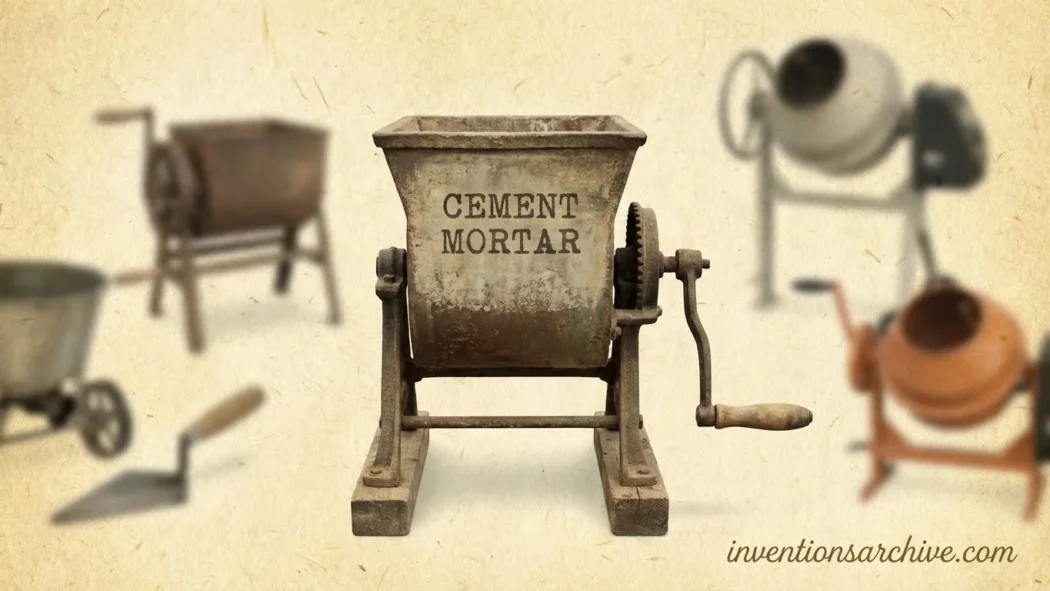
| Invention Name | Cement Mortar |
|---|---|
| Short Definition | A masonry bonding material made from a cementitious binder, fine aggregate, and water. |
| Approximate Date / Period | Modern cement mortar: 19th century; wider standard use: late 19th to early 20th century Approximate |
| Geography | Modern Portland cement origin: Britain; later spread across Europe, North America, and global building trades. |
| Inventor / Source Culture | No single inventor for cement mortar; linked to collective masonry practice and Portland cement development Attribution varies |
| Category | Material; construction; manufacturing; masonry technology. |
| Main Problem Solved | Stronger, faster-setting, more water-resistant bonding for brick, stone, block, and engineered masonry. |
| How It Works | Cement hydrates with water, binds fine aggregate, and hardens into a joint between masonry units. |
| Material Base | Portland cement or masonry cement; sand; water; sometimes lime for workability and flexibility. |
| Earlier Forms | Earth mortar, gypsum mortar, lime mortar, hydraulic lime mortar, natural cement, Roman cement. |
| Development Path | Lime and sand mortar → hydraulic lime and natural cement → Portland cement mortar → standardized masonry mortars. |
| Early Use Areas | Brickwork, stone masonry, pointing joints, transport works, industrial buildings, foundations, and repair work. |
| Evidence Status | Based on patent history, preservation records, technical standards, and surviving masonry evidence. |
| Surviving Evidence | Historic mortar joints, building fabric, cement patents, conservation reports, and masonry standards. |
| Modern Descendants | Masonry cement mortar, cement-lime mortar, thin-set mortar, repair mortars, cement renders, engineered masonry systems. |
| Related Inventions | Lime mortar; Portland cement; concrete; brick; masonry cement; reinforced concrete. |
| Why It Matters | It changed how masonry walls, foundations, blocks, and engineered structures could be bonded, repaired, and standardized. |
What Cement Mortar Is
Cement mortar is a paste-like masonry material used to bond bricks, stones, concrete blocks, tiles, and other units. In simple terms, it is not the same thing as cement. Cement is the binder. Mortar is the working mixture that holds masonry together.
In technical language, mortar can be described as a mixture of cement paste and fine aggregate. In masonry work, it may contain masonry cement or hydraulic cement with lime to improve plasticity and workability.[a]
This difference matters. Cement is a powdery binder. Concrete usually contains coarse aggregate and can form larger structural masses. Mortar is shaped for joints, beds, bonding, pointing, and surface work. Its value comes from controlled adhesion, not from acting as a large standalone block.
How the Origin Is Traced
The origin of cement mortar cannot be reduced to one inventor. Earlier builders already used earth, gypsum, lime, crushed brick, natural cement, and pozzolanic materials. These older mortars answered many needs, but they varied by local geology, fuel, craft knowledge, and building tradition.
Portland cement changed the story. The National Park Service notes that lime and sand mortar had been part of masonry for thousands of years, while Portland cement was patented in Britain in 1824, first manufactured in the United States in 1872, and not widely used throughout the country until the early 20th century.[b]
This makes cement mortar a gradual invention. The binder had a patent milestone. The mortar had a trade history. The widespread system came later, as cement production, transport, bags, standards, and masonry practice became more organized.
The Problem It Answered
Before modern cement mortar, many builders depended on lime-based mortars. Lime mortar could be durable, workable, and well suited to many older buildings, but it cured slowly and was less suited to some demanding wet, industrial, and high-load conditions.
Cement mortar answered several practical needs:
- Faster setting for busy building sites and infrastructure work.
- Hydraulic hardening, meaning the binder could set through reaction with water rather than only by slow air exposure.
- Higher early strength where builders needed firmer masonry joints.
- More predictable supply once cement was manufactured, bagged, transported, and standardized.
- Compatibility with new masonry systems, including concrete block and later engineered wall assemblies.
The change was not simply “old material replaced by better material.” Lime mortar stayed useful, especially in older or softer masonry. Cement mortar became important where strength, speed, water resistance, and standard supply were needed.
How It Worked in Simple Terms
Cement mortar works because cement is a hydraulic binder. When it reacts with water, it forms hardened compounds that lock fine sand particles into a firm mass. The sand gives body, texture, and volume. The binder creates the hardening action.
Portland cement is made from clinker that contains hydraulic calcium silicates, usually with calcium sulfate added during grinding. ACI identifies the main cement phases as tricalcium silicate, dicalcium silicate, tricalcium aluminate, and tetracalcium aluminoferrite; the silicate phases are closely tied to strength development after hydration.[c]
In masonry, the hardened mortar joint does several jobs at once. It beds units into position, spreads load across uneven surfaces, seals gaps, and gives the wall a controlled joint. In many walls, the joint is also the part expected to weather and be repaired before the masonry units themselves are harmed.
Earlier Ideas and Development Path
Cement mortar stands inside a long line of binder experiments. Builders wanted joints that could be shaped while soft, then become firm enough to hold masonry. They also wanted materials that matched local stone, brick, climate, and available fuel.
Historic England’s mortar history describes changing terminology, the long use of earth, gypsum, lime, pozzolans, and hydraulic materials, and the growth of artificial cement production in Britain from the 1840s, with large-scale commercial Portland cement production coming later in the 1890s.[d]
| Stage | Form | What Changed |
|---|---|---|
| Earlier Tool | Earth, clay, and gypsum mortars | Local materials could fill and bind joints, but performance depended strongly on climate and material quality. |
| Long-Used Predecessor | Lime and sand mortar | Workable, breathable masonry joints became common in many building traditions. |
| Intermediate Step | Hydraulic lime, pozzolanic mortar, natural cement, Roman cement | Builders gained binders that could set better in damp or demanding conditions. |
| Invention Form | Cement mortar using Portland cement or related cement binders | Faster setting, stronger early hardening, and industrial supply changed masonry work. |
| Improved Form | Cement-lime mortar and masonry cement mortar | Workability, water retention, and field consistency became easier to control. |
| Modern Descendant | Specialized cementitious mortars | Mortars became tailored for blockwork, repair, tile setting, rendering, and engineered masonry. |
Before and After Cement Mortar
The main change was practical. Cement mortar gave builders a jointing material that could set faster and serve newer forms of masonry. It also created new responsibilities, because stronger mortar is not always better for every wall.
| Before Cement Mortar Became Common | What Changed After It Became Common |
|---|---|
| Lime and sand mortars dominated many building traditions. | Portland cement and cement-lime mortars gave builders faster-setting alternatives. |
| Mortar performance depended heavily on local lime, sand, burning quality, and craft practice. | Industrial cement production helped create more predictable binder supply. |
| Wet or high-demand masonry often required special hydraulic lime, pozzolans, or natural cement. | Cement mortar supported stronger, more water-resistant joints for many new construction needs. |
| Repair materials were often close to the original local mortar. | Repair practice became more technical because hard cement mortars can be unsuitable for softer historic masonry. |
| Masonry standards were less uniform across regions and trades. | Mortar types, testing ideas, and material specifications became more formalized. |
Main Types and Variations
Modern cement mortar is not one fixed material. It appears in several forms depending on binder type, masonry unit, exposure, and performance need. Standards helped turn trade practice into clearer categories.
ASTM C270 covers mortars for reinforced and non-reinforced unit masonry and describes four mortar types under proportion and property specifications, while noting that field-sampled mortar strength is not the same as laboratory-tested mortar or mortar in the wall.[e]
| Variation | Main Material Idea | Typical Historical or Practical Role |
|---|---|---|
| Plain Portland Cement Mortar | Portland cement, fine aggregate, and water | Useful where stronger hydraulic set was valued, but often less workable without lime or additives. |
| Cement-Lime Mortar | Portland cement with lime, sand, and water | Improved plasticity, water retention, and handling made it common in masonry practice. |
| Masonry Cement Mortar | Factory-made masonry cement combined with sand and water | Helped simplify site work and create more consistent commercial mortar products. |
| Mortar Types M, S, N, and O | Standardized masonry mortar categories | Used to match mortar performance to masonry needs such as load, exposure, and wall type. |
| Thin-Set Cementitious Mortar | Fine cement-based adhesive mortar | Used for tile and surface bonding rather than traditional brick or stone bed joints. |
| Repair Mortars | Cement-based or blended materials selected for repair compatibility | Used in restoration, patching, and masonry repair where material match is important. |
Where It Was Used
Cement mortar spread through the same fields that needed more predictable masonry: brick walls, stonework, engineered structures, public works, industrial buildings, foundations, chimneys, and block construction. Its growth followed cement manufacturing, transport networks, and the professionalization of building specifications.
Cement-lime mortar became especially important because it softened the sharp divide between older lime work and stronger cement work. A National Research Council Canada record describes cement-lime mortar as widely used in North America and Europe for unit masonry, with properties such as strength and weather resistance affected by the type of mortar used.[f]
Related articles: Wheelbarrow (Han Dynasty) [Ancient Inventions Series], Reinforced Concrete [Industrial Age Inventions Series]
This is one reason cement mortar belongs in invention history. It was not only a material. It was a bridge between craft masonry, industrial cement production, and modern building standards.
What Changed Because of Cement Mortar
Cement mortar changed masonry in visible and quiet ways. Walls could be built with new expectations of speed, strength, and supply. Materials could be ordered, specified, and repeated across larger projects.
- Building schedules changed: faster-setting binders suited larger and more organized construction sites.
- Masonry systems changed: concrete block, brickwork, and engineered wall assemblies could rely on standardized mortars.
- Repair work changed: masons and conservators had to judge whether cement-rich mortar matched the older masonry around it.
- Material supply changed: cement, hydrated lime, and masonry cement became commercial products rather than purely local craft materials.
- Standards changed: mortar moved from local habit toward tested and named categories.
Common Misunderstandings
Cement Mortar Is Not the Same as Cement
Cement is the binder. Cement mortar is the masonry mixture that uses a cementitious binder with fine aggregate and water. Concrete is different again because it usually includes coarse aggregate and is used as a structural mass.
Joseph Aspdin Did Not Invent All Mortar
Aspdin’s name belongs to the Portland cement patent story. Mortar existed long before that. Cement mortar developed when Portland cement and other hydraulic binders entered masonry practice.
Harder Mortar Is Not Always Better
A strong cement-rich mortar can be useful in the right wall. In softer historic masonry, a very hard joint may move stress and moisture into the masonry units instead of allowing the joint to act as the repairable part.
The First Surviving Use Is Not Always the First Use
Buildings, patents, and written references show what survived or was recorded. They do not prove that no earlier experiment existed. Cement mortar’s history should be read through evidence, not through a single “first ever” claim.
Related Inventions and Later Developments
Cement mortar sits between older binder traditions and later engineered construction. These related inventions and material systems help place it in a wider technology history:
- Lime Mortar: the long-used predecessor that shaped masonry before cement became common.
- Hydraulic Lime: a binder that could set in damp conditions and helped prepare the way for cement-based mortars.
- Roman Cement: an early natural cement used before Portland cement became dominant.
- Portland Cement: the binder that made modern cement mortar practical on a large scale.
- Concrete: a related composite material that uses cement paste with aggregate in a different structural role.
- Brick: a masonry unit whose performance depends heavily on the mortar joint around it.
- Masonry Cement: a later commercial binder developed to simplify mortar production.
- Reinforced Concrete: a later structural system that grew from the wider use of cement-based materials.
Frequently Asked Questions
Who invented cement mortar?
Cement mortar does not have one clear inventor. Mortar is ancient, while modern cement mortar developed through Portland cement, hydraulic binders, industrial production, and masonry practice. Joseph Aspdin is important for the 1824 Portland cement patent, not for inventing every form of mortar.
Is cement mortar the same as concrete?
No. Cement mortar is mainly used for masonry joints and contains fine aggregate. Concrete is a larger composite material that usually includes coarse aggregate and is used for structural elements such as slabs, foundations, and columns.
Why did cement mortar become popular?
It became popular because it could set faster, develop higher early strength, and serve new masonry and infrastructure needs. Its spread also depended on industrial cement production, transport, bagged materials, and formal building standards.
Was cement mortar always better than lime mortar?
No. Cement mortar was useful for many modern construction needs, but lime mortar can be more suitable for some older masonry because it is softer and more vapor-permeable. The right mortar depends on the wall, material, exposure, and repair purpose.
What is the main difference between cement mortar and cement-lime mortar?
Cement-lime mortar includes lime along with cement, sand, and water. The lime can improve workability, water retention, and handling, while the cement provides hydraulic hardening and early strength.
Sources and Verification
- [a] Definition of concrete, hydraulic cement, mortar, and grout — Used to verify the technical distinction between mortar, concrete, hydraulic cement, and grout. (Reliable because it is an institutional technical reference from the American Concrete Institute.)
- [b] Preservation Brief 2: Repointing Mortar Joints in Historic Masonry Buildings — Used to verify the long use of lime and sand mortar, the 1824 Portland cement patent, U.S. manufacturing in 1872, and early 20th-century adoption context. (Reliable because it is a National Park Service preservation publication.)
- [c] Definition of portland cement — Used to verify Portland cement composition, hydraulic calcium silicates, main cement phases, and Joseph Aspdin’s 1824 patent attribution. (Reliable because it is an American Concrete Institute technical reference.)
- [d] Webinar on Mortars for Conservation: Part 1 History and Materials — Used to verify the wider historical path from lime, gypsum, pozzolans, hydraulic materials, and artificial cements to large-scale Portland cement production. (Reliable because it is published by Historic England, a public heritage body.)
- [e] C270 Standard Specification for Mortar for Unit Masonry — Used to verify modern masonry mortar standardization, mortar type coverage, and the distinction between proportion and property specifications. (Reliable because it is an ASTM International standards page.)
- [f] Cement-lime mortars — Used to verify cement-lime mortar as a widely used masonry material and to support its role in strength, durability, and weather resistance. (Reliable because it is from the National Research Council Canada publications archive.)