
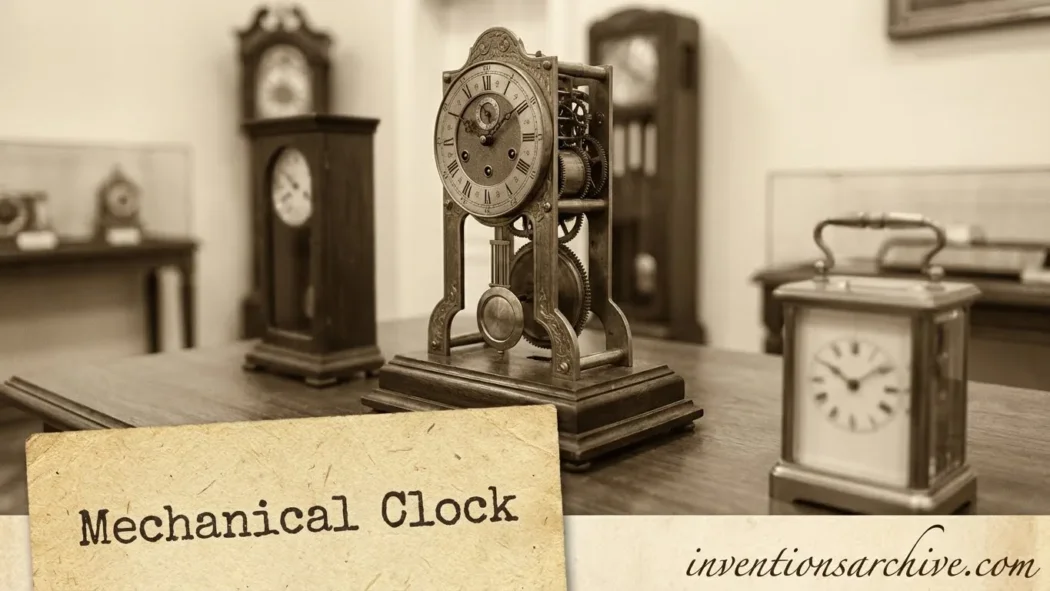
| Invention Name | Mechanical Clock |
|---|---|
| Short Definition | A timekeeping device that uses mechanical power, gears, a regulator, and an escapement to divide and display or announce time. |
| Approximate Date / Period | c. 1270–1300 Approximate [a] |
| Geography | Northern Italy to southern Germany; later documented across medieval European towns and cathedrals. |
| Inventor / Source Culture | Anonymous / collective medieval clockmakers Attribution varies |
| Category | Measurement; mechanical engineering; public timekeeping |
| Main Problem Solved | Regular time signaling without constant dependence on sun, water flow, or sand intervals. |
| How It Worked | Falling weight → gear train → escapement → regulator → bell, dial, or hand movement. |
| Material / Technology Base | Iron frames, steel parts, gears, drums, cords, bells, later brass and spring mechanisms. |
| Early Use | Monasteries, cathedrals, town towers, civic time signals, and later domestic interiors. |
| Evidence Status | Based on surviving evidence Early origin is reconstructed from later objects, written records, and surviving tower mechanisms. |
| Development Path | Sundial / water clock / sandglass → weight-driven tower clock → spring clock → pendulum clock → chronometer and precision regulator. |
| Related Inventions | Sundial, water clock, sandglass, escapement, pendulum clock, marine chronometer, quartz clock. |
| Modern Descendants | Mechanical watches, longcase clocks, marine timekeepers, observatory regulators, electric clocks, quartz clocks, atomic clocks. |
The mechanical clock changed time from something observed in nature into something that could be counted by a machine. Earlier timekeepers could mark daylight, water flow, candle burn, or sand movement, but the mechanical clock used stored energy, gears, and controlled release. Its early purpose was not private wristwatch-style precision. It was mainly a public machine for sounding hours, coordinating services, organizing labor, and giving towns a shared rhythm.
What the Mechanical Clock Is
A mechanical clock is a machine that uses a physical energy source to move a system of gears at a controlled pace. Early tower clocks were usually powered by falling weights. Later clocks used springs, pendulums, balance wheels, and improved escapements.
The central idea is simple: energy must be released slowly and evenly. Without a controlling part, a falling weight would drop too quickly and the wheels would spin out of control. The escapement solved that problem by allowing the gear train to move in small steps. That step-by-step motion created the familiar measured rhythm of clockwork.
In early public clocks, the goal was often audible time, not visual time. A bell could tell a whole community that an hour had passed. Dials and hands became more important as clocks moved from towers into houses, workshops, observatories, and ships.
How Its Origin Is Traced
The origin of the mechanical clock is traced through a mix of written references, surviving mechanisms, museum objects, cathedral records, and later horological study. The strongest evidence does not point to a named single inventor. It points to a period in late medieval Europe when tower clocks began to appear in civic and religious settings.
The earliest known mechanical clocks were probably built in a zone stretching across parts of northern Italy and southern Germany around the late 13th century. These were not small household objects. They were large machines, often installed high in towers, where their bells could be heard across a town or religious complex.
A useful way to understand the evidence is to separate three claims:
- First known period: late 13th century, based on historical reconstruction and early references.
- First named inventor: not securely known.
- Surviving early examples: mostly 14th-century mechanisms, often altered, restored, or preserved in institutional collections.
The Problem It Answered
Before mechanical clocks, people used several timekeeping methods. Sundials worked only when sunlight was available. Water clocks depended on controlled flow and maintenance. Sandglasses were useful for intervals but did not automatically organize a whole town’s day. Bells, human watchmen, and natural light still carried much of the burden.
The mechanical clock answered a practical need: regular, repeatable time signaling that could work indoors, at night, and in cloudy weather. It did not make time perfectly accurate by modern standards, but it made time more mechanical, public, and repeatable.
| Before the Mechanical Clock | What Changed After It |
|---|---|
| Time was often read from sunlight, water flow, sand, candles, or human observation. | Time could be counted by a machine using stored energy and controlled gear motion. |
| Night, cloudy weather, and indoor spaces limited many older timekeeping methods. | Clock bells and later dials could work without direct sunlight. |
| Many systems measured intervals rather than giving a shared public hour. | Town and cathedral clocks helped communities hear or see the same time signal. |
| Local schedules depended heavily on custom, natural light, and manual signaling. | Work, worship, trade, learning, and travel could be organized around more regular mechanical time. |
How It Worked in Plain Terms
Early mechanical clocks worked by turning stored energy into measured motion. In a tower clock, a heavy weight hung from a rope or cord. As the weight slowly descended, it turned a drum and gear train. The gears transferred motion to a striking mechanism, dial, or later hands.
The important part was the escapement. It did not create the power. It controlled the power. It allowed a wheel to advance tooth by tooth, instead of spinning freely. A regulator, such as a foliot balance in early clocks, helped set the rhythm of that release.
Early clocks were not silent precision instruments. Many were large iron machines. They needed winding, adjustment, and skilled care. Their value came from making time mechanical enough to be shared by many people, not from matching modern seconds-level accuracy.
Earlier Tools and Ideas Before It
The mechanical clock did not appear from nothing. It depended on older ways of thinking about time and motion. Sundials showed the movement of the sun. Water clocks and sandglasses measured intervals. Bells already marked communal moments. Gears had been used in earlier machines and astronomical devices.
The new step was the controlled release of mechanical energy. Once weight, gearing, regulator, and escapement worked together, time could be divided by a machine rather than only observed from nature or measured by flowing material.
This is why the mechanical clock belongs to both measurement history and machine history. It is a timekeeping invention, but it is also an early example of automatic control.
Development Path
The mechanical clock grew through many forms. Early tower clocks led to smaller domestic clocks. Spring power made portability possible. Pendulum regulation greatly improved accuracy. Marine chronometers carried precision timekeeping into navigation.
| Stage | Form | What Changed |
|---|---|---|
| Earlier Tool | Sundials, water clocks, sandglasses, candle clocks | Time was read from natural light, flow, burning, or measured intervals. |
| Early Mechanical Form | Weight-driven tower clock | Stored mechanical energy moved gears and struck hours for a community. |
| Improved Form | Spring-driven clock | Clock mechanisms became smaller and more suitable for rooms and portable objects. |
| Precision Form | Pendulum clock | A regular swinging pendulum improved timekeeping accuracy. |
| Later Descendant | Marine chronometer and precision regulator | Accurate clocks became important for navigation, astronomy, mapping, and standard time. |
Surviving Early Evidence
One of the best-known surviving early clocks is the Salisbury Cathedral clock, built in 1386 according to the cathedral’s own account. It has no face and was designed to strike the hour. Its mechanism is driven by falling weights that have to be wound, showing how early public clocks were often heard before they were read visually. [c]
The Wells Cathedral clock mechanism, dated 1392 in the Science Museum Group collection, is another major surviving example. It was formerly in Wells Cathedral and is described as a weight-driven clock with associated bells and parts. The collection record also notes that the builders are unknown and that the mechanism was originally regulated by a foliot before later conversion to pendulum regulation. [d]
These objects do not prove the first-ever use of mechanical clocks. They prove something more careful: by the late 14th century, large mechanical clocks were already complex, valued, and durable enough to leave surviving material evidence.
Main Parts and Technical Principle
The early mechanical clock can be understood through several parts working together:
- Power source: usually a falling weight in early tower clocks; later, a coiled spring in smaller clocks.
- Gear train: a set of wheels and pinions that transferred motion and divided it into usable intervals.
- Escapement: the control device that let the gear train move step by step.
- Regulator: an oscillating part such as a foliot, pendulum, or balance wheel that helped set the rate.
- Display or signal: a bell, dial, hand, or later a more complex astronomical display.
The invention’s strength was not only in any single part. It was in the partnership between power and control. The clock stored energy, released it in small pulses, and counted those pulses mechanically.
Main Types and Variations
| Type or Variation | Typical Period or Setting | Main Use or Feature |
|---|---|---|
| Turret Clock | Late medieval towers, cathedrals, town buildings | Large public mechanism, often weight-driven and bell-striking. |
| Domestic Wall Clock | Late 14th century onward | Smaller household version of public mechanical timekeeping. |
| Spring-Driven Clock | c. 15th century onward | Used stored spring energy, allowing smaller and more portable designs. |
| Astronomical Clock | Late medieval and early modern civic settings | Displayed calendar, lunar, solar, or celestial information as well as time. |
| Pendulum Clock | 17th century onward | Used a pendulum as a more regular regulator, improving accuracy. |
| Longcase Clock | 17th century onward | Tall domestic case allowed a long pendulum and falling weights. |
| Marine Chronometer | 18th century navigation | Precision timekeeper designed for finding longitude at sea. |
The Pendulum Shift
The pendulum was one of the largest improvements in mechanical clock history. Early verge-and-foliot clocks could be useful for sounding hours, but their accuracy was limited. A pendulum gave clockmakers a more regular oscillator.
Related articles: Ratchet and Pawl [Medieval Inventions Series], Nilometer [Ancient Inventions Series]
Christiaan Huygens made the first successful pendulum clock in December 1656, and Salomon Coster of The Hague made early examples under the right granted by Huygens. A surviving Coster clock dated 1657–1659 in the Science Museum Group collection shows how the pendulum was applied to a spring-driven clock with a verge escapement. [e]
This did not make every clock perfect. Early pendulum systems still had design limits. Yet the change was real. Mechanical clocks became more useful for science, navigation, astronomy, and domestic scheduling because they could keep time more steadily than many earlier designs.
Early Uses and Daily Context
The first mechanical clocks were social machines. Their bells gave shared time to people who might not own any timekeeper. In a cathedral or monastery, a striking clock helped mark services and ordered routine. In a town, it helped regulate markets, labor, meetings, and civic life.
As clocks became smaller, their use moved indoors. Households, workshops, schools, offices, and scientific spaces began to treat clock time as part of daily organization. The clock did not simply show time; it helped people plan, compare, record, and coordinate activities.
This was a slow change. Many communities continued using older practices alongside mechanical clocks. Sundials remained useful for checking local solar time. Bells still mattered. Human judgment did not vanish. The invention added a new mechanical layer to older time habits.
What Changed Because of It
The mechanical clock affected more than time display. It supported new expectations about regular schedules, measured labor, coordinated learning, and shared public hours. It also changed mechanical thinking. Clockwork became a model for controlled motion, precision craft, and repeatable machine behavior.
Later developments carried this influence further. The pendulum clock improved accuracy. The marine chronometer brought precision timekeeping into navigation. Royal Museums Greenwich describes John Harrison’s marine timekeepers as devices that allowed ships to determine longitude at sea; H1 was unveiled in 1735, and H4 became his most successful watch. [f]
By that point, the mechanical clock had moved far beyond the tower. It had become part of navigation, astronomy, scientific measurement, transport, communication, and public standards of time.
Common Misunderstandings
It Was Not Clearly Invented by One Named Person
Many short histories treat the mechanical clock as if it had a single inventor. The safer view is that early mechanical clockmaking developed through anonymous and collective work by medieval craftsmen, institutions, and technical communities.
The Oldest Surviving Clock Is Not Necessarily the First Clock
A surviving 14th-century clock proves that such machines existed by that date. It does not prove that no earlier examples existed. Many early machines were altered, replaced, melted down, or lost.
Early Clocks Did Not Always Have Faces
Some early mechanical clocks were designed mainly to strike bells. A clock could serve its purpose by being heard, even if it did not yet display time with a familiar dial and hands.
Mechanical Did Not Mean Highly Accurate at First
Early mechanical clocks could be valuable while still being inaccurate by modern standards. Their usefulness came from regular public signaling and mechanical repeatability, not from perfect precision.
Related Inventions and Later Developments
The mechanical clock sits in a wider history of measurement and controlled motion. These related inventions help place it in context:
- Sundial — an older solar timekeeper based on shadow position.
- Water clock — an interval-measuring device based on controlled flow.
- Sandglass — a portable interval timer useful in work, study, and navigation.
- Escapement — the control mechanism that made mechanical time division possible.
- Pendulum clock — a later improvement that greatly raised clock accuracy.
- Marine chronometer — a precision timekeeper that helped solve longitude at sea.
- Quartz clock — a later electric timekeeper using quartz vibration as a regulator.
- Atomic clock — a modern standard based on atomic frequency rather than mechanical motion.
Frequently Asked Questions
Who invented the mechanical clock?
No single inventor is securely known for the earliest mechanical clock. The first all-mechanical escapement clocks appear to have developed through medieval European clockmaking rather than from one named individual.
When did mechanical clocks first appear?
The earliest mechanical clocks are usually dated to around 1270–1300. This date is approximate because the first surviving objects are later than the first likely use.
Did early mechanical clocks have hands and dials?
Many early mechanical clocks did not have the kind of face, hands, and minute display associated with later clocks. Some were built mainly to strike bells and announce hours.
Why was the escapement important?
The escapement controlled the release of energy from the clock’s power source. It allowed the gear train to move in measured steps instead of turning freely.
How did the pendulum improve mechanical clocks?
The pendulum gave clockmakers a more regular regulator than earlier foliot systems. This helped clocks keep steadier time and made them more useful in science, navigation, and daily scheduling.
Sources and Verification
- [a] First-ever mechanical clock | THE SEIKO MUSEUM GINZA — Used to verify the approximate late-13th-century origin range, early tower-clock form, weight-driven power, and core timepiece components. (Reliable because it is an official museum horology resource.)
- [b] Clock | Mechanical, Digital, & Atomic | Britannica — Used to verify the uncertain origin of the all-mechanical escapement clock, early turret-clock form, and the distinction between early striking clocks and later dial clocks. (Reliable because it is an edited institutional reference written and checked by subject specialists.)
- [c] What to See – Salisbury Cathedral — Used to verify Salisbury Cathedral’s account of its 1386 working mechanical clock, faceless design, hourly striking purpose, and weight-driven operation. (Reliable because it is the official page of the institution that houses the clock.)
- [d] Wells Cathedral clock, 1392 | Science Museum Group Collection — Used to verify the Wells Cathedral clock date, maker status, weight-driven mechanism, former cathedral setting, foliot regulation, later pendulum conversion, and surviving object details. (Reliable because it is an official museum collection record.)
- [e] Early pendulum clock by Salomon Coster, c.1657. | Science Museum Group Collection — Used to verify Huygens’s first successful pendulum clock, Salomon Coster’s early production, and the technical adaptation of the pendulum to a clock mechanism. (Reliable because it is an official museum collection record.)
- [f] John Harrison’s marine timekeepers | Royal Museums Greenwich — Used to verify the role of Harrison’s marine timekeepers in longitude, the H1 date context, and the later navigation impact of precision clockmaking. (Reliable because it is an official Royal Museums Greenwich and Royal Observatory resource.)