
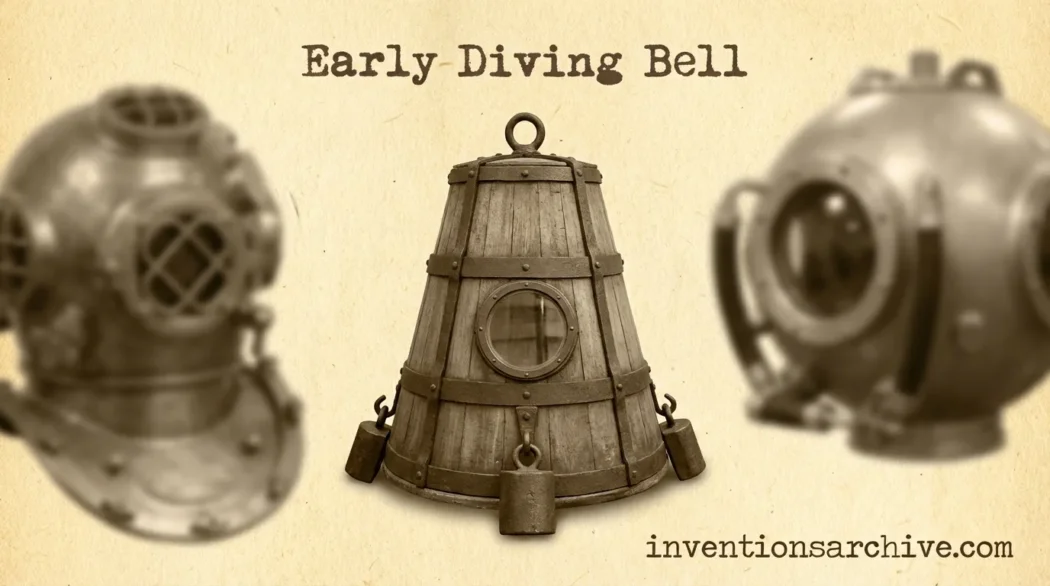
| Invention Name | Early Diving Bell |
|---|---|
| Short Definition | An open-bottomed chamber lowered into water while retaining a pocket of breathable air. |
| Approximate Date or Period | Principle described in antiquity; practical apparatus securely documented in 1535 |
| Geography | Ancient Mediterranean; later Renaissance Italy, especially Lake Nemi near Rome |
| Inventor or Source Culture | Ancient Greek textual antecedent; Renaissance apparatus commonly attributed to Guglielmo de Lorena |
| Category | Underwater technology and diving equipment |
| Importance | Provided an underwater air space without requiring a diver to carry an independent breathing supply |
| Evidence Status | Ancient principle documented 1535 use documented Exact early mechanism debated |
| Main Problem Solved | Extending the time a person could remain and work beneath the surface beyond ordinary breath-hold diving |
| Development Path | Trapped-air vessel → Renaissance working bell → replenished-air bells → surface-supplied diving systems |
| Early Use Context | Sponge diving concepts, underwater observation, wreck investigation and salvage |
| Technical Basis | Air remains inside an upright inverted chamber because water cannot completely displace it through the opening below |
The Idea Appears Long Before a Securely Documented Machine
The diving bell began with a remarkably simple physical observation: an inverted container pushed vertically beneath the surface does not immediately fill with water. Air remains trapped in its upper part. A person able to place the head or upper body inside that air space can breathe from it for a limited period.
A description of this principle survives in the ancient Greek Problemata, a collection traditionally associated with Aristotle but now generally treated with caution regarding authorship. The passage describes divers using a lowered cauldron that retains air when kept upright underwater. The Smithsonian Ocean history of underwater exploration identifies this passage as the earliest description of what can reasonably be interpreted as a diving bell.[a]
This evidence is important, but it does not prove that a standardized diving bell existed in the fourth century BCE. The passage establishes knowledge of the physical effect and indicates that it was connected with diving. It provides far less information about the vessel’s shape, suspension, duration of use or whether the practice was widespread.
Early Mediterranean divers already worked underwater for fishing, sponge gathering, military tasks and salvage. Most relied on breath-hold techniques. The concept of bringing a reservoir of surface air downward therefore addressed one of the oldest restrictions on underwater work: the diver’s need to return repeatedly to the surface.
Why an Inverted Bell Keeps an Air Pocket Underwater
The earliest bell did not need to be a sealed submarine. Its lower side remained open to the surrounding water. When the chamber entered the water in the correct orientation, the air already inside had no easy path upward and remained captured beneath the roof of the vessel.
Water entered the open lower part, but the trapped air resisted complete flooding. As the bell descended, surrounding water pressure compressed the enclosed air and the internal water level rose. The diver therefore occupied a space containing both water and a pocket of compressed air.
This distinction separates the diving bell from a later pressure-resistant submersible. An early open bell did not isolate its occupant at normal surface pressure. The air inside was exposed indirectly to the pressure of the surrounding water. The chamber functioned as an underwater breathing station rather than as a sealed underwater vessel.
The concept was mechanically simple but operationally limited. A fixed quantity of trapped air gradually became unsuitable for breathing, and early systems lacked the controlled ventilation, communication, monitoring and physiological understanding associated with later professional diving. The bell also had to remain properly oriented because substantial tilting could allow the trapped air to escape.
Alexander the Great and the Famous Underwater Legend
Alexander the Great is frequently presented in popular histories as an early passenger in a diving bell. Medieval manuscripts and versions of the Alexander Romance depict him descending beneath the sea in an enclosed or translucent vessel. In different retellings, the descent becomes an episode of exploration, observation or military reconnaissance.
The story should not be treated as evidence that Alexander actually used a diving bell. The surviving narratives belong to a literary tradition that developed and changed long after his lifetime. The Smithsonian’s historical overview explicitly distinguishes the story from securely documented technology and describes the underwater voyage as probably fictional.[a]
The legend is still relevant to the history of invention because it shows how the idea of enclosing a person with air underwater entered the medieval imagination. Illustrations of Alexander beneath the sea helped preserve a cultural image of human underwater travel, but they cannot establish an inventor, date or working design.
Lake Nemi Turned the Concept Into Documented Underwater Work
The strongest early evidence for a functional diving bell comes from Renaissance Italy. Lake Nemi, southeast of Rome, contained the remains of two enormous Roman vessels associated with Emperor Caligula. Their submerged timbers had been known locally for centuries, and Renaissance scholars became interested in recovering and studying them.
Cardinal Prospero Colonna commissioned Leon Battista Alberti to investigate the wrecks in the fifteenth century. Attempts to retrieve material from the ships demonstrated both their archaeological interest and the difficulty of examining large structures that could not simply be observed from the surface. Texas A&M University Press describes the Nemi investigations as part of a broader Renaissance effort to recover knowledge of Classical shipbuilding and as an important precursor to underwater archaeology.[b]
A major change came in 1535. Guglielmo de Lorena developed a diving apparatus used during renewed investigation of the Nemi wrecks. Francesco de Marchi participated in the dives and later left an account of the operation. Unlike the distant literary stories attached to Alexander, the Nemi episode is supported by Renaissance documentation and later historical study.
De Marchi was able to examine the submerged vessel closely enough to record structural observations and recover material. Research into the episode credits the operation with an unusually early combination of diving technology and systematic investigation of a historic wreck. Historian Joseph Eliav’s study of the apparatus describes de Lorena and de Marchi using the bell to examine the ship, take measurements and bring objects or structural material to the surface.[c]
Guglielmo de Lorena’s Bell Remains Partly Mysterious
Calling the 1535 device the first diving bell requires qualification. The physical principle was known much earlier, and descriptions of underwater air-retaining vessels precede Renaissance Italy. What makes the Lake Nemi apparatus different is the quality of the evidence for an actual working device employed in a recorded underwater operation.
Even here, historians do not possess a complete engineering specification. De Marchi’s account describes the experience and capabilities of the apparatus, but de Lorena did not leave a straightforward technical disclosure that resolves every question about its internal arrangement. The exact way the bell maintained useful air for the reported dives has therefore attracted historical reconstruction and debate.
Related articles: Submarine (Cornelis Drebbel) [Renaissance Inventions Series]
Eliav examined the surviving description and argued that some form of air-renewal arrangement may explain the reported performance of the bell. He also emphasized that this reconstruction remains a hypothesis rather than a demonstrated fact. That distinction matters: the historical record securely establishes the diving operation more strongly than it establishes every technical feature of the device.[c]
The Bell Changed What a Diver Could Do at a Wreck
Breath-hold diving permits only brief visits to a submerged object. A bell created something different: a temporary underwater station where a diver could obtain air without immediately returning to the surface. Even an imperfect version could make observation and manual examination more practical.
At Lake Nemi, that advantage had intellectual consequences. De Marchi was interested not merely in extracting valuables but in the construction of the ancient vessels. His investigation contributed observations about hull structure and fastening methods. Modern scholarship on the Nemi projects therefore treats the episode as part of the early history of nautical archaeology rather than solely as salvage.[b]
The relationship between diving equipment and archaeology is important. Underwater sites had long been exploited by fishermen and salvors, but sustained examination required a way to overcome the human body’s limited ability to remain submerged. The bell extended the observer’s presence in the underwater environment without yet solving all of the physiological and technical problems of diving.
From Stored Air to Renewable Air
The central weakness of a primitive bell was its finite air supply. The next major stage was therefore not simply making a stronger chamber. Engineers sought ways to replace or refresh the air while the bell remained underwater.
By the seventeenth century, diving bells became associated increasingly with organized salvage and engineering. Designs varied, and several inventors experimented with methods of sustaining underwater occupants. The basic inverted chamber remained recognizable, but the technology moved toward controlled communication with the surface and a renewable breathing supply.
Edmond Halley’s work around the turn of the eighteenth century is an important point in this transition. His bell incorporated a method for replenishing its air while submerged. The Smithsonian chronology describes Halley’s system as receiving fresh air in containers lowered from the surface and notes that divers could leave the main bell while remaining connected to its air supply.[a]
This was a conceptual shift. The earliest bell carried a pocket of air downward. Later systems treated the surface as an ongoing source of breathing gas. That path ultimately contributed to surface-supplied diving helmets and suits, in which the large shared chamber of the bell was reduced to equipment worn by an individual diver.
Why the Early Diving Bell Was Not a Submarine
Diving bells and submarines sometimes appear together in histories of underwater technology, but their functions differ. A traditional bell is normally lowered and raised from a supporting vessel or structure. It does not navigate independently through the water. Its primary purpose is to provide access, transport or an air space for underwater workers.
A submarine or self-contained submersible is a mobile vessel. It must manage buoyancy, structural loads, life support and movement as an integrated vehicle. Early bells avoided much of that complexity by remaining tethered to the surface and open below.
The distinction explains why the bell emerged so early. Builders did not yet need to solve the full problem of creating an independently moving underwater craft. They could exploit one physical property—trapped air in an inverted chamber—to improve an activity humans already practiced.
A Small Device With a Long Technological Lineage
The early diving bell occupies an unusual position in invention history because its underlying principle was understood long before the first well-documented surviving account of a practical Renaissance machine. Ancient literature, medieval legend and Renaissance engineering therefore have to be separated rather than compressed into a single invention date.
The ancient Greek cauldron description demonstrates knowledge of trapped air underwater. The Alexander tradition demonstrates the persistence of imagined underwater enclosure. The Lake Nemi dives of 1535 provide firm evidence that a purpose-built apparatus could support real investigation beneath the surface. Later air-renewal systems turned the bell into a more capable working platform.
Modern diving bells used in commercial and saturation diving are technologically far removed from the Renaissance apparatus, yet the defining idea remains recognizable: a chamber transported between the surface and an underwater workplace, providing divers with a controlled space during the journey or at depth. The early bell did not conquer the underwater environment, but it introduced a practical method of bringing a breathable space into it.
Sources and Verification
- [a] Deep-Sea Submersibles — Smithsonian Ocean’s history of underwater exploration documents the ancient cauldron description, distinguishes the Alexander story from secure history, identifies the 1535 bell associated with Guglielmo de Lorena, and describes the later Halley system. The Smithsonian Institution provides institutional museum and educational context for the chronology.
- [b] Caligula’s Barges and the Renaissance Origins of Nautical Archaeology Under Water — Texas A&M University Press documents the Renaissance investigations of the Lake Nemi ships and their place in the development of underwater exploration and nautical archaeology. It is an academic university-press source centered directly on the Nemi investigations.
- [c] Guglielmo’s Secret: The Enigma of the First Diving Bell Used in Underwater Archaeology — Joseph Eliav’s historical engineering study examines the 1535 dives of Guglielmo de Lorena and Francesco de Marchi, the surviving description of the apparatus, and competing explanations for how its air system may have functioned. The article distinguishes documented evidence from technical reconstruction.