
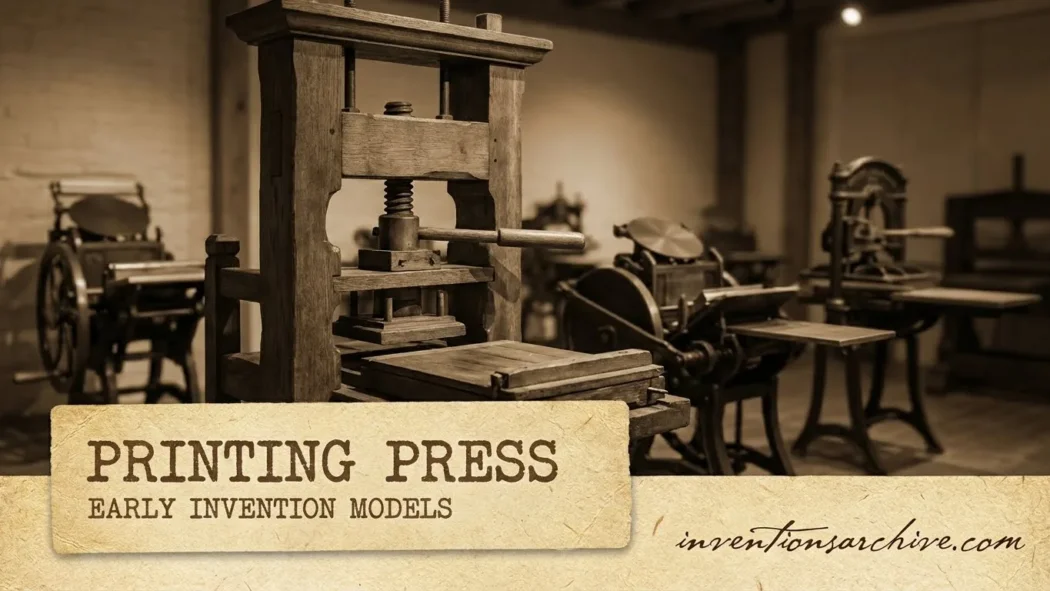
| Invention Name | Printing Press |
|---|---|
| Short Definition | A machine that transfers inked text or images onto paper, parchment, or another surface by applying controlled pressure. |
| Approximate Date / Period | Europe: around the 1450s Approximate; earlier printing traditions existed in East Asia Based on surviving evidence |
| Main Geography | Mainz, Germany, for Gutenberg’s European movable-type press; China and Korea for earlier printing and movable-type traditions |
| Inventor / Source Culture | Johannes Gutenberg is generally credited for the European mechanical movable-type press; earlier printing developed through collective work in East Asia |
| Category | Communication, education, manufacturing, book production, knowledge storage |
| Evidence Status | 868 Diamond Sutra: Confirmed surviving dated print; Bi Sheng movable type: Documentary; 1377 Jikji: Confirmed surviving metal-type evidence; Gutenberg system: Based on surviving evidence |
| Main Problem Solved | Slow and costly copying of texts by hand or by carved blocks that had to be remade for each page |
| How It Worked | Reusable type pieces were arranged into pages, inked, and pressed against a sheet to make repeated impressions |
| Material / Technical Base | Metal type, oil-based ink, paper or parchment, press screw or spindle, forme, matrix, hand mould |
| Early Major Use | Books, religious texts, administrative notices, pamphlets, scholarly works, commercial print jobs |
| Development Path | Manuscript copying and woodblock printing → movable type → mechanical press → metal and cylinder presses → industrial and digital printing |
| Related Inventions | Paper, ink, movable type, woodblock printing, type casting, letterpress, lithography |
| Surviving Evidence | Printed books and scrolls, historical descriptions of movable type, museum presses and reconstructions, library copies of the Gutenberg Bible, East Asian printed works |
| Modern Descendants | Letterpress printing, newspapers, book publishing, offset printing, desktop publishing, digital presses |
| Why It Matters | It made repeated text production faster, more consistent, and easier to scale across schools, workshops, libraries, trade, and scholarship |
The printing press was not simply a machine for making books faster. It was a new way to turn written language into a repeatable manufactured object. Before its spread in Europe, a long text usually depended on scribes, manuscript workshops, or carved blocks. Each method could produce beautiful work, but each had limits. The press changed that balance. A page could be set once, inked many times, and printed in multiple copies with far more consistency than hand copying allowed.
What the Printing Press Is
A printing press is a pressure-based machine. Its job is to bring an inked surface and a receiving surface together with enough force to leave a clear impression. In early European book printing, the inked surface was usually a page made from movable metal type. Each letter was a separate object. Printers arranged those letters into words, lines, and pages, locked them in place, applied ink, and pressed paper or parchment onto the form.
This simple idea had a large practical effect. Once the type was set, the same page could be printed again and again. A workshop still needed skill, labor, good materials, and careful correction, but the work no longer depended on rewriting every copy by hand.
Why the Origin Is Not a Single Simple Moment
The common sentence “Gutenberg invented the printing press” is partly true, but too short. It hides the older history of paper, ink, woodblock printing, and movable type. It also hides the fact that inventions often arrive when several older tools meet a new practical need.
Gutenberg’s achievement was not the first printed text and not the first movable type in human history. His importance comes from the working combination of metal type, reusable letters, a press mechanism, suitable ink, and repeatable production in fifteenth-century Europe. The Library of Congress describes the Gutenberg Bible as the first great book printed in Western Europe from movable metal type and notes that its printing was probably completed late in 1455 at Mainz.[c]
Who Was First? Evidence Comparator
The answer changes with the claim being tested. A dated woodblock-printed book, the earliest documented movable-type method, the oldest surviving book printed with movable metal type, and the European mechanical press are four different milestones. The first category below is deliberately limited to the earliest surviving dated printed book; it does not claim that printing itself began in 868.
First Dated Printed Book
Best-supported result: Diamond Sutra, China, 868 CE. The surviving scroll carries a dated colophon and was produced by woodblock printing. The International Dunhuang Programme describes it as the world’s earliest dated printed book.[a]
Claim limit: this identifies the earliest surviving printed book with a secure date. It does not mean woodblock printing began in 868.
First Documented Movable Type
Best-supported result: Bi Sheng, China, 1041–1048. A later account by Shen Kuo describes Bi Sheng making individual earthenware characters, arranging them on an iron plate, fixing them for printing, and reusing the characters afterward.[g]
Claim limit: the evidence is documentary. The original Bi Sheng type and a securely identified surviving book printed from it are not the basis of this claim.
Movable Metal Type: Oldest Surviving Book
Best-supported result: Jikji, Korea, 1377. UNESCO records the surviving second volume as the oldest available book evidence printed with movable metal type. It was printed at Heungdeok-sa Temple in Cheongju in July 1377.[b]
Claim limit: older Korean records mention metal-type printing, so Jikji should be described as the oldest surviving evidence of a book printed with movable metal type rather than the proven first use of metal type.
European Mechanical Movable-Type Press
Best-supported result: Johannes Gutenberg, Mainz, around the 1450s. Gutenberg’s workshop system combined cast interchangeable metal letters with page composition, suitable printing ink, and a spindle press designed for controlled transfer onto paper or parchment. The Gutenberg Bible was probably completed in 1455.[d][c]
Claim limit: this is the European mechanical movable-type press system, not the first printing or first movable type in world history.
| Milestone | Date and Place | Material | Printing Method | Surviving Evidence | Claim Scope |
|---|---|---|---|---|---|
| Diamond Sutra | 868 CE Dunhuang, China | Paper and carved woodblocks | Woodblock printing; complete page content carved into blocks | Surviving printed scroll with dated colophon | Confirmed Earliest surviving dated printed book[a] |
| Bi Sheng Movable Type | 1041–1048 Song China | Earthenware individual characters, iron plate, fixing material | Reusable individual characters assembled into printable text | Historical description preserved through Shen Kuo’s account | Documentary Earliest well-known documented movable-type method; not surviving original type[g] |
| Jikji | 1377 Cheongju, Korea | Movable metal type and paper | Individual cast metal characters arranged and printed as pages | Surviving second volume, preserved as documentary heritage | Confirmed Oldest surviving evidence of a book printed with movable metal type[b] |
| Gutenberg System | c. 1450s Mainz, Germany | Cast metal type, oil-suited printing ink, paper or parchment, spindle press | Reusable movable type combined with mechanical press pressure and repeatable type casting | Surviving Gutenberg Bibles and contemporary documentary evidence; reconstructed equipment based on the historical process | Based on surviving evidence European mechanical movable-type press system; Gutenberg Bible completed about 1455[c][d] |
The comparison prevents four different questions from collapsing into one name. Diamond Sutra answers a dated surviving print question. Bi Sheng belongs to the documented history of reusable movable characters. Jikji provides surviving book evidence for movable metal type before Gutenberg. Gutenberg belongs to the development of the European mechanical press system that combined repeatable metal type production with press-based printing.
The Problem It Answered
Before the press became useful at scale, written information had a bottleneck: copying took time. A manuscript could be copied by hand with care, but each copy required trained labor. Woodblock printing allowed repeated impressions, yet a whole page had to be carved into a block. If the page changed, the block changed. If a book had many pages, many blocks were needed.
The printing press answered a different need: repeatable text production. Letters could be reused. Pages could be reset. Errors could be corrected by changing pieces of type rather than recopying a whole manuscript or carving another block. This made printing useful not only for large books, but also for smaller texts, notices, forms, pamphlets, teaching materials, and commercial work.
Before and After the Printing Press
| Before the Invention | What Changed After It |
|---|---|
| Many long texts depended on scribes or manuscript workshops. | Workshops could produce multiple copies from the same prepared pages. |
| Woodblock printing required a carved block for each page or design. | Movable type allowed letters to be rearranged and reused for new pages. |
| Copies could differ because hand copying introduced variation. | Printed sheets could be made with more consistent layout and wording. |
| Books were slower and more expensive to reproduce. | Book production became better suited to trade, education, and wider circulation. |
| Correction often meant rewriting or recarving. | Printers could correct a page by replacing type or resetting a line. |
| Text circulation was limited by the speed of copying and local access. | Printed works could move through booksellers, schools, libraries, workshops, and learned networks. |
How It Worked in Simple Terms
The early European press worked through three linked actions: setting, inking, and pressing. First, a compositor arranged small pieces of type into lines and pages. Then the raised surfaces of the type were inked. Finally, paper or parchment was pressed against the type so the ink transferred to the sheet.
Gutenberg’s system depended heavily on metalworking. The Gutenberg Museum’s official explanation describes how characters were cut into steel punches, transferred into softer metal matrices, and cast as individual letters. It also notes the use of a hand casting instrument and a metal alloy that cooled quickly and could endure pressure from the press.[d]
The press itself mattered because pressure had to be even. Too little pressure made a weak print. Too much pressure could damage paper, type, or the page form. Good printing required practical judgment as much as machinery.
Main Parts of an Early Movable-Type Press
- Type: individual raised letters, punctuation marks, and other marks used to build a page.
- Matrix: a moulding surface used to help cast letters with repeatable shapes.
- Forme: the locked arrangement of type for one page or sheet side.
- Ink: a thick printing ink that could sit on raised metal type and transfer clearly.
- Platen or pressure surface: the part that helped press the sheet against the inked type.
- Paper or parchment: the receiving material that carried the printed impression.
Earlier Ideas and Tools Before the Press
The printing press did not appear out of nowhere. It grew from older practices that had already solved parts of the problem.
- Manuscript copying preserved texts through skilled handwriting.
- Seals and stamps showed that designs could be pressed repeatedly onto a surface.
- Woodblock printing proved that carved text and images could be printed in multiple copies.
- Paper making provided a more suitable surface for printed books than many heavier or costlier materials.
- Metal casting made repeatable, durable type possible.
- Screw presses used for other forms of pressing helped shape the mechanical idea of applying controlled pressure.
Development Path
| Stage | Form | What Changed |
|---|---|---|
| Earlier Tool | Manuscript copying | Texts were preserved, but every copy required handwriting. |
| Earlier Printing | Woodblock printing | Repeated impressions became possible, but each page required a carved block. |
| Movable Type | Reusable characters in East Asian and European traditions | Text could be rearranged instead of recarved as full pages. |
| European Press System | Gutenberg-style movable metal type and press pressure | Reusable type, ink, paper, and mechanical pressure worked together in a production process. |
| Improved Form | Metal presses, cylinder presses, steam-powered printing | Printing became faster and better suited to newspapers, books, and larger print runs. |
| Modern Descendant | Offset printing, phototypesetting, digital printing | Text and images moved from hand-set type to photographic, electronic, and digital systems. |
Main Types and Variations
The phrase “printing press” can refer to several related machines and printing systems. They share a basic aim: transfer a prepared image or text to a surface. The mechanism and materials changed over time.
| Type or Variation | Main Feature | Typical Use or Importance |
|---|---|---|
| Woodblock Printing | Text or image carved into a block | Useful for repeated images, religious texts, playing cards, and early printed sheets |
| Movable-Type Hand Press | Reusable type arranged by hand and printed with mechanical pressure | Early European book printing, pamphlets, notices, and scholarly works |
| Letterpress | Raised type or plates press ink onto paper | Books, newspapers, job printing, fine press work |
| Cylinder Press | A cylinder helps carry or press sheets at higher speed | Larger print runs and faster newspaper production |
| Rotary Press | Printing surfaces move around cylinders | High-volume newspapers, magazines, and packaging |
| Offset Printing | Image transfers from plate to blanket to paper | Modern commercial printing with high speed and clean reproduction |
| Digital Printing | Image data is sent directly from digital files to the printer | Short runs, variable data, on-demand books, office printing |
Early Uses in Daily Work and Learning
Early printing served practical needs. It produced books, but it also served schools, religious institutions, merchants, administrators, and scholars. A printed sheet could carry a notice, a form, a poem, a calendar, a teaching text, a legal document, or a short argument. That flexibility made the press more than a book machine.
In workshops, printing created new kinds of labor. Compositors set type. Press workers inked and printed sheets. Correctors checked proofs. Booksellers and binders turned printed sheets into finished objects. The invention therefore changed not only reading, but also workshop organization, trade, education, and the physical rhythm of book production.
How It Spread and Changed Over Time
Once the press proved useful in Europe, printing moved through skilled workers, business partnerships, urban workshops, book fairs, and trade routes. It did not spread as a single machine copied everywhere in the same way. Local scripts, markets, paper supply, laws, languages, and reading communities shaped how printing worked in each place.
The University of Chicago Library notes that printing in the West gained force in the 1450s with Johannes Gutenberg and Johann Fust, and that Gutenberg built on existing press technologies used for olive oil and wine. The same source also identifies books printed between 1455 and 1501 as incunabula, a term used for the early period of European print culture.[e]
Related articles: QWERTY Keyboard Invention: Who Invented QWERTY and Why? [Industrial Age Inventions Series], Crank Handle [Medieval Inventions Series]
What Changed Because of the Printing Press
The most direct change was production speed. A page did not have to be copied by hand for each new copy. The same type setting could produce repeated impressions. This helped printed texts reach more readers, more schools, more libraries, and more trades.
The second change was consistency. A printed edition could keep the same wording and layout across many copies, even though errors and variations still existed. That consistency mattered for teaching, reference works, religious texts, law, science, music, maps, and commerce.
The third change was storage. Printed pages made information easier to preserve, compare, sell, lend, correct, and cite. A reader in one city could work from a text that matched copies in another city more closely than many manuscript copies did.
Fields That Benefited
- Education: schools and universities could use more printed teaching texts.
- Science: diagrams, tables, observations, and corrections could circulate in repeatable form.
- Trade: notices, price lists, forms, and printed labels became easier to reproduce.
- Administration: printed documents helped offices distribute standardized information.
- Culture: poems, stories, music, images, and public texts could move beyond one manuscript circle.
- Craft and industry: printing itself became a skilled trade with tools, roles, suppliers, and standards.
Common Misunderstandings
“Gutenberg Printed the First Book Ever”
This is not accurate. The Library of Congress states that it is important not to call the Gutenberg Bible the first printed book, since evidence for movable metal type in Korea predates Gutenberg. A more careful phrase is the first great book printed in Western Europe from movable metal type.[f]
“Bi Sheng’s Movable Type Is the Same Claim as Jikji”
They represent different kinds of evidence. Bi Sheng’s 11th-century movable-type method is known through a historical description and used earthenware characters. Jikji is a surviving 1377 book printed with movable metal type. One is an early documented method; the other is surviving metal-type book evidence.[g][b]
“The Press Was Only a Book Machine”
Books were important, but the press also printed shorter materials. Notices, forms, pamphlets, teaching sheets, calendars, and commercial texts were part of the broader print economy.
“Movable Type Alone Explains the Change”
Movable type was only one part. The useful system needed type casting, ink, paper, press pressure, page setting, proofreading, skilled labor, and a market for printed texts.
“Printed Books Were Immediately Perfect”
Early printed books could still contain errors, hand decoration, local variation, and later binding changes. Printing improved repeatability, but it did not remove human judgment from bookmaking.
Why the Invention Appeared When It Did
Fifteenth-century Europe offered several useful conditions at the same time. Paper was becoming more available. Towns had skilled metalworkers. Existing screw presses offered a model for controlled pressure. There was demand for books and documents from churches, schools, courts, merchants, and learned readers. Gutenberg’s work belongs in that setting.
The invention also depended on patience. Casting type, setting pages, choosing ink, adjusting pressure, and correcting proofs all required repeated testing. The press was not a single object doing all the work. It was a production method built around many smaller skills.
Related Inventions
These related inventions and technologies help place the printing press in a wider history of communication and production:
- Paper: the surface that made large-scale book printing more practical.
- Ink: the material that carried text and images from type to page.
- Woodblock Printing: an earlier method for repeated printed impressions.
- Movable Type: reusable letters or characters arranged to form pages.
- Type Casting: the metalworking process behind repeatable type pieces.
- Letterpress: the raised-surface printing method that continued from early movable-type presses.
- Lithography: a later printing method based on surface chemistry rather than raised type.
- Offset Printing: a modern descendant used for large-scale commercial printing.
Frequently Asked Questions
Who invented the printing press?
Johannes Gutenberg is generally credited with developing the European mechanical movable-type printing press in Mainz around the 1450s. Earlier printing and movable-type traditions existed in East Asia, so the answer depends on whether the question means printing, movable type, movable metal type, or the European press system.
Was the Gutenberg Bible the first printed book?
No. The Gutenberg Bible was not the first printed book in world history. It is better described as the first great book printed in Western Europe from movable metal type. The Chinese Diamond Sutra is a surviving dated printed book from 868, while Jikji provides surviving movable-metal-type book evidence from Korea in 1377.
Who first used movable type?
Bi Sheng is associated with the earliest well-known documented movable-type method in China between 1041 and 1048. The method used individual earthenware characters. The claim is based on a historical account rather than surviving original type from Bi Sheng’s workshop.
What is the oldest surviving book printed with movable metal type?
Jikji, printed at Heungdeok-sa Temple in Cheongju, Korea, in July 1377, is recognized by UNESCO as the oldest surviving book evidence printed with movable metal type. Earlier Korean records mention metal-type printing, so the claim refers to surviving evidence rather than the absolute first use.
How did an early printing press work?
An early press used arranged type, ink, and pressure. Printers set individual pieces of type into a page, inked the raised surfaces, and pressed a sheet against them to transfer the text.
Why was the printing press important?
It made repeated text production faster and more consistent. That helped books, teaching materials, notices, scholarly works, and commercial documents circulate more widely than hand copying usually allowed.
What came before the printing press?
Earlier methods included manuscript copying, stamps, seals, woodblock printing, and movable type traditions. The European press combined several older ideas with metal type and mechanical pressure.
Sources and Verification
- [a] Buddhist texts: The Diamond Sūtra — Used to verify the 868 CE Diamond Sutra as the world’s earliest dated printed book and to distinguish dated surviving printing from later movable-type developments. (Reliable because it is an institutional British Library / International Dunhuang Programme source.)
- [b] Baegun hwasang chorok buljo jikji simche yojeol (vol.II) — Used to verify Jikji’s printing at Heungdeok-sa Temple in Cheongju in July 1377 with movable metal type and its status as the oldest surviving book evidence of that method. (Reliable because it is an official UNESCO Memory of the World record.)
- [c] The Gutenberg Bible – Library of Congress Bible Collection — Used to verify the Gutenberg Bible’s place as the first great book printed in Western Europe from movable metal type and its probable completion in Mainz in 1455. (Reliable because it is an official Library of Congress exhibition page.)
- [d] Gutenberg’s invention — Used to verify Gutenberg’s type-making process, hand casting instrument, metal alloy, page composition, and spindle press used for controlled transfer to paper or parchment. (Reliable because it is the official Gutenberg information site of Mainz and the Gutenberg Museum.)
- [e] A Short History of Printing — Used to verify Gutenberg and Johann Fust’s role in 1450s mechanized printing, the link to earlier press technologies, and the term incunabula for early European printed books. (Reliable because it is a University of Chicago Library exhibition source.)
- [f] Library of Congress Bibles Collection Interactive Presentation — Used to verify that the Gutenberg Bible should not be called the first printed book and to support careful wording about movable metal type in Western Europe. (Reliable because it is an official Library of Congress educational resource.)
- [g] The History of Printing in Asia According to Library of Congress Asian Collections – Part 1 — Used to verify the documentary account of Bi Sheng’s movable-type method between 1041 and 1048, including the use of individual earthenware type. (Reliable because it is an institutional Library of Congress Asian Collections resource drawing on the Library’s holdings.)