
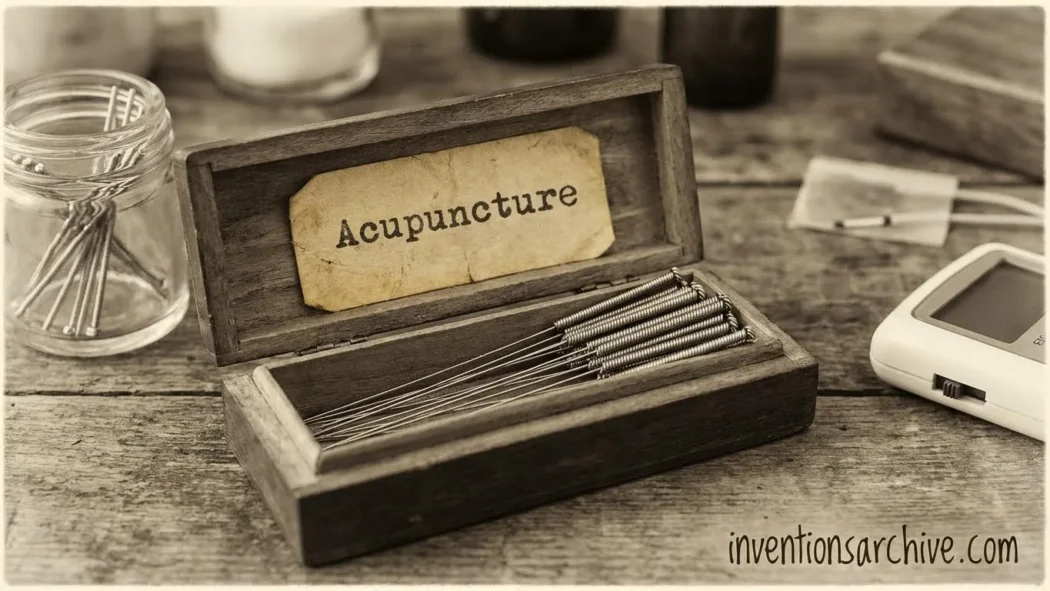
Acupuncture is a needle-based medical technique that developed within the long history of Chinese medicine. As an invention, it is not a single object like a wheel or a press. It is a linked system of tools, body maps, written theory, training methods, and clinical practice. Its early history is difficult to date with perfect certainty, but the surviving record points strongly to ancient China, where needling methods became part of a wider tradition known as zhen jiu, or acupuncture and moxibustion.
| Invention Name | Acupuncture |
|---|---|
| Short Definition | Stimulation of selected body points with fine needles, historically linked to Chinese medical theory. |
| Approximate Date / Period | Systematic written evidence by the late Warring States to Han period; often discussed around the 2nd century BCE Approximate |
| Geography | Ancient China; later East Asia, Europe, the Americas, and wider global use |
| Inventor / Source Culture | Anonymous / collective Chinese medical tradition Attribution varies |
| Category | Medicine, medical instruments, body mapping, therapeutic technique |
| Evidence Status | Early written and archaeological evidence; exact origin remains debated Based on surviving evidence |
| Main Problem Solved | Need for structured ways to relieve symptoms, manage pain, and treat illness within early medical systems |
| How It Works in Simple Terms | Fine needles stimulate selected points; modern research studies nervous system, tissue, and nonspecific effects |
| Material / Technology Basis | Earlier stone or bone tools; later metal needles; modern sterile single-use needles |
| Early Written Record | Huangdi Neijing, especially acupuncture theory and needle categories in the early Chinese medical canon [a] |
| Development Path | Bian-style stone tools → metal needles → mapped point systems → modern regulated needles and training standards |
| Related Inventions | Moxibustion, medical needles, body charts, electroacupuncture, auricular acupuncture, sterile disposable devices |
| Surviving Evidence | Classical medical texts, excavated needles, bamboo slips, museum and archaeological records |
| Modern Descendants | Electroacupuncture, laser acupuncture, standardized acupoint charts, regulated medical needles |
| Long-Term Importance |
|
What Acupuncture Is
Acupuncture is the use of fine needles to stimulate selected points on the body. The U.S. National Center for Complementary and Integrative Health describes it as a technique in which practitioners insert fine needles into the skin; the needles may be moved manually or stimulated with small electrical currents, and the practice has been used in some form for at least 2,500 years. [b]
Invention history often favors machines and visible devices. Acupuncture is different. Its main invention was the pairing of a small instrument with a repeatable map of the body. The needle mattered, but so did the idea that specific locations could be named, taught, remembered, and used in a controlled way.
That is why acupuncture belongs not only to the history of medicine, but also to the history of measurement, body diagrams, specialized tools, and professional training.
How Its Origin Is Traced
No surviving record names a single inventor of acupuncture. It appears to have grown from many early practices: puncturing, pressing, warming, massage, and the use of pointed tools in medical settings. Over time, these actions were organized into a more formal medical method.
One reason the origin is hard to date is that early sharp tools may have served several purposes. A stone or bone point could be used for lancing, massage, ritual, craftwork, or medical treatment. Finding an old pointed object does not automatically prove acupuncture in the later sense.
Archaeological discussion is still valuable. A study of materials from the Xiaoyingzi tomb area near Yanji describes stone and bone needles, needle cases, massage stones, and related objects, with the authors arguing that these finds help explain a bridge between older stone tools and later metal acupuncture needles. The same study places some of this evidence in a Bronze Age East Asian context around the Tumen River basin. [c]
The Problem It Answered
Before formal acupuncture systems, people still had pain, swelling, stiffness, digestive trouble, injury, and many other health problems. Early societies used touch, heat, herbs, bleeding, massage, cautery, and sharp tools. What acupuncture added was a more organized method for linking a bodily point with a medical explanation.
Its value in history was not that it replaced every other treatment. It gave healers a repeatable technique that could be taught, recorded, debated, and adapted. That changed the role of the needle from a simple pointed implement into a medical instrument.
| Before Acupuncture Was Structured | What Changed After It |
|---|---|
| Pointed tools could be used in general puncturing, lancing, or local treatment. | Needles became part of named methods, point systems, and written medical theory. |
| Body knowledge was often practical, local, and teacher-dependent. | Body locations were organized into charts, channels, points, and teaching traditions. |
| Earlier tools did not always separate medical technique from other uses. | Specialized medical needles and later needle types gave the practice clearer identity. |
| Clinical knowledge could disappear when a teacher or local school ended. | Texts, commentaries, and later printed manuals helped preserve and spread the system. |
| Regional methods stayed narrow unless carried by healers or students. | Acupuncture moved through East Asia and later into Europe and the Americas. |
How It Worked in Simple Terms
In the traditional system, acupuncture was explained through channels, points, balance, and the movement of qi. These ideas belonged to the medical language of their time. They helped practitioners describe the body as a connected system rather than a set of isolated parts.
Modern biomedical research explains acupuncture differently. It studies the nervous system, local tissue response, connective tissue, brain signaling, and nonspecific effects such as expectation and the practitioner-patient setting. The mechanism is still not fully settled, so careful wording is better than overclaiming.
As an invention, acupuncture joined three things: the needle, the mapped point, and the idea of controlled stimulation. That combination is what made it durable.
Earlier Tools and Ideas Before It
The usual historical path begins with bian-style stone tools, massage stones, bone points, and early metal implements. Some of these may have been used for pressing, puncturing, draining, or stimulating the skin. Later medical writers connected needling with channels and specific body locations.
The leap from “sharp tool” to acupuncture was not just sharper metal. It was classification. Practitioners distinguished needle shapes, treatment ideas, body regions, and effects. That is the kind of change that turns a tool into a technical system.
Main Materials, Mechanism, and Technical Principle
Early needles may have been made from stone, bone, bronze, iron, silver, or gold, depending on period and context. Later acupuncture favored finer metal needles. Modern clinical use in many countries relies on sterile, disposable needles made under medical-device rules.
The technical principle stayed simple at the surface: a small instrument stimulated a chosen body point. The interpretation changed across time. Classical texts used the language of channels and balance. Modern discussion often uses anatomy, neurophysiology, tissue response, and clinical research.
The Huangdi Neijing is central here, but it should not be treated as a simple book written at one moment by one author. Cambridge scholarship describes the transmitted medical canon as a body of texts shaped through editing, transmission, and later scholarly handling, with the Suwen and Lingshu forming two major parts of the tradition. [d]
| Stage | Form | What Changed |
|---|---|---|
| Earlier Tool | Bian-style stone or bone tools | General puncturing, pressing, lancing, or local stimulation before a fully mapped system |
| Early Medical System | Needling within Chinese medical theory | Body points, channels, and therapeutic explanations became teachable and recordable |
| Improved Form | Metal needles and written point systems | Finer tools, clearer categories, and more portable clinical knowledge |
| Later Regional Forms | Chinese, Korean, Japanese, and other East Asian traditions | Different schools adapted needle size, stimulation style, theory, and teaching methods |
| Modern Descendant | Sterile single-use needles, electroacupuncture, standardized training | Medical-device regulation, hygiene rules, research methods, and formal education |
Early Uses
Early acupuncture was used within a larger Chinese medical environment that also included herbs, pulse reading, massage, heat treatment, cautery, diet, and observation of symptoms. It was not an isolated invention.
The method gave practitioners a way to connect bodily discomfort with named points and patterns. This helped turn practical experience into a medical language that could be passed from teacher to student.
Some early uses likely focused on pain, local symptoms, and functional complaints, but the surviving written tradition also placed acupuncture inside broader theories of the body. That mix of practical treatment and system-building made it unusually resilient.
How It Spread and Changed Over Time
Acupuncture spread through teaching, migration, medical writing, court medicine, local schools, and later formal education. Its growth was not one straight line. It moved across regions, declined or changed in some periods, and then returned in new forms.
UNESCO describes acupuncture and moxibustion as forms of traditional Chinese medicine practiced in China and found in regions of Southeast Asia, Europe, and the Americas. UNESCO also notes that the tradition has been transmitted through verbal instruction, demonstration, master-disciple relations, clan settings, and formal academic education. [e]
As it moved, acupuncture changed. Japanese practice developed very fine needle techniques and guide-tube use. Korean traditions developed their own point systems and hand acupuncture styles. In modern clinical settings, some practitioners explain acupuncture through traditional theory, while others discuss nerves, fascia, trigger points, or pain modulation.
Main Types and Variations
Acupuncture is often discussed as if it were one fixed practice. Historically, it is better understood as a family of related techniques. The common thread is stimulation of selected points, but the tools and explanations vary.
| Variation | Main Form | Historical or Technical Note |
|---|---|---|
| Manual Acupuncture | Fine needles stimulated by hand | The best-known form; linked to classical point systems and later clinical practice |
| Moxibustion | Heat stimulation with dried mugwort | Often paired historically with acupuncture under the term zhen jiu |
| Electroacupuncture | Small electrical stimulation applied to inserted needles | A modern adaptation that connects traditional needling with electrical technology |
| Auricular Acupuncture | Stimulation of points on the ear | A later specialized system that treats the ear as a mapped treatment area |
| Japanese Tube-Assisted Needling | Fine needle guided through a small tube | Associated with later Japanese refinement of insertion methods |
| Laser Acupuncture | Point stimulation without a penetrating needle | A modern descendant rather than an ancient form |
What Changed Because of It
Acupuncture changed the history of medicine in several concrete ways. It helped preserve a model of the body based on mapped points and channels. It also made the needle a specialized medical instrument rather than a general sharp tool.
Its long life also changed how medical knowledge traveled. A technique could move through texts, diagrams, apprenticeships, and later schools. That made acupuncture portable across regions and periods.
Modern practice added a new layer: regulation, training, sterilization, and research. The World Health Organization’s practice benchmarks for acupuncture emphasize minimum infrastructure and safety elements for acupuncture services, showing how an old medical invention has been placed inside present-day health-system standards. [f]
Modern Safety and Regulation
The oldest needles belong to the history of medicine. Modern acupuncture needles belong to medical-device systems. That distinction matters. Historical acupuncture can be studied as culture and invention, but modern needling involves hygiene, training, consent, disposal, and local rules.
In the United States, the FDA classifies acupuncture needles under medical-device regulation, including single-use acupuncture needles and acupuncture point locators under the relevant product classification. [g]
This is one of the clearest examples of how the invention evolved. The early idea was a body-point needling system. The modern form adds sterility, manufacturing standards, professional education, and regulated devices.
Common Misunderstandings
It Was Not Invented by One Named Person
Acupuncture is better understood as a collective medical development. No reliable surviving source identifies one single inventor.
Old Pointed Tools Are Not Always Acupuncture Needles
Stone or bone tools can support the history of early medical puncturing, but they do not always prove acupuncture in the later mapped and textual sense.
Modern Acupuncture Is Not the Same as Early Acupuncture
Modern practice uses regulated needles, hygiene rules, formal training, and research language that did not exist in early China.
Moxibustion Is Related but Not Identical
Acupuncture and moxibustion were often linked historically. Acupuncture uses needles; moxibustion uses heat from prepared mugwort.
Related Inventions and Later Developments
These related inventions and systems help place acupuncture inside a wider technology history:
- Moxibustion — heat-based stimulation often paired with acupuncture in traditional Chinese medicine.
- Medical Needles — the broader family of pointed medical instruments used for puncturing, injection, sampling, and treatment.
- Anatomical and Body Charts — visual systems that helped teach points, channels, and body locations.
- Electrotherapy — later electrical stimulation methods that influenced electroacupuncture.
- Sterile Disposable Medical Devices — modern manufacturing and safety systems that changed needle use.
- Clinical Training Standards — formal teaching and assessment systems for regulated practice.
Frequently Asked Questions
Who invented acupuncture?
Acupuncture has no confirmed single inventor. It developed through early Chinese medical practice, written theory, tools, teaching traditions, and later regional schools.
When did acupuncture begin?
The exact beginning is debated. Systematic written evidence is usually connected with early Chinese medical texts from the late Warring States to Han period, while some archaeological finds may point to earlier needle-like medical tools.
Is acupuncture the same as moxibustion?
No. Acupuncture uses needles to stimulate selected points. Moxibustion uses heat, traditionally from dried mugwort. They are closely related and often appear together in the Chinese term zhen jiu.
Why is acupuncture important in invention history?
It joined a small medical instrument with mapped body points, written theory, and repeatable training. That made it more than a needle; it became a long-lasting medical technology system.
Are ancient acupuncture needles the same as modern needles?
No. Ancient tools could be stone, bone, or metal, and their exact use is sometimes uncertain. Modern acupuncture needles are manufactured as medical devices and are commonly sterile and single-use in regulated settings.
Sources and Verification
- [a] Acupuncture (PDQ®) – PDQ Cancer Information Summaries – NCBI Bookshelf — Used to verify the early written record, the connection with the Huangdi Neijing, and the historical discussion of needle categories. (Reliable because it is hosted by NCBI Bookshelf, a U.S. National Library of Medicine resource.)
- [b] Acupuncture: Effectiveness and Safety | NCCIH — Used to verify the modern definition of acupuncture, the 2,500-year historical framing, and the cautious explanation of possible mechanisms. (Reliable because it is an official U.S. National Institutes of Health health information page.)
- [c] New Perspectives on the Origin of Korean Acupuncture: Based on Materials from Xiaoyingzi Tomb, Yanji and Neighbouring Region – PubMed — Used to verify archaeological discussion of stone and bone needles, needle cases, and related Bronze Age evidence from the Xiaoyingzi and neighboring region. (Reliable because it is indexed in PubMed and identifies the scholarly article, authors, journal, and DOI.)
- [d] Medicine and Healing in Ancient East Asia | Cambridge Core — Used to verify the scholarly caution that the Huangdi Neijing tradition was transmitted, edited, and preserved through later textual history. (Reliable because it is published by Cambridge University Press.)
- [e] Acupuncture and moxibustion of traditional Chinese medicine – UNESCO Intangible Cultural Heritage — Used to verify the cultural description of acupuncture and moxibustion, their transmission, and their presence in China and other regions. (Reliable because it is an official UNESCO intangible cultural heritage page.)
- [f] WHO benchmarks for the practice of acupuncture — Used to verify that modern acupuncture practice is discussed through benchmarks for procedures, facilities, and safety. (Reliable because it is an official World Health Organization technical document page.)
- [g] Product Classification — Used to verify FDA medical-device classification information for acupuncture needles and related devices. (Reliable because it is an official U.S. Food and Drug Administration device classification database page.)