
| Invention Name | Geocentric model |
|---|---|
| Short Definition | An Earth-centered astronomical model in which the Sun, Moon, visible planets, and fixed stars were understood to move around Earth. |
| Approximate Date / Period | Greek development from the 4th century BCE; Ptolemaic mathematical form around the 2nd century CE Approximate |
| Geography | Ancient Greek world; later centered in Hellenistic Alexandria and transmitted through medieval scholarly traditions |
| Inventor / Source Culture | Collective development; strongly associated with Aristotle, Hipparchus, and Claudius Ptolemy Attribution varies |
| Category | Science, astronomy, measurement, education |
| Main Problem Solved | Explaining and predicting the visible motions of the Sun, Moon, planets, and stars from an Earth-based viewpoint |
| How It Worked | Earth was placed at the center; celestial bodies moved in circular paths, later refined with deferents, epicycles, eccentrics, and equants |
| Material / Technical Basis | Geometric astronomy, naked-eye observation, star catalogs, planetary tables, circular motion models |
| Evidence Status | Known through surviving texts, later manuscript traditions, teaching diagrams, and historical instruments Based on surviving evidence |
| Surviving Evidence | Ptolemy’s Almagest, medieval astronomical manuscripts, armillary spheres, printed diagrams, later scholarly commentaries |
| Development Path | Eudoxan spheres → Aristotelian cosmos → Hipparchan refinements → Ptolemaic system → Copernican and Keplerian astronomy |
| Related Inventions | Armillary sphere, astrolabe, celestial sphere, astronomical tables, heliocentric model, telescope |
| Modern Descendants | Celestial coordinate systems, planetarium teaching models, observational astronomy methods, history-of-science education |
| Importance | It organized sky observations into a teachable system and shaped astronomy, calendars, navigation, and scientific debate for many centuries |
What the Geocentric Model Was
The geocentric model was an Earth-centered model of the universe. In its classical form, Earth stood still near the center while the Moon, Mercury, Venus, the Sun, Mars, Jupiter, Saturn, and the fixed stars moved around it.
This was not a casual guess. Ancient observers saw the sky rotate daily. They saw the Sun rise and set. They saw the Moon change position against the stars. They saw planets wander along the zodiac. From that viewpoint, an Earth-centered model felt natural and matched ordinary experience.
The model also answered a practical need. People needed ways to organize time, seasons, calendars, religious observances, agricultural cycles, and later navigation. A model that could predict celestial positions had real value, even if its physical explanation was later replaced.
Why Earth Seemed to Belong at the Center
The model rested on several ideas that made sense inside ancient natural philosophy. Earth felt stable. Heavy things fell downward. The stars appeared to rotate around the observer. The heavens seemed orderly, distant, and circular.
Greek thinkers often connected the sky with perfect circular motion. The circle was useful because it repeated without obvious beginning or end. This idea shaped the earliest mathematical attempts to explain planetary paths.
A University of Virginia astronomy history lecture traces this development through Plato, Eudoxus, Aristotle, Hipparchus, and Ptolemy. It notes that Eudoxus placed the fixed stars on a rotating sphere around a central Earth, while Aristotle’s system required many concentric spheres to account for observed motions.[b]
The Problem It Answered
The largest challenge was not the daily motion of the stars. That was easy to picture with a rotating celestial sphere. The harder problem was the behavior of the planets.
Planets do not move across the sky like fixed stars. They normally drift eastward against the star background, but at certain times some appear to slow, stop, move backward, and then move forward again. This is called retrograde motion.
The geocentric model had to explain:
- why planets changed speed against the stars;
- why Mars, Jupiter, and Saturn sometimes appeared to reverse direction;
- why Mercury and Venus stayed near the Sun in the sky;
- why the Moon and planets changed brightness and apparent size;
- how to predict positions for calendars and astronomical tables.
The model became more complex because the sky itself looked complex. Its strength was not simplicity. Its strength was that it gave astronomers a working geometry for visible motion.
How It Worked in Simple Terms
In the Ptolemaic version, a planet did not simply ride on one circle around Earth. It moved on a small circle called an epicycle. The center of that small circle moved along a larger circle called a deferent.
This created loop-like motion when seen from Earth. With careful choices of circle size and speed, the model could reproduce many observed planetary patterns. Ptolemy also used refinements such as the eccentric and the equant to improve the fit between the model and observations.
Earlier Ideas and Tools Before It
The geocentric model grew from several earlier ideas and practices. No single source culture supplied every part.
- Babylonian sky records: long-term observations of planetary positions and cycles influenced later mathematical astronomy.
- Greek geometry: circles, spheres, and angles gave thinkers a language for modeling the heavens.
- Eudoxan spheres: nested spheres offered one early way to combine circular motions.
- Aristotelian natural philosophy: Earth’s central position was tied to ideas about natural place and the behavior of heavy elements.
- Hipparchan refinements: eccentric circles and lunar models helped prepare the way for Ptolemy’s more detailed system.
These earlier tools mattered because the geocentric model was not merely a belief. It was an attempt to bring observation, geometry, and inherited natural philosophy into one system.
Development Path
| Stage | Form | What Changed |
|---|---|---|
| Earlier Sky Observation | Recorded motions of the Sun, Moon, planets, and stars | Regular patterns were noticed and used for calendars and prediction |
| Greek Spherical Models | Concentric spheres around a central Earth | The heavens were explained through circular and spherical motion |
| Aristotelian Cosmos | Earth at the natural center; heavens above the sublunary world | A physical explanation was added to the geometric picture |
| Hipparchan Refinement | Eccentric circles and early epicycle-like methods | Models became better at matching uneven apparent motion |
| Ptolemaic System | Deferents, epicycles, eccentrics, and equants | Planetary prediction became more mathematically detailed |
| Later Replacement | Copernican, Keplerian, and Newtonian astronomy | The Sun-centered system and elliptical orbits replaced the old physical model |
Main Forms and Variations
The phrase geocentric model can refer to more than one form. Some versions were philosophical, some mathematical, and some were teaching devices.
| Form or Variation | Main Feature | Historical Role |
|---|---|---|
| Simple Earth-Centered Cosmos | Earth fixed at the center; heavens rotate around it | Explained daily sky motion in a direct way |
| Eudoxan Spheres | Nested rotating spheres carrying celestial bodies | Used geometry to combine several circular motions |
| Aristotelian Cosmos | Physical universe divided between earthly and heavenly regions | Connected astronomy with natural philosophy |
| Ptolemaic System | Epicycles, deferents, eccentrics, and equants | Produced a more detailed mathematical astronomy |
| Medieval Teaching Diagrams | Layered heavens, planetary order, and celestial spheres | Helped teach cosmology in manuscripts and schools |
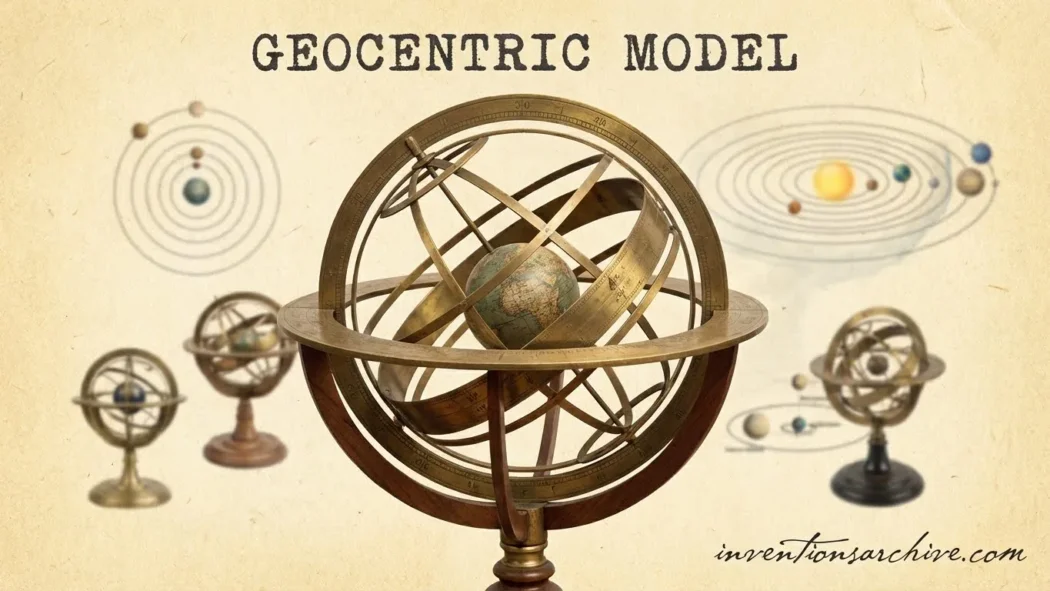
| Armillary Sphere Models | Rings representing celestial circles around Earth | Made the model visible as a physical teaching instrument |
Before and After
The geocentric model did not replace a modern scientific system. It replaced scattered observation with a more organized way to describe the sky. Its later replacement also happened gradually, as new models explained planetary motion with fewer physical assumptions.
| Before the Model Took Shape | What Changed After It |
|---|---|
| Sky observations were often recorded as cycles, omens, calendar markers, or local traditions. | Greek and later Ptolemaic astronomy arranged observations into geometric models and tables. |
| Planetary wandering was difficult to explain in a single ordered system. | Epicycles and deferents gave a structured way to model retrograde motion. |
| Teaching the heavens depended heavily on description and observation. | Spheres, diagrams, and instruments made the cosmic order easier to teach. |
| Calendrical and astronomical prediction had fewer shared mathematical tools. | Planetary tables and geometric astronomy became central to advanced learning. |
| Earth’s place in the universe was treated through older cosmological ideas. | Later heliocentric and gravitational models forced a new explanation of Earth as a moving planet. |
What Ptolemy Added
Ptolemy did not simply say that everything circled Earth. His work made the model mathematically stronger. He used several linked geometric devices to match observed positions more closely.
NASA describes the Ptolemaic system as placing Earth at the center, arranging the Moon, Mercury, Venus, Sun, Mars, Jupiter, and Saturn beyond it, and using large circles with smaller epicycles to account for observed motions.[c]
The most important parts were:
- Deferent: the larger circular path.
- Epicycle: a smaller circle carried along the deferent.
- Eccentric: a circle whose center was not exactly Earth.
- Equant: an off-center point used to make motion appear uniform in a mathematical sense.
This system was clever but demanding. It preserved circular motion while allowing the model to follow irregular-looking planetary paths.
How the Model Was Used
The geocentric model was used in education, calendar work, astronomy, astrology, religious cosmology, and learned debate. It shaped how many scholars pictured the order of the heavens.
In practical astronomy, its value came from prediction. Astronomers could use tables to estimate where celestial bodies would appear. In teaching, it gave students a structured picture of the universe. In instrument making, it influenced armillary spheres and celestial diagrams.
The University of Nebraska-Lincoln’s astronomy education material explains how early modelers used spheres, and how Ptolemy introduced epicycles, deferents, and the equant to deal with retrograde motion.[d]
How It Spread and Changed Over Time
The geocentric model moved through languages, schools, manuscripts, commentaries, and teaching instruments. Greek astronomy was studied, translated, discussed, and adapted across the Mediterranean and beyond.
Related articles: Armillary Sphere [Ancient Inventions Series]
In medieval and Renaissance education, the model was not only a technical astronomy system. It also became part of a larger view of nature, where Earth, the heavens, elements, and motion were explained together.
Stanford Encyclopedia of Philosophy notes that the traditional geocentric picture in Renaissance thought was elaborated by Ptolemy, indebted to Aristotle, and described an immobile Earth under perfect heavenly spheres.[g]
Why the Model Lasted So Long
The geocentric model lasted because it worked well enough for many visible-sky needs. It matched ordinary experience. It had a strong mathematical form. It also fit older physical ideas about Earth, heaviness, and circular heavenly motion.
It did not disappear the moment a better idea appeared. New astronomy had to answer old questions more accurately and explain why Earth’s motion was not felt in everyday life. That took time, better observations, better mathematics, and new physical theory.
What Changed After Copernicus
Copernicus did not instantly end the geocentric model. His Sun-centered arrangement changed the question. Instead of asking how the planets could be made to circle Earth, astronomers began asking whether Earth itself could be one of the moving planets.
The Library of Congress records the 1543 publication of Copernicus’s De revolutionibus orbium coelestium, whose title page is associated with the statement that the Sun, not Earth, is the center of the universe.[e]
Later work by Kepler, Galileo, and Newton changed the issue again. Elliptical orbits, telescopic observations, and gravitational theory gave astronomy a new physical basis. The old model remained important as a historical achievement, but it no longer described the real structure of the solar system.
Physical Teaching Objects and Surviving Evidence
Although the geocentric model was mainly a mathematical and cosmological idea, physical teaching objects helped people see it. The armillary sphere was one of the most important. Rings represented celestial circles, while Earth appeared at the center.
A Library of Congress exhibition describes Caspar Vopel’s 1543 terrestrial globe with armillary sphere as presenting the Ptolemaic, Earth-centered cosmic system through interlocking brass rings that illustrated the circles of the Sun, Moon, known planets, and important stars.[f]
Such objects show that the model was not only read in books. It was handled, displayed, taught, and visualized.
Common Misunderstandings
Ptolemy Did Not Create the Whole Idea Alone
The Earth-centered picture existed before Ptolemy. His lasting role was to give it a detailed mathematical form that could be used for prediction and teaching.
The Model Was Not Simply “Unscientific”
It was built from observation and geometry. Its physical assumptions were later rejected, but its methods belonged to a real history of mathematical astronomy.
Geocentric Does Not Mean Flat Earth
Many ancient and medieval scholars who used geocentric models understood Earth as spherical. The model concerned Earth’s position and motion, not a flat shape.
The Copernican Model Did Not Solve Everything at Once
Copernicus still used circular motions. The later shift to elliptical orbits and gravitational explanation made the replacement more complete.
Related Inventions
The geocentric model sits inside a wider history of astronomical tools, models, and later scientific changes. Closely related inventions and systems include:
- Armillary sphere — a ring-based teaching instrument for celestial circles.
- Astrolabe — an astronomical instrument used for measuring and modeling sky positions.
- Celestial sphere — a conceptual model for locating stars and celestial paths.
- Astronomical tables — calculated tables for predicting celestial positions.
- Heliocentric model — the Sun-centered model associated with Copernicus and later astronomy.
- Telescope — a later instrument that changed the evidence available to astronomers.
- Planetarium model — a teaching descendant used to visualize celestial motion.
Frequently Asked Questions
What is the geocentric model?
The geocentric model is an Earth-centered model of the cosmos. In its classical form, Earth is stationary while the Sun, Moon, visible planets, and fixed stars move around it.
Who created the geocentric model?
No single person created the whole model. It developed through earlier Greek astronomy and natural philosophy. Claudius Ptolemy produced the most influential mathematical version in the 2nd century CE.
Why did the geocentric model use epicycles?
Epicycles helped explain why planets sometimes appeared to slow down, stop, reverse direction, and then move forward again when viewed from Earth.
Was the geocentric model the same as believing Earth was flat?
No. The geocentric model placed Earth at the center of the cosmos, but many scholars who used it understood Earth as spherical.
What replaced the geocentric model?
It was gradually replaced by heliocentric astronomy, especially after Copernicus, Kepler, Galileo, and Newton supplied stronger mathematical, observational, and physical explanations.
Sources and Verification
- [a] The Geocentric Model — Used to verify the Greek geocentric assumptions, Ptolemy’s role, and the use of epicycles and deferents. (Reliable because it is a university astronomy course page from Penn State.)
- [b] How the Greeks Used Geometry to Understand the Stars — Used to verify Eudoxan spheres, Aristotelian celestial spheres, Hipparchus, and Ptolemy’s circular-motion tradition. (Reliable because it is an educational astronomy history resource from the University of Virginia.)
- [c] Interesting Fact of the Month 2023 – NASA — Used to verify the Ptolemaic order of celestial bodies and the use of large circles and epicycles. (Reliable because it is an official NASA source.)
- [d] Early Modeling – Solar System Models – NAAP — Used to verify the educational explanation of early spheres, retrograde motion, and Ptolemy’s deferent, epicycle, and equant. (Reliable because it is a university astronomy education resource from the University of Nebraska-Lincoln.)
- [e] Title page of De revolutionibus orbium coelstium, with statement that the sun, and not the earth, is the center of our universe — Used to verify the 1543 publication context of Copernicus’s work. (Reliable because it is a Library of Congress catalog record.)
- [f] The Mediterranean World – 1492: An Ongoing Voyage — Used to verify the Caspar Vopel armillary sphere and its Ptolemaic, Earth-centered presentation. (Reliable because it is a Library of Congress exhibition page.)
- [g] Aristotelianism in the Renaissance — Used to verify the Renaissance description of the traditional geocentric picture as Ptolemaic and Aristotelian in character. (Reliable because it is a Stanford Encyclopedia of Philosophy entry.)