
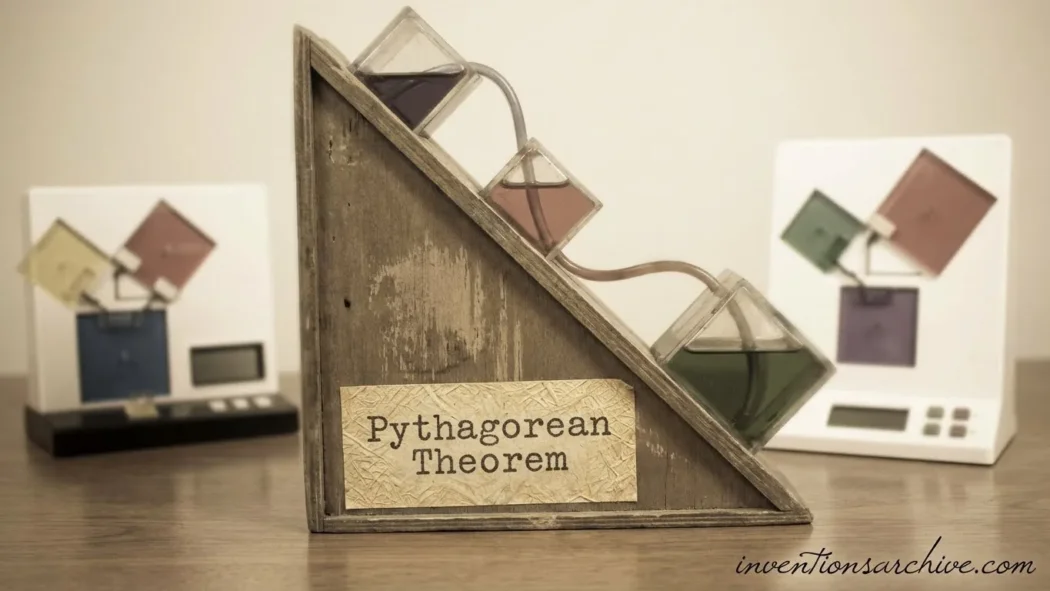
| Invention Name | Pythagorean Theorem |
|---|---|
| Short Definition | A rule in Euclidean geometry stating that, in a right triangle, the square on the hypotenuse equals the sum of the squares on the two shorter sides. |
| Common Formula | a2 + b2 = c2, where c is the hypotenuse. |
| Approximate Date / Period | Old Babylonian evidence: 19th–17th century BCE Based on surviving evidence; Euclid’s written proof: around 300 BCE Approximate |
| Geography | Southern Mesopotamia; later Greek, Indian, Chinese, and wider mathematical traditions |
| Inventor / Source Culture | Anonymous and multi-tradition; named after Pythagoras, but earlier evidence survives from Babylonian mathematics Attribution varies |
| Category | Science, measurement, education, geometry, mathematical reasoning |
| Main Problem Solved | Finding or checking unknown lengths in right triangles without direct measurement |
| How It Works | The areas of the two squares built on the legs of a right triangle equal the area of the square built on the hypotenuse. |
| Technical Principle | Right-angle geometry, squares on side lengths, proportional triangles, numerical triples |
| Early Evidence | YBC 7289; Plimpton 322; later Greek proof tradition in Euclid’s Elements |
| Early Uses | Scribal mathematics, geometric problem solving, land measurement, construction planning, education |
| Development Path | Right-triangle calculations → geometric theorem → written proof → algebraic formula → coordinate geometry and applied mathematics |
| Evidence Status | Confirmed for surviving Babylonian mathematical evidence; Debated for personal attribution to Pythagoras |
| Related Inventions | Surveying tools, geometric diagrams, Euclidean proof, coordinate grids, trigonometric tables, engineering drawing |
| Modern Descendants | Distance formula, vector length, navigation calculations, architecture, physics, computer graphics, engineering design |
What the Pythagorean Theorem Is
The Pythagorean Theorem describes a right triangle: a triangle with one angle of exactly 90 degrees. If the two shorter sides are called a and b, and the longest side opposite the right angle is called c, the relationship is written today as a2 + b2 = c2.
That modern formula is compact, but the older geometric idea is even clearer. Imagine a square built on each side of a right triangle. The area of the square on the longest side equals the combined areas of the two squares on the shorter sides. This is why the theorem belongs to area, distance, and right-angle geometry at the same time.
It applies only to right triangles. It does not say that every triangle follows this rule, and it does not merely mean that a diagonal is “shorter than walking around two sides.” That common shortcut idea is closer to the triangle inequality, not the Pythagorean Theorem.
Why This Mathematical Invention Mattered
Before reliable right-triangle rules were written and taught, unknown distances had to be estimated, measured directly, or handled through local rules of craft. The theorem gave scribes, builders, teachers, and later scientists a stable relationship between three lengths.
Its value was not only in one calculation. It helped people think about space in a repeatable way. A right angle, two known sides, and one unknown side could become a solvable relation. That made measurement more portable: the same idea could move from a tablet exercise to a survey, a classroom diagram, a proof, or a technical drawing.
How the Rule Works in Simple Terms
The theorem is about squares on lengths, not just the lengths themselves. A side of length 3 has a square area of 9. A side of length 4 has a square area of 16. A side of length 5 has a square area of 25. Since 9 + 16 = 25, a triangle with side lengths 3, 4, and 5 can be a right triangle.
This is why 3-4-5 triangles appear so often in teaching examples. They are not the whole theorem. They are one easy set of whole numbers that fits it. Such sets are called Pythagorean triples.
The theorem also explains the diagonal of a square. If both sides of a right triangle are equal, the diagonal relates to the square root of 2. That is the idea visible in YBC 7289, where the Babylonian notation gives a remarkably accurate value for this relationship.
Earlier Ideas and Tools Before the Theorem
The theorem grew from practical and intellectual needs that came before formal proof. Ancient people worked with fields, building lines, altars, diagrams, and numerical tables. These activities did not always require an abstract theorem in the modern sense, but they did require reliable right angles and dependable length relations.
- Geometric diagrams: squares, diagonals, and right angles helped turn visual space into mathematical form.
- Numerical tables: scribal cultures used tables to train calculation and solve standard problems.
- Surveying practice: measured land and planned boundaries created a need for consistent right-angle methods.
- Proof traditions: Greek mathematics later placed geometric knowledge into a formal deductive structure.
These earlier tools matter because the theorem was not a sudden isolated discovery. It was a meeting point between measurement practice, numerical skill, and geometric reasoning.
Before and After the Theorem
| Before the Theorem Was Formalized | What Changed After It Was Written and Taught |
|---|---|
| Distances and diagonals often depended on direct measurement, local practice, or repeated examples. | Unknown right-triangle sides could be found or checked through a general relationship. |
| Whole-number triples could be useful, but their wider rule might not be stated as an abstract theorem. | Pythagorean triples became part of a broader geometric and numerical pattern. |
| Right-angle work existed in practical settings such as layout, land measurement, and teaching exercises. | Geometry could explain why the relationship works, not only that certain examples work. |
| Mathematical knowledge was often tied to scribal or craft settings. | The theorem entered formal education, proof-based geometry, and later algebraic notation. |
| Spatial calculation was limited by tools, local methods, and available records. | The same idea could be reused in architecture, navigation, physics, engineering, and digital geometry. |
How Its Origin Is Traced
The origin of the Pythagorean Theorem is traced through surviving objects, written mathematical traditions, and later historical reports. The safest reading is not that one person suddenly created the theorem. The evidence points to older practical knowledge, then later formal proof and naming.
Babylonian Evidence
Old Babylonian tablets are central because they survive as physical records. YBC 7289 shows the diagonal of a square and an accurate value connected with the square root of 2. Plimpton 322 lists numerical relationships that fit Pythagorean triples. These tablets do not look like a modern textbook page, but they show that scribes handled right-triangle relations with real mathematical sophistication.
Columbia University’s exhibition material notes that Plimpton 322 was interpreted in the 1940s by Otto Neugebauer and Abraham Sachs as containing Pythagorean triples, while later scholarship has also considered a more ordinary teaching or problem-generation role for the tablet. That makes the object more interesting, not less: it shows mathematics as part of scribal learning, not only as a named theorem. [c]
Greek Proof Tradition
The theorem is most famously preserved in Greek geometry through Euclid’s Elements. In Book I, Proposition 47, Euclid states the right-triangle relation geometrically: the square on the side opposite the right angle equals the squares on the sides containing the right angle. This is a proof-based presentation, not only a numerical example. [d]
This Greek proof tradition helped make the theorem part of formal education for centuries. It also shaped the way later cultures taught geometry: definitions first, then propositions, then proof.
Pythagoras and Attribution
Pythagoras of Samos lived much later than the Old Babylonian tablets. The University of St Andrews MacTutor biography notes both the importance of Pythagoras in mathematical tradition and the uncertainty around his direct writings and personal mathematical achievements. It also notes that the theorem was known to the Babylonians earlier, while Pythagoras may have been associated with its proof. [e]
This is why careful wording matters. It is safe to say the theorem is named after Pythagoras. It is not safe to say, without qualification, that he was the first person ever to know the relationship.
Development Path from Earlier Tools to Later Forms
| Stage | Form | What Changed |
|---|---|---|
| Earlier Tool | Right-angle layout, diagonal measurement, whole-number length patterns | Practical geometry supported construction, land work, and teaching before formal theorem language. |
| Early Written Evidence | Old Babylonian tablets such as YBC 7289 and Plimpton 322 | Right-triangle relationships and related numerical patterns were recorded in durable mathematical objects. |
| Named Theorem | Pythagorean Theorem | The rule became associated with Pythagoras and the Pythagorean tradition, though attribution is not simple. |
| Formal Proof | Euclid’s Elements, Book I, Proposition 47 | The theorem was placed inside a proof-based geometric system. |
| Algebraic Form | a2 + b2 = c2 | The geometric statement became easier to use in symbolic mathematics and education. |
| Modern Descendant | Distance formula, vector length, analytic geometry, computer graphics | The same right-triangle relation became a tool for measuring distance in coordinate systems and digital spaces. |
Main Types, Versions, and Related Forms
The theorem has one central meaning, but it appears in several forms. These versions help explain why the idea moved so easily from ancient geometry into modern science and technology.
| Form | Expression | Main Use |
|---|---|---|
| Geometric Statement | The square on the hypotenuse equals the sum of the squares on the two legs. | Proof-based geometry and visual explanation |
| Algebraic Formula | a2 + b2 = c2 | Finding an unknown side in a right triangle |
| Pythagorean Triples | Whole-number sets such as 3, 4, 5 or 5, 12, 13 | Teaching, checking right angles, number theory |
| Converse Form | If a triangle’s sides satisfy the relation, the triangle is right-angled. | Testing whether a triangle is a right triangle |
| Distance Formula | Distance from horizontal and vertical differences | Coordinate geometry, maps, design, digital graphics |
| Higher-Dimensional Form | Length from squared components | Vectors, physics, data spaces, engineering calculations |
Early Uses and Spread
The earliest surviving evidence points to mathematical cultures where scribes used tablets, tables, diagrams, and standard problems. In that world, the theorem was not a classroom slogan. It was part of the way trained people handled numbers, shapes, and measurements.
Later traditions show the same relationship in different forms. Indian mathematical texts linked right-triangle geometry to altar construction and geometric transformation. The MacTutor history project notes that the Baudhayana Sulba Sutra contains a statement of the theorem and Pythagorean triples in a religious-geometry context. [f]
Greek geometry then gave the theorem a proof-centered home. The theorem’s spread was not a single road from one person to the whole world. It was a long transfer across scribal education, geometric proof, religious geometry, practical measurement, and later algebra.
What Changed Because of It
The Pythagorean Theorem gave later mathematics a simple bridge between shape and number. A triangle became more than a figure. It became a relation that could be tested, proved, and reused.
Several fields benefited from that shift:
- Geometry: right triangles became a foundation for many later results.
- Surveying: diagonal lengths and right-angle checks became more systematic.
- Architecture: plans and layouts could use geometric consistency rather than guesswork alone.
- Navigation and mapping: distance across coordinate-like spaces could be modeled mathematically.
- Physics: perpendicular components of motion, force, and distance could be combined through squared lengths.
- Computing: pixels, vectors, game environments, and graphics use distance relationships that descend from the same idea.
The theorem’s real influence is not that it is difficult. It is influential because it is small, exact, and reusable.
Common Misunderstandings
Pythagoras Was Not Necessarily the First Person to Know It
The theorem carries his name because of later Greek mathematical tradition. Surviving Babylonian evidence is older than Pythagoras, so personal invention should be treated carefully.
The Formula Is Modern, the Idea Is Older
Ancient texts and tablets did not present the theorem with today’s algebraic symbols. The compact form a2 + b2 = c2 is a later way to express an older geometric relation.
It Applies Only to Right Triangles
The theorem does not work for every triangle. The 90-degree angle is the condition that makes the relation true.
A Theorem Is Not an Unproven Guess
In mathematics, a theorem is a statement proved from accepted assumptions. The word is not used the same way as “theory” in everyday speech.
Related Inventions and Later Developments
The Pythagorean Theorem sits near several other inventions, tools, and mathematical developments. These related ideas help place it inside a wider history of measurement and proof.
- Surveying rope and measuring cords: practical tools for laying out distance and right angles.
- Geometric diagramming: drawn squares, triangles, and diagonals used to reason about space.
- Euclidean geometry: the proof tradition that preserved the theorem as a formal proposition.
- Trigonometric tables: later systems for working with angles and side ratios.
- Cartesian coordinate system: a later mathematical system where the theorem becomes the distance formula.
- Engineering drawing: technical plans that rely on consistent length and angle relationships.
- Computer graphics: digital distance, vectors, and spatial rendering built on related geometric principles.
Frequently Asked Questions
What is the Pythagorean Theorem?
The Pythagorean Theorem is a geometric rule for right triangles. It states that the square of the hypotenuse equals the sum of the squares of the two shorter sides.
Did Pythagoras invent the Pythagorean Theorem?
The theorem is named after Pythagoras, but older Babylonian evidence shows that right-triangle relationships were known before his lifetime. His connection is usually treated as part of Greek proof tradition rather than as certain first invention.
What is the oldest evidence for the theorem?
Important early evidence includes Old Babylonian tablets such as YBC 7289 and Plimpton 322. These objects show knowledge of right-triangle relationships, square diagonals, and Pythagorean triples long before the Greek proof tradition.
Why is the theorem important today?
It remains important because it connects geometry, distance, and measurement. Modern uses appear in architecture, physics, surveying, coordinate geometry, computer graphics, engineering, and many school mathematics topics.
Does the Pythagorean Theorem work for every triangle?
No. The theorem applies to right triangles only. If a triangle does not have a 90-degree angle, its side lengths do not follow the Pythagorean relation in the same way.
Sources and Verification
- [a] Before Pythagoras: Tablet illustrating Pythagoras’ Theorem and the square root of 2 — Used to verify YBC 7289, its Old Babylonian date range, and its relation to the diagonal of a square and square root of 2. (Reliable because it is an institutional exhibition page from New York University’s Institute for the Study of the Ancient World.)
- [b] Before Pythagoras: Table of whole-number sides of Pythagorean triangles — Used to verify Plimpton 322, Pythagorean triples, and the scholarly debate over the tablet’s purpose. (Reliable because it is an institutional mathematics-history exhibition from New York University’s Institute for the Study of the Ancient World.)
- [c] Columbia University Libraries Online Exhibitions — Our Tools of Learning — Used to verify Plimpton 322’s collection context, date range, Neugebauer and Sachs interpretation, and later educational interpretation. (Reliable because it is an official Columbia University Libraries exhibition page.)
- [d] Euclid, Elements, Book I, Proposition 47 — Used to verify the classical Greek proof statement of the theorem in Euclid’s Elements. (Reliable because it is hosted by the Perseus Digital Library at Tufts University.)
- [e] Pythagoras — MacTutor History of Mathematics — Used to verify the cautious attribution to Pythagoras and the note that earlier Babylonian knowledge existed. (Reliable because MacTutor is a long-running history of mathematics resource from the University of St Andrews.)
- [f] Mathematics in the service of religion: II. Sulba Sutras — Used to verify the Sulba Sutra connection with right-triangle geometry, Pythagorean triples, and altar-construction mathematics. (Reliable because it is part of the University of St Andrews MacTutor History of Mathematics project.)