
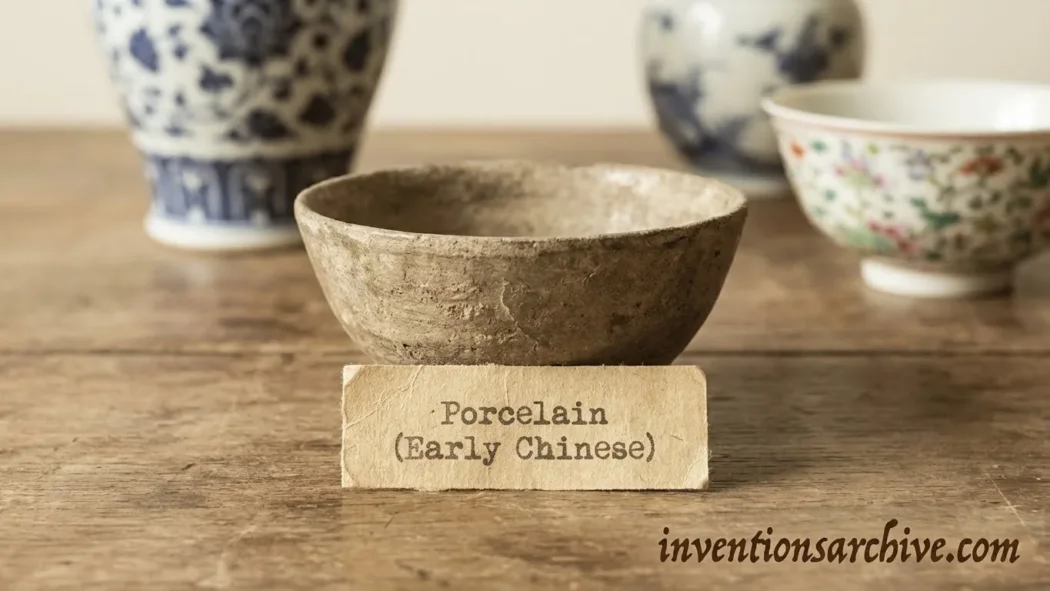
| Invention Name | Porcelain(Early Chinese) |
|---|---|
| Short Definition | A refined, high-fired ceramic body known for hardness, whiteness, low porosity, and, in many examples, partial translucency. |
| Approximate Date / Period | Proto-porcelain antecedents from the Erlitou period (about 1750–1550 BCE); mature glazed porcelain is identified by some archaeometric studies by the late Eastern Han period; later porcelain traditions expanded through the first millennium CE and at Jingdezhen. Definition-dependent[a] |
| Geography | China; early activity in northern and southern kiln regions, with later strength at Jingdezhen, Jiangxi. |
| Inventor / Source Culture | Anonymous Chinese ceramic workshops and kiln communities. Attribution varies |
| Category | Material, manufacturing, craft technology, trade, culture |
| Main Problem Solved | Created a finer, stronger, less porous ceramic than ordinary earthenware for tableware, storage, ritual, tea culture, and export. |
| Material / Technology Base | Refined white clay, kaolin-rich materials, feldspathic stone, glaze chemistry, and high-temperature kiln firing. |
| How It Worked | The ceramic body was fired hot enough for part of the material to vitrify, producing a hard, glassy, dense structure. |
| Evidence Status | Based on proto-porcelain and porcelain vessels, shards, kiln sites, compositional studies, museum objects, and later written records. Terminology varies by period and material |
| Surviving Evidence | Erlitou-period proto-porcelain evidence; Shang–Zhou proto-porcelain; later glazed porcelain and celadon; early white-glazed porcelain; Jingdezhen kiln remains; museum collections. |
| Development Path | White and hard pottery traditions → proto-porcelain → mature glazed porcelain and celadon → refined white porcelain → Jingdezhen production and export expansion → later global porcelain traditions |
| Related Inventions | High-temperature kiln, glazed stoneware, celadon, cobalt underglaze painting, hard-paste porcelain, soft-paste porcelain, bone china |
| Modern Descendants | Fine tableware, laboratory porcelain, electrical insulators, sanitary ceramics, dental ceramics, and technical ceramic materials |
| Importance | It changed ceramic production by combining beauty, durability, heat resistance, and global trade value in one material. |
Porcelain was one of the most refined ceramic inventions to emerge from early China. It was not simply “better pottery.” It was a new kind of fired material: dense, hard, often white, sometimes translucent, and able to hold liquids without the coarse absorbency of ordinary earthenware. Its invention depended on materials, kiln heat, clay preparation, glaze control, and workshop knowledge coming together over time.
Early Chinese porcelain also changed how ceramics moved through the world. A bowl, cup, dish, or ewer made from this material could serve daily life, elite dining, tea drinking, court display, religious use, and long-distance trade. Few materials crossed so easily between craft, science, commerce, and taste.
What Early Chinese Porcelain Was
Early Chinese porcelain was a high-fired ceramic made from refined mineral-rich clays and related stone materials. In simple terms, it sat beyond ordinary pottery because its body became hard, dense, and glassy during firing. Many examples were white or pale in body, and some were thin enough to show a soft translucency when held toward light.
Porcelain should not be confused with every white ceramic. A white surface alone does not make an object porcelain. The material depends on the fired body: its density, vitrification, hardness, and relationship between clay and glaze. That is why some early pieces are described carefully as porcelain, porcellanous stoneware, or high-fired ware, depending on their structure and scholarly classification.
Early Chinese porcelain was a material invention as much as an artistic one. It required clay bodies that could survive high temperatures without collapsing, kilns capable of controlled heat, and glazes that fused properly with the vessel surface.
How Its Origin Is Traced
The origin of porcelain is traced through surviving objects, archaeological kiln remains, ceramic shards, compositional analysis, and written references. A useful later example is a 7th-century Sui–Tang bowl in The Metropolitan Museum of Art, described as porcelain with white glaze. The same museum discussion links Chinese porcelain to kaolin clay and high-temperature firing, noting its role as a valued trade object.[c]
Archaeometric evidence now extends the technical ancestry much farther back. A 2026 study of the Dongtiaoxi production center describes proto-porcelain as first appearing during the Erlitou period (about 1750–1550 BCE) and continuing through the Shang, Zhou, Qin, and Western Han periods.[a] A separate 2026 study of proto-porcelain from the Tangbei site in Suzhou found a regional technological trajectory shaped by Yue ceramic traditions and changing over time rather than following one fixed recipe.[d]
This evidence does not prove the absolute first porcelain vessel ever made. It shows that the ceramic technologies leading toward porcelain were already developing in the second millennium BCE, while later categories such as mature glazed porcelain, celadon, white porcelain, and hard-paste porcelain need to be distinguished from those earlier antecedents.
Proto-Porcelain and Mature Porcelain
Proto-porcelain is an antecedent, not simply an early name for fully mature porcelain. Archaeometric literature uses the term for early high-fired glazed ceramics made with porcelain-stone bodies and related technologies. These wares already show part of the material and kiln tradition that later supported porcelain, but their bodies, glazes, production control, and classifications differ from later mature wares.
A 2025 archaeometric study places the earliest confirmed proto-porcelain production around the transition between the Xia and Shang periods and describes continued development through the Shang and Zhou. The same study states that proto-porcelain was later superseded by celadon after mature glazed porcelain developed during the late Eastern Han period.[e] This does not create one universally agreed “first porcelain” date; it marks a material transition that scholars classify in different ways.
| Stage | Approximate Period | What the Evidence Shows |
|---|---|---|
| Proto-Porcelain Antecedents | Second millennium BCE onward; Erlitou evidence about 1750–1550 BCE | High-fired glazed ceramics formed an early technological line leading toward later porcelain traditions. |
| Mature Glazed Porcelain | Definition-dependent; developed by the late Eastern Han in some archaeometric literature | Material and glaze control moved beyond proto-porcelain, with celadon and later porcelain traditions following. |
| Jingdezhen Production and Export Expansion | Later first millennium CE onward; especially Song, Yuan, Ming, and Qing | Specialized production, court demand, decoration, and long-distance trade expanded without representing the first origin of porcelain technology. |
Archaeometry and Production Technology Matrix
Material studies make the long transition easier to compare, but the columns do not all come from the same test. A reported firing temperature is included only where the cited study measured or explicitly reported it. A dash means that the cited dataset did not provide a directly comparable value for that field.
| Period | Archaeological Site | Body Raw Material | Glaze Type | Vitrification Indicator | Kiln / Firing Technology | Reported Firing Temperature | Classification |
|---|---|---|---|---|---|---|---|
| Maqiao culture | Tangbei, Suzhou | Porcelain stone used as the body raw material | High-temperature calcium-rich glaze with plant ash as the main flux source; early surfaces can be very thin or patchy | Glassy matrix and mullite are present, but many early samples show weaker vitrification and less-developed mullite | High-temperature firing was already available, while temperature and atmosphere control remained uneven | 1202 ± 10°C for sample MQ3 | Proto-porcelain[d] |
| Post-Maqiao culture | Tangbei, Suzhou | Porcelain stone | Calcium-rich plant-ash glaze; some early glaze surfaces may also reflect ash deposition during firing | Vitrification becomes more controlled; well-developed mullite appears in some samples | Improved control of firing temperature and atmosphere compared with the preceding phase | 1109 ± 10°C for sample HMQ4 | Proto-porcelain[d] |
| Spring and Autumn period | Tangbei, Suzhou | Porcelain stone; raw-material preparation became more selective than in the earlier phases | High-temperature calcium-rich plant-ash glaze; applied glaze becomes more regular | More developed glass phase and mullite; body processing and firing became more controlled | High-temperature production operating around the same thermal range as later Tangbei phases | 1186 ± 10°C for sample CQ2 | Proto-porcelain[d] |
| Warring States period | Tangbei, Suzhou | Porcelain stone | High-temperature calcium-rich plant-ash glaze | Dense acicular mullite and strongly vitrified matrix occur; the tested group also shows evidence of overfiring at high temperature | High-temperature firing above 1200°C in the measured specimen | 1235.5 ± 10°C for sample ZG6 | Proto-porcelain[d] |
| Han dynasty | Tangbei, Suzhou | Porcelain stone | High-temperature calcium-rich plant-ash glaze | Glassy phase and mullite remain present; high firing temperature did not by itself produce a uniform rise in body quality | Firing temperature had stabilized near the high-temperature range used in the preceding phases | 1180.2 ± 10°C for sample HD2 | Proto-porcelain / high-fired glazed ware[d] |
| Late Eastern Han | Xiaoxiantan Yue kiln, Shangyu, Zhejiang | Porcelain-stone / china-stone body characteristic of southern Yue production | Thin transparent high-temperature celadon glaze; calcium-rich glaze technology belongs to the southern high-fired tradition | A measured green-glazed shard had a sintered body, 0.62% apparent porosity and 0.28% water absorption; studies of early mature Yue celadon also report denser bodies and more complete firing than earlier proto-celadon | High-temperature Yue firing; reduction firing is associated with the green glaze. Surviving kiln remains at Xiaoxiantan are incomplete | 1310 ± 20°C for the cited green-glazed stamped lei shard; other reported Xiaoxiantan samples include 1260 ± 20°C and 1270 ± 20°C | Mature celadon / mature glazed porcelain Definition-dependent[k][l] |
The matrix does not treat the Erlitou date as a laboratory temperature measurement. The 2026 Dongtiaoxi study places the appearance of proto-porcelain in the Erlitou period (about 1750–1550 BCE) and describes the broader technology as porcelain-stone bodies, lime-rich plant-ash glazes, and firing around 1200°C, but its 43 newly analyzed shards come from later production sites. The early date therefore belongs in the historical sequence without being converted into a measured Erlitou firing value.[a]
The transition to mature porcelain cannot be reduced to a single temperature threshold. The late Eastern Han comparison is stronger because several material properties move together: a denser fired body, lower porosity and water absorption, better-controlled glaze, and high-temperature firing. That is also why the terminology remains definition-dependent across archaeological and ceramic-science literature.[k]
The Problem Porcelain Answered
Before porcelain, people used earthenware, stoneware, bronze vessels, lacquerware, wood, and metal containers for food, drink, storage, and ritual. These materials worked well in many settings, but each had limits.
- Earthenware could be porous unless well glazed.
- Bronze and other metals were costly and heavy.
- Lacquerware was elegant but not suitable for every kind of heat or liquid use.
- Stoneware was strong, but it did not always provide the pale, refined surface that later porcelain offered.
Porcelain answered these limits by offering a material that was durable, clean-looking, finely shaped, and suitable for repeated use. It could be made into thin bowls, cups, jars, dishes, ewers, ritual vessels, and export wares. For tea drinking and refined dining, its surface and body gave a very different experience from coarse pottery.
| Before Early Porcelain | What Changed After Porcelain |
|---|---|
| Common pottery could be porous, thick, or coarse. | Porcelain offered a dense, hard, fine-grained body with a more refined surface. |
| High-status vessels often depended on metal, lacquer, or rare stone materials. | Porcelain gave workshops a fired ceramic that could look elegant while remaining practical. |
| Color and surface quality depended heavily on glaze alone. | The body itself became part of the appeal: white, pale, thin, and sometimes translucent. |
| Long-distance trade favored durable objects, but breakage and weight mattered. | Porcelain became a high-value trade ceramic that could travel by land and sea. |
| Foreign potters could imitate Chinese forms but not always the material body. | Chinese porcelain became a model that later inspired soft-paste, hard-paste, and bone china traditions elsewhere. |
How It Worked in Simple Terms
Porcelain worked because the ceramic body was fired at a high enough temperature for some mineral components to melt and bind the structure together. This process, called vitrification, made the fired body dense and glassy rather than crumbly or open-textured.
Reference descriptions of hard-paste porcelain usually mention kaolin, a white china clay, and petuntse, or china stone. In firing, the feldspathic stone helped form a glassy phase, while the refractory clay helped the object keep its shape under heat.[f]
That is the central technical idea: one part helped the body fuse, while another helped it stand. The result was a material that could be thin, strong, and clean in appearance.
Earlier Ideas and Materials Before Porcelain
Porcelain did not appear in an empty space. China already had long ceramic traditions before porcelain became distinct. Potters knew how to shape clay, apply glaze, build kilns, manage firing atmospheres, and imitate vessel forms from bronze, jade, lacquer, and metalwork.
The earlier sequence also included white pottery, hard pottery, and proto-porcelain. Recent compositional studies treat proto-porcelain as part of a long transition in raw-material selection, glaze use, and high-fired ceramic production rather than as a sudden appearance of mature porcelain.[e]
Another important path ran through high-fired stoneware and green-glazed wares. Yue wares from Zhejiang, for example, were praised in Tang texts and improved through kiln technologies such as saggars, protective clay fire boxes that helped shield vessels during firing.[g]
These traditions pushed ceramic production toward higher heat, cleaner surfaces, thinner forms, controlled glazing, and better kiln management. Mature porcelain grew from this much older workshop history.
| Stage | Form | What Changed |
|---|---|---|
| Earlier Tool | Earthenware and glazed pottery | Useful fired clay vessels, but often thicker, more porous, or less refined. |
| Early Technical Antecedent | White pottery, hard pottery, and early high-fired ceramic traditions | Raw-material selection, higher firing, and glaze experiments developed before mature porcelain. |
| Proto-Porcelain | Erlitou through Shang, Zhou, Qin, and Western Han traditions | Porcelain-stone bodies and applied glazes formed a long-lived predecessor technology. |
| Mature Glazed Porcelain | Late Eastern Han and later, depending on classification | Body and glaze technology moved beyond proto-porcelain and into mature glazed ware and celadon traditions. |
| Refined Porcelain Traditions | Sui–Tang through Song | White porcelain, celadon, qingbai, and related wares developed more specialized material and kiln control. |
| Jingdezhen Expansion | Song, Yuan, Ming, and Qing | Production scale, decoration, court organization, and export networks expanded. |
| Modern Descendant | Hard-paste porcelain, bone china, technical ceramics | The idea of a strong vitrified ceramic body spread into tableware, science, industry, and design. |
Main Materials and Technical Principles
The main technical principle behind porcelain was the controlled transformation of mineral-rich clay into a dense fired body. The exact recipes varied by region and period. Early workshops did not work from modern industrial formulas. They relied on local deposits, repeated testing, trained touch, and kiln experience.
Clay Body
The body needed to be fine enough for refined shaping and strong enough to survive firing. Kaolin-rich clay later became closely linked with hard-paste porcelain because it could endure high heat without losing form.
Feldspathic Stone
China stone, or petuntse, helped the body vitrify. This gave porcelain its hard, glassy quality. Without the right mineral balance, a vessel might warp, slump, crack, or fail to become dense.
High-Temperature Kilns
The kiln was not just a container for heat. It was part of the invention. Kiln design, fuel, airflow, stacking, and firing control affected the final body and glaze. Porcelain depended on repeatable high heat, not only good clay.
Glaze Fit
Porcelain surfaces depended on glaze that fused with the body without peeling, crawling, or cracking in unwanted ways. Some crackled glazes later became admired effects, but early porcelain required strong control over body and surface.
Early Uses in Daily and Elite Life
Early porcelain moved through several kinds of use. It was not limited to one social class or one function, although fine examples were often expensive and admired.
- Tableware: bowls, cups, dishes, and serving vessels.
- Tea culture: refined bowls and cups suited to changing preferences in drinking and display.
- Court and elite use: pale bodies, fine forms, and controlled glazes made porcelain desirable for high-status settings.
- Ritual and religious contexts: later porcelain forms served temples, court ritual, and ceremonial exchange.
- Trade: porcelain became a portable luxury material that could travel across long routes.
Its value came from more than appearance. A porcelain vessel could be light, strong, smooth to the touch, and visually clean. That made it suitable for food, drink, storage, gift exchange, and collecting.
How It Spread and Changed Over Time
Porcelain spread first through Chinese kiln networks, then through domestic markets, court demand, and long-distance trade. Jingdezhen became especially important. UNESCO describes the city as the “Porcelain Capital,” with ancient porcelain production stretching back more than 1,700 years, and notes that porcelain traveled over land and sea along Silk Road routes for hundreds of years.[h]
Jingdezhen’s strength came from more than one factor. It had access to suitable raw materials, skilled labor, kiln organization, water routes, and demand from court and commercial buyers. Over time, it became a center where material science, craft discipline, and large-scale production reinforced one another.
By the Yuan, Ming, and Qing periods, porcelain was no longer only an early Chinese ceramic achievement. It had become a global trade material. Foreign courts, merchants, and potters studied it, collected it, copied its surfaces, and tried to reproduce its body.
Main Types and Variations
Early Chinese porcelain did not remain one fixed object type. It developed into several related bodies, glazes, and decorative traditions. Some terms refer to true porcelain; others describe high-fired wares closely connected to its development.
| Type or Variation | Period or Context | Why It Matters |
|---|---|---|
| Proto-Porcelain | Erlitou period through the first millennium BCE and into the early imperial period | An earlier high-fired glazed ceramic stage that preceded mature porcelain and should not be treated as identical to it. |
| Early White-Glazed Porcelain | Sui–Tang and related early contexts | Shows later refinement toward pale, dense ceramic bodies that museums commonly classify as porcelain. |
| Yue and Celadon-Related High-Fired Wares | Third–tenth centuries and later | Helped develop kiln control, glaze quality, and high-status ceramic culture. |
| Qingbai Ware | Song and Yuan periods | Known for pale bluish-white glaze and thin, refined porcelain bodies. |
| Ding-Type White Ware | Song period and related northern traditions | Important for white-bodied, refined ceramic taste and court-quality production. |
| Shufu Ware | Yuan period | Often seen as a step between qingbai traditions and later Jingdezhen porcelain. |
| Blue-and-White Porcelain | Tang experiments; major refinement in Yuan Jingdezhen | Combined white porcelain bodies with cobalt underglaze decoration. |
| Imperial Jingdezhen Porcelain | Ming and Qing periods | Linked to court supervision, specialized workshops, and wide export influence. |
Jingdezhen and Large-Scale Porcelain Production
Jingdezhen became the best-known name in Chinese porcelain because it joined raw materials, skilled workshops, water transport, kiln systems, and court demand. Its later imperial kiln sites show how porcelain production became organized at a large scale.
The UNESCO World Heritage Centre’s description of the Imperial Kiln Sites of Jingdezhen notes porcelain-firing workshops, kiln ruins, porcelain pieces deposited underground, raw-material mining and processing sites, water transportation docks, and other remains tied to porcelain production and transport.[i]
This matters for invention history because Jingdezhen represents the expansion and organization of an already long-developing ceramic technology, not the first appearance of porcelain itself. Porcelain became a production system involving clay extraction, processing, forming, glazing, firing, sorting, transport, and court selection.
Blue-and-White Porcelain and Later Influence
Blue-and-white porcelain was not the earliest form of Chinese porcelain, but it became one of the most recognizable. V&A records describe blue-and-white ceramics as first appearing in the Tang dynasty, with Yuan-period Jingdezhen potters refining clay recipes by adding kaolin and developing firing technology; cobalt pigment came from Yunnan or was imported from the Middle East.[j]
This later development shows how porcelain could absorb outside materials and taste while remaining rooted in Chinese kiln technology. The white body became a surface for cobalt painting. The clear glaze sealed the decoration beneath. The result traveled widely and was copied across Asia, the Islamic world, and Europe.
That is one reason porcelain is hard to treat as a single invention only. The body, glaze, kiln, decoration, trade network, and workshop organization each changed over time.
Common Misunderstandings
It Was Not Invented by One Person
Early porcelain came from workshop traditions. The names of individual early potters are not preserved as inventors.
The Earliest Surviving Piece Is Not Always the First Piece
Surviving museum objects and shards show the earliest known evidence, not necessarily the first vessel ever made.
Porcelain Is Not Just White Pottery
Color alone is not enough. The fired body, density, vitrification, and material structure matter.
Blue-and-White Was a Later Famous Branch
Blue-and-white porcelain became globally famous, but early Chinese porcelain began before that decorative style matured.
What Changed Because of Porcelain
Porcelain changed ceramics in practical and cultural ways. It gave potters a body that could support thin forms, delicate profiles, pale surfaces, and durable use. It gave courts and households objects that were both functional and refined. It gave merchants a high-value product that could move across long trade routes.
The invention also changed how other cultures thought about ceramics. For centuries, potters outside China admired Chinese porcelain and tried to imitate it. Some copied the look with white slips or tin glazes. Others later developed soft-paste porcelain, hard-paste porcelain, and bone china. Each of those later materials belongs to a larger story that begins with early Chinese porcelain.
The lasting impact was not only artistic. Porcelain helped shape dining habits, collecting, global trade, kiln science, mineral processing, and eventually technical ceramic industries.
Related Inventions
- High-Temperature Kiln: The firing technology that made dense porcelain bodies possible.
- Glazed Stoneware: A major ceramic predecessor that helped refine firing and surface control.
- Celadon: A high-fired glazed ware tradition closely tied to Chinese ceramic development.
- Kaolin Processing: The preparation of white clay materials for strong, pale ceramic bodies.
- Cobalt Underglaze Painting: A decorative technology that helped create blue-and-white porcelain.
- Hard-Paste Porcelain: The mature porcelain body later reproduced in Europe after long experimentation.
- Soft-Paste Porcelain: A European attempt to imitate Chinese porcelain before true hard-paste production spread.
- Bone China: A later ceramic body that adapted porcelain traditions for different material properties.
Frequently Asked Questions
When was porcelain first invented in China?
There is no single agreed year because the answer depends on what is being classified. Proto-porcelain antecedents are documented from the Erlitou period, about 1750–1550 BCE. Some archaeometric literature places mature glazed porcelain by the late Eastern Han period, while later Sui–Tang, Song, and Jingdezhen traditions represent further stages of refinement and expansion.
Who invented early Chinese porcelain?
No named inventor is known. Early porcelain was developed by Chinese kiln communities and workshop traditions, especially through long experimentation with clay, glaze, and high-temperature firing.
What made porcelain different from ordinary pottery?
Porcelain was fired to a dense, hard, vitrified body. Many examples were pale, fine-grained, nonporous, and partly translucent, unlike much ordinary earthenware.
Was blue-and-white porcelain the first Chinese porcelain?
No. Blue-and-white porcelain became one of the most famous later forms, especially from Yuan-period Jingdezhen, but Chinese porcelain existed before blue-and-white reached its mature form.
Why did Jingdezhen become so closely linked with porcelain?
Jingdezhen had suitable raw materials, skilled workshops, kiln organization, water transport, court demand, and later imperial kiln systems. These factors made it one of the most famous porcelain centers in the world.
Sources and Verification
- [a]Compositional characteristics of proto-porcelain wares of the Dongtiaoxi production center in southeast China — Used to verify Erlitou-period proto-porcelain, its continuation through later early Chinese periods, and changing body and glaze characteristics within the Dongtiaoxi production center. (Reliable because it is a peer-reviewed npj Heritage Science article.)
- [b]The Chelsea porcelain factory · V&A — Used to verify the material definition of porcelain, its Chinese origin, kaolin and petunse ingredients, and high-temperature firing range. (Reliable because it is an official museum source from the Victoria and Albert Museum.)
- [c]Tracing the Development of Ceramics along the Silk Road – The Metropolitan Museum of Art — Used to verify early Sui–Tang porcelain evidence, kaolin-based porcelain context, and its role as a valued trade ceramic. (Reliable because it is an official museum publication by The Metropolitan Museum of Art.)
- [d]Analysis of proto-porcelain manufacturing technology at the Tangbei site in Suzhou, China — Used to verify Tangbei proto-porcelain body and glaze technology, vitrification and mullite observations, chronological changes in firing control, and the reported firing-temperature measurements from Maqiao through the Han period. (Reliable because it is a peer-reviewed npj Heritage Science article published in 2026.)
- [e]New evidence of correlation between craftsmanship and provenance in early Chinese protoporcelain and hard pottery — Used to verify the early proto-porcelain sequence, its relationship with hard pottery, and the transition toward mature glazed porcelain by the late Eastern Han period. (Reliable because it is a peer-reviewed npj Heritage Science article.)
- [f]Porcelain | Definition, History, Types, & Facts | Britannica — Used to verify hard-paste porcelain materials, Tang and Yuan period context, and the distinction between true porcelain, soft-paste porcelain, and bone china. (Reliable because it is a long-established institutional reference source with editorial review.)
- [g]dish | British Museum — Used to verify Tang Yue ware context, kiln improvement through saggars, and the role of high-fired wares in Chinese ceramic development. (Reliable because it is an official British Museum collection record.)
- [h]Jingdezhen – Creative Cities Network — Used to verify Jingdezhen’s long porcelain production history and the movement of porcelain along land and sea Silk Road routes. (Reliable because it is an official UNESCO page.)
- [i]Imperial Kiln Sites of Jingdezhen – UNESCO World Heritage Centre — Used to verify Jingdezhen imperial kiln remains, workshop ruins, raw-material sites, transport facilities, and archaeological evidence. (Reliable because it is an official UNESCO World Heritage Centre record.)
- [j]Chinese blue-and-white ceramics · V&A — Used to verify the Tang and Yuan development of blue-and-white ceramics, Jingdezhen refinement, kaolin use, and cobalt pigment context. (Reliable because it is an official Victoria and Albert Museum article.)
- [k]A comparative study of typical early celadon shards from Eastern Zhou and Eastern Han dynasty (China) — Used to verify the archaeometric distinction between earlier proto-celadon and Eastern Han mature Yue celadon, including differences in body density, glazing quality, firing, and the use of porcelain-stone bodies with lime-rich glaze. (Reliable because it is a peer-reviewed Journal of Archaeological Science: Reports study.)
- [l]Study on the Origin of Chinese Porcelain — Used to verify reported Xiaoxiantan Eastern Han firing temperatures and physical measurements, including the 1310 ± 20°C green-glazed shard, 0.62% apparent porosity, and 0.28% water absorption. (Reliable because it reports laboratory measurements of excavated Zhejiang ceramic material in the Journal of Ceramics.)