
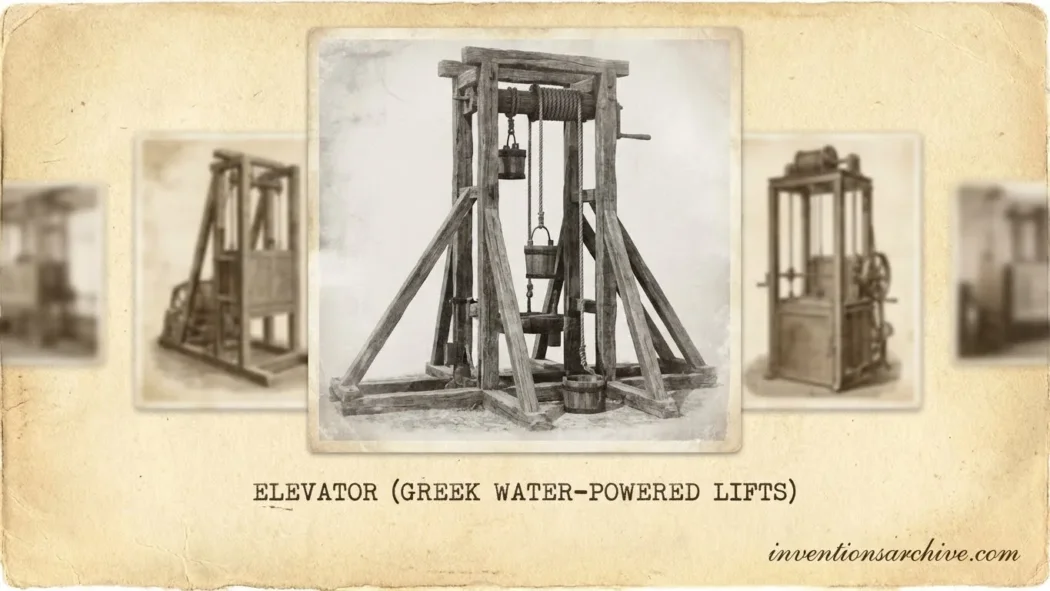
| Invention Name | Elevator — Greek water-powered lifts and early hoisting systems |
|---|---|
| Short Definition | Early vertical-lifting systems that used ropes, pulleys, winches, counterweights, water wheels, containers, valves, or hydraulic pressure to raise loads, water, or moving parts. |
| Approximate Date / Period | 6th–3rd century BC for Greek hoisting and hydraulic lifting traditions; Archimedes’ hoist is usually placed around 236 BC Approximate |
| Geography | Ancient Greece, Syracuse, Alexandria, and the wider Hellenistic Mediterranean |
| Inventor / Source Culture | Anonymous Greek engineers; later associated with Archimedes, Ctesibius, Philon of Byzantium, and Heron of Alexandria Attribution varies |
| Category | Transport, hydraulic technology, construction, mechanical engineering, energy use |
| Main Problem Solved | Raising heavy materials, lifting water to higher levels, and moving mechanical parts without relying only on direct human carrying. |
| Basic Working Principle | Mechanical advantage from pulleys and winches; water movement or pressure used to lift, rotate, fill, empty, or counterbalance parts. |
| Materials / Technology Base | Wooden frames, hemp ropes, bronze or clay containers, wheels, axles, valves, pistons, siphons, counterweights, water reservoirs |
| Early Use Areas | Construction, water supply, fountains, irrigation, workshops, temple automata, theatrical and display mechanisms |
| Evidence Status | Textual records, museum reconstructions, technical descriptions, and some archaeological remains from related hydraulic devices Based on surviving evidence |
| Development Path | Lever and rope lifting → pulley hoists and cranes → hydraulic pumps and water wheels → hydraulic elevators and modern lift systems |
| Related Inventions | Crane, pulley block, winch, chain pump, piston pump, Archimedes screw, water wheel, hydraulic elevator |
| Surviving Evidence | Vitruvian descriptions, later manuscripts, museum reconstructions, and excavated remains of related water-lifting machines |
| Modern Descendants | Passenger elevator, freight lift, hydraulic lift, construction hoist, water pump, automated building systems |
| Why It Matters | It shows how early engineers joined vertical movement, water control, mechanical advantage, and automation long before electric elevators. |
The Greek water-powered lift was not a modern elevator with a closed passenger cabin, buttons, rails, and electric control. It was a family of early lifting ideas: hoists, pulley systems, water-raising wheels, chain pumps, piston pumps, and hydropneumatic automata. Together, these devices show how ancient engineers learned to move weight vertically by combining ropes, wheels, containers, valves, pressure, and counterbalance. The safest way to understand the invention is to see it as an early stage in the long history of the elevator, not as a finished modern lift.
What the Invention Was
A Greek water-powered lift was an early attempt to solve a simple but demanding problem: how to move something upward without carrying it by hand. Depending on the device, the “something” could be stone, a platform, a bucket of water, a chain of containers, or a moving part inside an automatic mechanism.
In elevator history, this invention sits between two worlds. On one side were older tools such as levers, ramps, ropes, sledges, and simple cranes. On the other side were later hydraulic elevators, safety brakes, guided lift cars, and electric traction elevators. The Greek contribution was not one single machine. It was a mechanical vocabulary: pulley, axle, drum, valve, siphon, counterweight, piston, water wheel, and controlled motion.
The most important point is precision. Early Greek devices did not create the modern elevator industry. They showed that vertical movement could be designed, controlled, multiplied, and powered in more than one way.
How Its Origin Is Traced
The origin is traced through a mix of technical texts, later summaries, museum reconstructions, and related archaeological finds. The Archimedes tradition is usually connected with a rope-and-pulley hoist, not a water-powered passenger elevator. Britannica’s educational article states that mechanical lifting loads was known by 236 BC, when Archimedes made a hoist operated by ropes and pulleys.[b]
This does not mean that Archimedes invented every form of lift. It means his name became attached to an early, well-known stage of mechanical lifting. Greek engineering was collective. Workshops, builders, mathematicians, temple technicians, and writers all contributed to a wider culture of machines.
The water-powered side is linked more closely with Hellenistic hydraulic technology. Alexandria was especially important because engineers such as Ctesibius and Heron studied air pressure, water pressure, valves, pumps, siphons, and automatic motion. These are not modern elevators, but they are part of the same long search for controlled vertical movement.
The Problem It Answered
Before hoists and hydraulic lifting devices became more refined, people relied heavily on direct labor, ramps, animal force, and simple rope systems. These could work, but they had limits.
- Heavy building materials needed many workers and careful coordination.
- Water had to be raised from wells, rivers, or lower channels to higher storage points.
- Repeated lifting tired workers and slowed construction or irrigation tasks.
- Moving parts in temples, displays, and theatres needed controlled motion rather than random movement.
The Greek lift tradition answered these problems by changing the form of effort. Instead of lifting a load directly, the operator could turn a winch, walk a wheel, pull a rope through pulleys, or use water flow and pressure to do part of the work. The invention did not remove labor. It made labor more directed, more repeatable, and often more efficient.
| Before the Invention | What Changed After It |
|---|---|
| Loads were often moved with ramps, sledges, direct pulling, or carrying. | Ropes, winches, pulleys, and wheels allowed force to be redirected and multiplied. |
| Raising water required repeated manual dipping, shaduf-like levers, or simple buckets. | Water wheels, chain pumps, and piston pumps could raise water in a more continuous pattern. |
| Construction lifting depended on large groups working at the same moment. | Mechanical systems made lifting more controlled and easier to repeat. |
| Automation was limited to simple manual effects. | Water, air pressure, siphons, and counterweights could trigger movement without direct handling at the moving part. |
| Vertical transport was a local, task-specific challenge. | Vertical movement became a design problem that later influenced cranes, pumps, hoists, hydraulic lifts, and elevators. |
How It Worked in Simple Terms
The working principle depended on the type of lift. The most direct form was the hoist: a rope was wrapped around a drum or axle, passed through pulleys, and attached to a load. Turning the axle wound the rope and raised the load. A pulley block reduced the effort needed by spreading the weight across more rope sections.
Water-powered lifting devices worked differently. Some raised water itself. Others used water to move a container, shift a balance, turn a wheel, or create pressure. In each case, water acted as a source of motion, weight, or pressure.
Vitruvius describes a machine of Ctesibius for raising water to a considerable height. His account includes buckets, pipes, valves, pistons, a central basin, and pressure that drove water upward through a vertical pipe.[c] In simple terms, this was a pressure-based water-raising machine. It belongs to the history of pumps, but it also belongs to the wider history of lifting because it moved a substance upward in a controlled mechanical way.
Main Technical Principles
- Mechanical advantage: pulleys and winches reduced the force needed to lift a load.
- Rotary motion: wheels, axles, and drums turned pulling or flowing motion into lifting motion.
- Water as weight: filling a container could tip a balance or move a linked part.
- Water as pressure: pistons, valves, and sealed vessels could force water upward.
- Counterbalance: one weight could help move another weight in the opposite direction.
Earlier Tools and Ideas Before It
The Greek lift did not appear from nowhere. It grew from older and simpler ways of moving heavy objects.
- Levers: used to pry, shift, and raise objects in small controlled movements.
- Ramps: used to move heavy loads upward over distance instead of lifting them straight up.
- Ropes and sledges: used to pull materials across ground or prepared surfaces.
- Simple cranes: used to suspend and position loads.
- Water buckets and levered water lifters: used to raise water from lower levels.
The Greek improvement was the joining of these ideas into machines that could repeat a lifting action. A single pulley was useful. A pulley system with a winch was far more useful. A water wheel with containers could repeat a water-lifting cycle again and again. A sealed vessel with air and water could create delayed, controlled movement.
Development Path
| Stage | Form | What Changed |
|---|---|---|
| Earlier Tool | Lever, ramp, rope, bucket, simple crane | Basic lifting depended mostly on direct labor and simple geometry. |
| Greek Hoisting Stage | Pulley block, winch, crane, rope drum | Force could be redirected, multiplied, and controlled through mechanical advantage. |
| Greek Hydraulic Stage | Water wheel, chain pump, piston pump, siphon automaton | Water flow, water weight, and pressure became sources of movement. |
| Improved Form | Roman hoists, water-lifting machines, medieval treadwheels, early hydraulic platforms | Large buildings, wells, mines, and workshops used more specialized vertical-lifting devices. |
| Modern Descendant | Hydraulic elevator, traction elevator, freight lift, construction hoist | Guided cars, safety systems, powered drive units, and formal engineering codes changed the scale and reliability of vertical transport. |
Main Types and Variations
The topic is best understood as a group of related lifting systems rather than one object. Some lifted solid loads. Some lifted water. Some used water to move another part.
| Type or Variation | Main Mechanism | Typical Use |
|---|---|---|
| Rope-and-Pulley Hoist | Rope, pulley block, drum, winch, load hook or platform | Raising building materials or heavy workshop loads |
| Greek Construction Crane | Wooden mast, balancing ropes, hoists, winches, axle, pulley wheels | Stone construction and controlled lifting on building sites |
| Hydraulic Wheel | Vertical wheel with containers filling at a low point and emptying at a higher point | Raising water to a higher channel or reservoir |
| Chain Pump | Two chains carrying small vessels around an upper and lower structure | Lifting water through a repeated container cycle; Philon’s chain pump could use water-driven wings or foot power.[e] |
| Piston Force Pump | Pistons, valves, pipes, basin, pressure | Forcing water upward for fountains or supply systems |
| Hydropneumatic Automaton | Sealed vessels, heated or compressed air, water transfer, counterweight | Moving doors, figures, sounds, or display mechanisms |
| Later Hydraulic Elevator | Pressurized liquid moves a plunger or piston under a car | Raising people or freight in buildings, especially before electric traction became dominant |
Physical Evidence and Surviving Traces
No original Archimedean passenger elevator survives. That absence is not surprising. Ancient lifting devices often used wood, rope, leather, and metal fittings. Many of those materials decay, get reused, or disappear.
The stronger evidence comes from related machines. The hydraulic wheel of Perachora, dated to the 3rd century BC in museum presentation, is described as a water pump and as one of the earliest known pumping devices in Europe; remains were found during excavations at Perachora in Corinthia.[d] This is not a passenger elevator, but it is a valuable piece of the same technical story: a rotating machine that lifted water from a lower level to a higher one.
Written evidence is also important. Vitruvius preserves technical descriptions of machines, including water-lifting devices connected with Ctesibius. Later museum reconstructions help modern readers visualize how these systems may have worked, but reconstructions should not be confused with original surviving machines.
How Water Powered Motion
Water helped early engineers in three main ways. First, flowing water could turn a wheel. Second, the weight of collected water could tip a balance. Third, water in a sealed system could transmit pressure or displace air.
Heron’s automatic temple doors show the last two ideas especially well. In the reconstructed description, heated air pushed water through a siphon into a container on a balance; the added water weight tipped the balance and moved chains wrapped around the door axles.[f] This was not an elevator, but the logic is close to lift engineering: controlled energy, counterweight, rotation, and movement at a distance.
This is why Greek water-powered lifts matter. They show that early engineers were not only pulling objects upward. They were learning how to store motion, release motion, and connect water behavior to mechanical output.
What Changed Because of It
The changes were practical rather than dramatic. Greek lifting and hydraulic machines made certain tasks easier to organize.
- Construction: cranes and hoists helped raise heavy blocks and building materials with better control.
- Water supply: wheels, pumps, and container systems moved water upward for fountains, irrigation, and storage.
- Mechanical thinking: engineers began to treat force, weight, pressure, and rotation as design tools.
- Automation: water and air mechanisms could trigger movement without a person touching the final moving part.
- Later elevators: the idea of vertical transport developed through hoists, platforms, hydraulic lifts, safety devices, and eventually electric traction systems.
Modern elevator safety belongs to a much later era. ASME notes that Elisha Otis invented a safety brake in 1853 and that elevator regulation became a major issue as buildings grew taller; the current A17.1/CSA B44 code is an accepted guide for elevator and escalator design, installation, operation, inspection, testing, maintenance, alteration, and repair.[g]
Common Misunderstandings
“The Greeks Had Modern Elevators”
They had important lifting machines and hydraulic mechanisms, but not modern passenger elevators. A modern elevator needs a guided car, shaft, safety systems, controls, and a reliable drive system.
“Archimedes Alone Invented the Elevator”
Archimedes is linked with an early hoist tradition, but ancient vertical-lifting technology was broader. It also involved anonymous builders, Greek crane design, Ctesibius’ hydraulic work, Philon’s mechanisms, and Heron’s automata.
“Water-Powered Means It Carried People by Water Pressure”
Not necessarily. Some systems used water to raise water. Others used water weight or pressure to move parts. A later hydraulic elevator is a different, more developed machine.
“A Reconstruction Is the Same as an Artifact”
Reconstructions are useful educational tools, especially when based on texts and technical knowledge. They are not the same as an original surviving machine. The difference matters for historical certainty.
Related Inventions
- Pulley Block: redirected force and reduced the effort needed to lift loads.
- Winch: wound rope around an axle to raise or lower weight with control.
- Greek Crane: used hoists, ropes, and wooden frames for construction lifting.
- Archimedes Screw: raised water through a rotating screw-like form.
- Chain Pump: lifted water through a repeated chain-and-container cycle.
- Ctesibius’ Piston Pump: used valves and pressure to raise water.
- Hydraulic Elevator: later used pressurized liquid to raise a car or platform.
- Elevator Safety Brake: changed public trust in passenger elevators during the 19th century.
Frequently Asked Questions
Was the Greek water-powered lift the first elevator?
It depends on what is meant by elevator. Greek hoists and hydraulic lifting devices were early ancestors or relatives of elevator technology, but they were not modern passenger elevators with guided cars and safety controls.
Did Archimedes invent the elevator?
Archimedes is traditionally associated with an early hoist operated by ropes and pulleys around 236 BC. The broader development of lifting technology involved many Greek and Hellenistic engineers, so the invention should not be reduced to one person alone.
How did water help ancient lifting machines work?
Water could turn wheels, fill containers, tip balances, move through siphons, or create pressure in sealed systems. These effects could raise water, rotate shafts, shift counterweights, or move linked mechanical parts.
Were Greek water-powered lifts used in buildings like modern elevators?
The evidence supports early hoisting machines, water-lifting devices, and automata more strongly than building elevators for everyday passenger travel. Modern building elevators developed much later through hydraulic, steam, electric, and safety-control technologies.
What is the strongest evidence for this invention?
The strongest evidence is a combination of ancient technical texts, descriptions preserved by authors such as Vitruvius, museum reconstructions of Greek machines, and archaeological traces of related water-lifting technology such as the Perachora hydraulic wheel.
Sources and Verification
- [a] The crane for large load (6th c. B.C.) | Museum of the Ancient Greek Technology — Used to verify the Greek crane’s mast, hoists, winches, pulley wheels, and lifting role. (Reliable because it is a museum page focused on ancient Greek technology.)
- [b] elevator and escalator – Students | Britannica Kids | Homework Help — Used to verify the Archimedes hoist tradition around 236 BC and the later distinction between early hoists and practical hydraulic elevators. (Reliable because it is an Encyclopaedia Britannica educational reference page.)
- [c] The Ten Books on Architecture, 10.7 — Used to verify Vitruvius’ description of Ctesibius’ water-raising machine with buckets, pipes, valves, pistons, and upward water pressure. (Reliable because it is a text-focused source presenting a classical technical passage.)
- [d] The hydraulic wheel of Perachora | Interactive Inventions & Mechanisms — Used to verify the 3rd-century BC Perachora hydraulic wheel, its water-lifting function, and the note about remains found during excavations. (Reliable because it is a museum exhibit page on a specific ancient hydraulic machine.)
- [e] The chain pump of Philon | Interactive Inventions & Mechanisms — Used to verify the chain pump’s parallel chains, vessels, water-driven wings, and water-lifting purpose. (Reliable because it is a museum exhibit page for a named Hellenistic hydraulic device.)
- [f] The automatic opening of the temple gates | Interactive Inventions & Mechanisms — Used to verify Heron’s hydropneumatic door mechanism using heated air, water transfer, a balance, counterweight, chains, and door axles. (Reliable because it is a museum exhibit page explaining a specific ancient automaton.)
- [g] Heavy Lifting: The History of the Elevator Code – ASME — Used to verify the later elevator safety-brake milestone and the safety-code context of modern elevators. (Reliable because it is an institutional engineering source from ASME.)