
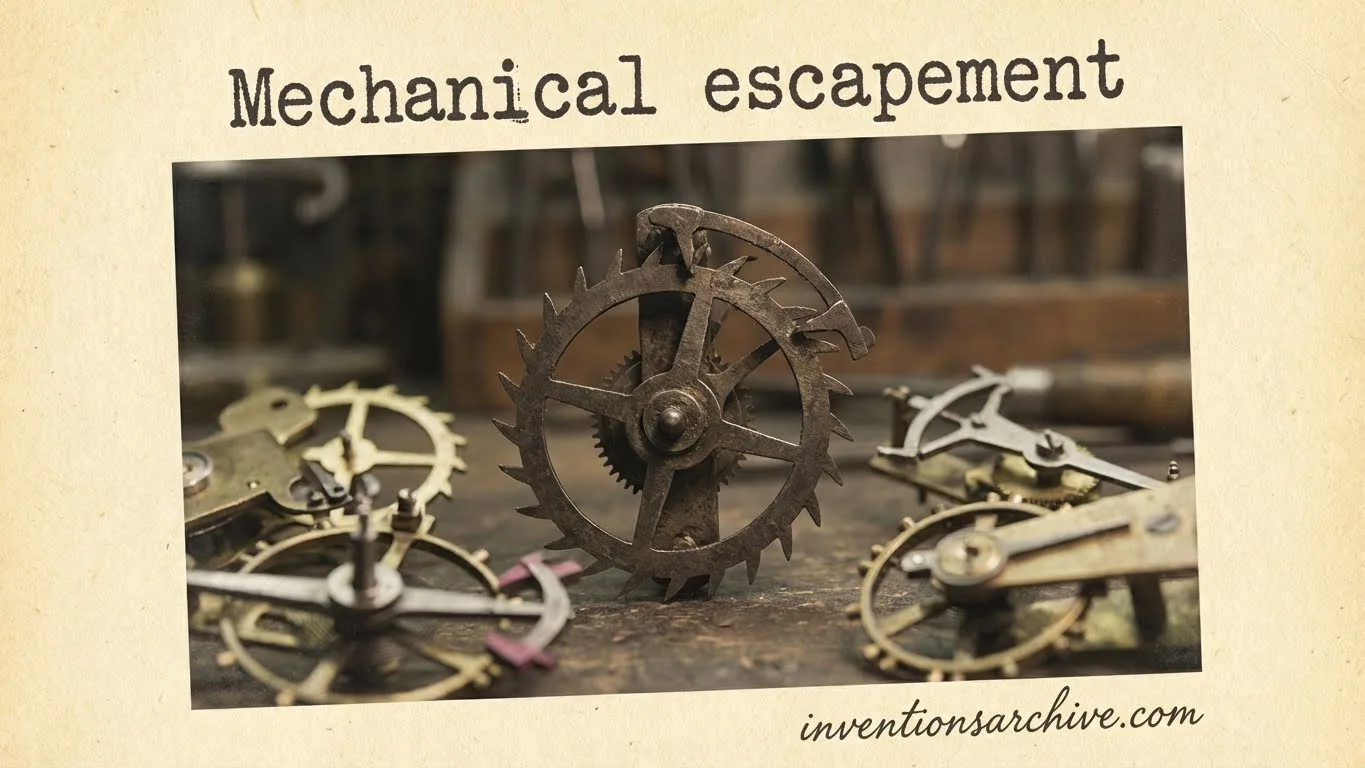
| Invention Name | Mechanical Escapement |
|---|---|
| Short Definition | Mechanism that meters power into timed “steps” for a clock or watch |
| Approximate Date / Period | Late 13th–early 14th century Approximate |
| Geography | Western Europe (early public tower clocks) |
| Inventor / Source Culture | Anonymous / collective Uncertain |
| Category | Timekeeping, mechanical engineering |
| Importance |
|
| Need / Why It Appeared | Regular intervals instead of continuous drift |
| How It Works | Locks, releases, and “impulses” an oscillator in repeating cycles |
| Material / Technology Base | Gears, pallets, oscillator; controlled friction and geometry |
| First Typical Use | Weight-driven tower clocks |
| Spread Route | Italian city towers → broader European workshops |
| Derived Developments | Pendulum clocks; precision regulators; watch escapements |
| Impact Areas | Science, education, industry, daily scheduling |
| Debates / Different Views | “First” inventor and earliest drawings remain disputed |
| Precursors and Successors | Water clocks → early mechanical regulators → anchor/deadbeat → lever/detent |
| Key People / Cultures | Medieval city workshops; later specialist clockmakers |
| Types Influenced | Turret clocks; pendulum clocks; portable watches |
A mechanical escapement is the regulating heart of many clocks and watches. It turns a steady push from a weight or spring into measured releases, so the gear train advances in repeatable steps instead of rushing forward. That single idea made long-running mechanical timekeeping possible, then shaped everything from public tower clocks to fine watchmaking. The oldest forms were likely built by collective workshop knowledge, with no single inventor firmly recorded.Details
Table of Contents
What an Escapement Does
The escapement sits between the power source (spring or weight) and the oscillator (pendulum, balance wheel, or early foliot). Its job is not only to let energy through, but to do it in a way that matches a steady rhythm. In practical terms, a good escapement:
- Creates locking, so the gear train cannot run freely.
- Delivers a small impulse to keep the oscillator moving.
- Turns oscillations into a countable advance of the escape wheel.
- Balances efficiency with gentle contact, so wear stays controlled.
In early forms such as the verge with a foliot, the mechanism literally “releases” part of the motive force at regular intervals so the regulator can keep moving.Details That same principle still defines the family today, even when the geometry is far more refined.
Main Parts and Energy Flow
Core Components
- Escape Wheel: the gear that advances tooth by tooth.
- Pallets: the faces that lock and unlock the wheel.
- Arbor / Verge: the shaft that carries the pallets in many designs.
- Oscillator: pendulum, balance wheel, or foliot.
- Train: gearing that drives hands or indicators.
Energy Path
Power moves through the gear train toward the escape wheel. At the escapement, motion becomes a controlled exchange:
- The wheel tries to turn, then is stopped by a pallet.
- A swing of the oscillator shifts contact so one tooth releases.
- As it releases, the wheel delivers an impulse that sustains the oscillator.
- The next tooth lands on the other pallet and locks again.
Locking, Impulse, and the Tick
That familiar tick is not decoration. It is a record of the escapement’s repeating cycle. Each cycle has three ideas that appear across many designs, even when the shapes differ:
- Lock: a pallet face holds the escape wheel tooth.
- Impulse: a shaped face transfers energy to the oscillator.
- Drop: a brief free movement before the next lock.
Designers care deeply about how those phases happen. A small change in angles can shift friction, change how long contact lasts, or alter whether the wheel “pushes back” (known as recoil). Over centuries, escapements evolved toward less disturbance of the oscillator and more stable timing.
Early Designs and Timeline
The mechanical escapement is closely tied to the rise of public clocks. In the first half of the 14th century, large tower clocks appeared in parts of Europe, and they were regulated by a verge-and-foliot escapement. Variations of that approach remained common for more than 300 years, with performance strongly affected by driving force and friction.Details
| Period | What Changed | Why It Mattered |
|---|---|---|
| Late medieval era | Verge with foliot (early tower clocks) | Enabled steady, repeatable gear advance |
| 17th century | Pendulum becomes a practical oscillator for clocks | Sharper regularity and improved accuracy |
| 17th century | Anchor escapement spreads in pendulum clocks | Smaller swing and less interference |
| 11 Dec 1675 | Anchor escapement diagram recorded in scientific correspondence | Links practical design to precision discussion, including deadbeat ideasDetails |
| 18th–19th centuries | Detached watch escapements mature | Better balance freedom and sustained motion |
| Modern era | New materials and refined geometries | Lower friction, improved stability, longer service life |
Escapement Families
“Mechanical escapement” is a broad label. In practice, it covers a set of families that solve the same problem with different trade-offs. The names below are widely used in horology, and each family can include many variations.
Verge and Foliot
The verge family is among the earliest widely used escapements. It commonly pairs a crown-shaped escape wheel with a vertical shaft carrying two pallets, while a foliot (a bar with adjustable weights) provides the oscillation. It is historically important because it made early mechanical clocks workable, yet it is sensitive to changes in force and friction.
Anchor and Recoil
The anchor escapement reshaped the pallets into an anchor-like form and works with a pendulum. A key advantage is that it allows smaller arcs than a verge pendulum arrangement. Over time, the broader idea of detachment became central: the oscillator should be disturbed as little as possible while still receiving energy.Details
Deadbeat and Precision
“Deadbeat” describes an approach where the escape wheel does not drive the pendulum backward during the lock phase. In well-tuned regulators, that calmer interaction supports cleaner timing and reduced disturbance. Historically, deadbeat ideas appear in discussions around improving accuracy, especially where scientific timekeeping demanded stable results.
Related articles: Pendulum Regulator [Renaissance Inventions Series], Pendulum Clock [Renaissance Inventions Series]
Watch Escapements
Portable timekeepers favor compact designs that work well with a balance wheel. Over the centuries, watch escapements explored many paths, including:
- Lever escapement: a dominant modern standard in mechanical watches, valued for robustness.
- Detent escapement: built to keep the balance as free as possible, traditionally used where refined performance is prioritized.
- Cylinder and duplex types: historically notable solutions with distinct geometries.
- Pin-pallet variants: simplified forms that still follow the lock-and-impulse principle.
The technical goal remains consistent: deliver enough energy to sustain motion while keeping contact time, sliding, and sensitivity to small changes under control.
Gravity and Specialized Escapements
Some large clocks use “gravity” concepts where the pendulum receives energy through a separate lifting action, helping isolate the oscillator from variations in driving force. Other specialized families—such as pinwheel or grasshopper styles—show how inventive geometry can reduce friction or change how the impulse is delivered. These designs are often studied for their engineering elegance as much as their practical use.
Types Compared
| Family | Typical Oscillator | Signature Idea | Common Setting |
|---|---|---|---|
| Verge | Foliot / balance | Early lock-and-release with crown wheel | Tower clocks, early watches |
| Anchor | Pendulum | Smaller swing; reduced disturbance | Pendulum clocks |
| Deadbeat | Pendulum | Minimal recoil during lock | Regulators and precision clocks |
| Lever | Balance wheel | Reliable impulse with practical durability | Mechanical wristwatches |
| Detent | Balance wheel | High detachment; very free balance | High-grade timekeepers |
| Gravity | Pendulum | Separates drive variability from the pendulum | Large public clocks |
Why Accuracy Improved
Early escapements proved the concept, then later refinements raised performance. A recurring theme is isochronism: the oscillator’s period should stay stable even when conditions shift slightly. In the verge-and-foliot era, timekeeping was especially sensitive to changes in force and friction. Introducing the pendulum sharply improved stability, and academic analyses describe improvements on the order of tens of times in accuracy compared with verge-and-foliot behavior under typical conditions.Details
Design Choices That Matter
- Reduced sliding: less energy lost to friction.
- Shorter contact: the oscillator swings more freely.
- Stable lock geometry: predictable release timing.
- Consistent impulse: enough energy without excess disturbance.
Where Mechanical Escapements Still Matter
Mechanical escapements remain central to traditional horology. They also serve as clear teaching tools for feedback, oscillation, and energy transfer. In museums and collections, escapements offer a direct look at how precision was pursued with gears and careful surfaces long before electronics. For many readers, the appeal is simple: a working escapement is visible physics, quietly repeating the same controlled exchange thousands of times per day.
Key Terms Used in Escapements
- Escape wheel: the wheel that advances in steps.
- Pallet: locking and impulse surface.
- Lock: the state where motion is held.
- Drop: free movement before the next lock.
- Impulse: energy delivered to sustain oscillation.
- Recoil: a brief backward motion in some designs.
- Detachment: minimizing interference with the oscillator.
- Beat rate: oscillations per unit time (often discussed in watches).
FAQ
Is an escapement the same as a balance wheel or pendulum?
No. The oscillator is the balance wheel or pendulum. The escapement is the mechanism that locks and releases the gear train while giving the oscillator small impulses. Together they create a stable rhythm.
Why do some clocks “tick” louder than others?
The sound is influenced by contact geometry, case construction, and how the impulse is delivered. A design with stronger, sharper locking events can produce a more pronounced tick, while other designs feel softer.
What does “recoil” mean in an escapement?
Recoil describes a brief backward motion of the escape wheel during part of the cycle in some designs. It is a known behavior of certain families and is part of how they manage locking and impulse.
Why was the move from foliot to pendulum so important?
A pendulum provides a very regular oscillation under small swings, which supports steady timing. Analytical and historical accounts commonly describe a large jump in accuracy when pendulum regulation replaced earlier behavior under comparable conditions.
Are modern mechanical escapements still being improved?
Yes. Work continues on materials, surface finishing, and refined geometry to reduce friction and keep timing stable. The core aim stays the same: reliable impulses with minimal disturbance.