
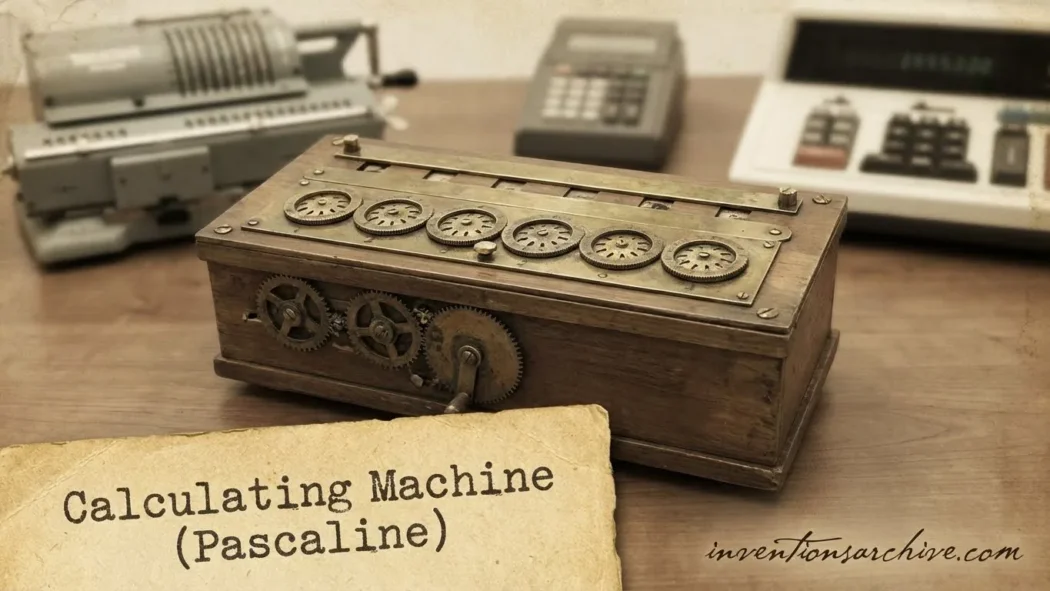
| Invention Name | Calculating Machine (Pascaline) |
|---|---|
| Short Definition | Mechanical calculator for addition and subtraction with an automatic carry mechanism. |
| Approximate Date / Period | 1642–1645 Certain |
| Geography | Rouen (Normandy), France |
| Inventor / Source Culture | Blaise Pascal; 17th-century French craftsmanship |
| Category | Mechanical computation; accounting; early business machine |
| Need / Reason | Tax and currency arithmetic; reliable totals; fewer manual errors |
| How It Works | Dial wheels + result windows + gravity-assisted carry (“sautoir”) |
| Material / Technology Base | Gears; numeral wheels; metal levers; wooden case |
| First Known Use Context | Tax administration; commercial accounting; demonstrations in learned circles |
| Typical Capacity | Multi-wheel totals up to large place values Varies by model |
| Known Surviving Examples | About 9 Approximate |
| Importance |
|
| Predecessors + Successors | Abacus, counting boards → Leibniz-style calculators, later mechanical adding machines |
| Areas Influenced | Accounting; engineering; education; computing history |
Pascal’s calculating machine, often called the Pascaline, is a landmark in the story of mechanical calculation. It turns arithmetic into a physical process: you set digits on rotating dials, and the machine stores the total in small display windows. The idea feels simple, yet the precision behind it is striking—especially the way it handles carry from one digit to the next.
On This Page
What The Pascaline Is
The Pascaline is a compact mechanical calculator built around a set of numbered dials. Each dial represents a place value, and the machine keeps the running total in an internal accumulator. The result appears through small windows—an early, elegant form of stored output.
- Input: rotating dials set digits directly
- Storage: the mechanism holds a live total
- Output: windows show the current sum
- Signature feature: automated carry between wheels
It is often described as an arithmetic machine because it targets the work that dominates daily calculation: adding long columns of numbers and keeping place values consistent. The Pascaline makes that discipline visible, turning digits into motion.
Why It Was Needed
The Pascaline emerged from a real administrative need. In 17th-century accounting, totals had to be correct, repeatable, and fast enough for routine work. A device that could add reliably and manage carry offered a practical advantage, especially where many small entries had to become one clean number.
The Problem It Targeted
- Long addition chains across many entries
- High value in error reduction
- Place-value mistakes during manual carry
A Design Choice With Meaning
Some Pascalines were made to match how people actually counted money at the time, using mixed bases rather than pure decimal steps. That detail matters: it shows the machine was built for real workflows, not only for theory.
Timeline and Early Evidence
Work on the Pascaline began around 1642, with key refinements appearing by the mid-1640s. One period detail stands out: French monetary accounts used non-decimal steps—20 sols to a livre and 12 deniers to a sol—so a calculator that respected that structure had immediate value for accounting practice.Details
- 1642: early concept and trials (period sources describe development starting here)
- 1644–1645: major refinements and presentation of mature forms
- Later 1640s–1650s: continued crafting of small-batch machines (exact counts vary by catalog)
How The Pascaline Works
At the surface, the Pascaline behaves like a careful clerk who never loses track of place values. Each dial is a digit wheel. Turning a wheel advances the stored total, and the machine’s internal linkage passes a carry when a digit rolls over.
Input Dials and Stops
Numbers are entered by rotating a dial to the chosen digit, typically using a small stylus or fingertip against a toothed edge. The rotation halts at a physical stop, which helps make each digit setting repeatable and precise.Details
Reading The Result
The total appears in small windows along the top surface. This layout keeps input and output separate, so the operator can change dials without losing sight of the accumulated number.
Carry and The “Sautoir”
The heart of the Pascaline is its carry device, often described as a sautoir (a “jumper”). As one dial crosses from 9 to 0, the mechanism transfers a single step to the next wheel. This approach also supports long carry chains, keeping the motion orderly even when several digits roll over in sequence.Details
What You See vs What Happens
On the surface
- Dial turns to set a digit
- Window shows a new total
- Carry appears “automatic”
Inside the mechanism
- Wheel motion arms the carry device
- At rollover, the device advances the next wheel
- The accumulator keeps place values aligned
Subtraction Through Complements
Many dial calculators are naturally “one-direction” devices, so subtraction is often handled by a clever representation trick. In Pascaline-style systems, subtraction can be expressed as addition using complements (such as a 9’s complement), allowing the same smooth dial motion to produce a correct difference.Details
Design and Variations
The Pascaline is not one single fixed blueprint. Surviving descriptions and replicas show variation in capacity, layout, and intended number system. Some builds follow pure decimal place values, while others align with period bookkeeping where place values can be mixed-radix.
| Configuration Focus | Place-Value Logic | Typical Use Case | What Changes Physically |
|---|---|---|---|
| Decimal | 10 per wheel | General totals | Uniform digit wheels |
| Currency-Aligned | Mixed bases (money units) | Accounting with historical units | Wheel steps reflect unit conversions |
| Higher-Capacity | More digit positions | Larger totals | Extra wheels and windows |
Materials and Craft
These machines were built as precision objects, not disposable tools. The outer case is typically wood, while the working parts rely on metal components shaped to tight tolerances. That mix—warm exterior, exact interior—captures the Pascaline’s character: human-scale craftsmanship supporting a disciplined numeric goal.
What It Does Well
- Addition across multiple digits, with clean carry
- Stable totals visible at a glance in result windows
- Consistent handling of structured number systems (including non-decimal units)
Legacy and Influence
The Pascaline helped prove that arithmetic could be delegated to a machine without losing clarity. It made a subtle promise: numbers can live inside mechanisms. That promise would echo through later calculators, office adding machines, and eventually the broader idea of mechanised information.
Lasting Contributions
- Made carry a physical, automatic action
- Popularised the idea of a visible accumulator
- Strengthened the link between administration and technical invention
Why It Still Matters
The Pascaline remains a clear example of purpose-built technology. It focuses on one job, does it with discipline, and shows its work through readable output. That blend of function and transparency keeps it relevant for anyone studying the roots of calculation.
FAQ
Who Invented The Pascaline?
The Pascaline is attributed to Blaise Pascal, developed in the 1640s in France as a serious attempt to mechanise everyday arithmetic.
What Could It Calculate?
It performs addition directly. It can also handle subtraction through complement-based methods that convert subtraction into an addition-like process.
Why Did Some Versions Use Non-Decimal Units?
Period bookkeeping sometimes relied on structured units—especially in money—so a calculator aligned to those unit steps reduced mental conversions and kept totals consistent.
What Is The “Sautoir”?
The sautoir is a carry component that advances the next wheel when a digit rolls over. It is central to the Pascaline’s automatic carry behavior.
How Many Pascalines Survive Today?
Counts vary by catalog and collection status, but references commonly describe about nine surviving examples (approximate).