
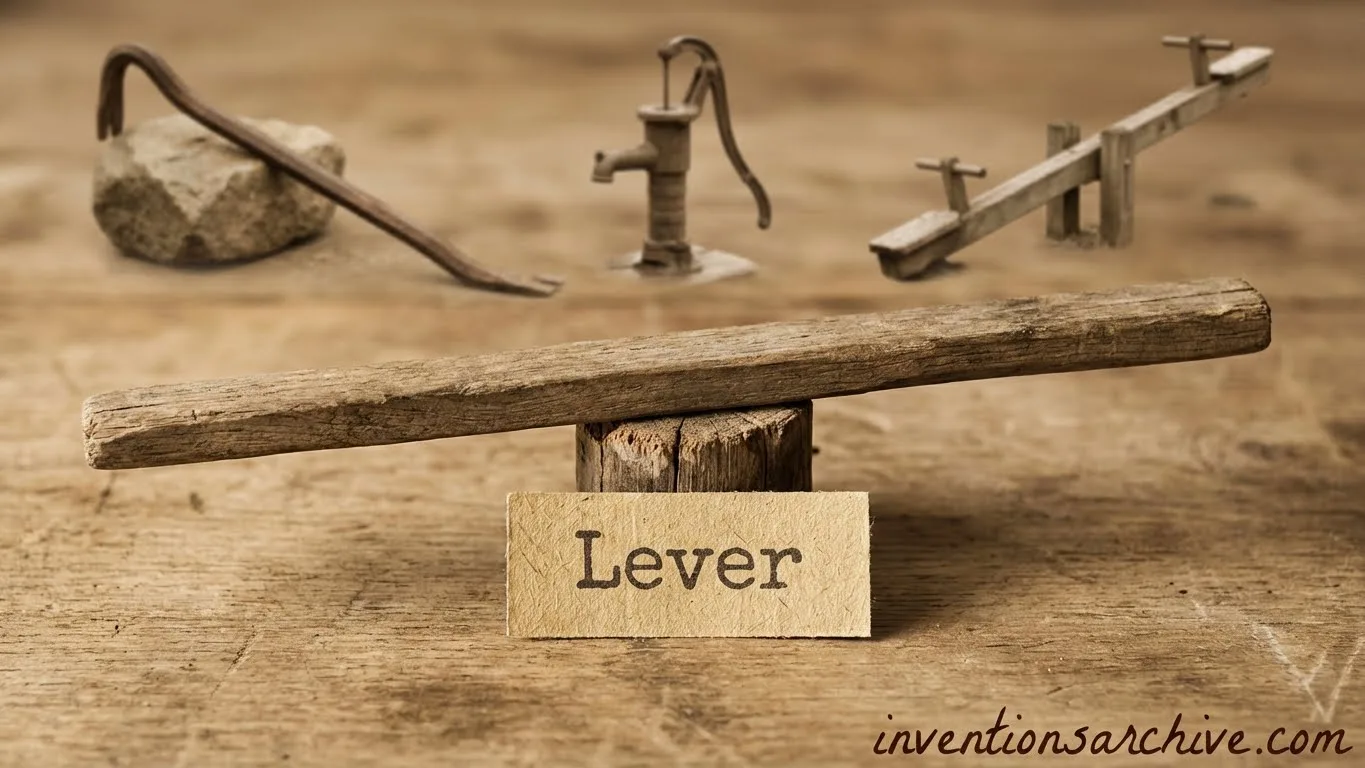
| Invention Name | Lever |
|---|---|
| Short Definition | A rigid bar or body that turns around a fixed point to move, lift, balance, press, or control a load. |
| Approximate Date or Period | Practical use likely prehistoric; early surviving lever-related evidence appears in ancient balances around 3000 BCE Based on surviving evidence |
| Geography | Early evidence in Egypt; related applications across Mesopotamia, the Mediterranean, and later many craft traditions. |
| Inventor or Source Culture | Anonymous / collective; Archimedes later gave the lever a formal mathematical statement Attribution varies |
| Category | Measurement, manufacturing, agriculture, transport, mechanics |
| Evidence Status | Practical origin is Approximate; early balances and later texts are Confirmed |
| Main Problem Solved | Moving or balancing loads with less direct effort, or controlling force more precisely. |
| How It Works | Force is applied at one point; the bar turns around a fulcrum; distance from the fulcrum changes force and motion. |
| Material or Technical Basis | Wood, bone, stone, bronze, iron, steel, and later engineered alloys; principle based on torque and balance. |
| Early Use Areas | Weighing goods, lifting water, moving stones, pressing materials, hand tools, and workshop control mechanisms. |
| Development Path | Digging stick or pry bar → lever → balance, shaduf, press, wheelbarrow → modern tools, pedals, linkages, and controls. |
| Related Inventions | Balance scale, shaduf, pulley, wheelbarrow, pliers, scissors, crank, mechanical press. |
| Surviving Evidence | Ancient balances, museum objects, mathematical texts, water-hoist models, and historical engineering descriptions. |
| Modern Descendants | Crowbars, nail pullers, pliers, brake pedals, bicycle levers, door handles, switches, hand presses, and machine linkages. |
| Why It Matters |
|
The lever is one of the oldest known ways to make force easier to manage. It can be as simple as a wooden bar resting on a stone, yet the same principle appears in balances, presses, pliers, wheelbarrows, pedals, switches, and many mechanical controls. Its value is not only that it can help move a load. The lever also made force measurable, repeatable, and easier to direct.
The Lever as an Invention
A lever is a simple machine. It uses a rigid arm and a turning point, called the fulcrum, to change how force acts on a load. In plain terms, the lever lets a person trade distance for force, or force for distance.
This trade is what makes the lever so useful. A long handle on a pry bar gives more turning effect than a short one. A balance scale uses two arms to compare weights. A pair of scissors uses paired levers to turn hand pressure into cutting motion. The object may look different, but the idea stays the same: force acts through a distance around a pivot.
How the Origin Is Traced
The earliest practical levers were probably not recognized as “inventions” in the modern sense. A person using a stick to pry up a stone was already using lever action, even without a written rule or named device.
More secure evidence appears when the lever becomes part of a specialized object. Research from the Max Planck Institute for the History of Science notes that the first evidence of scales and weights dates to around 3000 BCE in Egypt, and describes equal-arm balances as lever balances that compare mass on two arms of equal length.[a]
This distinction matters. The first surviving evidence is not always the first use. It shows what has lasted, not everything people once knew.
The Problem It Answered
Before lever-based tools became common, moving, lifting, weighing, or pressing depended more directly on muscle, rope, dragging, repeated handling, or simple carrying. Those methods worked, but they had limits.
- Heavy loads were hard to shift without many people or repeated effort.
- Weighing goods required a stable way to compare mass.
- Workshop tasks such as pressing, bending, gripping, or cutting needed controlled force.
- Water lifting for irrigation needed a way to raise water repeatedly without lifting the full weight directly each time.
The lever answered these problems by giving people a simple way to control force with length and position. It did not remove effort. It made effort more useful.
How the Lever Works in Simple Terms
A lever has three main parts: the effort, the load, and the fulcrum. The effort is the force applied by a person, animal, weight, spring, or mechanism. The load is what is being moved or resisted. The fulcrum is the support point around which the lever turns.
OpenStax describes a lever as a rigid bar pivoted at a fixed place called the fulcrum, with torque involved because the system rotates around that pivot. It also explains that the longer handle of a nail puller gives greater force at the working end, and that wheelbarrows and shovels are related lever forms.[b]
Earlier Tools and Ideas Before the Lever
The lever grew from practical human contact with materials. Long before formal mechanics, people knew that a longer stick could move something that a short stick could not. This knowledge likely came from handling wood, stone, soil, baskets, doors, animal loads, and workshop materials.
Earlier or related ideas include:
- Digging sticks, which concentrated force at a point.
- Prying poles, used to shift stones, logs, or packed material.
- Carrying poles, which distributed loads across shoulders or supports.
- Balance beams, which used equal distances to compare weight.
- Counterweights, later used with lever-like lifting devices.
The lever was not born as one finished machine. It became visible through many objects that used the same physical idea.
Main Materials and Technical Principle
Early levers could be made from almost any strong, stiff material. Wood was common because it was available, easy to shape, and strong enough for many tasks. Stone, bone, bronze, iron, and later steel changed what levers could do.
The technical principle depends on distance from the fulcrum. When force is applied farther from the pivot, the turning effect increases. This is why a long handle can make a tool feel stronger, while a short handle may feel harder to use for the same load.
Parts That Matter Most
- Lever arm: the rigid part that turns.
- Fulcrum: the support or pivot point.
- Effort point: where force is applied.
- Load point: where the resisted object acts.
- Arm length: the distance that shapes the mechanical advantage.
Early Uses in Work, Trade, and Measurement
The lever mattered because it entered daily work. It was not only an abstract idea in mechanics. People used lever action in fields, workshops, markets, building sites, kitchens, writing rooms, and later factories.
Balances and Trade
The equal-arm balance is one of the clearest early lever devices. It uses a beam suspended at the center. One side holds the unknown item; the other holds known weights. When the beam balances, the user can compare mass.
The Science Museum Group describes an Ancient Egyptian equal-arm balance dated 1370–1350 BCE from Tel El-Amarna, Upper Egypt. The museum explains that equal-arm balances of this type consist of a beam with a pan at each end and are among the simplest early methods of weighing.[c]
Water Lifting and Irrigation
The shaduf, or water-hoist, is a lever-based lifting device. It uses a long pole, a pivot, a container, and often a counterweight. This form helped raise water from a lower level to fields or channels.
One academic survey of water-lifting devices describes the shaduf as widely spread in the ancient world, with disputed origins, and notes evidence connected with Mesopotamia and later use in Egypt after 2000 BCE. It also links the device to irrigation near river banks and canals.[d]
Workshop and Household Tools
Lever action also appears in tools that grip, cut, crack, press, bend, or pull. Tongs, pliers, nutcrackers, scissors, door latches, brake handles, and hand presses all show how the same idea could be adapted to different work.
From Earlier Tools to Later Forms
| Stage | Form | What Changed |
|---|---|---|
| Earlier Tool | Digging stick, pry pole, carrying pole | Force was extended through a longer rigid object. |
| Early Lever Device | Equal-arm balance | Lever action became a tool for measurement and exchange. |
| Agricultural Form | Shaduf or water-hoist | Counterweight and pivot helped raise water repeatedly. |
| Craft Form | Tongs, presses, pliers, scissors | Hand effort became gripping, cutting, pressing, or bending force. |
| Improved Form | Metal levers, hinged tools, compound levers | Stronger materials allowed smaller, more precise mechanisms. |
| Modern Descendant | Pedals, switches, brake levers, machine linkages | Lever action became part of control systems and engineered machines. |
Main Types and Variations
Levers are often grouped by the position of the fulcrum, effort, and load. These classes help explain why a crowbar, a wheelbarrow, and a pair of tongs feel different even though they use the same principle.
Related articles: QWERTY Keyboard Invention: Who Invented QWERTY and Why? [Industrial Age Inventions Series], Ratchet and Pawl [Medieval Inventions Series]
| Type | Arrangement | Typical Examples | Main Effect |
|---|---|---|---|
| First-Class Lever | Fulcrum between effort and load | Seesaw, crowbar, balance scale, scissors | Can change force direction and may increase force or movement. |
| Second-Class Lever | Load between fulcrum and effort | Wheelbarrow, nutcracker, bottle opener | Often increases force at the load. |
| Third-Class Lever | Effort between fulcrum and load | Tongs, tweezers, some limb motions, fishing rod | Often increases speed or range of motion. |
| Compound Lever | Two or more levers linked together | Pliers, bolt cutters, compound presses | Combines lever action across multiple pivots. |
| Counterweighted Lever | Lever balanced by a weight on one side | Shaduf, some lifting arms, counterbalanced mechanisms | Reduces repeated lifting effort by offsetting part of the load. |
Before and After the Lever
The lever did not replace all earlier ways of working. People still carried, dragged, lifted, and pulled. What changed was the ability to redirect effort and make certain tasks more controlled.
| Before the Lever Became a Common Tool | What Changed After Lever-Based Tools Spread |
|---|---|
| Loads were moved mainly by direct lifting, dragging, carrying, or repeated pushing. | A rigid bar and pivot allowed force to be concentrated and redirected. |
| Weighing goods depended on less precise comparison methods or local practice. | Balance beams made trade, storage, and measurement more consistent. |
| Water lifting required direct hauling or less efficient repeated motion. | Counterweighted levers such as shadufs helped raise water for irrigation. |
| Cutting, gripping, and pressing required more direct hand strength. | Lever tools turned hand effort into controlled pressure at a working point. |
| Mechanical control was limited in early tools. | Levers became handles, pedals, switches, and linkages in later machines. |
How the Lever Changed Over Time
The lever’s form changed as materials and uses changed. A wooden pole could lift, pry, or balance. Metal allowed thinner parts, sharper jaws, hinged tools, and stronger control arms. Later engineering added pins, springs, bearings, gears, and linkages.
One useful point is easy to miss: the lever did not develop in one straight line. It appeared in different tasks because the same physical relationship was useful in many places. Measurement, irrigation, transport, craft production, household work, and scientific mechanics each used lever action for different reasons.
Archimedes and the Law of the Lever
Archimedes is strongly linked with the lever because he expressed its law in mathematical form. A New York University page on Archimedes’ law of the lever gives the statement from On the Equilibrium of Planes: magnitudes are in equilibrium at distances reciprocally proportional to their weights. The same source also notes debate over what Archimedes proved and how the proof should be interpreted.[e]
This is why Archimedes belongs in the history of the lever, but not as its lone inventor. He helped turn a familiar practical tool into a subject of mathematical mechanics.
Surviving Objects and Later Evidence
Some lever-based devices survive as museum objects or later models. These do not always prove the first use of the invention, yet they show how long the principle stayed useful.
The British Museum holds a wooden model of a shaduf, described as a water-hoist and irrigation device, made around 1900–1927 and connected with Upper Egypt field collection notes. The object is modern, but it helps show the long survival of lever-based water lifting in daily agricultural practice.[f]
What Changed Because of the Lever
The lever changed work in small, practical ways that added up over time. It helped people move objects, compare weights, lift water, press materials, shape goods, and control mechanisms with more accuracy.
Fields Affected by Lever Action
- Measurement: equal-arm balances and steelyards supported trade and storage.
- Agriculture: shadufs and related lifting devices helped move water.
- Craft Production: presses, clamps, tongs, and cutting tools made hand work more controlled.
- Transport and Handling: pry bars, wheelbarrows, and loading tools helped shift loads.
- Science and Education: the lever became a basic example in mechanics, torque, balance, and mechanical advantage.
- Machine Control: handles, pedals, switches, and linkages brought lever action into later devices.
The lever’s influence is broad because it is not one object alone. It is a repeatable principle that can be placed inside many tools.
Common Misunderstandings
Archimedes Did Not Invent Every Lever
Archimedes is linked with the law of the lever, not with the first practical use of a lever. People almost certainly used lever action long before formal Greek mechanics.
The Oldest Evidence Is Not the First Use
An ancient balance or written text shows surviving evidence. It does not prove that no earlier levers existed. Wooden tools often decay, and simple tools may leave little trace.
A Lever Does Not Remove Work
A lever can reduce the force needed at one point, but the effort usually moves through a longer distance. It changes how work is applied.
Modern Levers Can Look Nothing Like a Stick
A brake pedal, keyboard key, machine handle, or plier joint may all use lever action. The early form was simple, but later forms became compact and specialized.
Related Inventions and Later Developments
The lever belongs to a wider family of tools and mechanisms that helped people control force, motion, and measurement.
- Balance Scale: used lever balance for weighing goods and materials.
- Shaduf: used a lever and counterweight to raise water.
- Pulley: changed lifting direction and later combined with lever systems.
- Wheelbarrow: used second-class lever action to carry loads more easily.
- Pliers and Tongs: turned hand pressure into gripping force.
- Scissors: combined lever action with cutting blades.
- Mechanical Press: used lever force for printing, shaping, pressing, or forming materials.
- Crank and Linkage: carried lever principles into rotating and repeating mechanical motion.
Frequently Asked Questions
Who invented the lever?
The lever has no known single inventor. Its practical use likely began before written records, while Archimedes later gave the lever a famous mathematical explanation.
What is the earliest evidence for lever use?
Early lever-related evidence includes ancient weighing systems and equal-arm balances. These show lever principles in measurement, but they do not prove the first moment people used a lever.
Why is the fulcrum important?
The fulcrum is the point around which the lever turns. Moving the fulcrum changes the distances between effort and load, which changes the force or movement advantage.
Is a balance scale a lever?
Yes. An equal-arm balance is a lever with a central pivot and two arms of equal length. It compares the mass of an object with known weights.
What are the three main classes of levers?
The three main classes are first-class, second-class, and third-class levers. They differ by the positions of the fulcrum, effort, and load.
Sources and Verification
- [a] Ancient Balances at the Nexus of Innovation and Knowledge | MPIWG — Used to verify early evidence for scales and weights around 3000 BCE in Egypt and the equal-arm lever balance principle. (Reliable because it is an institutional research source from the Max Planck Institute for the History of Science.)
- [b] 9.5 Simple Machines – College Physics 2e | OpenStax — Used to verify the lever as a rigid bar pivoted at a fulcrum, the role of torque, and examples such as nail pullers, wheelbarrows, and shovels. (Reliable because OpenStax is an educational textbook publisher based at Rice University.)
- [c] Ancient Egyptian equal-arm balance | Science Museum Group Collection — Used to verify the dated Ancient Egyptian equal-arm balance from Tel El-Amarna and its function as a beam with suspended pans. (Reliable because it is an official museum collection record.)
- [d] Evolution of Water Lifting Devices (Pumps) over the Centuries Worldwide | MDPI — Used to verify historical information about the shaduf, its disputed origin, ancient spread, and use in irrigation. (Reliable because it is an academic publisher article with references.)
- [e] Archimedes’ Law of the Lever — Used to verify the statement of Archimedes’ law of the lever and the note that interpretation of his proof has been debated. (Reliable because it is an academic page hosted by New York University.)
- [f] model; water-hoist; irrigation equipment | British Museum — Used to verify the British Museum record for a wooden shaduf model, its date, material, and irrigation use. (Reliable because it is an official museum collection record.)