
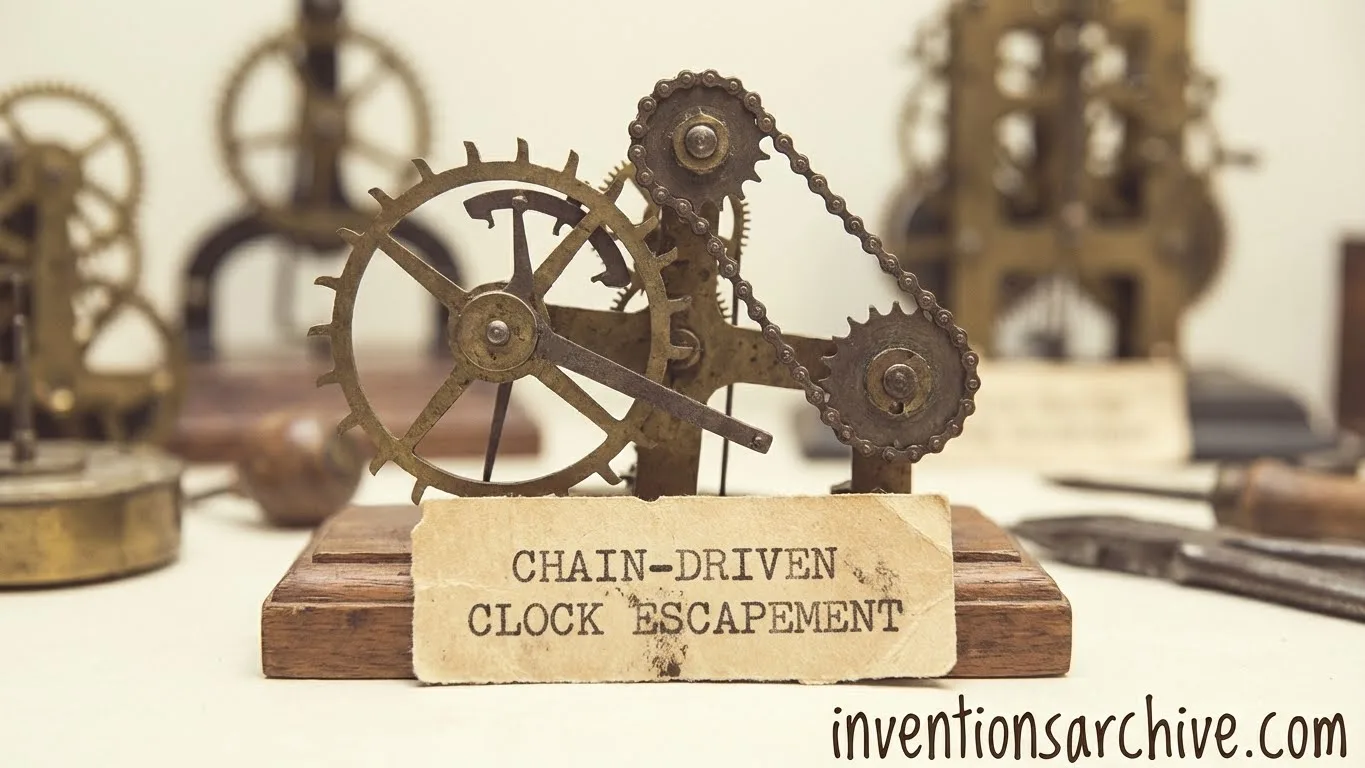
| Invention Name | Chain-Driven Clock Escapement, more precisely Su Song’s water-driven astronomical clock tower with an endless chain transmission |
|---|---|
| Short Definition | A hydro-mechanical system that released a waterwheel in measured steps and transmitted the regulated motion through gears and an endless chain to astronomical and time-display mechanisms |
| Approximate Date / Period | Late eleventh century; a working form is associated with 1088 Based on surviving evidence [a] |
| Geography | Kaifeng, Northern Song China |
| Inventor / Source Culture | Su Song, working with Han Gonglian and an imperial technical team Attribution varies by source |
| Category | Time measurement; astronomy; mechanical engineering; hydraulic machinery; motion transmission |
| Main Problem Solved | Converting a continuous water supply into regular stepwise motion, then carrying that motion through a tall tower to coordinate observation, celestial display, and audible and visible time signals |
| How It Worked | Water filled wheel-mounted containers; a balance-and-lock system periodically released the wheel; gears and a continuous chain carried the resulting motion to higher mechanisms |
| Technical Basis | Clepsydra regulation, waterwheel drive, locking levers, balances, counterweights, geared shafts, chain-and-sprocket transmission |
| Early Uses | Imperial astronomy; tracking celestial motion; timekeeping; audible and visible time announcements |
| Evidence Status | Based on surviving text and reconstructions; the original tower no longer survives |
| Surviving Evidence | Su Song’s illustrated treatise Xin Yixiang Fayao; later scholarly studies; museum reconstruction models |
| Development Path | Water clocks and powered armillary instruments → regulated astronomical tower → later escapement clocks and automated instrument drives |
| Related Inventions | Clepsydra; waterwheel; armillary sphere; celestial globe; chain pump; verge escapement; pendulum clock |
| Modern Descendants | Regulated mechanical clocks, chain-and-sprocket transmissions, automated astronomical displays, driven tracking instruments |
| Historical Importance |
|
Su Song’s clock tower joined several tasks that had often been handled separately: measuring intervals, observing the sky, modelling celestial motion, and announcing time. Water supplied the driving force. A regulated wheel divided that force into repeated steps. Gears and an endless chain then carried motion through the tall structure, where it turned an armillary sphere, moved a celestial globe, and operated visible and audible time displays.
What the Mechanism Was
The invention was not a small household clock. It was a water-powered astronomical tower built within the Northern Song state’s astronomical program. The Hong Kong Space Museum describes a structure about 12 metres high, with an armillary sphere at the top, a celestial globe in the middle, and timekeeping machinery below. Su Song recorded the design and operation in Xin Yixiang Fayao after the tower was completed. [b]
Its mechanical identity came from the way it controlled motion. A normal waterwheel can turn continuously as water acts on it. A clock needs something more selective: the drive must be held, released by a measured amount, and held again. Su Song’s lever-and-balance system made the wheel advance intermittently rather than freely.
The chain served another need. The main regulating and driving machinery sat lower in the tower, while the observation instruments were above. An endless chain made it possible to carry rotation over that vertical distance without placing every working part on one shaft.
The Problem It Answered
Water clocks could indicate elapsed time, and armillary spheres could support astronomical observation. The harder task was to make a large instrument move in a repeatable rhythm while coordinating several outputs.
- Continuous flow had to become timed motion. Water is steady only within limits; the machine needed a release system that converted flow into discrete advances.
- Motion had to travel upward. The observing instrument and celestial display occupied different levels from the drive.
- Several displays had to agree. The astronomical model, time indicators, bells, drums, gongs, and presenting figures all depended on one regulated sequence.
- Time had to be visible and audible. Sound signals and figures holding plaques made intervals available even to people who were not reading an astronomical instrument.
The National Museum of Natural Science’s working reconstruction shows this integrated purpose clearly. Its account describes the armillary sphere, celestial globe, multi-tier time display, quarter-hour indicators, and sound-making figures as parts of one water-driven system. [c]
How the Clock Worked
Water Supplied the Driving Force
A controlled water supply fed the lower mechanism. Water accumulated in containers associated with the driving wheel. As a container reached the required condition, its weight helped trigger a sequence of levers and locks.
This arrangement did not depend on water merely turning a paddle wheel at any available speed. The hydraulic input was coupled to a mechanical arrest-and-release cycle. That distinction made the machine a regulator rather than only a powered display.
The Escapement Produced Stepwise Motion
The escapement repeatedly performed two actions. First, it held the wheel. Then it released the wheel far enough for the next working position to arrive before locking it again. Balances, counterweights, links, and stops coordinated that cycle.
In simple terms, each completed filling-and-release event created one mechanical step. The clock’s rhythm came from repeated energy accumulation and release, not from an oscillating pendulum. A university reconstruction study describes the arrangement as a waterwheel steelyard-clepsydra device in which energy accumulated and was released repeatedly, allowing a lever escapement to maintain regular intermittent motion. [e]
The Chain Carried Motion Through the Tower
Once the lower mechanism produced regulated movement, gearing transferred it to a continuous chain running between wheels. Columbia University’s Asia for Educators project describes Su Song’s machine as adding a chain-driven mechanism to an existing water-powered clock tradition. The same account notes that the tower displayed the time, calendar information, lunar phase, and celestial positions. [d]
The chain can be understood as a long flexible transmission. It linked separated shafts while preserving a repeating relationship between their motions. Its role was closer to a modern chain-and-sprocket drive than to the stop-and-release action of an escapement.
Gears Distributed the Regulated Output
The chain and shafts did not perform only one task. The motion was divided among mechanisms that rotated the astronomical instruments and drove the time-announcement system. Different gear ratios allowed one regulated source to support motions occurring over different intervals.
This distribution of motion was one of the tower’s strongest technical ideas. The machine did not simply tell time at one dial. It coordinated observation, representation, and announcement.
Earlier Ideas and the Song-Era Setting
Su Song’s tower grew from an established Chinese tradition of water clocks, hydraulic machinery, gearing, and powered astronomical instruments. It should not be presented as an isolated machine appearing without predecessors.
Earlier devices had already linked water flow with astronomical movement. The surviving record for those machines is often less complete, so their exact escapement arrangements remain harder to reconstruct. This makes Su Song’s illustrated treatise especially valuable: it preserves enough relationships between parts for later engineers to test working interpretations.
The project also depended on institutional support. A tower of this scale required astronomical knowledge, metal and wood workmanship, hydraulic control, gear cutting, construction planning, attendants, and repeated adjustment. Calling Su Song the inventor is reasonable, yet Su Song, Han Gonglian, court officials, and skilled makers all belong in the attribution.
From Earlier Tools to Later Forms
| Stage | Form | What Changed |
|---|---|---|
| Earlier Tools | Clepsydras, waterwheels, geared astronomical instruments, armillary spheres | Water measured intervals or drove instruments, but surviving descriptions vary in mechanical detail |
| Integrated Song-Era System | Water-balance escapement, geared shafts, endless chain, astronomical and time displays | Continuous hydraulic input became repeated steps and powered several coordinated outputs |
| Later Mechanical Clock | Weight-driven train with verge-and-foliot escapement | A falling weight supplied stored energy while an oscillating regulator controlled release |
| Pendulum-Regulated Clock | Weight or spring drive with pendulum and anchor-type escapement | A more stable oscillator supported finer and more repeatable timekeeping |
| Modern Descendants | Mechanical clock trains, automated displays, chain transmissions, driven tracking systems | Regulation, transmission, and output became separable modules adapted to many machines |
A surviving early sixteenth-century European clock in the British Museum shows the later weight-driven pattern: a going train, verge escapement, and foliot regulator. Its mechanism solved the same broad problem of metering stored energy, but it used a different drive and regulator from Su Song’s hydraulic system. [g]
Main Forms and Closely Related Variations
| Form | Energy Source | Regulator | Transmission or Output |
|---|---|---|---|
| Su Song’s Astronomical Tower | Controlled water supply | Waterwheel, balances, levers, locks, and counterweights | Gears and endless chain driving celestial and time displays |
| Weight-Driven Verge Clock | Descending weight | Verge escapement and foliot | Gear train driving hands and often a striking mechanism |
| Weight-Driven Pendulum Clock | Descending weight, often suspended by rope or chain | Pendulum with an anchor-type escapement | Gear train driving dial, strike, and calendar work |
| Spring Clock With Fusee Chain | Wound spring | Verge, cylinder, lever, or another escapement | Short chain and fusee used to smooth changing spring force |
| Modern Chain Transmission | Human, motor, engine, or stored mechanical energy | Separate controller when timing is required | Roller chain and sprockets transfer rotation between shafts |
Before and After the Invention
| Before the Integrated System | What Changed With Su Song’s Tower |
|---|---|
| Water clocks could mark intervals, while astronomical instruments could be operated or observed separately | One regulated drive coordinated time measurement, celestial modelling, observation, and announcement |
| Continuous water motion could vary and did not by itself create a clock-like sequence | A locking and release mechanism converted hydraulic input into repeated mechanical steps |
| Motion was difficult to carry through a tall structure while keeping linked displays synchronized | Gears, shafts, and an endless chain transmitted movement between lower and upper levels |
| Time information might require reading a vessel, scale, or specialist instrument | Figures, plaques, bells, drums, and gongs made intervals visible and audible |
| Astronomical representation and civic time signals could require different devices | The tower joined several functions under one controlled motion system |
Real Use in the Astronomical Tower
The machine belonged to an observatory and time service, not to domestic life. Its armillary sphere supported observation. Its celestial globe represented the sky’s apparent motion. Its lower display announced intervals through moving figures and sound.
This combination mattered because astronomical work depends on linking an observation to a time. A coordinated machine helped keep the model, instrument, and time signals in the same mechanical sequence.
The figures also translated technical timekeeping into ordinary experience. A person outside the working mechanism did not need to inspect the water supply or calculate a gear ratio. The machine presented time through recognizable actions: a plaque appeared, a bell rang, a gong sounded, or a drum marked a shorter interval.
How the Design Survived
The original tower did not survive. The later loss of the structure and its working knowledge mean that no intact eleventh-century mechanism can be examined today. What remains is a mixture of text, diagrams, historical references, and experimental reconstruction.
Twentieth-century researchers treated the surviving description as an engineering problem. A 1963 Nature paper reported a working model of the mechanical escapement, and the Science Museum made a one-sixth-scale model in 1965. These reconstructions do not turn every uncertain feature into fact; they show that a plausible mechanism derived from the record can operate. [f]
Modern full-scale and reduced-scale museum reconstructions add another kind of evidence. They test clearances, timing relationships, transmission paths, and the coordination of visible outputs. A reconstruction is still an interpretation, but a working interpretation can reveal problems that remain hidden in a flat diagram.
What Changed Because of It
Regulation Became a Mechanical Sequence
The tower demonstrated that continuous natural motion could be divided into controlled increments. That principle appears throughout later timekeeping: energy is stored or supplied, an escapement meters its release, and a train carries each release to a display.
One Drive Coordinated Several Functions
The same regulated movement supported astronomical observation, celestial simulation, time display, and signalling. This is an early example of mechanical synchronization across different outputs.
Flexible Transmission Reached Distant Components
The endless chain allowed separated parts to remain mechanically connected. That idea later became ordinary in mills, clocks, bicycles, engines, conveyors, and factory machinery, though direct descent from Su Song’s design should not be assumed without evidence.
Documentation Became Part of the Invention’s Legacy
The tower’s physical loss did not erase its design. The treatise preserved enough information to support later models and scholarly debate. In this case, the surviving record is almost as important to engineering history as the vanished machine.
Common Misunderstandings
The Chain Was Not the Escapement
The chain transmitted motion. The water-balance and locking mechanism regulated the wheel’s release.
It Was Not a Later European-Style Weight Clock
The tower used hydraulic drive and a waterwheel regulator. A descending-weight verge clock uses a different source of energy and a different regulating element.
The Project Was Not the Work of One Pair of Hands
Su Song directed and documented the project, while Han Gonglian and a larger court workshop contributed design, calculation, fabrication, construction, and adjustment.
The Earliest Surviving Description Is Not Proof of the First Attempt
Earlier Chinese astronomical mechanisms may have used related regulating ideas. Their records are less complete, so the history must distinguish between earliest surviving evidence and absolute first invention.
Similar Later Clocks Do Not Prove Direct Transfer
Chinese and European escapements answered a shared mechanical need: controlled release of energy. Similar function alone cannot establish a documented route of transmission.
Related Inventions
- Clepsydra: a water clock that measures time through controlled inflow or outflow.
- Waterwheel: a rotary machine that converts moving or falling water into mechanical motion.
- Armillary Sphere: a ring-based astronomical instrument used to represent celestial coordinates and support observation.
- Celestial Globe: a spherical model showing stars and the apparent structure of the sky.
- Chain Pump: a continuous chain fitted with lifting elements, used to raise water and closely related to endless-chain mechanical practice.
- Verge-and-Foliot Escapement: a later regulator widely associated with early European weight-driven clocks.
- Pendulum Clock: a clock regulated by a pendulum, usually working with an escapement and geared train.
- Chain-and-Sprocket Drive: a transmission that carries rotation between separated toothed wheels.
Frequently Asked Questions
Who Invented the Chain-Driven Clock Escapement?
The term most often refers to the astronomical clock tower directed by Su Song in Northern Song China. Han Gonglian and an imperial team also took part. The tower combined an older hydraulic timekeeping tradition with a water-balance escapement, gearing, and an endless chain transmission.
When Was Su Song’s Clock Tower Built?
The project belongs to the late eleventh century. Museum records associate a working escapement with 1088, while Su Song’s illustrated treatise dates from the early 1090s.
Did the Chain Control the Clock’s Speed?
Not directly. The water-balance escapement controlled the stepwise release of the driving wheel. The endless chain carried the regulated motion to mechanisms higher in the tower.
Was Su Song’s Tower a Fully Mechanical Clock?
It was a hydro-mechanical clock and astronomical machine. Mechanical locks, balances, gears, shafts, and a chain regulated and transmitted motion, but flowing water supplied the drive.
Does the Original Clock Still Exist?
No. Knowledge of the mechanism survives through Su Song’s text, historical references, and later museum and academic reconstructions. These sources preserve the operating concept while leaving some construction details open to interpretation.
Did This Machine Lead Directly to European Mechanical Clocks?
A direct line of transmission has not been proved. The systems share the idea of controlled energy release, but they use different drives and regulators. Their relationship is best described as a comparison in mechanical function, not a settled chain of descent.
Sources and Verification
- [a] Scale model of Su Song’s Water-Balance Escapement — Used to verify the 1088 association, the waterwheel escapement interpretation, the 1965 museum model, and the limits of single-origin claims. (Reliable because it is an official Science Museum Group collection record.)
- [b] Su Song and the Water-driven Astronomical Clock-tower — Used to verify the tower’s scale, three-level functional arrangement, hydropower, surviving treatise, and later loss. (Reliable because it is published by the official Hong Kong Space Museum.)
- [c] Water-powered Armillary Sphere and Celestial Globe Tower — Used to verify the integrated astronomical, time-display, quarter-hour, and sound-signalling functions shown by a working museum reconstruction. (Reliable because it is an official National Museum of Natural Science exhibition page.)
- [d] Song Dynasty China | Asia for Educators — Used to verify the chain-driven mechanism and the coordinated display of time, lunar phase, calendar information, and celestial positions. (Reliable because it is an educational project hosted by Columbia University.)
- [e] The Waterwheel Steelyard-Clepsydra Device — Used to verify the repeated accumulation-and-release principle and the waterwheel lever escapement described in a university reconstruction. (Reliable because it is published by the Ancient Machinery Research Center at Southern Taiwan University of Science and Technology.)
- [f] A Working Model of the Mechanical Escapement in Su Sung’s Astronomical Clock Tower — Used to verify the publication of a working reconstruction study in 1963. (Reliable because it is a peer-reviewed Nature article with a permanent DOI record.)
- [g] Hour-Striking, Weight-Driven Clock — Used to verify the structure of a later European weight-driven clock with a verge escapement and foliot regulator. (Reliable because it is an official British Museum collection record.)

