
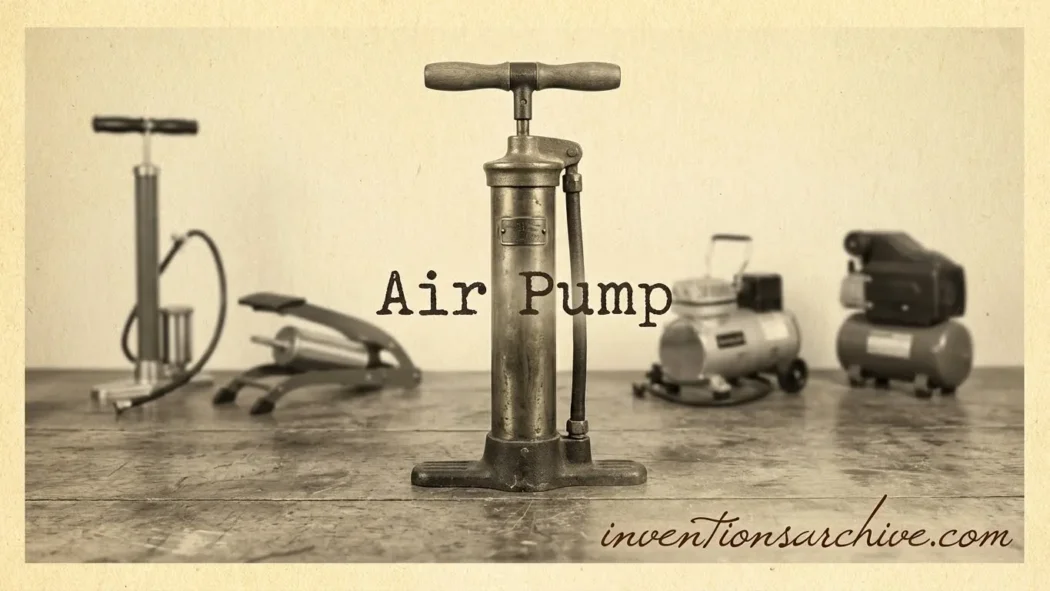
| Invention Name | Air Pump |
|---|---|
| Short Definition | A mechanical apparatus that removes air from a sealed vessel to create a partial vacuum. |
| Approximate Date or Period | Circa 1650 |
| Geography | Magdeburg, Holy Roman Empire; later developed further in Oxford and London |
| Inventor or Source Culture | Commonly attributed to Otto von Guericke |
| Category | Pneumatics, vacuum technology, scientific instruments |
| Importance | Made controlled experiments on reduced air pressure and partial vacuum practical. |
| Evidence Status | Well documented |
| Main Problem Solved | Mechanical removal of air from an enclosed space. |
| How It Works | A pump enlarges a chamber, draws gas from a connected vessel, then prevents that gas from returning during the next pumping cycle. |
| Development Path | Guericke’s evacuation pump → Boyle-Hooke experimental pump → improved double-barrel instruments → specialized vacuum pumps |
| Early Scientific Uses | Studies of atmospheric pressure, gas behavior, combustion, sound, respiration and other phenomena under reduced pressure. |
Why the Seventeenth-Century Air Pump Was Different
Pumps existed long before the seventeenth century. Water pumps, bellows and other devices could move fluids or force air into a space. The invention historically associated with Otto von Guericke was different in purpose: it was designed to withdraw air from a closed vessel and thereby produce an artificially rarefied space.
That distinction makes the historical air pump an early form of the vacuum pump. Modern language can cause confusion because “air pump” may also describe devices that inflate tires, aerate water or supply compressed air. In seventeenth- and eighteenth-century experimental science, however, the term commonly referred to apparatus used to evacuate a receiver.
The problem mattered because the existence of a vacuum was still disputed. Aristotelian natural philosophy had long treated empty space as physically problematic. Experiments with barometers and columns of liquid in the seventeenth century challenged older explanations, but a controllable mechanical device made it possible to investigate the question repeatedly rather than infer it from a single phenomenon.
Evangelista Torricelli’s mercury experiments in the 1640s were an important precursor. They showed that atmospheric pressure could support a column of mercury and left a space above the liquid that became central to arguments about the possibility of a vacuum. Mechanical evacuation extended this line of investigation by giving experimenters a chamber in which different objects and processes could be observed under reduced pressure.[e]
Otto von Guericke and the First Mechanical Vacuum Pump
The invention of the air pump is commonly dated to about 1650 and attributed to Otto von Guericke, a German engineer, natural philosopher and civic official associated with Magdeburg. The National Gallery’s scholarly catalogue for Joseph Wright’s later painting An Experiment on a Bird in the Air Pump identifies Guericke’s Magdeburg apparatus of 1650 as the invention of the air pump.[a]
Guericke’s early equipment used a piston arrangement to remove air from an enclosed vessel. The attainable pressure was far above what would now be considered a high vacuum, and sealing large vessels was technically difficult. Even so, the apparatus established an important principle: air could be mechanically extracted from a container far enough for the effects of atmospheric pressure to become unmistakable.
One of Guericke’s best-known demonstrations used two close-fitting hollow hemispheres. After air had been removed from the interior, atmospheric pressure acting on their outer surfaces held them together with extraordinary force. The Science Museum Group preserves an eighteenth-century demonstration apparatus based on these so-called Magdeburg hemispheres and notes that the experiment became a standard demonstration of atmospheric pressure.[b]
The experiment is sometimes loosely described as proving that a vacuum itself “pulled” the hemispheres together. That reverses the physics. Removing much of the internal air reduced the pressure pushing outward from inside. The surrounding atmosphere continued pressing on the external surfaces, so the pressure difference held the halves together.
A nineteenth-century copy of Guericke’s air pump also survives in the Science Museum Group collection. Its presence does not make that replica an original seventeenth-century object, but it documents how Guericke’s apparatus was reconstructed and presented in later histories of vacuum technology.[c]
From Demonstration Machine to Experimental Instrument
Guericke showed that mechanical evacuation was possible, but his apparatus was not ideally suited to the kind of repeated laboratory experimentation that Robert Boyle wanted to perform in Oxford. Boyle learned of continental work on vacuum experiments and became interested in using rarefied air as a controlled experimental condition.
Robert Hooke, then working with Boyle, designed and constructed a more practical air pump. The Science Museum Group dates the Boyle-Hooke design to 1659 and identifies Hooke as its maker in the record for a modern reconstruction of the instrument.[d]
The Boyle-Hooke apparatus combined a pumping mechanism with a comparatively large glass receiver. That arrangement was especially useful because objects could be placed inside the receiver before the air was removed. The pump therefore became a platform for experiments rather than merely an apparatus for demonstrating that evacuation could be achieved.
Boyle published the results in New Experiments Physico-Mechanicall, Touching the Spring of the Air, and its Effects in 1660. The experiments examined what happened when pressure around physical processes was reduced. Surviving Royal Society archival material also records Boyle’s experiments with an air pump and their investigation of the nature and effects of a vacuum.[f]
What the Pump Actually Made Possible
An air pump does not need to create a perfect vacuum to transform an experiment. Removing part of the gas from a sealed receiver lowers the number of gas molecules inside and therefore changes the pressure and density of the enclosed atmosphere.
In a piston-type experimental pump, increasing the volume of a pump chamber lowers its pressure relative to the connected receiver. Gas then moves from the receiver toward the lower-pressure chamber. Valves control the direction of this movement. The extracted gas is discharged, and successive cycles progressively reduce the pressure in the receiver.
Each cycle becomes less effective as the pressure falls. Leakage around seals, trapped gas, valve behavior and the mechanical limits of the apparatus establish a practical lower-pressure limit. Seventeenth-century pumps consequently produced what would now be described as a partial vacuum, not an empty space in the absolute sense.
This was enough to investigate several questions that could not be isolated easily in ordinary atmospheric conditions. Boyle, Hooke and later experimenters studied combustion, respiration, sound transmission, pressure effects and the behavior of physical objects in rarefied air.
Related articles: Crank Handle [Medieval Inventions Series], Caravel [Medieval Inventions Series]
Air as a Physical Substance
The pump helped establish that ordinary air was not merely an invisible absence between objects. It exerted pressure, could be compressed and expanded, and affected processes taking place within it.
Boyle’s investigations of pressure and volume contributed to the relationship later called Boyle’s law. The air pump was particularly useful because it permitted the pressure around enclosed gas to be altered experimentally. Boyle’s work helped move the study of air toward measurable physical relationships rather than purely qualitative speculation.
Sound in Rarefied Air
Experiments also addressed whether sound could travel when air was removed. In one famous experiment reported by Boyle, a sounding watch was placed inside the receiver while the air pressure was reduced. The sound weakened as the air became more rarefied. The experiment did not produce the near-perfect vacuum available to modern laboratories, but it provided evidence that transmission of sound depended on a material medium.
Combustion and Respiration
Flames changed or went out as air was withdrawn, while living creatures showed respiratory distress under reduced pressure. Such experiments helped establish that ordinary air participated in processes essential to both combustion and animal life, although seventeenth-century investigators did not yet possess the later chemical understanding of oxygen.
Historical experiments involving animals became part of the public culture of experimental philosophy as well as laboratory research. Their role is documented in period accounts and in later works such as Joseph Wright of Derby’s 1768 painting An Experiment on a Bird in the Air Pump. They belong to the history of experimentation, but modern standards for research involving animals are fundamentally different.
The Air Pump Became Easier to Demonstrate and Use
The original designs did not remain fixed. Instrument makers sought better seals, easier operation and more effective evacuation. By the beginning of the eighteenth century, double-barrel designs allowed alternating pumping action and became associated with increasingly elaborate scientific demonstrations.
A surviving Royal Society instrument designed by Francis Hauksbee around 1705 has two pump barrels, a glass bell and a substantial wooden frame. The Society describes it as an air pump designed to create a partial vacuum.[g]
| Stage | Form | What Changed |
|---|---|---|
| Circa 1650 | Guericke evacuation pump | Mechanical removal of air from enclosed vessels demonstrated that strongly rarefied spaces could be produced. |
| 1659 | Boyle-Hooke air pump | A practical receiver made it easier to place experimental subjects and apparatus inside an evacuated chamber. |
| Late 17th century | Experimental-philosophy apparatus | Air pumps spread among scientific investigators and became associated with demonstrations of pressure, combustion, sound and respiration. |
| Early 18th century | Double-barrel pumps | Instrument makers improved pumping action and produced more specialized apparatus for laboratories and demonstrations. |
| 19th–20th centuries | Specialized vacuum pumps | Mechanical, mercury, rotary, diffusion and later high-vacuum technologies extended attainable pressure ranges far beyond early piston instruments. |
During the eighteenth century, air pumps also became recognizable pieces of scientific furniture. Instruments could be accompanied by bells, gauges, hemispheres and other accessories designed to demonstrate particular properties of gases and atmospheric pressure. The National Gallery’s historical research notes that by the period of Wright’s 1768 painting, air pumps had become familiar items in collections of apparatus for experimental philosophy.[a]
Why Vacuum Technology Did Not Stop with the Air Pump
The piston air pump opened a field of experimentation, but later science required pressures far below those obtainable with early mechanical instruments. Better manufacturing reduced leakage, while new pumping principles allowed gases to be removed more efficiently.
Nineteenth-century developments included mercury-based pumps capable of reaching lower pressures than many conventional piston machines. Later rotary mechanical pumps became practical sources of rough and medium vacuum, while diffusion pumps, molecular pumps and other systems extended the accessible range further. Modern vacuum installations may combine several kinds of pumps because a mechanism effective near atmospheric pressure may not work efficiently at extremely low pressure.
The Science Museum Group’s vacuum-technology collection reflects this branching development. Its holdings range from historical air pumps and Magdeburg hemisphere apparatus to mercury, rotary, molecular and diffusion pumps, illustrating how the seventeenth-century problem of evacuating a vessel eventually developed into a specialized field of engineering.
From Experimental Philosophy to Modern Technology
The air pump’s lasting importance lies less in the original piston mechanism than in the experimental environment it created. Investigators could deliberately alter pressure inside a vessel, observe what changed and compare the result with conditions in ordinary air.
That capability became important far beyond the early debates about whether a vacuum could exist. Vacuum environments later supported research in gas physics, electrical discharge, spectroscopy and the study of matter at low pressures. Industrial descendants became important in electric-lamp manufacture, vacuum tubes, scientific instrumentation, chemical processing, refrigeration, electron microscopy and semiconductor production.
The terminology evolved as the technology became more specialized. “Air pump” remained appropriate for many teaching and laboratory instruments, while vacuum pump became the broader technical term for equipment designed to lower gas pressure within a system. Modern machines can differ radically from Guericke’s piston apparatus, yet they address the same basic physical task: removing enough gas from an enclosed space to establish and maintain pressure below the surrounding atmosphere.
The sequence from Guericke to Hooke and Boyle also illustrates an important distinction in invention history. Guericke is commonly credited with the first mechanical vacuum-producing air pump around 1650, while Hooke’s 1659 apparatus substantially improved the instrument for experimental work. Boyle then used that improved equipment in an extensive published research program. The invention therefore has a recognizable origin, but its scientific importance emerged through rapid redesign and use by several investigators rather than through a single unchanged machine.
Sources and Verification
- [a] An Experiment on a Bird in the Air Pump: Catalogue entry — The National Gallery’s scholarly catalogue identifies Otto von Guericke’s Magdeburg air pump of 1650, discusses its experimental uses and documents the later spread of air-pump demonstrations.
- [b] George III’s Magdeburg hemispheres — Science Museum Group collection documentation explains Guericke’s hemisphere demonstration and the role of atmospheric pressure.
- [c] Copy of Otto von Guericke’s air pump — The Science Museum Group record documents a historical reconstruction of Guericke’s pumping apparatus and its materials and museum history.
- [d] Reconstruction of the Boyle-Hooke air pump — The Science Museum Group identifies the Boyle-Hooke design as dating to 1659 and credits Robert Hooke as maker.
- [e] Robert Boyle’s landmark book of 1660 with the first experiments on rarified air — An American Physiological Society journal article examines the development of Boyle and Hooke’s apparatus and places it in the experimental sequence following Torricelli and Guericke.
- [f] Mr Boyle’s experiments (with air pump) — The Royal Society Archives preserves a seventeenth-century manuscript describing Boyle’s experiments with an air pump on the nature and effects of a vacuum.
- [g] Double-barrelled air pump by Francis Hauksbee — The Royal Society museum record documents Hauksbee’s circa-1705 double-barrelled air pump and its function in producing a partial vacuum.