
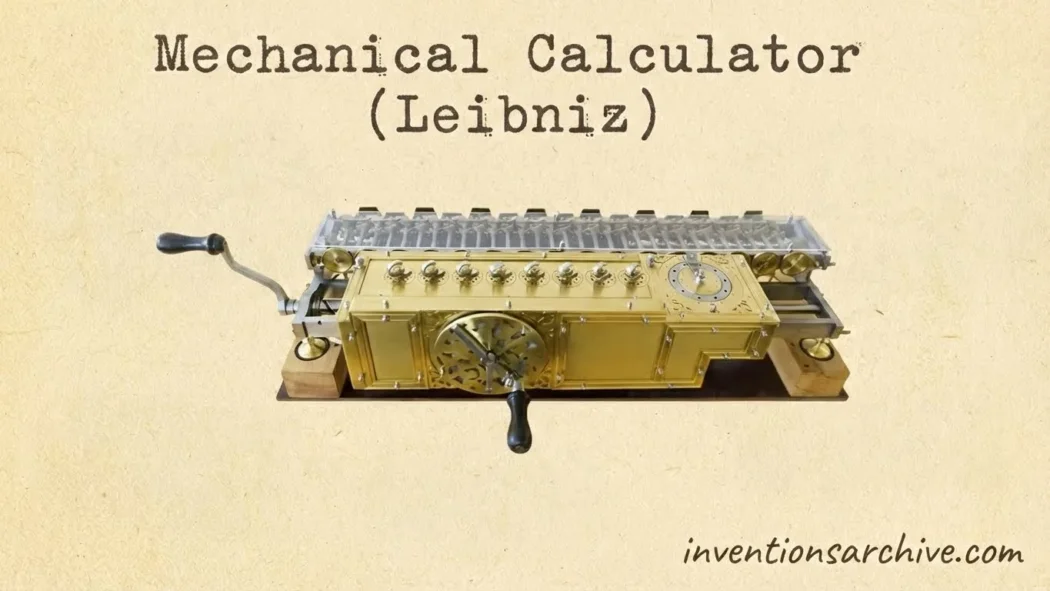
| Invention Name | Leibniz Mechanical Calculator (Stepped Reckoner / Machina Arithmetica) |
|---|---|
| Short Definition | A gear-driven calculator that mechanizes addition, subtraction, multiplication, and division with a stepped-drum mechanism. |
| Approx. Date / Era | 1671 (design); 1 Feb 1673 (public demo); 1690s–early 1700s (surviving build) Approximate |
| Geography | Paris; London; Hanover (modern Germany) |
| Inventor / Source Culture | Gottfried Wilhelm Leibniz |
| Category | Mechanical computation; scientific instruments |
| Need / Reason It Emerged | Faster arithmetic for records, finance, and technical calculation |
| How It Works | Stepped drum transfers 0–9 per crank turn; carry mechanism advances higher digits; shifting supports repeated addition/subtraction |
| Material / Tech Basis | Metal gears; dials; cranks; stepped cylinder (Leibniz wheel) |
| Early Use Context | Demonstration of mechanical arithmetic; learned circles; instrument collections |
| Spread / Influence Path | Concept → replicas → industrial mechanical calculators using stepped-drum principles |
| Derived Developments | Desk calculators with stepped-drum variants; long-lived mechanical calculation traditions |
| Impact Areas | Science; education; commerce; engineering (broad utility) |
| Debates / Different Views | Dating of the surviving machine’s build span Approximate |
| Precursors + Successors | Precursors: manual arithmetic tools; early adding devices + Successors: industrial mechanical calculators; later electronic calculators |
| Key People / Institutions | Royal Society (London); Hannover collections; university and museum replicas |
| Notable Variations | Wooden model; multi-version builds; museum replicas; stepped-drum calculator families |
| Why It Matters |
Four operations in one mechanism Stepped-drum idea shaped later mechanical calculators |
The Leibniz mechanical calculator is one of the clearest early proofs that abstract arithmetic can be turned into moving metal. Instead of asking the human mind to repeat long chains of addition, it uses a stepped drum to “encode” digits and transfer them into a result register, one controlled crank turn at a time.
Table Of Contents
What This Machine Is
A mechanical calculator is not a metaphor. It is a physical arithmetic system where digits are represented by positions, gears represent counts, and a carry mechanism handles base-10 overflow. Leibniz’s design is famous because its core element, the stepped drum, lets one rotating part express any digit from 0 to 9 by changing how many teeth engage.
Names You May See
- Stepped Reckoner — a common English label for the machine family.
- Machina arithmetica — a Latin naming tradition used in catalogues.
- Staffelwalze — German term for the stepped drum.
- Leibniz wheel — the stepped cylinder that makes the digit transfer possible.
Design and Early Milestones
Leibniz began developing a four-operation calculator in the early 1670s, shaped by work on decimal arithmetic and the practical need to speed up repetitive computation. A working model was shown in London to the Royal Society on 1 February 1673Details. That moment matters because it frames the calculator as an instrument: something meant to be handled, tested, and improved.
The machine’s history is not a single build date. It is better understood as a long technical effort that produced multiple versions and later replicas. Catalogues often place the surviving original’s construction across the late 1690s into the early 1700s, reflecting the reality that precision mechanics at the time demanded patience, iteration, and skilled workmanship.
How The Stepped Drum Works
The heart of the Leibniz calculator is the stepped drum (also called the Leibniz wheel): a cylinder with teeth of graduated lengths. When a counting gear slides along the drum, it meshes with a chosen number of teeth. That single motion sets the transfer amount for one digit, from 0 up to 9, within a single revolution.
This is the key leap: the digit is not stored as a printed symbol. It is stored as a mechanical engagement. The stepped drum becomes a reusable “digit generator,” and each crank turn becomes a controlled, repeatable unit of arithmetic.
What The Drum Solves
- Digit selection without swapping gears
- Repeatable transfer per crank turn
- Compact logic for 0–9 in one part
What The Drum Needs
- Accurate tooth geometry
- Stable alignment of moving parts
- Reliable carry between digits
University explanations of the device highlight how the Staffelwalze regulates the amount of rotation for each digit, effectively mapping 0–9 into controlled motion, and how that idea later proved valuable for industrial mechanical calculatorsDetails.
Inside The Mechanism
Most descriptions separate the machine into an input area (where numbers are set) and a result area (where totals accumulate). The practical idea is simple: set a number, rotate the crank, and the mechanism transfers that number into the accumulator—once, or many times, depending on the operation.
Input And Control
- Setting dials for each decimal position
- Engagement choice that defines 0–9 transfer
- Crank direction associated with add vs subtract in many replicas
Accumulator And Carry
- Result register that holds multi-digit totals
- Carry transfer that advances the next digit at rollover
- Readable windows or indicator discs for output
A Notable Catalog Detail
The Gottfried Wilhelm Leibniz Library notes that the machine aimed to mechanize addition, subtraction, multiplication, and division for decimal numbers up to eight digits, centered on the Staffelwalze, and that newer research has treated the preserved example as fully functional, with a replica used for demonstrationsDetails.
Operations It Could Perform
Leibniz’s concept was a four-operation device. That does not mean each operation is “instant.” It means the same machine can express all four in a controlled, mechanical way, using repeated transfer and positional shifting.
- Addition: a single crank cycle transfers the set digits into the accumulator.
- Subtraction: the accumulator changes in the opposite direction, relying on the same digit transfer idea.
- Multiplication: repeated addition with shifting across decimal positions, reflecting place value.
- Division: repeated subtraction with shifting and tracking of how many times a value can be removed.
Arithmeum’s collection description emphasizes this exact strategy: multiplication as successive additions and division as repeated subtraction, enabled by the stepped-drum concept and its ability to reapply the same set number into the result registerDetails.
Versions and Related Machines
The Leibniz calculator is best seen as a design line, not a single box. It includes prototypes, long-term refinements, and later replicas that museums use to explain the mechanism. This is normal for early instruments that depended on craft precision.
Common Variations Around The Core Idea
- Demonstration models meant to prove the principle.
- Refined builds that pursue smoother carry and more dependable motion.
- Museum replicas that make the stepped-drum action easy to show.
- Stepped-drum families in later desk calculators, where the same digit-transfer idea appears in new housings.
Why It Mattered
The lasting value of Leibniz’s machine is not only that it performed arithmetic. It showed that place value, digit selection, and carry could be implemented as a repeatable mechanism. That is a conceptual bridge between written computation and the later history of computation devices.
Many catalogues emphasize the stepped-drum principle’s long reach. The Deutsche Digitale Bibliothek entry describes the machine as a milestone and notes that the Staffelwalzenprinzip remained a basic technique in mechanical calculating over two centuriesDetails. Even when later designs changed the casing and controls, the central idea—turning a chosen digit into controlled gear motion—kept paying off.
Preservation and Demonstrations
Today, the Leibniz calculator lives most clearly through collections, catalogues, and working replicas. This matters for understanding, because a stepped drum is easier to grasp when its teeth and engagement are seen as real geometry, not a diagram.
When museums demonstrate a replica, the focus is usually on how digits become motion: the setting of dials, the rhythm of the crank, and the visible roll of the result indicators. It is a calm kind of wonder—mechanical clarity turning arithmetic into a physical process.
FAQ
Is the Leibniz calculator the same as the Stepped Reckoner?
Yes. Stepped Reckoner is a common name for Leibniz’s stepped-drum mechanical calculator family, also referenced in catalogues as a machina arithmetica.
What is the Leibniz wheel or stepped drum?
It is a cylindrical gear with teeth of graduated lengths. By sliding a counting gear along it, the mechanism transfers a chosen digit value (0–9) as controlled motion during one revolution.
Why are there multiple dates associated with the machine?
The calculator is tied to design work, demonstrations, and a long period of refinement. Many references distinguish early concept and public demonstration dates from the later, approximate build span of the surviving original.
Could it really do all four arithmetic operations?
Yes. The machine mechanizes addition and subtraction directly, and expresses multiplication and division through controlled repetition and positional shifting aligned with decimal place value.
What is the main legacy of the Leibniz mechanical calculator?
Its stepped-drum digit-transfer method influenced later mechanical calculators for a long period, showing that place value and carry can be built as a repeatable mechanism.