
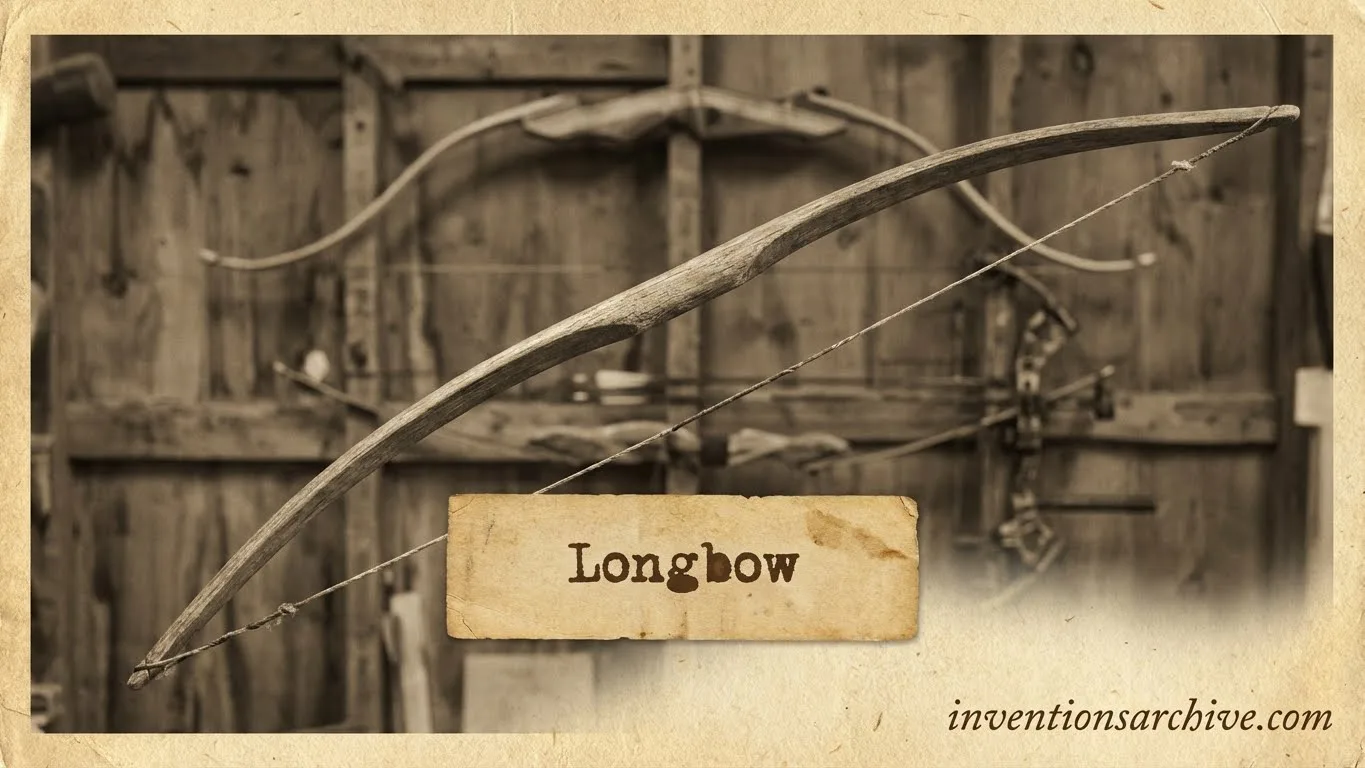
| Invention Name | Longbow |
|---|---|
| Short Definition | A tall bow with long limbs that bends to store elastic energy and sends an arrow forward with a single string. |
| Approximate Date / Period | Early long wooden bows: 4040–3640 cal BC (Certain for one find); widespread longbow traditions later (Approximate) |
| Geography | Britain & Ireland; longbow-style forms also appear in many regions |
| Inventor / Source Culture | Anonymous / collective |
| Category | Archery technology; materials engineering; craft design |
| Importance |
|
| Need / Why It Emerged | Reach; repeatable performance; portable tool |
| How It Works | Limbs bend; string transfers stored energy to an arrow |
| Material / Tech Basis | Wood elasticity; often yew with heartwood + sapwood |
| Early Use Contexts | Hunting; community archery; later formal training (Varies) |
| Spread Route | Craft exchange; migration; local wood supply (Approximate) |
| Derived Developments | Standardized arrows; tuned bow profiles; laminated longbows |
| Impact Areas | Sport; forestry and trade; education and craft; museum conservation |
| Debates / Different Views | Meaning of “longbow” (broad vs regional types) (Debated) |
| Predecessors + Successors | Earlier short bows → long self bows → modern longbows (flat, reflex/deflex, laminated) |
| Key Cultures / Periods | Early farming communities; medieval craft centers; modern target archery clubs |
| Varieties Influenced | Flatbow; D-section longbow; reflex/deflex; modern laminated longbow |
Longbows look simple at first glance: a tall piece of wood, a string, and a clean arc when drawn. The invention becomes more interesting the moment you treat it as a working spring. The long limbs manage tension and compression along their length, turning a steady pull into a fast release that remains repeatable when the materials and shape are right.
Contents
What The Longbow Is
A longbow is best understood by its geometry. The limbs are long enough to bend through a generous arc, so the bow behaves like a smooth spring rather than a short, sharp hinge. Many longbows are self bows—made from a single stave—though modern versions may be laminated for stability.
What Makes It A Longbow
- Overall form: long limbs, usually close to the user’s height
- Profile: typically not strongly recurved when unstrung
- Feel: a steady build of draw force over a long draw
- Structure: often a single-piece limb design (classic), or laminated (modern)
Close Neighbors
| Bow Form | Typical Trait |
|---|---|
| Longbow | Long limbs; smooth arc |
| Flatbow | Wider limbs; flatter belly |
| Recurve | Tips curve away; compact energy storage |
| Composite | Mixed materials; tuned stiffness |
Why Length Matters
With more limb length available, a longbow can spread bending stress across a larger area. That tends to reduce harsh “hot spots” and helps the bow keep a clean recovery after release. The result is often a stable feel and a consistent arrow launch—two traits that matter just as much as raw power.
Materials and Shape
Longbows live or fail on material behavior. Wood is not a single uniform substance; it has grain direction, growth rings, and zones that respond differently under tension and compression. A good longbow design aligns the shape with those natural strengths instead of fighting them with extra complexity.
Yew and The Two-Zone Idea
Yew became famous because a single stave can include both sapwood and heartwood. In many traditional designs, the sapwood sits on the “back” where it handles tension, while heartwood supports compression on the belly. That pairing can feel almost like a built-in composite, achieved with one tree.
- Sapwood: more elastic under tension
- Heartwood: resilient under compression
- Grain: straight grain reduces weak points
- Knots: fewer knots usually means more predictable bending
Cross-Section and Bending
The classic “English-style” profile is often described as a D-shaped cross-section. That shape places more wood where compression is heavy, while keeping the back flatter. Other longbows lean toward a wider flatbow section, which can reduce stress by spreading it across width.
| Common Section | Simple Effect |
|---|---|
| D-shaped | More belly mass for compression |
| Flatbow-like | Spreads stress through width |
| Oval | Balanced bending; forgiving feel |
How It Stores and Releases Energy
When a longbow is drawn, its limbs behave like a bent beam. The back side stretches under tension, the belly side shortens under compression, and the middle zone carries the transition between them. That stored elastic energy is then transferred to the string, and the string transfers it to the arrow.
A Simple Mechanical View
Researchers who tested yew in tension, compression, and bending found that its toughness supports efficient bow performance, and that wood age structure (juvenile vs mature growth) can strongly influence results.Details It is a quiet reminder that a longbow is not “just wood,” but a carefully stressed spring.
The String and The Arrow
The string does two jobs. First, it holds the limbs in a loaded state. Second, it becomes the moving link that accelerates the arrow. In well-tuned systems, the limbs recover cleanly, the string stays stable, and the arrow leaves with minimal sideways disturbance—important for accuracy and consistent flight.
- Draw length: how far the string moves back
- Draw weight: force needed at a given draw length
- Arrow mass: heavier arrows often feel steadier; lighter arrows can feel quicker
- Spine: arrow stiffness that helps it recover cleanly
Why Longbows Feel Different
Compared with more compact bow forms, longbows often build force more gradually through the draw. That can make the experience feel smooth rather than abrupt. The long limbs also tend to store energy across a larger section, which may help a bow keep a stable rhythm shot after shot.
None of this requires mystery. It is classic materials behavior—elastic deformation and controlled recovery—applied with a craft tradition that learned what works through careful observation and long, patient practice.
Evidence and Dating
Because wood usually decays, surviving bows are rare. When they do survive, they offer a direct look at dimensions, profiles, and the real-world variety of archery tools across time. A well-known early example from Scotland, found in peat, has a radiocarbon range of 4040–3640 cal BC and is described as the oldest bow in Britain and Ireland in that reference.Details It also highlights something easy to miss: not every “long” bow aimed for extreme strength; needs and contexts varied.
Measured Examples From A Single Collection
One museum collection notes longbows made from a single piece of yew, with lengths ranging from 1,839 mm to 2,113 mm, a mostly D-shaped cross-section, and suggested draw weights between 65 and 175 pounds (with a peak around 110 pounds).Details That kind of record is invaluable because it anchors the longbow in real measurements, not just stories.
| Feature | What The Data Shows | Why It Matters |
|---|---|---|
| Length | Long, often near adult height | Smoother bending; more stable loading |
| Section | D-shaped common in that set | Compression-friendly belly mass |
| Draw weight | Wide spread across bows | Different roles; different users; different tuning |
Dating: What It Can and Cannot Do
A date attached to one bow is a date for that object, not a claim that every region used the same design at the same time. What the evidence can do is show that long, carefully shaped bows existed early, and that later traditions refined profiles, standard measurements, and arrow systems with impressive consistency.
Types and Variations
“Longbow” is a family term. It covers multiple limb profiles and construction choices, all centered on a long working limb and a direct energy transfer through a single string. Below are common longbow variations, described in neutral design terms rather than dramatic labels.
Classic Self Longbow
- Single stave construction
- Often uses growth ring logic for durability
- Commonly associated with yew, elm, ash, and similar woods
Flatbow-Leaning Longbow
- Wider limbs; stress spread through width
- Often feels forgiving with varied arrow weights
- Works well with many hardwoods
Reflex and Deflex Profiles
Some modern longbows add gentle reflex (tips away from the user) or deflex (handle area forward) to tune stability and hand feel. These choices adjust how the limbs load and return, often aiming for a blend of comfort and efficiency.
Laminated Longbow
- Multiple layers for stability
- Allows careful control of stiffness along the limb
- Often paired with modern strings and consistent arrow setups
Influence and Legacy
The longbow’s legacy is not only historical. It shaped how people think about spring design in natural materials. It also strengthened traditions of standard measurement—consistent arrows, reliable strings, predictable limb profiles—so a craft could be taught, repeated, and improved without losing its human touch.
Craft and Knowledge
- Wood selection became a serious skill
- Grain reading turned into practical engineering
- Long-term seasoning and storage encouraged careful handling
- Museum conservation today protects surviving bows as material documents
Modern Archery
In modern target and field archery, longbows remain popular because the experience is direct. The form invites focus on rhythm, clean release, and the quiet partnership between bow, string, and arrow. It is a technology that still feels alive in the hands, even when the design stays beautifully simple.
FAQ
Is a longbow always made from yew?
No. Yew is iconic, yet longbows can be made from many suitable woods. The shared requirement is reliable elastic behavior and grain that supports bending without sudden weak points. In modern builds, laminated designs broaden material options even further.
What is the simplest way to define a longbow?
A longbow is a tall bow with long working limbs and a generally non-recurved profile at rest. The defining idea is not a single measurement, but the way length enables smooth bending and consistent energy storage.
Why do many historic longbows have a D-shaped section?
The D-like profile places more wood on the belly side where compression is heavy, while keeping the back flatter where tension dominates. It is a practical shape that matches the stress map of a bending limb.
Were all longbows extremely strong?
Not at all. Surviving examples and records show a wide range. Some bows prioritize manageable draw weight and close-range use, while others are built for higher energy. “Long” does not automatically mean “maximum strength.”
Are modern longbows the same as historical longbows?
Modern longbows often keep the long-limb idea while adjusting handle geometry, limb profile, and materials. Many also use consistent modern strings. The core physics—bending, energy storage, and a clean release—remains the same, which is why the longbow stays evergreen.
How do museums preserve surviving bows?
Preservation focuses on keeping the wood’s moisture balance stable and protecting surfaces from stress and rapid climate change. Bows are treated as fragile material evidence, so conservation aims for stability rather than display drama—quiet work that keeps history intact.