
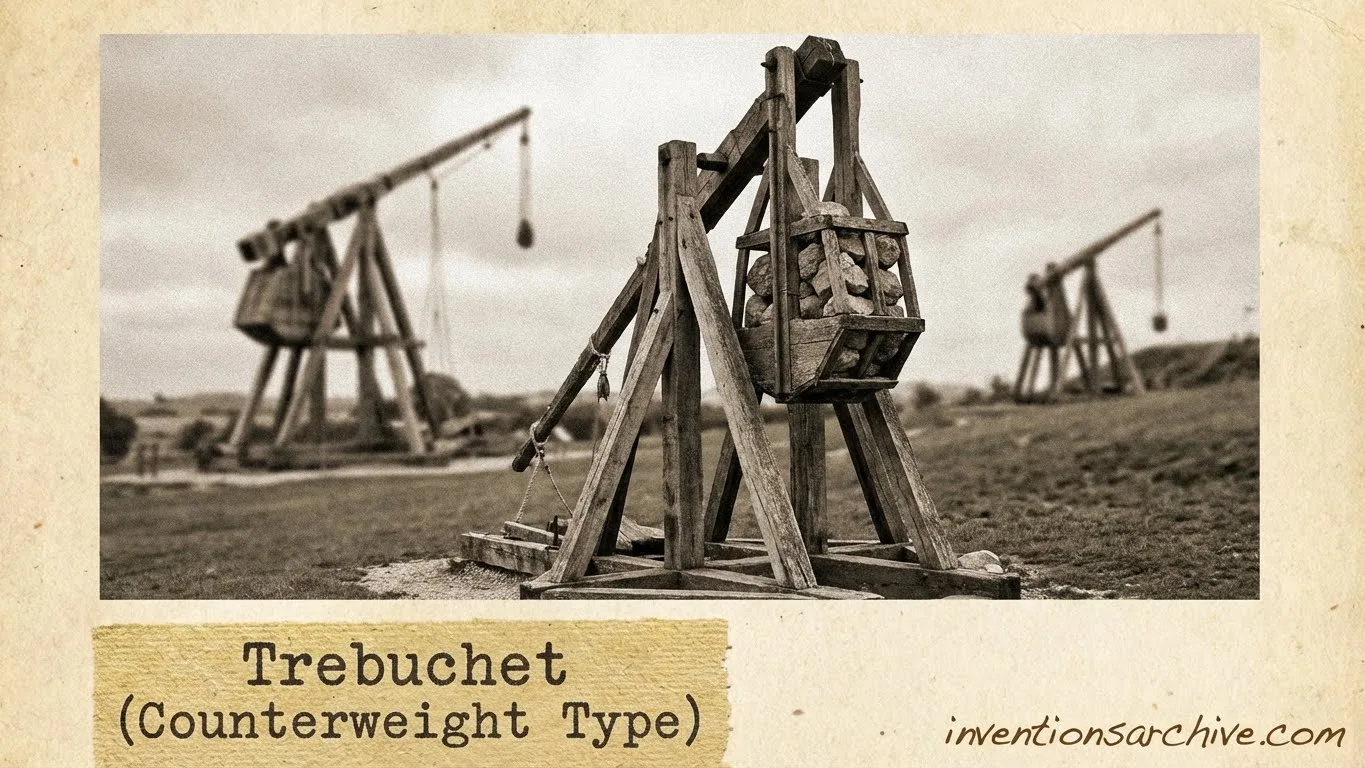
| Invention Name | Counterweight trebuchet |
|---|---|
| Short Definition | A gravity-powered throwing engine with an off-center beam, a heavy counterweight, and a sling. |
| Approximate Date or Period | Late 12th century for its emergence; widespread use followed in the 13th century. Approximate |
| Geography | Eastern Mediterranean, the Islamic world, Latin Europe, and later wider Eurasia |
| Inventor or Source Culture | Anonymous or collective development; exact origin remains debated |
| Category | Mechanical artillery; siege engineering; gravity-powered machinery |
| Evidence Status | Based on surviving evidence Attribution varies |
| Main Problem Solved | Launching heavier projectiles more consistently than human-pulled traction engines |
| Power Source | Gravitational potential energy stored in a raised counterweight |
| Simple Mechanism | Falling counterweight → rotating beam → accelerating sling → projectile release |
| Main Materials | Heavy timber, rope, iron fittings, axle components, sling material, and stone or earth ballast |
| Early Use | Siege bombardment against walls, towers, gates, and defended positions |
| Surviving Evidence | Chronicles, administrative records, technical drawings, manuscript illustrations, and later reconstructions |
| Development Path | Traction trebuchet → fixed counterweight form → hinged counterweight form → gunpowder artillery |
| Main Areas Affected | Fortification design, siege logistics, carpentry, mechanical engineering, and military administration |
| Related Inventions | Traction trebuchet, sling, winch, treadwheel crane, battering ram, cannon |
| Modern Descendants | Experimental replicas, physics teaching models, engineering demonstrations, and historical reconstructions |
The counterweight trebuchet was a large medieval throwing machine powered by the controlled fall of a heavy mass. It belonged to the broader trebuchet family, but it differed from earlier traction machines because gravity replaced teams of people as the main source of force. That change made heavier, more repeatable bombardment possible and turned the machine into a demanding project involving carpenters, metalworkers, haulers, stone cutters, and siege engineers.
What the Counterweight Trebuchet Was
A counterweight trebuchet used a long beam mounted on a horizontal axle above a timber support structure. The axle divided the beam into unequal arms. A heavy counterweight acted on the shorter arm, while a sling and projectile were attached to the longer arm.
When released, the raised counterweight descended. The beam rotated, and the long arm moved through a much larger arc. The sling extended that motion before releasing the projectile. The machine therefore combined a lever, a rotating beam, and a flexible sling in one system.
It is often grouped loosely with catapults, yet the power source matters. Classical torsion engines stored energy in twisted rope or sinew. Traction trebuchets depended on people pulling ropes. The counterweight trebuchet drew its working energy from a raised mass.
How Its Origin Is Traced
The counterweight form grew from an older line of swing-beam artillery. Traction trebuchets had long used an off-center beam and sling, but their short arm was driven by pulling crews. The gravity-powered version replaced that changing human pull with a descending mass.
Paul E. Chevedden’s study in Dumbarton Oaks Papers treats the counterweight trebuchet as a medieval use of gravitational energy that spread across Eurasia and North Africa. The study also links the machine with changes in siegecraft, fortification, and mechanical thought. [a]
Why a Single Inventor Is Hard to Name
The change from traction power to a counterweight may sound like one clear moment of invention. The record is less tidy. Engineers in the Byzantine, Islamic, and Latin Christian worlds exchanged ideas through travel, warfare, trade, translation, and the movement of skilled workers. Written terms were not standardized, and illustrations often survive without enough explanation to identify every mechanical detail.
For that reason, the safest attribution is anonymous and collective. A named ruler might commission a machine, and a named engineer might supervise one, but that does not show who first discovered the counterweight principle.
Earlier Evidence and Later Certainty
References from the late 12th century are central to the origin debate, but the evidence becomes easier to read in the 13th century. By then, chronicles and technical drawings describe or depict large trebuchets with counterweights, hauling systems, and substantial timber structures.
Around 1230, Villard de Honnecourt recorded a trebuchet in his drawing book. The Bibliothèque nationale de France identifies the manuscript as Français 19093, folio 30r, and the accompanying text refers directly to a very heavy counterweight. [b]
The Problem It Answered
Earlier traction trebuchets could launch projectiles efficiently, but their performance depended on coordinated pulling crews. More people could add force, yet human timing, available space, fatigue, and rope handling placed practical limits on scale and consistency.
The counterweight form answered that limit by storing energy before each shot. A raised mass could be released in a repeatable way. This allowed builders to enlarge the beam, counterweight, sling, and support structure without depending on a much larger pulling crew for the main power stroke.
- Heavier bombardment: larger machines could deliver heavier stone projectiles.
- More repeatable force: the same counterweight could provide a similar energy input from shot to shot.
- Better use of labor: workers were still needed for hauling, loading, maintenance, and resetting, but not as the main source of throwing force.
- Greater engineering scale: siege preparation now required stronger timber work, lifting systems, transport, and organized supply.
How It Worked in Simple Terms
Cambridge University Press describes the trebuchet as an off-center beam working through mechanical advantage. The long arm moves faster than the short arm, and the sling makes the projectile travel farther before release. In the counterweight version, gravitational force acting on a heavy mass powers the short arm. [c]
Energy Transfer
The raised counterweight held gravitational potential energy. As it fell, that stored energy became motion in the counterweight, beam, sling, and projectile. Not all of the energy reached the projectile. Some remained in the moving structure or was lost through friction, vibration, rope movement, and air resistance.
The unequal beam was central to the process. A relatively small movement at the short arm produced a larger and faster movement at the long arm. The sling then acted as a flexible extension of the long arm.
The Sling and Release
One end of the sling remained attached to the long arm. The other was arranged to release during the upward sweep. At the release point, the projectile left the sling and continued on a ballistic path.
Historical sources rarely preserve enough detail to reconstruct the exact settings of a particular machine. Beam shape, sling behavior, counterweight motion, projectile mass, timber flexibility, and axle friction all affected performance. The trebuchet was simple in principle but difficult to tune at full scale.
Materials, Craft, and Siege Organization
A large trebuchet was not simply a beam with a stone box. It was a temporary engineered structure. Its construction demanded suitable timber, joints able to carry changing loads, an axle and bearings, strong rope, lifting equipment, and a prepared working area.
The counterweight could be formed as a rigid mass or as a container loaded with dense material. The projectile supply also required planning. Stones had to be selected, shaped when needed, transported, and stored close enough for repeated use.
Modern experimental work shows why organization mattered. A Cambridge study based on surviving drawings, manuscripts, traditional timber methods, and reconstruction work emphasizes the difficulty of raising and assembling very large machines with premodern lifting equipment. [d]
These demands connected the trebuchet with several other technical fields: carpentry, rope making, quarrying, haulage, metal fitting, surveying, and the use of winches or hoisting devices.
Development Path
| Stage | Form | What Changed |
|---|---|---|
| Earlier Tool | Traction trebuchet | Pulling crews supplied the force through ropes attached to the short arm. |
| Transitional Debate | Proposed hybrid or counterpoised forms | Some historians identify intermediate arrangements; other scholars question whether a true hybrid type existed as once described. |
| Gravity-Powered Form | Fixed counterweight trebuchet | A rigidly attached mass replaced the pulling crew as the main power source. |
| Improved Form | Hinged or swinging counterweight trebuchet | The counterweight moved on a joint, changing the motion and reducing some of the abrupt loading seen in rigid forms. |
| Later Artillery | Gunpowder cannon | Stored chemical energy, metal barrels, and new projectile systems gradually displaced large mechanical throwing engines. |
Early Uses and Spread
The counterweight trebuchet served mainly in sieges. Its projectiles could batter masonry, damage towers and gates, strike structures inside an enclosure, or keep defenders away from exposed positions. It could also be used defensively from a fortress or city when space and structure allowed.
Knowledge moved between the eastern Mediterranean, the Islamic world, Latin Europe, and Mongol-controlled routes. That movement did not follow one straight path. Different regions used their own names, support structures, counterweight forms, and operating practices.
Large machines were often assembled near a siege because transporting a complete engine was impractical. Timber, ironwork, rope, ballast, and workers might come from different places. Some parts could be prepared in advance, while the final structure was fitted to local ground and available materials.
The Warwolf at Stirling
One of the best-known recorded trebuchets was the Warwolf, built for Edward I during the 1304 siege of Stirling Castle. Historic Environment Scotland reports that five master carpenters and 50 workmen assembled large beams, winches, and an enormous counterweight. The account illustrates the labor and supply system behind a royal siege engine, not merely the throwing mechanism. [e]
The Warwolf’s fame can distort the wider history. Most trebuchets were not named, and many were smaller than the largest royal machines. The surviving record naturally favors exceptional projects because chroniclers and officials were more likely to describe them.
Main Types and Variations
| Type | Counterweight Arrangement | Historical Character |
|---|---|---|
| Fixed Counterweight | Counterweight rigidly attached to the short arm | Mechanically direct, but the motion could place abrupt loads on the structure. |
| Hinged Counterweight | Counterweight suspended from a pivoting joint | Allowed the mass to swing during the shot and altered energy transfer through the beam. |
| Propped Hinged Form | Hinged counterweight held in an offset starting position | Appears in technical discussions as a refined arrangement, though evidence for exact historical practice varies. |
| Large Breaching Engine | Very heavy counterweight and large timber structure | Built for major sieges where transport, labor, timber, and projectile supply were available. |
| Smaller Counterweight Engine | Reduced counterweight and lighter structure | More manageable, but with lower projectile capacity than the largest machines. |
These labels help modern readers, but medieval terminology was not always this precise. A chronicle might use a broad word for a stone-throwing engine without stating whether the counterweight was fixed or hinged.
Before and After the Counterweight Type
| Before the Invention | What Changed After It |
|---|---|
| Pulling crews supplied the main throwing force. | A raised mass stored the main energy before release. |
| Performance depended heavily on crew coordination and fatigue. | The power stroke became more repeatable when the counterweight and starting position remained similar. |
| Scaling required more pullers and more room for ropes. | Machines could grow through heavier counterweights, stronger beams, and larger support structures. |
| Traction engines remained useful for faster or lighter bombardment. | Counterweight engines became suited to heavier siege work. |
| Fortifications faced older forms of mechanical artillery. | Builders placed more attention on towers, wall profiles, protected positions, and defenses against heavy bombardment. |
| Siege artillery relied mainly on mechanical or muscular energy. | Later cannon introduced gunpowder, metal barrels, and a different engineering system. |
What Changed Because of It
The counterweight trebuchet altered the scale of mechanical siege artillery. It did not make every wall obsolete, and it did not guarantee the fall of a fortress. Defenders repaired damage, strengthened exposed sections, used earth backing, launched counter-bombardment, or waited for the attackers’ supplies to fail.
Its clearest effects appeared in four areas:
- Fortification: heavy bombardment encouraged attention to stronger towers, shorter exposed wall sections, protected fighting positions, and repairs using timber or earth.
- Logistics: large engines required organized labor, transport, food, rope, timber, metalwork, ballast, and projectiles.
- Mechanical knowledge: builders worked with leverage, falling masses, hoisting, rotating joints, structural loading, and sling motion.
- Administrative records: rulers and cities recorded payments for carpenters, materials, transport, and specialized workers.
The machine’s value therefore extended beyond its projectile. It was also a test of whether an army or city could gather materials, skill, and labor at the same place and time.
How the Trebuchet Record Survived
No known full-size medieval counterweight trebuchet survives intact. Timber decays, ropes fail, iron fittings are reused, and siege engines were often dismantled after a campaign. Much of the evidence comes from records made for another purpose.
Drawings and Manuscripts
Villard de Honnecourt’s 13th-century notebook preserves one of the most useful early technical references. Later illustrated works add more views of medieval machinery. The Bellifortis, associated with Konrad Kyeser and written in the early 15th century, is described by the Library of Congress as the first fully illustrated manual of military technology; trebuchets appear among its many machines. [f]
Chronicles and Accounts
Chronicles record named engines, sieges, unusual projectiles, damaged structures, and reactions from witnesses. Administrative accounts may be less dramatic but more useful for understanding costs, wages, transport, and materials.
Experimental Reconstruction
Modern replicas can test whether an interpretation is mechanically plausible. They cannot prove that every medieval machine had the same dimensions or settings. A reconstruction is strongest when it clearly separates surviving evidence from modern engineering choices.
Common Misunderstandings
It Was Not Invented by One Famous Person
No surviving record securely identifies one inventor. The counterweight trebuchet is better understood as a development within a long tradition of swing-beam artillery.
The Earliest Evidence Is Not Necessarily the First Use
A late 12th-century reference shows that the idea existed by that time. It does not reveal the first workshop experiment or the earliest machine that left no record.
Trebuchet and Catapult Are Not Exact Synonyms
Catapult is often used as a broad modern term. The trebuchet is more precisely a swing-beam engine, while many ancient catapults used torsion or tension rather than a falling counterweight.
The Largest Machines Were Not Typical of Every Siege
Named engines such as the Warwolf receive attention because they were exceptional. Smaller machines, mixed artillery groups, mining, blockade, negotiation, and starvation remained part of siege practice.
Cannon Did Not Replace It Overnight
Mechanical artillery and early gunpowder weapons overlapped. Counterweight trebuchets remained useful until cannon became more reliable, mobile, and effective against masonry.
From Trebuchet to Gunpowder Artillery
The counterweight trebuchet remained in use from roughly the mid-12th to the mid-15th century, though dates varied by region. Utah State University’s historical study notes that later gunpowder cannon replaced the large mechanical engines. [g]
Cannon changed the engineering problem. Instead of raising a heavy counterweight, gunners used expanding gases inside a barrel. This required metal casting, gunpowder production, new carriage systems, and different forms of ammunition. Early cannon had their own limits, so the change was gradual rather than immediate.
The trebuchet survived in another form: as a record of medieval applied mechanics. Modern museums, universities, and historical sites use replicas to study gravity, rotational motion, timber structures, experimental archaeology, and the interpretation of incomplete evidence.
Related Inventions
- Traction trebuchet: the human-powered swing-beam predecessor.
- Sling: the flexible projectile holder that extended the effective throwing arm.
- Winch: used in medieval lifting and resetting work.
- Treadwheel crane: a related gravity-and-lifting technology used in large construction projects.
- Battering ram: another siege machine directed against gates and walls.
- Siege tower: a mobile structure used to approach defended walls.
- Counterweight crane: a non-military application of balancing and lifting principles.
- Cannon: the gunpowder artillery system that gradually displaced large trebuchets.
Frequently Asked Questions
Who invented the counterweight trebuchet?
No single inventor is securely known. The surviving evidence points to collective development in the eastern Mediterranean during the late 12th century, followed by wider adoption and adaptation.
What powered a counterweight trebuchet?
A raised mass supplied gravitational potential energy. When released, the mass descended and rotated the beam, which accelerated the sling and projectile.
How was it different from a traction trebuchet?
A traction trebuchet used teams pulling ropes on the short arm. A counterweight trebuchet replaced that main pulling force with a heavy falling mass.
What is the difference between fixed and hinged counterweights?
A fixed counterweight was rigidly attached to the short arm. A hinged counterweight could swing on a joint, changing its motion and the way energy and structural loads passed through the machine.
Did the Warwolf really exist?
Yes. Records connect the Warwolf with Edward I’s siege of Stirling Castle in 1304. Its exact dimensions remain uncertain, but the labor and materials recorded for the project show that it was an unusually large royal siege engine.
Why did cannon replace the trebuchet?
As gunpowder artillery improved, cannon could deliver force through compact metal barrels and became more effective against masonry. The change took place over time, with both systems used during part of the late medieval period.
Sources and Verification
- [a] The Invention of the Counterweight Trebuchet: A Study in Cultural Diffusion — Used to verify the debated origin, geographic diffusion, gravity-powered character, and wider historical effects. (Reliable because it is a university-hosted record of an academic journal article.)
- [b] Villard de Honnecourt, Français 19093, folio 30r — Used to verify the circa-1230 manuscript evidence and its reference to a trebuchet with a heavy counterweight. (Reliable because it is the official manuscript database of the Bibliothèque nationale de France.)
- [c] Anglo-Norman Artillery in Narrative Histories, from the Reign of William I to the Minority of Henry III — Used to verify the off-center beam, sling, traction predecessor, and gravity-powered counterweight mechanism. (Reliable because it is an academic chapter published by Cambridge University Press.)
- [d] Raising the Medieval Trebuchet: Assembly Method and the Standing of a Half-scale Machine — Used to verify the scale, craft, lifting, and assembly problems associated with large trebuchets. (Reliable because it is academic research published by Cambridge University Press.)
- [e] The War Wolf at Stirling Castle — Used to verify the 1304 Stirling context and the recorded workforce and materials associated with the Warwolf. (Reliable because it is published by Historic Environment Scotland.)
- [f] The Bellifortis (Strong in War) — Used to verify the date, authorship, illustrated character, and trebuchet content of the medieval technical manuscript. (Reliable because it is an official Library of Congress collection record.)
- [g] Building The Medieval Trebuchet — Used to verify the broad period of use, later replacement by gunpowder cannon, and the scarcity of detailed construction evidence. (Reliable because it is a university-hosted history thesis.)

