
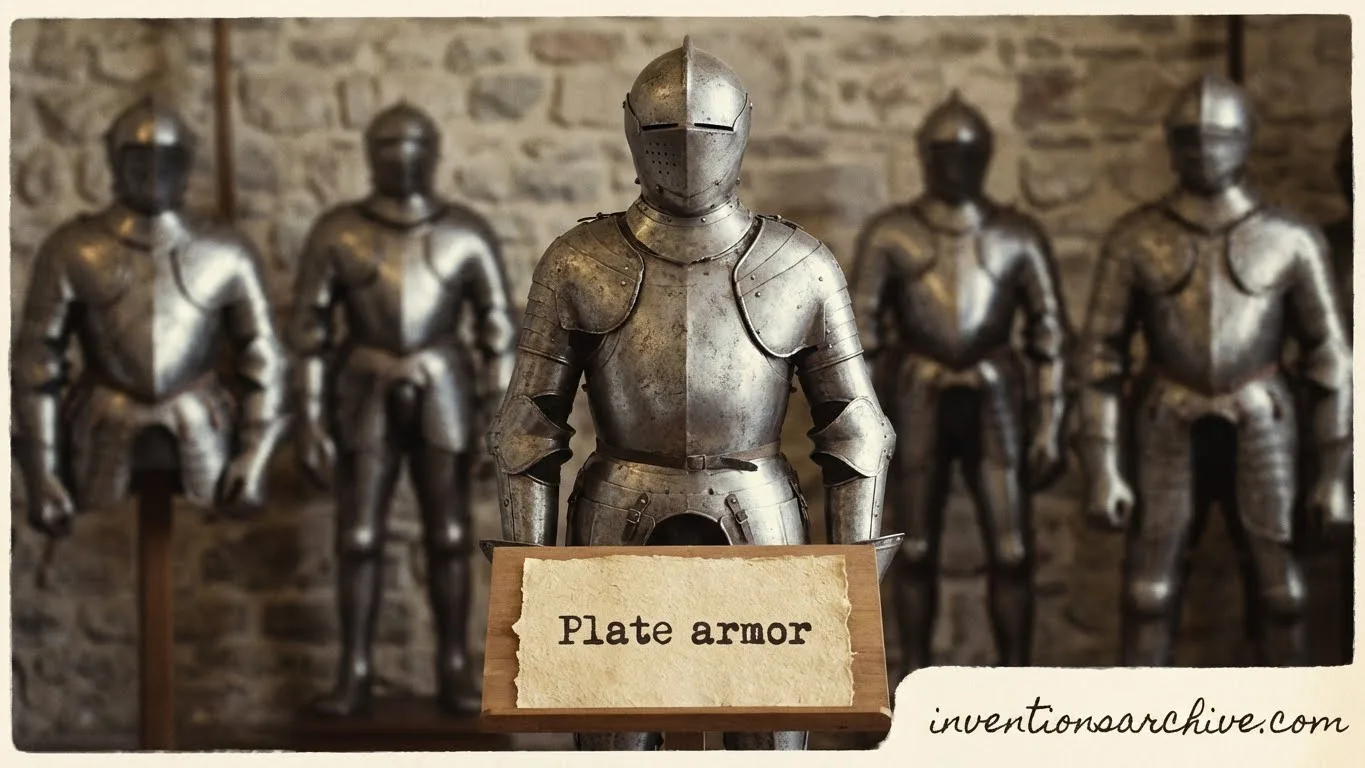
| Invention Name | Plate armor, also written plate armour |
|---|---|
| Short Definition | Body protection formed from shaped metal plates fitted around the wearer and joined so that the body could still move. |
| Approximate Date or Period | Western European body plates developed during the 13th and 14th centuries; articulated full plate armor was established by about 1420. Based on surviving evidence [b] |
| Earlier Plate Evidence | Large bronze body plates existed long before medieval full armor. Surviving Greek and Italic cuirasses show that shaped plate protection was already known in antiquity. Confirmed artifact [a] |
| Main Geography | Western and Central Europe, with major production centers in northern Italy and southern Germany. Their designs influenced workshops across Europe. [d] |
| Inventor or Source Culture | Anonymous and collective; developed by generations of armorers, metalworkers, patrons, and military users rather than one named inventor. |
| Category | Protective equipment, metalworking, manufacturing, and fitted mechanical design |
| Evidence Status | Approximate development date supported by surviving components, complete later suits, artwork, inventories, workshop records, and museum objects |
| Main Problem Solved | Improved protection against concentrated impacts, points, and projectiles that could defeat or damage mail, padded clothing, and shields. |
| How It Worked | Curved plates covered exposed areas, while overlapping sections, movable rivets, straps, padding, and mail protected joints and preserved movement. [e] |
| Material and Technology Base | Iron or steel plates, leather straps, movable rivets, textile padding, mail sections, buckles, and occasional copper-alloy or precious-metal decoration |
| Early Use | Protection for mounted and foot combatants; later adapted for tournaments, ceremonial display, court dress, and specialized mounted roles |
| Development Path | Padded armor and mail → coat of plates and separate limb defenses → breastplate and articulated plate elements → full plate harness by about 1420 [c] |
| Main Types | Field armor, tournament armor, parade armor, armor garnitures, three-quarter armor, munition armor, and plate defenses for horses |
| Adaptable Forms | Some garnitures used exchange and reinforcing pieces so one fitted armor could serve several field or tournament roles. A dated Greenwich example from 1527 preserves this system. [f] |
| Surviving Evidence | Separate medieval components, near-complete harnesses, workshop marks, written accounts, paintings, funerary monuments, royal inventories, and museum collection records |
| Rare Surviving Example | A near-complete German armor for man and horse, dated to about 1480, survives in the Wallace Collection. The man’s armor weighs 27.161 kilograms. [g] |
| Why It Mattered |
|
| Related Inventions | Mail armor, gambeson, coat of plates, brigandine, visor helmet, barding, cuirass, and modern rigid body-armor plates |
| Modern Descendants | Protective steel cuirasses, industrial protective shells, helmets, and rigid ballistic plates; these share a protective principle but not the same construction |
What Plate Armor Is
Plate armor is a system of shaped rigid defenses worn over selected areas or almost the whole body. A complete European suit was often called a harness. It was not one hollow shell. It consisted of many fitted elements assigned to the head, torso, arms, hands, hips, legs, and feet.
Each major element could contain several plates. Narrow overlapping sections called lames allowed knees, elbows, shoulders, hips, and parts of the neck to bend. Leather straps, buckles, hinges, sliding rivets, and internal fittings kept the pieces aligned.
Plate armor worked as a layered system. Steel covered broad exposed surfaces. Mail guarded narrow gaps. A fitted textile garment supported the armor and reduced direct contact between metal and skin. No single material performed every task.
Partial Plate and Full Plate
The term can describe both isolated metal defenses and a nearly complete suit. A breastplate alone is plate armor. So are plate-covered arms or legs. Full plate armor refers to a coordinated harness covering almost the entire body with articulated components.
This distinction matters because metal breast protection is far older than the European full harness. Ancient bronze cuirasses, helmets, greaves, and shoulder defenses were plate forms, but they did not use the same head-to-toe arrangement found in the 15th century.
How Its Origin Is Traced
Ancient Plate Defenses
People shaped bronze into body defenses many centuries before steel full plate appeared. Ancient cuirasses commonly used a front and back plate formed around the torso. Helmets and greaves protected the head and lower legs. These objects show an early understanding of curved metal as wearable protection.
Ancient plate traditions did not produce a continuous, unchanged path to the late medieval harness. Materials, workshop organization, fighting equipment, clothing, and methods of joining movable parts differed across time and place.
The Medieval Development
Mail remained a leading form of European body defense for centuries. It was flexible and effective against many cutting actions, yet its rings could transfer heavy impact to the body. Concentrated points and stronger projectiles also encouraged users to add rigid protection over exposed areas.
Armorers first combined mail and padded clothing with separate defenses for the knees, shins, elbows, shoulders, and hands. Coats of plates placed multiple metal pieces inside or beneath a textile or leather covering. Later designs used larger breastplates and backplates.
By the early 15th century, these changes had produced a fitted system that covered most of the wearer in exposed steel. The result came from many linked improvements, not one sudden discovery.
The Problem It Answered
Earlier defenses involved trade-offs. Thick textile armor could absorb part of an impact but added bulk. Mail moved easily and resisted cuts, yet it did not create a broad rigid surface. Shields gave strong mobile protection, though one hand normally had to control them.
Plate armor added hard, curved surfaces over vulnerable areas. A well-shaped plate could redirect a point away from the body and spread part of an impact over a larger area. It also permitted protection to be distributed across the wearer rather than carried mainly through a shield.
| Before Plate Armor | What Changed After It |
|---|---|
| Mail and padded garments supplied much of the body protection. | Rigid plates covered more of the torso, limbs, hands, and joints. |
| A heavy impact could still injure the body through flexible rings. | Shaped plates helped spread force and turn some blows away from the wearer. |
| Shields remained central to the protective system. | Improved body coverage allowed smaller shields or no shield in some roles. |
| Rigid protection was often limited to helmets, greaves, knee pieces, or hidden plates. | Separate defenses became one fitted and coordinated harness. |
| Earlier equipment offered fewer options for exchanging role-specific pieces. | Garnitures could add or remove reinforcing elements for different activities. |
| Protective metalwork relied on relatively isolated components. | Armor production encouraged close fitting, articulation, surface shaping, and specialized regional workshops. |
How Plate Armor Worked
Plate armor relied on shape, overlap, movement, and support. The metal did not need to form a thick wall around the body. Its curved surfaces and fitted position helped manage contact while keeping weight distributed across several areas.
Curved Surfaces
Breastplates, helmets, shoulder pieces, and limb defenses were rarely flat. Curves strengthened the form and made it harder for a point to meet the surface at a direct angle. Raised ridges, central creases, and turned edges could also stiffen selected areas.
Overlapping Plates
Joints could not be enclosed by one fixed sheet. Armorers placed smaller plates in overlapping rows around moving areas. As a limb bent, the plates slid across one another while retaining coverage.
Articulated Connections
Movable rivets allowed controlled sliding. Leather straps held elements together or connected them to the supporting garment. Hinges and pins closed larger sections around the body. The exact arrangement varied by date, region, intended use, and workshop.
Textile and Mail Support
A fitted padded garment, often called an arming doublet, helped carry and position the pieces. Mail remained useful at the armpits, groin, inner elbows, and other areas where tightly fitted solid plates would restrict motion.
Earlier Tools and the Development Path
Full plate armor became possible only after several earlier technologies had matured. Mail supplied flexible protection. Quilted garments provided support and cushioning. Helmets demonstrated how metal could be shaped around the body. Coats of plates joined multiple rigid pieces inside a flexible covering.
| Stage | Form | What Changed |
|---|---|---|
| Earlier Defense | Padded textile armor and mail | Flexible layers protected broad areas but provided limited rigid coverage. |
| Added Plate Elements | Helmets, greaves, knee pieces, elbow pieces, and shoulder defenses | Rigid material was placed over areas most exposed to direct contact. |
| Transitional Form | Coat of plates and brigandine | Multiple plates protected the torso beneath a textile or leather shell. |
| Developed Form | Articulated full plate harness | Fitted elements enclosed almost the whole body while preserving joint movement. |
| Improved Form | Specialized field armor, tournament armor, and garnitures | Armor could be adapted to a defined role through altered shapes or exchange pieces. |
| Later Form | Three-quarter armor and cuirasses | Protection concentrated on the head, torso, arms, and upper legs rather than the whole body. |
| Functional Descendants | Rigid helmets and modern hard body-armor plates | Hard protection remained useful, though materials, threats, testing, and carrier systems changed. |
Materials, Fit, and Workshop Practice
Most well-known late medieval and Renaissance plate armor used iron or steel. The finished harness also depended on leather, textile, rivets, buckles, and mail. Decorative examples could include etched, engraved, gilded, blackened, or embossed surfaces.
Armorers shaped plates to the wearer’s body and intended activity. A poor fit could shift weight badly, interfere with joints, or expose gaps. A carefully fitted harness placed articulated areas close to the wearer’s natural points of movement.
Work Was Divided Among Specialists
Armor production was not always completed by one person. A workshop might divide shaping, fitting, polishing, fastening, lining, and decoration among several workers. Merchants and court officials could also arrange commissions across long distances.
Regional centers developed recognizable preferences. Italian armor was often associated with smooth rounded surfaces and broad forms. German armor could favor sharper lines, narrow waists, ridges, or fluting. These were changing workshop traditions rather than fixed national rules.
Decoration Was Not Separate From Design
Plain field armor and highly decorated armor used many of the same structural ideas. Decoration could communicate rank, ownership, workshop identity, court fashion, or ceremonial purpose. Some surfaces were polished bright, while others were darkened, painted, covered, etched, or partly gilded.
The familiar phrase shining armor describes only one possible finish. Many historical surfaces would not have appeared as uniformly bright mirror-polished steel.
Early Uses in Real Settings
Field Armor
Field armor was designed for practical protection and movement. Its exact coverage depended on the wearer’s role, available resources, local practice, and date. A mounted user and a foot soldier did not always need the same pieces.
Full suits belonged mainly to people and institutions able to pay for skilled metalwork and fitting. Other users combined helmets, breastplates, arm defenses, mail, brigandines, padded garments, and second-hand components.
Tournament Armor
Tournaments created specialized requirements. Some events used reinforced helmets, breastplates, shoulder defenses, gauntlets, or barriers on one side of the body. These pieces could be heavier or more restrictive than field armor because they were designed for a narrow activity rather than general movement.
Related articles: Pocket Watch [Renaissance Inventions Series], Gunpowder weapons [Medieval Inventions Series]
This specialized equipment helped create the false impression that all plate armor was extremely heavy and rigid. Ordinary field armor and specialized tournament armor should not be treated as the same object.
Court and Ceremonial Use
Armor also appeared in ceremonies, formal entries, portraits, court festivals, gifts, and displays of status. A decorated suit could present the owner as trained, wealthy, disciplined, or connected to a respected workshop.
Some ceremonial armor remained wearable. Other objects placed visual effect above practical field use. Museum records must therefore distinguish between field equipment, tournament equipment, costume-like armor, parade pieces, and later historical reproductions.
Armor for Horses
Mounted equipment could extend plate protection to a horse. Horse armor, commonly called barding, might protect the head, neck, chest, body, or hindquarters. It required large shaped plates and careful attention to the animal’s movement.
Near-complete early horse armors are much rarer than individual helmets, breastplates, or human armor components. Their survival gives historians evidence about elite mounted equipment, workshop scale, and the resources required for a matched set.
How It Spread and Changed
Northern Italian and southern German cities became leading centers of armor production. Skilled products moved through court commissions, trade, diplomatic gifts, family connections, and the movement of trained craftspeople.
Armor made in one center could be worn far from its place of production. Local workshops also copied, adjusted, or combined outside styles. This exchange makes it difficult to assign every surviving piece by appearance alone.
Italian and German Workshop Influence
Italian and German armorers supplied customers across Europe. Their designs were adapted in France, England, Spain, the Low Countries, and other regions. Surface style could travel faster than complete workshop methods, producing local armor with imported visual features.
During the 15th century, regional differences became more visible. Later, court fashions and international commissions encouraged further mixing. A suit’s style, place of manufacture, and owner’s homeland may all be different.
The Greenwich Workshops
Royal workshops established at Greenwich in England during the early 16th century developed a recognizable court style. They employed skilled armorers and produced fitted equipment for royal and aristocratic patrons.
The surviving 1527 garniture associated with the Greenwich workshops shows how one armor could use matching exchange pieces. Parts could alter coverage or reinforce areas for a particular field or tournament role.
From Full Harness to Partial Coverage
Armor did not disappear on one date. Full body coverage became less common while helmets, breastplates, backplates, arm defenses, and three-quarter suits continued in selected roles. Protection shifted toward the areas judged most exposed or valuable to cover.
This change reflected cost, weight, movement, changing equipment, organized supply, and the need to equip larger groups. The story is better described as adaptation and reduction than instant replacement.
Main Types and Variations
| Type or Variation | Main Setting | Defining Features |
|---|---|---|
| Full Field Armor | Mounted or foot service | Coordinated head-to-toe protection designed for broad movement and practical use. |
| Tournament Armor | Organized martial contests | Special reinforcement or restricted shapes suited to one event, direction of impact, or equipment set. |
| Parade Armor | Ceremony and display | Strong visual decoration, unusual surface work, or classical and court-inspired forms. |
| Armor Garniture | Several field and tournament roles | A main suit supplied with matching exchange, reinforcing, or removable pieces. |
| Three-Quarter Armor | Mounted and selected foot roles | Protection for the head, torso, arms, hands, and upper legs, with lower legs left uncovered. |
| Cuirass | Torso protection | A breastplate, often paired with a backplate; continued after full suits became uncommon. |
| Munition Armor | Issue to larger groups | More standardized armor made in repeated sizes or stock forms rather than for one closely fitted patron. |
| Horse Armor | Protected mounted use | Plate defenses for the horse’s head, neck, chest, body, or hindquarters. |
Styles Within Plate Armor
Terms such as Gothic armor, Milanese armor, and Maximilian armor usually describe regional or period styles rather than completely different protective principles.
- Gothic armor: Often associated with late 15th-century German forms, pointed outlines, narrow profiles, and shaped ridges.
- Milanese armor: Linked with northern Italian production and often recognized by smooth, rounded, broad surfaces.
- Maximilian-style armor: An early 16th-century fashion associated with dense fluting and German court taste.
- White armor: Armor with exposed polished metal rather than a textile covering; the term does not mean that the metal was painted white.
What Changed After Plate Armor
Plate armor changed both protection and the work required to produce it. A complete harness demanded accurate fitting, controlled articulation, coordinated components, and close attention to how the body moved.
Body Coverage Became More Independent
As armor covered more of the wearer, a large shield became less necessary in some roles. Hands could be used for reins, pole weapons, or two-handed equipment while protection remained attached to the body.
Metalworking Became Closely Fitted
Armorers shaped hard material around a moving human form. The work joined sculpture-like surface shaping with practical hinges, rivets, overlaps, fastenings, and replaceable parts.
Equipment Became More Specialized
Field service, mounted contests, foot contests, ceremonies, and court display encouraged different forms. Instead of one universal suit, workshops produced armor for defined users and settings.
Later Protective Systems Kept the Hard-Plate Idea
Later cuirasses and rigid protective plates retained the idea of placing hard material over selected body areas. Modern protective equipment uses different metals, ceramics, fibers, test standards, and carriers, so it should not be described as medieval armor in a new shape.
Common Misunderstandings
Related Inventions
- Mail Armor: Interlinked metal rings that remained useful beneath and beside plate components.
- Gambeson and Arming Doublet: Textile garments that cushioned, supported, and positioned protective equipment.
- Coat of Plates: A transitional torso defense using metal plates attached inside a flexible covering.
- Brigandine: A later plate-lined garment with many small plates riveted beneath fabric.
- Visored Helmet: A movable facial defense that combined head coverage with controlled vision and ventilation.
- Barding: Armor designed for horses, including plate protection for the head, neck, chest, and body.
- Armor Garniture: A matched system of exchange pieces that adapted one armor to several roles.
- Rigid Ballistic Plate: A modern protective concept using tested hard materials over selected body areas.
Frequently Asked Questions
Who invented plate armor?
Plate armor has no known single inventor. Medieval full plate developed through the work of many European armorers during the 13th, 14th, and early 15th centuries. Ancient cultures had used separate bronze plate defenses much earlier.
When did full plate armor appear?
Separate plate defenses developed throughout the 13th and 14th centuries. By about 1420, Western European armorers had established a nearly complete harness of articulated steel plates.
Was plate armor too heavy for normal movement?
Properly fitted field armor allowed a wide range of movement because its weight was distributed and its joints were articulated. Very restrictive examples were usually designed for specialized tournament events rather than ordinary field use.
What was worn under plate armor?
A wearer commonly used a fitted padded garment such as an arming doublet. Mail could cover flexible gaps around the armpits, elbows, groin, neck, or other areas that solid plates could not enclose comfortably.
What is the difference between plate armor and a brigandine?
Plate armor normally displays shaped metal elements on the exterior. A brigandine uses many smaller plates fixed beneath a textile covering, with the rivet heads often visible on the outside.
Why did full plate armor become less common?
Protection gradually shifted toward helmets, breastplates, backplates, and partial suits. Cost, organized equipment supply, mobility needs, changing weapons, and the value of covering selected body areas all affected this change.
Are museum suits always preserved exactly as they were made?
Not always. Some suits remain closely associated groups, while others contain restored, replaced, altered, or historically assembled elements. Museum catalog records normally state when an object is composite or uncertain.
Sources and Verification
- [a] cuirass — Used to verify a surviving Western Greek bronze cuirass dated to about 350–300 BCE. (Reliable because it is an official British Museum collection record.)
- [b] The Function of Armor in Medieval and Renaissance Europe — Used to verify the 13th- and 14th-century development of European body plate, its mixed materials, and its dominance by about 1500. (Reliable because it is a specialist educational essay from The Metropolitan Museum of Art.)
- [c] Arms and Armor in Medieval Europe — Used to verify the progression from mail and coats of plates to breastplates and head-to-toe armor by about 1420. (Reliable because it is a museum essay prepared by The Metropolitan Museum of Art’s Department of Education.)
- [d] Fashion in European Armor, 1400–1500 — Used to verify articulated full plate by about 1420 and the influence of northern Italian and southern German armor-making centers. (Reliable because it is a subject-specific essay from The Metropolitan Museum of Art.)
- [e] Arms and Armor—Common Misconceptions and Frequently Asked Questions — Used to verify the use of plates, lames, movable rivets, and straps, as well as the movement possible in properly fitted armor. (Reliable because it is a specialist museum reference addressing documented construction and mobility.)
- [f] Armor Garniture, Probably of King Henry VIII of England (reigned 1509–47) — Used to verify the dated 1527 Greenwich garniture, its materials, weight, and surviving exchange and reinforcing pieces. (Reliable because it is an official Metropolitan Museum of Art object record.)
- [g] Armour for Man and Horse — Used to verify the date, origin, attribution, recorded weight, and rarity of a near-complete German armor for man and horse. (Reliable because it is an official Wallace Collection object record.)