
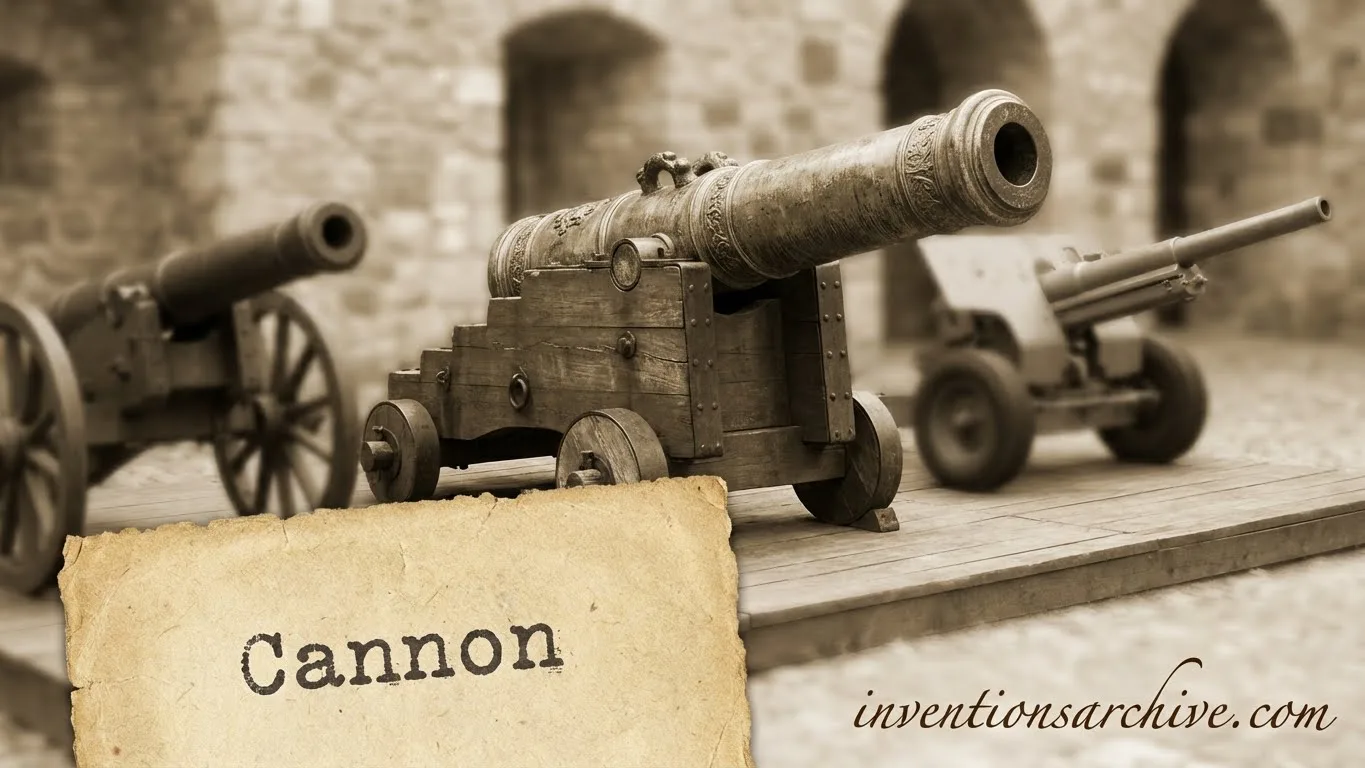
| Invention Name | Cannon |
|---|---|
| Short Definition | Metal barrel that launches a projectile using expanding gas |
| Approximate Date / Period | Late 13th–Early 14th Century Approximate |
| Date Certainty | Approximate (early records vary by definition) |
| Geography | East Asia; later wider Eurasia |
| Inventor / Source Culture | Anonymous / collective (early gunpowder cultures) |
| Category | Mechanical Engineering; Metallurgy; High-Pressure Propulsion |
| Importance |
|
| Need / Origin Driver | Compact force delivery; long-range mechanical impact |
| How It Works | Ignition → expanding gas → pressure → projectile acceleration |
| Materials / Tech Base | Gunpowder chemistry; bronze/iron/steel; precision boring |
| Early Use Context | Fortifications; shipboard defense; signaling |
| Spread Route | East Asia → trade & knowledge exchange → Europe and beyond |
| Derived Developments | Rifling; recoil control; breech mechanisms; proof testing |
| Impact Areas | Manufacturing; measurement; casting; logistics; education |
| Debates / Different Views | “First cannon” depends on definitions (hand cannon vs large gun) |
| Predecessors → Successors | Fire lance → hand cannon → bombards → rifled artillery; modern large guns |
| Key Civilizations | Yuan & Ming China; late medieval European foundries |
| Influenced Variants | Bombard; culverin; carronade; field gun; coastal gun; naval gun; ceremonial salute gun |
Cannons sit at the crossroads of metallurgy, mechanics, and early high-pressure design. They are more than oversized barrels. The cannon story is really about how people learned to shape stronger metals, measure tighter tolerances, and manage energy inside a tube without failure.
Table Of Contents
What A Cannon Is
A cannon is a large-bore gun that launches a projectile by turning chemical energy into pressure. The pressure pushes down the bore (the inner tube), and the projectile leaves the muzzle at speed. Most cannons are used with a mount or carriage because the barrel and its recoil forces are substantial.
The word “cannon” also changed over time. In early modern Europe, it could mean only certain heavy gun classes, then later grew into a broader label for large guns on mounts. Details
Core Ideas
- Barrel strength matters as much as power
- Accuracy depends on bore quality and consistency
- Standardization (caliber, shot, mounts) drives reliability
Early Evidence and Timeline
Early cannons grew out of smaller gunpowder devices and experiments with metal tubes. Written sources and surviving objects do not always use the same words, which is why timelines can look messy at first glance. Still, a few anchors stand out.
- A commonly cited early European record points to a manuscript dated AD 1327. Details
- Surviving objects with clear inscriptions are especially valuable because they combine material evidence with a date.
A Dated Museum Example
The Metropolitan Museum of Art holds a bronze hand cannon with an inscription that includes the year 1424 and provides measured details (including length and weight). Details
| Period | What Changed | Why It Mattered |
|---|---|---|
| Late 1200s–1300s Approx. | Metal-barrel gunpowder devices appear and spread | Materials and casting skill become limiting factors |
| 1300s–1400s | Growth of larger guns and improved mounts | Mobility and repeatability rise |
| 1400s–1500s | Refined foundry work; better boring and forms | Consistency improves; fewer weak barrels |
| 1600s–1800s | Standard calibers, better carriages, broader “cannon” terminology | Interchangeability becomes a practical goal |
| 1800s–1900s | Steel, precision machining, widespread rifling | Accuracy and durability climb |
How A Cannon Works
A cannon is a controlled pressure event. The key is that the pressure rises fast, stays contained, and is directed down the bore instead of outward. The physics is simple; the engineering is not.
Pressure and Motion
- Ignition starts a rapid chemical reaction
- Gas expansion increases pressure behind the projectile
- Force accelerates the projectile along the bore
- Recoil pushes back on the barrel and mount
Smoothbore and Rifled
- Smoothbore: simple bore; relies on fit and consistency
- Rifled: spiral grooves add spin for steadier flight
- Caliber discipline matters in both: small deviations add big errors
Main Parts and Materials
Cannon design is a set of choices about strength, heat, and control. Early makers tried bronze, wrought-iron construction, and later cast iron and steel. Each step raised the ceiling for consistent barrels and predictable results.
Common Barrel Features
- Muzzle (front opening)
- Breech (rear mass of metal)
- Trunnions (side supports for mounting)
- Vent (small channel used for ignition in some designs)
Mounting and Control
- Carriage supports the barrel and manages movement
- Elevation systems set angle with repeatable adjustment
- Transport gear (limbers or equivalent) appears in many historical systems
For a clear parts glossary (including muzzle, trunnions, and carriage terms), the U.S. National Park Service provides a detailed list. Details
Related articles: Gunpowder weapons [Medieval Inventions Series]
Cannon Types and Variations
“Cannon” covers a family, not a single shape. Differences in barrel length, bore size, and mounting produced distinct styles. Some were built for static positions. Others aimed for mobility and faster handling.
| Type | Typical Era | What Stands Out | Where It Often Appears |
|---|---|---|---|
| Hand Cannon | 1300s–1400s | Small metal barrel; early “portable” form | Early firearms transition stage |
| Bombard | 1400s–1500s | Very large bore; often short and massive | Fortification engineering |
| Culverin | 1500s–1600s | Longer barrel for steadier shot | Field and ship mounts |
| Carronade | 1700s–1800s | Shorter, lighter; designed for easier handling | Shipboard use |
| Rifled Cannon | 1800s–1900s | Grooved bore adds spin for better consistency | Coastal and field systems |
| Ceremonial Salute Gun | 1800s–Today | Used for sound and tradition, not range | Events and heritage sites |
Useful Ways To Sort Variants
- By barrel length: short (compact) vs long (stability)
- By mount: fixed, carriage, ship mount, coastal emplacement
- By bore: smooth vs rifled
- By role: field mobility, coastal coverage, signaling, ceremonial use
Wider Impact On Technology
Cannons pushed industries to solve hard problems in quality, repeatability, and measurement. The same habits that improved cannon barrels also improved many other metal products.
Manufacturing
- Large-scale casting and better molds
- Improved boring and finishing of long cylinders
- More disciplined inspection and proof-style testing
Measurement and Standards
- Clearer use of caliber as a shared reference
- More consistent mounts and fittings for interchangeability
- Better tracking of tolerances, wear, and repeat performance
Engineering Ideas
- Recoil management becomes a design discipline
- Better understanding of stress in thick-walled tubes
- Mounts evolve into robust systems with controlled motion
Why This Still Matters
- Pressure containment is a core idea in many engineered systems
- Precision machining and inspection habits scale beyond one product
- Standard parts make complex hardware easier to maintain
FAQ
Is a cannon the same as a howitzer or a mortar?
No. All are large guns, yet they differ by typical barrel length, firing arc, and intended role. In many historical texts, “cannon” can also be a broad umbrella term.
What makes a cannon “rifled”?
Rifling is a set of spiral grooves cut into the bore. It can add spin to a projectile, which often improves stability and consistency.
Why do early cannons vary so much in shape?
Early makers worked with limited metal quality and uneven casting skill. Designs adapted to what could be produced reliably in a given foundry and region.
Why is “the first cannon” hard to pin down?
Because definitions differ. Some historians focus on portable hand cannons, others reserve “cannon” for larger mounted guns. Dating also depends on the survival of documents and objects.
What are the most common cannon subtypes in museum collections?
Visitors often see hand cannons, large early bombards, long guns such as culverins, and later rifled barrels. Ceremonial pieces are also common in heritage settings.
What is the biggest non-obvious legacy of cannons?
The push for stronger metals, better boring, and tighter inspection. Those demands fed into broader manufacturing discipline and more consistent metalworking.