
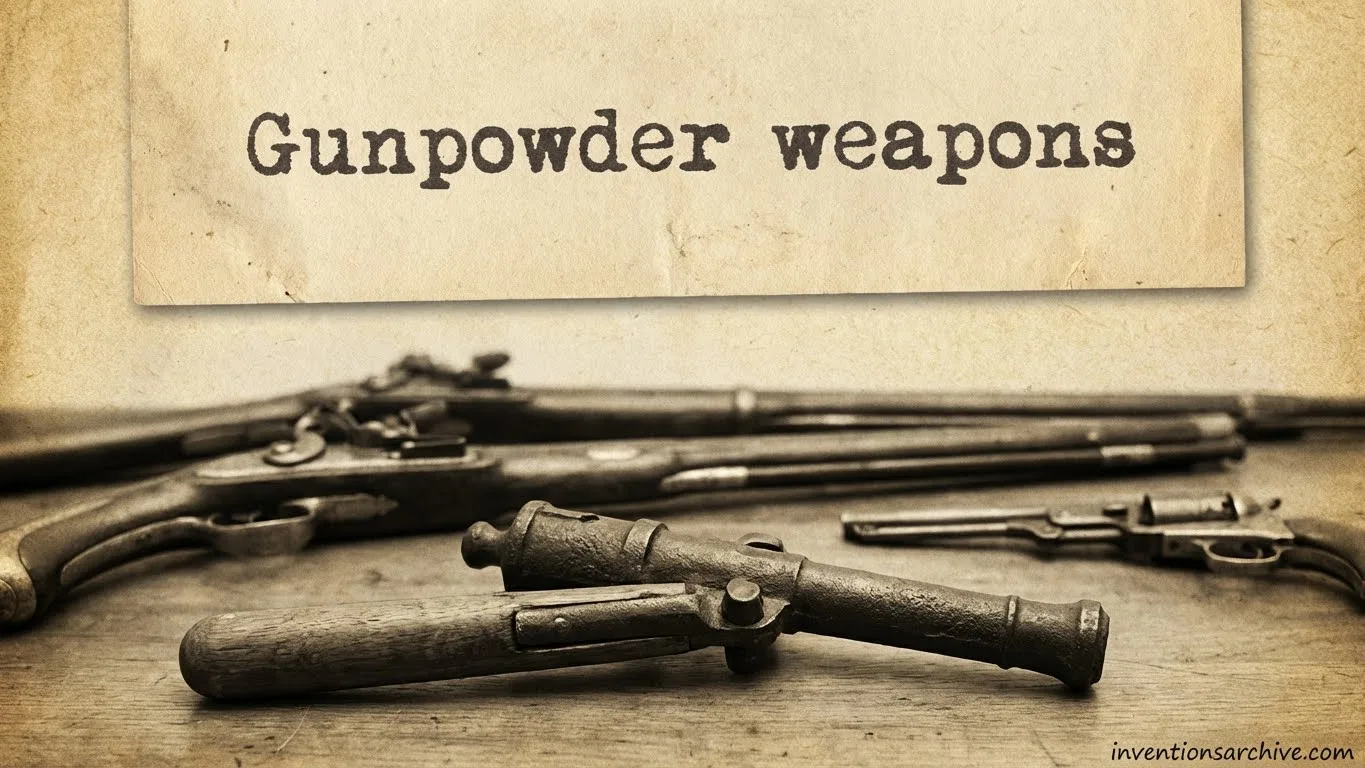
| Invention Name | Gunpowder Weapons |
|---|---|
| Short Definition | Projectile-launch devices powered by black powder gas pressure |
| Approximate Date / Period | 9th century CE (origins) Approximate Details |
| Geography | China; later Eurasia |
| Inventor / Source Culture | Anonymous / collective; early Chinese technologists |
| Category | Materials; propulsion; projectile launch; signaling |
| Importance |
|
| Need / Driver | Reliable stored energy; controlled force release |
| How It Works | Rapid combustion → hot gas → pressure → motion |
| Material / Technology Base | Black powder; metal tubes; ignition mechanisms |
| Early Written Record | Wujing zongyao (1044 CE) Recorded Details |
| Spread Route | East Asia → Central/West Asia → Europe Broad trend |
| Derived Developments | Cartridges; improved locks; industrial powders; modern propellants |
| Impact Areas | Engineering; chemistry; manufacturing; state logistics; education |
| Discussions / Different Views | “First weapon” depends on definition Debated |
| Precursors + Successors | Precursors: fire lances, signal devices; Successors: smokeless-propellant arms |
| Key Cultures / Periods | Song-era China; later craft centers across Eurasia |
| Influenced Variants | Hand cannons; muskets; pistols; cannons; mortars; rockets |
Gunpowder weapons are machines that turn stored chemical energy into fast mechanical motion. Their story is less about a single inventor and more about many small design leaps: better powders, stronger barrels, cleaner ignition, and tighter control of pressure. Each step shaped what “portable power” could mean in the real world.
Table of Contents
What Gunpowder Weapons Are
At the center is a simple idea: gas expansion. Black powder burns quickly, producing hot gas. In a confined space, that gas creates pressure, and pressure becomes motion.
- Firearms: pressure pushes a projectile down a barrel.
- Artillery: the same principle at larger scale.
- Rockets: gas exits one end and creates thrust.
Across time, designers chased three goals: reliability, repeatability, and control. That meant stronger barrels, smarter ignition, and tighter fit between projectile and bore.
- Ignition evolved from slow matches to sparks to caps.
- Sealing improved as chambers and projectiles became more precise.
- Manufacturing shifted from hand craft to standardized parts.
Early Evidence and Timeline
Dates in this field can be messy. A “first” can mean first written recipe, first surviving object, or first widespread use. Still, several milestones are well documented, and they help map the shift from chemical curiosity to mature devices.
| Period | What Changed | Why It Mattered |
|---|---|---|
| 9th–11th centuries CE | Recipes and early devices appear in East Asia | Knowledge base forms for repeatable effects |
| 1044 CE | Formal documentation of gunpowder in a technical manual | Standardization becomes possible across workshops |
| 13th–15th centuries CE | Metal barrels and improved ignition spread widely | Durability and repeat use improve |
| 1424 | Surviving hand cannon example dated to this year Details | Material evidence anchors the timeline |
| 16th–19th centuries | Locks, bores, and ammunition become more refined | Consistency rises, handling becomes more practical |
How the Technology Works
Gunpowder weapons are pressure machines. They store energy as a stable solid, then release it as gas when ignited. The details vary, but the physics is consistent: pressure seeks space.
Inside a Barrel
- Chamber holds the propellant and projectile.
- Ignition starts combustion in a small, controlled zone.
- Expanding gas drives the projectile forward.
- Barrel guides direction; a tight fit improves efficiency.
Inside a Rocket
- Propellant charge burns and generates gas.
- Nozzle opening shapes the exhaust flow.
- Thrust comes from gas leaving one end.
- Stability depends on body design and mass balance.
Even experts avoid claiming a single, exact birthplace for every step. Official training material notes that the exact date and place of early black powder invention is not fully pinned down, even though early discovery is widely associated with China Details. That uncertainty is normal for technologies built across centuries.
Main Types and Variations
“Gunpowder weapons” is a family name. It includes compact handheld devices, large-bore launchers, and rocket systems. Each branch solved the same problem with different priorities: portability, power, or range.
Handheld Firearms
- Hand cannon: early metal-tube firearms, often simple in form.
- Arquebus and musket: longer barrels for steadier aim.
- Pistols: compact formats shaped by lock design.
- Rifles: grooved bores that stabilize projectiles by spin.
Artillery Pieces
- Cannon: general term for large-bore launchers.
- Mortars: high-arc launch for short-to-medium distances.
- Bombards: early heavy forms, often built for mass.
- Field pieces: designs that balanced mobility and power.
Rocket Weapons
Rockets sit in the same family because the propellant logic is shared: burning solid fuel makes gas flow. The difference is direction: rockets push themselves forward by sending gas out the back, rather than pushing a separate projectile through a barrel. This branch also influenced later rocketry far beyond weapons.
Key Parts and Design Choices
Small changes in parts made big differences in performance. Designers learned to manage ignition timing, gas sealing, and barrel strength. Those themes appear again and again across centuries.
Related articles: Catapult [Ancient Inventions Series]
Barrel and Bore
- Smoothbore: simple interior; easier to produce.
- Rifled: spiral grooves; spin stability improves precision.
- Caliber: bore size that influences projectile choice and energy.
- Metallurgy: stronger alloys reduce bursting risk.
Chamber and Sealing
- Breech fit: better fit means less gas loss.
- Wadding and early packing: attempts to limit leakage.
- Cartridges: combine elements for faster, cleaner loading.
- Lock integration: ignition and sealing evolve together.
Ignition Systems
Ignition mechanisms shaped everyday usability. A reliable spark or flame meant predictable timing, fewer misfires, and better control. Major stages are commonly described as matchlock, wheellock, flintlock, and percussion Details.
| System | Core Idea | Practical Impact |
|---|---|---|
| Matchlock | Slow match provides flame | Simple, timing sensitive, weather dependent |
| Wheellock | Mechanical spark from a spinning wheel | More portable, complex engineering |
| Flintlock | Flint strikes steel to throw sparks | Widely adopted, faster handling |
| Percussion | Shock-sensitive cap ignites charge | Higher reliability, supports sealed ammunition systems |
Broader Effects Beyond the Devices
Gunpowder weapon development pushed measurement and standardization. Barrels needed consistent bores. Locks needed repeatable parts. Powders needed predictable burn behavior. Those pressures helped expand industrial precision and routine quality control.
- Metallurgy: stronger, cleaner metals to handle higher pressures.
- Machining: more exact drilling, reaming, and fitting.
- Interchangeable parts: early steps toward modern manufacturing logic.
- Ballistics thinking: more careful attention to trajectory and consistency.
FAQ
When was gunpowder first documented in writing?
A major early technical record is the Wujing zongyao, dated to 1044 CE, which includes a recognized gunpowder formula and related descriptions.
Is there a single inventor of gunpowder weapons?
No. The invention is best understood as a collective chain of improvements across chemistry, metalwork, and ignition design, with many workshops contributing over time.
What is the main difference between firearms and rockets in this family?
Firearms use confined pressure to push a projectile through a barrel. Rockets create thrust by sending gas out of one end, pushing the body forward.
Why do historians disagree on “the first gunpowder weapon”?
The label depends on definition. Some focus on surviving objects, others on written descriptions, and others on when a device became repeatable and widely used.
Are black powder weapons still relevant today?
Yes, mostly in historical study, museum interpretation, and regulated heritage contexts. Modern systems largely moved to later propellants, but black powder remains important for understanding the engineering roots of projectile technology.