
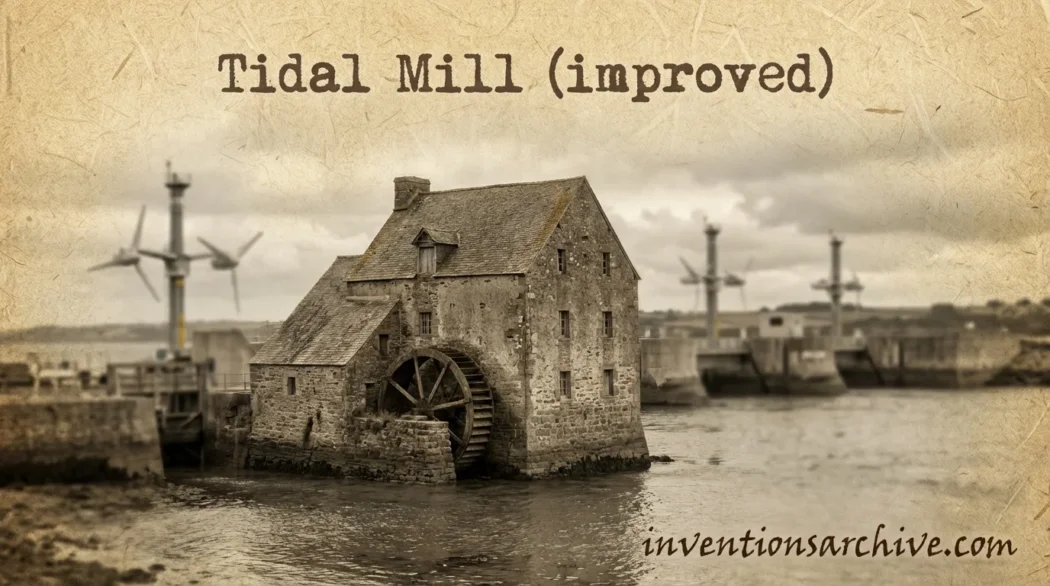
| Invention Name | Improved Tidal Mill |
| Short Definition | A tide-driven watermill that stores high-tide water in a pond, then releases it through a wheel and gearing to grind grain. |
| Approximate Date / Period | Early medieval onward; major refinements 12th–19th c. Approximate |
| Certainty | Core concept Definite / “firsts” Often debated |
| Geography | Coastal estuaries, tidal creeks, sheltered inlets |
| Inventor / Source Culture | Anonymous / collective (coastal communities, monastic estates, port towns) |
| Category | Mechanical power, food processing, hydraulic engineering |
| Importance |
|
| Need / Reason It Emerged | Reliable milling for grain in tidal settlements; steady work for coastal economies |
| How It Works | Fill pond on flood; hold; release on ebb to drive wheel |
| Material / Technology Basis | Dam/causeway, one-way gates, sluices, wheel, gears, millstones |
| First Main Use | Grain milling (flour and meal) |
| Derived Developments | Advanced sluice control, improved waterwheels, later parallels in tidal barrages |
| Impact Areas | Food supply, local trade, craft engineering, coastal infrastructure |
| Debates / Different Views | “Earliest” claims vary by evidence type; securely dated excavated examples are rare |
| Predecessors + Successors | River watermills → refined tidal mills → modern tidal turbines (conceptual line) |
| Notable Surviving Examples | Eling (Hampshire), Woodbridge (Suffolk) |
| Varieties Influenced | Horizontal-wheel tidal mills; vertical-wheel tidal mills; gate-and-pond tidal works |
A tidal mill turns the daily rise and fall of the sea into dependable mechanical power. The “improved” tidal mill is not a single patented device. It is a long chain of refinements that made the same basic idea more efficient, more predictable, and easier to run as a working mill. Think of it as coastal engineering meeting practical milling: better gates, better flow control, better wheels, better gearing, and sturdier structures—built around one simple asset, the tidal millpond.
Table Of Contents
What A Tidal Mill Is
A tidal mill is a watermill placed where the sea’s rhythm can be captured as usable head. The key move is storing water at (or near) high tide, then releasing it later through a controlled channel. That stored head drives a wheel and, through a mechanical train, turns millstones. The improved tidal mill keeps the same logic but makes it more controllable and less wasteful by tightening gates, smoothing flow, and strengthening parts that live in salt water and silt.
- Millpond: a reservoir filled by the rising tide
- One-way sea gates: let water in on the flood, shut on the ebb
- Sluice control: meters out flow to the wheel when the tide falls
Why Improvements Mattered
Early tidal mills worked, yet they lived with strict timing and messy water. A basic setup could waste head through leaks, lose efficiency to turbulence, and suffer from gate wear. Improvements focused on three practical goals: longer usable runs, steadier torque at the stones, and better survival in a harsh environment where saltwater, mud, and floating debris are normal. The best designs treated the site as a whole system—pond, gates, race, wheel, gearing, and millhouse—rather than isolated parts.
Improved in this context usually means fewer losses and better control. A tight gate and a clean race can matter as much as a fancy wheel. Add repeatable operation, and the mill becomes a dependable piece of coastal infrastructure.
How The System Works
The operating cycle is simple to describe, even when the hardware is sophisticated. On the flood tide, gates open and the millpond fills. Around high tide the gates shut, keeping the stored water. As the outside level drops, a height difference builds. When that difference is large enough, the mill releases water through a sluice so it hits the wheel with useful force. That motion becomes rotational power for the stones via gearing. One clear museum description walks through this exact sequence in plain terms (Details-1).
The Main Parts
- Causeway or dam: forms the pond and often serves as a crossing
- Sea gates: usually flap-style, designed to seal on the ebb
- Penstock or sluice: the controlled throat where water accelerates into the race
- Wheel or turbine-like runner: converts flow into rotation (horizontal or vertical)
- Power train: shafts, gears, and couplings that match wheel speed to stone speed
- Millstones: the grinding pair, usually a bedstone and runner stone
In a classic vertical-wheel millhouse, the power path often includes named gears such as the pit wheel, wallower, and spur wheel, stepping wheel rotation into the vertical drive for milling. A working mill guide uses these exact terms while describing the internal layout (Details-4).
Why The Pond Matters
The pond is not “extra storage.” It is the heart of the machine. A larger pond can deliver useful head for longer, while a well-shaped pond reduces dead zones where silt settles. Designers learned to value volume, tight sealing, and a clean flow path from pond to wheel. That is where many improvements quietly paid off.
Evidence and Timeline
Tidal milling appears wherever three conditions line up: a sheltered inlet, a usable tidal range, and people who need steady milling. Secure dates can be hard because wooden gates and races decay, and coastal landscapes change. Still, some archaeological records are unusually strong. A major excavation report for Nendrum (Strangford Lough) notes dendrochronology placing an early mill’s construction in AD 619–621, with a later mill replacement around AD 789 (Details-2).
- Early phase: horizontal-wheel mills and simple timberwork in protected bays
- Medieval expansion: larger ponds, sturdier dams, more standardized milling layouts
- Early modern refinement: improved gates and wheel/gear choices tuned for smoother runs
- Heritage survival: a small number of sites maintained or restored for demonstration milling
Heritage documentation for Eling highlights a typical mature configuration: mills built on causeways across tidal inlets that act as bridge and dam, storing water and releasing it through the mill race to run machinery for a limited window each tide. The same document also notes Eling’s standing as a rare working survivor that still produces stoneground flour on a regular basis (Details-3).
Improvements In Design
“Improved” tidal mills are best understood as systems that waste less head and deliver steadier power. The upgrades below show up again and again across successful sites. Each one targets a real loss: leakage, turbulence, drag, or unpredictable timing. The result is more useful work from the same tide, with less drama for the miller and better durability for the structure.
| Improvement | What Changes | Why It Matters |
| Tighter Sea Gates | Better sealing surfaces, stronger hinges, improved gate geometry | Holds head longer; reduces leakage on the ebb |
| Smarter Sluice Control | More precise opening control; staged releases | Smoother wheel speed; steadier milling |
| Cleaner Mill Race | Straighter flow path; fewer obstructions | Less turbulence; more energy reaches the wheel |
| Wheel Choice Matching Site | Geometry tuned to available head and flow rate | Higher efficiency; better torque where needed |
| Stronger Materials | Timber protection, iron fittings, later robust joinery | Survives saltwater wear; lowers downtime |
| Better Sediment Handling | Pond shaping; maintenance access; silt management | Protects gates and races; preserves capacity |
Gates That Do More Than Open and Close
Gate design is where a tidal mill becomes “improved” in the most practical sense. A gate must open readily on the flood yet shut reliably on the ebb without chatter or partial sealing. Small changes—weight balance, hinge placement, sealing edges—can decide whether the pond stays high enough to run the stones. A good gate turns a rough tide into usable stored head. A poor gate turns the same tide into lost minutes and a weak run.
Flow That Arrives As Power Not Turbulence
Water can carry energy and still fail to do work if it arrives as chaotic motion. Improved mills aimed for flow that is fast, directed, and consistent at the wheel. That is why the penstock and race matter so much. When the sluice is shaped and positioned well, the wheel receives repeatable force rather than a pulsing shove. The milling becomes smoother, and stones can be kept in a stable grinding condition.
Gearing That Matches The Stones
A tide-driven wheel does not naturally spin at the ideal speed for grinding. The improved tidal mill treats the power train as a tuning system. Gearing is used to match slow, torque-heavy wheel rotation to the faster motion needed at the runner stone. This is where mechanical clarity matters: fewer losses, fewer vibration points, and stable alignment under changing load.
Small Upgrades, Big Outcome
A tighter gate, a cleaner race, and well-matched gearing can make the mill feel like a different machine. The tide stays the same. The useful window grows, and the power arrives more evenly at the stones.
Types and Variations
Tidal mills are a family of solutions built around the same cycle. Variation comes from wheel orientation, pond layout, and how the site handles flow. Many improved designs are really “type choices” made wisely: picking the wheel and gate arrangement that fits the local tide, channel shape, and sediment load. The best match delivers stable torque with less strain on the structure and a cleaner path for the water.
Wheel Orientation
- Horizontal-wheel tidal mills: compact layouts; strong link to early medieval evidence in some regions
- Vertical-wheel tidal mills: often easier to connect to familiar gear trains in later millhouses
- Multiple-wheel sites: used where channels and flows allow more than one wheel path
Pond Layout
- Single-pond mills: simplest; run time strongly shaped by pond size and sealing
- Managed ponds: shaped to reduce silt traps and to keep the race clear
- Gate arrays: multiple gates can fill faster or seal more reliably, depending on site needs
What “Improved” Means Across Types
Across all variations, the common theme is control. Improved tidal mills are those that keep water where it should be, move it where it must go, and convert it to rotation with fewer losses. That is why gate sealing, sluice precision, and flow cleanliness show up as repeat winners.
Limits and Upkeep
Even a refined tidal mill lives on a schedule. It cannot run continuously because it relies on a changing outside level to create head. It also lives in a place that moves: silt builds, channels shift, and saltwater accelerates wear. “Improved” designs do not remove these realities. They reduce their impact with better access, sturdier hardware, and smarter flow paths. The goal is reliable operation with predictable maintenance, not perfection.
- Sedimentation: can shrink pond capacity and choke races over time
- Gate and hinge wear: sealing edges and fasteners take constant stress
- Debris management: floating vegetation and driftwood can interfere with gates
- Salt exposure: demands robust materials and periodic repair
Legacy and Modern Parallels
Tidal mills proved a powerful idea: predictable natural cycles can be stored, controlled, and turned into useful work. The improved tidal mill is a historical blueprint for systems thinking—where hydraulics, mechanics, and site design are treated as one. That mindset echoes in later tidal engineering, from controlled gates to larger water-control schemes that also rely on managing head and flow.
What Stayed The Same
- Stored head does the work
- Gates and sluices control timing
- Flow path determines efficiency
What Improved Over Time
- Seal quality and durability
- More stable output at the stones
- Maintenance access and resilience
FAQ
What Makes A Tidal Mill “Improved”?
An improved tidal mill wastes less head and gives more control over timing and flow. Typical upgrades include tighter one-way gates, better sluice control, cleaner races, and wheel/gearing choices that deliver steadier power to the stones.
How Often Can A Tidal Mill Operate?
Operation follows the tide cycle. The usable window depends on local tidal range, pond capacity, and how well the system holds water. Well-documented heritage descriptions note that the machinery runs for a limited period each tide rather than continuously by design.
Do All Tidal Mills Use The Same Wheel Type?
No. Some sites use horizontal wheels, others use vertical wheels. The best choice depends on available head, flow rate, and how the millhouse transfers power to the stones.
Why Are Gates So Important?
Gates decide whether the pond keeps its stored water. A good gate opens easily on the flood and seals tightly on the ebb, protecting stored head so the mill can run. In improved mills, gate reliability is often the difference between a strong run and a weak one.
Are Tidal Mills A Form Of Renewable Energy?
They convert a natural cycle into mechanical power without burning fuel. In modern terms, that is a renewable principle. The improved tidal mill shows how predictable tides can be turned into repeatable work through storage and control.