
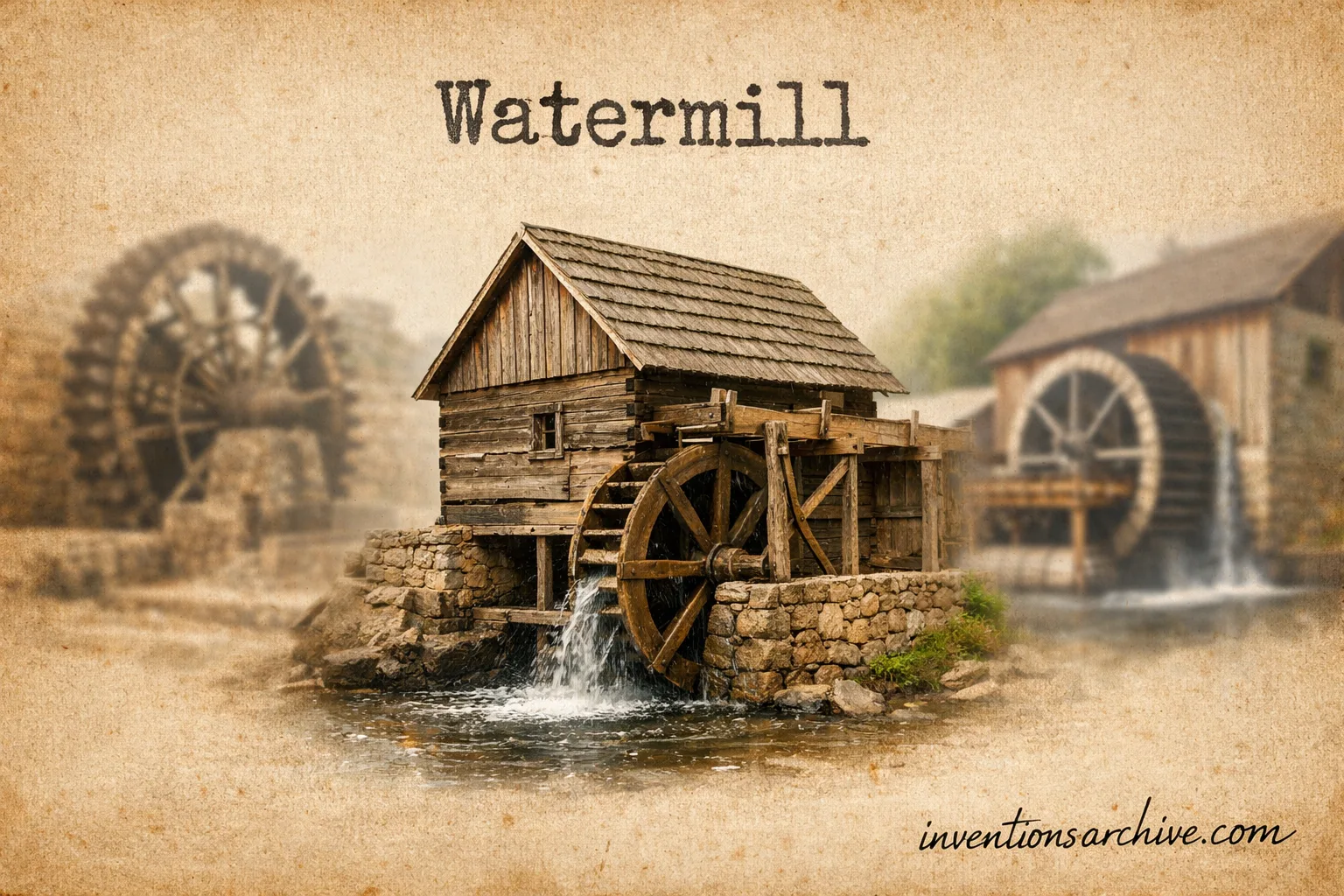
| Invention Name | Watermill |
|---|---|
| Short Definition | A mill that uses a waterwheel or water-driven turbine to turn machinery, most often for grinding grain. |
| Approximate Date / Period | Late Hellenistic to early Roman period, roughly 3rd–1st century BCE Approximate |
| Geography | Eastern Mediterranean, Anatolia, Hellenistic Egypt and Roman territories Attribution varies |
| Inventor / Source Culture | Anonymous / collective engineering tradition; not securely tied to one person |
| Category | Energy, manufacturing, agriculture, food processing |
| Main Problem Solved | Reducing the labor needed to grind grain and power repetitive workshop tasks |
| How It Worked | Flowing or falling water turned a wheel; gears or a shaft carried rotation to millstones or tools |
| Material / Technology Basis | Wooden wheels, stone millstones, shafts, gears, sluices, millraces, dams or streams |
| Early Uses | Grain grinding; later fulling cloth, paper making, metalworking, sawing and pumping |
| Evidence Status | Early written descriptions and later archaeological remains Based on surviving evidence |
| Surviving Evidence | Ancient texts, Roman mill sites, medieval mill remains, museum waterwheels and technical models |
| Development Path | Hand quern → animal mill / water-lifting wheel → watermill → geared mills → water turbines |
| Related Inventions | Millstone, gear train, waterwheel, millrace, sluice gate, turbine |
| Modern Descendants | Hydraulic turbines, small hydropower systems, industrial rotary power transmission |
| Why It Matters | It turned natural water movement into useful mechanical power on a repeatable scale |
What a Watermill Is
A watermill is a machine that uses moving water to power a mill. In its most familiar form, water turns a wheel, and the wheel turns a shaft. That shaft may rotate a pair of millstones, lift a hammer, drive a saw, operate a pump, or move other workshop machinery.
The early watermill belongs to the history of mechanical power. It did not create energy; it converted the movement of water into rotation. This made it useful wherever people had a steady stream, a controlled water channel, a fall in water level, or a tide that could be captured.
For grain milling, the watermill answered a very practical need. Before water power, grain could be ground by hand with querns or by animals turning larger mills. Those methods worked, but they demanded constant labor. A watermill could run for long periods when water flow was available, turning a repetitive food-processing task into a controlled mechanical process.
How the Origin Is Traced
The origin of the watermill is best described as anonymous and gradual. It drew on older knowledge of wheels, water-lifting devices, millstones and gears. The step that mattered was joining these ideas so that water did not merely move a wheel, but drove useful work through a shaft or gear system.
Several regions appear in discussions of early watermills:
- Hellenistic engineering centers, where mechanical devices, gears and hydraulic machines were studied.
- Anatolia and the eastern Mediterranean, where scholars have discussed early horizontal-wheel traditions.
- Roman territories, where written descriptions and archaeological remains become clearer.
Cambridge-published research on watermills around ancient Sagalassos notes that horizontal-wheel mills in that area may have originated in or near Turkey during the Hellenistic period, while also showing how hard these machines can be to date when surviving remains are limited.[c]
The Problem It Answered
The watermill addressed one of the most repeated tasks in settled life: turning grain into flour or meal. Hand grinding with a quern could be effective for a household, but it was slow and tiring. Animal mills increased power, yet they required animals, feed, space and human supervision.
A watermill changed the economics of milling. It could use a local stream or engineered watercourse to keep a wheel turning. Once the water was controlled, the machine could grind grain, raise materials, or power other tools with less direct human effort.
| Before the Watermill | What Changed After It |
|---|---|
| Grain was often ground by hand with querns or by animal-driven mills. | Flowing water could turn millstones for long periods when conditions allowed. |
| Power depended mainly on human or animal strength. | Mechanical power could come from a stream, channel, fall of water or tide. |
| Production was limited by labor, stamina and available animals. | Larger quantities of grain or material could be processed in a fixed mill site. |
| Many repetitive workshop jobs required direct manual force. | Water power later drove fulling stocks, hammers, saws, pumps and paper-mill machinery. |
| Mill location mattered less than labor supply. | Mill location became tied to water control, rights, channels, dams and seasonal flow. |
How a Watermill Worked in Simple Terms
A watermill used three linked parts: water control, rotating power and working machinery.
Water Control
Water had to reach the wheel in a useful way. A natural stream might be enough for a simple mill, but many mills used a millrace, sluice, dam, pond or channel. These features guided water toward the wheel and helped regulate flow.
The Wheel and Shaft
The water struck, filled or passed under the wheel. The wheel then turned a shaft. In a simple horizontal-wheel mill, the shaft could connect directly to the upper millstone. In a vertical-wheel mill, gears often changed the direction of rotation so a vertical wheel could drive horizontal millstones.
The Millstones or Tools
For grain, the upper stone rotated above a fixed lower stone. Grain entered near the center and moved outward as it was crushed and ground. In later mills, the same water power could drive other tools. A working museum watermill from Lurgashall shows this principle clearly: an overshot wheel drives shafts and gears that turn millstones and related equipment such as a grain cleaner and sack hoist.[d]
Earlier Ideas and Tools Before the Watermill
The watermill grew from several older technologies. None of them alone was a full watermill, but each supplied part of the idea.
- Hand querns: small stone tools for grinding grain by hand.
- Rotary querns: circular grinding stones that made rotation central to milling.
- Animal-powered mills: larger mills turned by donkeys, oxen or other animals.
- Water-lifting wheels: wheels that used motion to raise water rather than grind grain.
- Gearing: toothed wheels that changed speed, torque or direction of rotation.
The watermill became possible when these ideas met a practical need: a way to connect water-driven rotation to useful work.
Main Mechanism and Technical Principle
The technical principle is simple: moving water transfers force to a wheel. The wheel turns. The turning motion is carried through shafts or gears to the working part of the mill.
Different wheels used water in different ways. An undershot wheel was pushed by water passing under it. An overshot wheel was turned by water delivered near the top, using the weight of falling water. A breastshot wheel received water around the middle of the wheel. Horizontal wheels used a vertical shaft and were often simpler in construction.
Britannica describes the horizontal-wheel mill as a form suited to grinding because the upper millstone could be fixed to the vertical shaft, while the geared vertical-wheel mill offered more flexibility where stream conditions and gearing could be managed.[e]
| Stage | Form | What Changed |
|---|---|---|
| Earlier Tool | Hand quern and rotary quern | Grinding was done by direct human movement. |
| Intermediate Form | Animal-powered mill | Power increased, but animals still supplied the motion. |
| Invention | Watermill | Moving water became the power source for millstones or tools. |
| Improved Form | Geared vertical-wheel mill | Gears let engineers adapt waterwheel motion to different machines. |
| Later Development | Overshot, breastshot and improved undershot wheels | Wheel design was matched more carefully to water height, flow and site conditions. |
| Modern Descendant | Water turbine | Water power moved from open wheels toward enclosed, higher-speed hydraulic machines. |
Early Uses of the Watermill
The earliest and most important use was grinding grain. Flour and meal were daily needs in many settled societies, so any reliable improvement in milling mattered. A mill near a stream could serve farms, villages, estates or towns.
As the technology spread, watermills became useful for more than food. The same rotary power could be adapted to:
Related articles: Mechanical Sawmill [Medieval Inventions Series], Tidal Mill (Improved) [Renaissance Inventions Series]
- fulling cloth by lifting and dropping wooden stocks;
- sawing timber with reciprocating saw mechanisms;
- crushing ore or other materials;
- powering hammers in metalworking;
- pumping water from mines or low-lying areas;
- driving paper-making machinery.
A surviving undershot waterwheel in the Science Museum Group collection was used to power a paper mill near Leeds, showing how the older watermill principle remained useful in later industrial settings. The museum record explains that water passed beneath the wheel and struck it horizontally, and that the wheel was eventually removed when turbines replaced it at the site.[f]
How It Spread and Changed Over Time
Watermills spread because they matched a common need with a local resource. Where water flow could be controlled, a mill could become part of agriculture, craft production and local trade. The technology also adapted well. Some regions favored horizontal wheels because they were simpler and suited to certain streams. Other places developed larger vertical wheels with more complex gearing.
In the Roman world, large planned installations show a high level of organization. The Barbegal complex near Arles used a cascade of waterwheels fed by controlled channels. It is often discussed as one of the earliest known examples of concentrated mechanical production using water power.
In medieval Europe, watermills became common features of rural landscapes. They were tied to land rights, mill fees, water rights and estate management. A mill was not only a machine; it was also an economic site.
Later improvements focused on efficiency and control. Engineers studied wheel shapes, flow angles, sluices and gearing. The Science Museum Group’s record of Poncelet’s 1824 water wheel describes an improved undershot design with backward-curved floats and notes that such wheels were later displaced in many settings by low-fall turbines.[g]
Main Types and Variations
| Type or Variation | How It Used Water | Typical Strength |
|---|---|---|
| Horizontal-Wheel Mill | Water struck a wheel on a vertical shaft. | Simple layout; useful where direct drive to a millstone was practical. |
| Undershot Watermill | Water passed beneath the wheel and pushed paddles or floats. | Could work in low-head streams or channels with suitable flow. |
| Overshot Watermill | Water entered near the top and used gravity as it filled buckets. | Efficient where there was enough height difference. |
| Breastshot Watermill | Water entered around the middle of the wheel. | Balanced option for moderate head and controlled water supply. |
| Tide Mill | Stored tidal water was released to turn the wheel. | Useful in coastal areas with predictable tides. |
| Industrial Watermill | Water power drove hammers, saws, pumps or manufacturing machinery. | Extended the milling principle beyond grain. |
What Changed Because of the Watermill
The watermill made natural power part of ordinary work. It did not remove all human labor. Millers still controlled water, adjusted stones, maintained gears and managed grain. Yet the heavy, repeated turning was no longer limited to muscles.
The practical changes were concrete:
- Food processing: grain could be ground in larger quantities at fixed mill sites.
- Village economy: mills became places where farmers, millers and landholders interacted.
- Engineering knowledge: millwrights learned to match wheels, gears and water supply to local conditions.
- Workshop production: rotary power could be transferred to tools beyond millstones.
- Later energy systems: waterwheels helped shape the path toward turbines and modern hydropower.
The invention also changed how people thought about power. A flowing stream could become a reliable mechanical partner if it was guided, measured and connected to the right machine.
Common Misunderstandings
“The Watermill Had One Inventor”
No secure evidence names a single inventor. The watermill developed from older tools and mechanical ideas, probably through several workshops and regions.
“The Earliest Written Description Means the First Mill”
A written description shows that the technology was known by that time. It does not prove the first use. Earlier working mills may have existed without surviving records.
“All Watermills Looked the Same”
Watermills varied by water source, terrain and purpose. A small horizontal mill, an overshot flour mill and a paper-mill waterwheel were related, but not identical machines.
“Watermills Were Only for Flour”
Grain milling was central, but water power later supported cloth processing, metal hammers, sawmills, paper mills and pumping systems.
Related Inventions
The watermill sits between earlier hand tools and later industrial power systems. These related inventions help place it in a wider technology history:
- Hand Quern: an earlier grinding tool that shows the basic need for grain processing.
- Rotary Millstone: the rotating stone system that watermills often powered.
- Waterwheel: the rotating power source at the center of many watermills.
- Gear Train: the mechanism that transferred and changed rotary motion.
- Sluice Gate: a control device for managing water flow into the wheel.
- Tide Mill: a watermill variation using tidal movement.
- Water Turbine: a later machine that refined water power for higher-speed applications.
- Hydroelectric Generator: a modern descendant that converts water-driven rotation into electricity.
Frequently Asked Questions
Who invented the watermill?
The watermill has no securely known single inventor. It is better understood as an anonymous invention that grew from Hellenistic and Roman engineering traditions involving waterwheels, millstones and gearing.
What was the main purpose of early watermills?
The main early purpose was grinding grain into flour or meal. Later watermills also powered fulling, sawing, paper making, metalworking and pumping.
How did a watermill turn grain into flour?
Water turned a wheel. The wheel turned a shaft and, in many mills, gears. That motion rotated the upper millstone over a fixed lower stone, grinding grain as it moved outward between the stones.
What is the difference between an undershot and an overshot watermill?
An undershot wheel is pushed by water passing beneath it. An overshot wheel is fed from above and uses the weight of falling water, usually requiring a suitable height difference or engineered water supply.
Are watermills still used today?
Some historic watermills still operate for demonstration, heritage milling or small-scale production. In modern energy systems, turbines have largely replaced traditional waterwheels where water power is used for electricity or industrial work.
Sources and Verification
- [a] On Architecture, De architectura libri decem – Scaife Viewer — Used to verify Vitruvius’s ancient technical description of water wheels and water mills. (Reliable because it is an academic classical-text viewer based on institutional Perseus data.)
- [b] The second century CE Roman watermills of Barbegal — Used to verify the Barbegal Roman watermill complex and its importance as early large-scale water-powered production evidence. (Reliable because it is a peer-reviewed Science Advances research article.)
- [c] Water mills in the area of Sagalassos: a disappearing ancient technology — Used to verify the discussion of horizontal-wheel mills and their possible Hellenistic origin in or near Turkey. (Reliable because it is a Cambridge University Press academic journal article.)
- [d] Watermill from Lurgashall — Used to verify the working parts of an overshot watermill, including wheel, gearing, millstones, grain cleaner and sack hoist. (Reliable because it is an official living museum page for a reconstructed historic watermill.)
- [e] Waterwheel | History, Types & Uses | Britannica — Used to verify waterwheel types, the horizontal-wheel mill, the geared vertical-wheel mill and the role of Vitruvius in the surviving evidence. (Reliable because it is a long-standing edited reference source.)
- [f] Undershot waterwheel | Science Museum Group Collection — Used to verify a museum-recorded undershot waterwheel used to power a paper mill and its later replacement by turbines. (Reliable because it is an official Science Museum Group collection record.)
- [g] Poncelet’s Water Wheel, 1824 | Science Museum Group Collection — Used to verify later waterwheel improvement, Poncelet’s 1824 design and the movement from improved wheels toward low-fall turbines. (Reliable because it is an official Science Museum Group collection record.)