
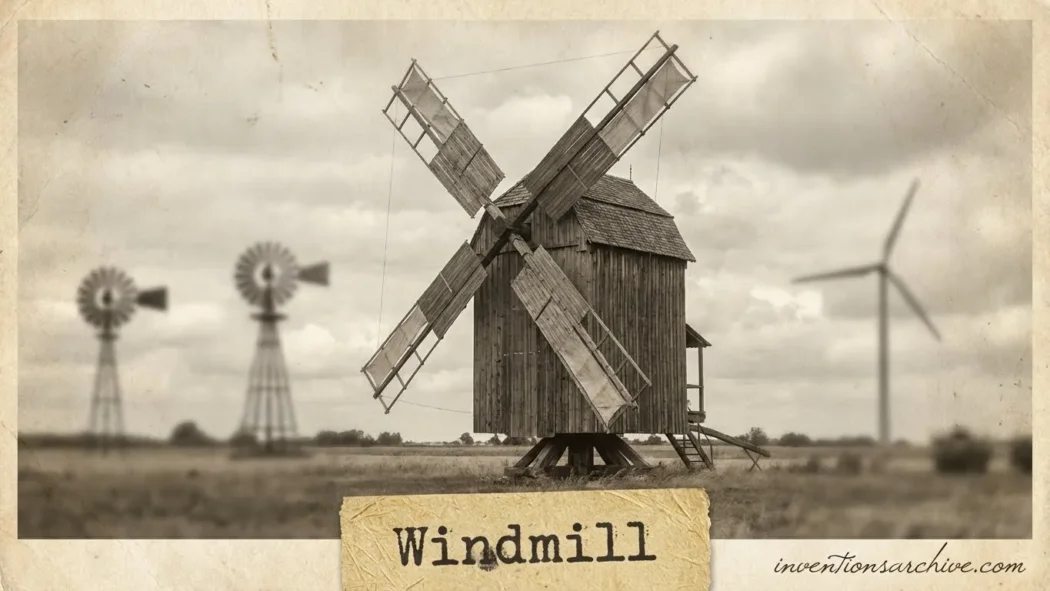
| Invention Name | Windmill |
|---|---|
| Short Definition | A wind-powered machine that converts moving air into rotary mechanical work for milling, pumping, sawing, pressing, or related tasks. |
| Approximate Date or Period | Practical Persian and Middle Eastern windmills documented around 500–900 CE; horizontal-axis European forms developed during the medieval period. Approximate [a] |
| Geography | Early evidence: Persia and the wider Middle East; later major development in northwestern Europe, the Netherlands, the Mediterranean, and North America. |
| Inventor or Source Culture | Anonymous / collective; developed by generations of millwrights rather than one securely identified inventor. Attribution varies |
| Category | Energy, agriculture, manufacturing, food production, water management, and mechanical engineering. |
| Evidence Status | Based on surviving evidence Early dates rely on written records, later technical descriptions, and surviving traditional structures; the absolute first use is not known. |
| Main Problem Solved | Supplying useful mechanical power where flowing water was limited and repeated human or animal labor was slow. |
| How It Works | Wind acts on sails or blades; a rotor turns a shaft; gears, cranks, or direct linkages carry motion to millstones, pumps, saws, or other machinery. |
| Material and Technology Base | Timber, cloth, reed matting, mud brick, brick, stone, iron fittings, millstones, gears, shafts, and later steel blades and enclosed gearboxes. |
| Early Uses | Grinding grain and lifting water; later uses included drainage, sawing timber, pressing oil, processing materials, and powering workshop machinery. |
| Development Path | Sails and earlier mills → vertical-axis windmill → post, tower, and smock mills → windpumps and wind-electric machines → modern wind turbines. |
| Spread and Adaptation | Regional wind-powered traditions spread and changed through trade, migration, craft knowledge, and local redesign; direct lines of influence are not always certain. |
| Main Variations | Asbad or panemone, post mill, tower mill, smock mill, drainage mill, paltrok mill, and multi-blade windpump. |
| Surviving Evidence | Traditional asbads, preserved European mills, working drainage networks, museum models, millwright records, technical drawings, and industrial-era windpumps. |
| Modern Descendants | Wind turbines, automated yaw systems, rotor controls, geared and direct-drive generators, and small off-grid wind machines. |
| Related Inventions | Millstone, watermill, gear train, mechanical governor, windpump, sawmill, electric generator, and wind turbine. |
| Why It Matters |
|
What a Windmill Is
A windmill is a machine that captures energy from moving air and turns it into useful motion. Traditional windmills usually produced mechanical power directly. Their shafts and gears moved millstones, pumps, saws, presses, or other equipment.
The word can describe several related machines. A grain mill grinds cereals. A windpump lifts water. A drainage mill moves water between channels. A wind turbine uses a rotor to drive an electrical generator. They share a wind-driven rotor, yet their working purpose is different.
The defining idea is energy conversion: moving air becomes rotation, and rotation becomes controlled work.
The Problem It Answered
Before windmills, most heavy work depended on people, animals, or flowing water. Hand querns could grind grain in small amounts. Animal-powered mills raised output but required feed, care, and space. Watermills were productive, though they needed a suitable stream, river, or managed water channel.
Windmills opened another geographic option. A windy ridge, plain, coast, island, or dry region could support machinery even where a dependable watercourse was absent. This did not remove weather limits. Wind could stop, shift, or become too strong. It did provide a new way to place power near farms, villages, workshops, wells, and drainage systems.
| Before the Windmill | What Changed After It |
|---|---|
| Grain was ground by hand, animals, or watermills. | Windy locations gained another source of rotary power for millstones. |
| Productive mills were often tied to rivers or managed water channels. | Mills could operate on ridges, plains, coasts, islands, and dry inland sites. |
| Water lifting depended on manual devices, animals, gravity, or local hydraulic works. | Wind-driven pumps and scoop systems moved water for wells, drainage, and irrigation. |
| Timber sawing and material processing required repeated manual effort. | Rotary wind power could drive saws, presses, and workshop machinery through linkages. |
| Remote farms could depend on hauled water or labor-intensive pumping. | Self-regulating windpumps supplied wells, livestock tanks, homes, and railway water stops. |
| Available power changed with labor supply, animal strength, and water flow. | Wind became an additional local energy source, though still weather-dependent. |
How Wind Became Mechanical Work
Sails, Blades, and the Rotor
Wind acts on a set of sails or blades fixed around a rotating axis. Early Persian panemones used a vertical shaft and wind-catching surfaces arranged around it. Many European mills used a horizontal windshaft with sails rotating in a vertical plane.
The sail shape matters. Flat or cupped surfaces rely mainly on drag. Angled sails can also use aerodynamic lift, much as a sailing vessel uses the shape and angle of its sail. The rotor does not create energy; it captures part of the wind’s kinetic energy and turns it into shaft rotation.
Shafts, Gears, and Working Machinery
The main shaft carries rotation into the mill. Gear wheels can change direction, speed, and torque. In a grain mill, the drive commonly turns an upper runner stone over a fixed bedstone. Grain enters near the center and moves outward as the patterned stone faces crush and shear it.
Other machines used the same rotating input differently. A pump linkage could turn rotation into an up-and-down stroke. A drainage mill could drive a scoop wheel or pumping system. A sawmill could convert rotation into repeated saw motion. The exact arrangement varied by region, task, and period.
Keeping the Sails into the Wind
A windmill works best when its rotor faces the useful wind direction. In a post mill, the whole upper body can turn around a central support. In a tower mill, the masonry tower remains fixed while the cap and sails rotate. Later mills added fantails and governing systems that adjusted orientation or working conditions with less manual effort.
English Heritage’s account of Sibsey Trader Windmill shows this design contrast clearly: older post mills turned their timber superstructure, while the later brick tower mill rotated only its timber-framed cap and sails. The fixed tower also created more room for machinery and several pairs of millstones. [c]
How the Origin Is Traced
Persian and Middle Eastern Windmills
The earliest practical tradition most often identified in technical histories is the Persian or Middle Eastern vertical-axis windmill. These machines are commonly linked with grain grinding and water lifting. Wind entered openings in a built enclosure and acted on sails or vanes connected to a vertical shaft.
This form was suited to areas with strong, regular winds and limited water. It was not simply a rotor placed outdoors. The building helped guide wind toward the working side of the rotor, while walls shielded the returning side. Surviving asbad traditions show that architecture and machinery formed one system.
No named maker can be treated as the sole inventor. The design reflects collective craft development: knowledge of sails, shafts, millstones, carpentry, masonry, and local wind patterns combined over time.
Medieval European Windmills
European horizontal-axis windmills appear in medieval records as a distinct machine family. Their sails turned a horizontal windshaft, and the body or cap was oriented toward changing winds. Post mills became an early common form; tower and smock mills later allowed larger fixed structures with only the upper section turning.
Historians have debated whether European windmills developed from knowledge moving westward, arose independently, or combined outside influence with local invention. The machinery differs enough that a simple one-line route from Persia to Europe is not proven. Shared wind power does not automatically mean an unchanged design lineage.
The Development Path
| Stage | Form | What Changed |
|---|---|---|
| Earlier Ideas and Tools | Sailing rigs, hand querns, animal mills, watermills, shafts, and gears | Existing knowledge supplied wind-catching surfaces, rotary milling, and power transmission. |
| Early Practical Windmill | Persian or Middle Eastern vertical-axis panemone or asbad | Strong local winds drove a vertical shaft for grain milling and water-related work. |
| Medieval European Form | Horizontal-axis post mill | The whole mill body turned to face the wind; geared machinery drove millstones. |
| Larger Fixed Structures | Tower mill and smock mill | Only the cap rotated, allowing taller structures, more workspace, and heavier machinery. |
| Specialized Industrial Forms | Drainage mills, paltrok sawmills, oil mills, paper mills, and processing mills | Wind power moved beyond grain into water management and workshop production. |
| Rural Windpump | Multi-blade wooden and steel windpump | Self-regulating rotors supplied steady pumping torque in light or changing winds. |
| Modern Descendant | Wind-electric generator and wind turbine | Rotor motion drove a generator, with modern controls managing direction, speed, and output. |
Early Uses in Daily Work
Grinding Grain
Grain milling was one of the clearest early uses. A windmill could turn wheat, rye, barley, oats, or other cereals into flour or meal. The miller controlled the feed, stone spacing, and sail area according to the grain and wind conditions.
The machine linked farming with local food production. Farmers delivered grain, millers processed it, and bakers or households used the output. A working mill was therefore both an energy machine and a place of trade, skilled labor, storage, and quality control.
Lifting and Draining Water
Wind power also moved water. Some mills raised water from wells. Others transferred it between drainage levels, channels, or reservoirs. In low-lying landscapes, one mill could be part of a larger hydraulic network rather than an isolated machine.
The Kinderdijk-Elshout system preserves this wider context. Its windmills worked with polders, channels, dikes, millraces, sluices, reservoirs, and later pumping stations. The surviving network shows how wind power supported settlement and cultivation by managing water across an entire landscape. [d]
Workshop and Industrial Uses
Once rotary power was available, millwrights adapted it to many tasks. Windmills could saw timber, press seeds for oil, grind pigments or spices, crush raw materials, prepare paper pulp, and power other workshop processes.
Related articles: Steam engine (Watt design) [Industrial Age Inventions Series], Wind-Powered Grain Mill [Medieval Inventions Series]
These uses depended on transmission machinery. Gears carried motion between floors or work areas. Cranks changed rotation into reciprocating movement. Governors and adjustable sails helped control speed. The windmill became a multi-purpose power source, not only a flour-making building.
Materials and Millwright Engineering
Windmills combined architecture with moving machinery. Early and regional forms used materials available nearby. Timber served as shafts, frames, gears, sail stocks, and structural members. Cloth or reed matting formed wind-catching surfaces. Mud brick, brick, or stone formed walls and towers. Iron strengthened bearings, shafts, teeth, fasteners, and working parts.
Millstones were specialized tools rather than ordinary rocks. Their working faces were dressed with grooves that cut, move, and ventilate the grain. Gears were often made from selected woods so worn teeth could be replaced without remaking a whole wheel.
A millwright needed practical knowledge of carpentry, gearing, masonry, wind exposure, lubrication, vibration, and load. The machine had to be strong enough for gusts yet adjustable enough to work in changing weather. Maintenance was part of the design, because sails, bearings, gears, and weather-facing surfaces wore over time.
Main Types and Variations
| Type | Defining Form | Typical Uses |
|---|---|---|
| Asbad or Panemone | Vertical shaft; wind-guiding enclosure; reed, cloth, or plant-covered vanes | Grain grinding and water-related work in strong-wind regions |
| Post Mill | Timber body rotates around a central post or support | Grain milling and small-scale processing |
| Tower Mill | Fixed brick or stone tower; rotating cap carries the windshaft and sails | Larger grain mills, drainage, and heavy machinery |
| Smock Mill | Tapered timber-framed body on a base; only the cap turns | Grain milling, drainage, and regional processing work |
| Paltrok Mill | Specialized rotating body with working space arranged for long timber | Wind-powered sawing |
| Drainage Mill | Windmill coupled to a scoop wheel or pump within a water-control network | Moving water from lower land into higher channels or reservoirs |
| Multi-Blade Windpump | Many narrow blades, tail vane or self-regulating head, tower-mounted pump drive | Wells, livestock water, household supply, irrigation, and railway tanks |
| Wind Turbine | Aerodynamic rotor linked to an electrical generator and control systems | Electricity generation; a modern descendant rather than a traditional mill |
How Windmills Spread and Changed
Windmill history is not a story of one fixed design copied unchanged across continents. Craftspeople adapted machines to local winds, building materials, crops, water conditions, and work. A dry, windy region favored a different structure from a wet lowland that needed drainage or a farm that needed water from a deep well.
European Millwright Traditions
European millwrights enlarged the machine, improved gearing, and developed ways to turn the rotor toward the wind. Tower and smock mills created more fixed interior space. Adjustable sail systems and fantails reduced some of the manual work of responding to changing wind.
Local forms remained distinct. Mediterranean mills often used cloth-covered sails suited to regional practice. Dutch mills became closely tied to water management and industrial processing. British mills developed many post, tower, and smock variations. The useful comparison is not which region owned the idea, but how each tradition solved a local power problem.
American Windpumps
On the North American plains, large cloth-sailed European mills were expensive and maintenance-heavy. Nineteenth-century manufacturers developed smaller, self-governing windpumps with many wooden and later metal blades. These machines could turn toward the wind, protect themselves in stronger weather, and pump from deep wells.
They supplied households, farms, livestock, irrigation systems, and railway water tanks. The National Park Service records the 1854 Halladay design, the spread of self-governing pumps, the move from wood to metal, and later geared and self-oiling forms. [e]
What Changed After the Windmill
The windmill changed where mechanical power could be used. Communities no longer needed to rely only on muscle, animals, or flowing water. Windy sites gained a machine that could grind food, move water, and operate tools.
Its effects were practical and uneven:
- Food production: larger milling capacity supported local grain economies and specialized millers.
- Water management: wind-driven drainage helped maintain low-lying farmland and settlements.
- Rural water supply: windpumps made deep groundwater more accessible to farms, ranches, homes, and railways.
- Manufacturing: wind power drove saws, presses, crushers, and processing equipment.
- Machine design: gears, governors, fantails, adjustable sails, and protective controls anticipated later automated machinery.
- Energy engineering: the rotor-and-shaft principle continued into wind-electric generators and turbines.
Windmills also kept clear limits. Output changed with weather. Sails and mechanisms needed inspection. Storms could damage machinery. Steam engines, combustion engines, and electric motors later offered steadier power in many industries.
Traditional wind machines did not disappear without descendants. Rural windpumps remained useful in remote areas, while wind-electric machines developed into modern turbines. The U.S. Energy Information Administration traces this shift from milling and pumping to small wind-electric generators, rural decline after electrification, and renewed wind-energy development. [f]
Common Misunderstandings
“One Person Invented the Windmill”
No surviving record supports a single universal inventor. The windmill grew from several skills and regional machine traditions. Named millwrights later improved particular forms, but that is different from inventing every windmill type.
“The Dutch Invented the First Windmill”
Dutch engineers developed notable drainage and industrial windmills, yet practical windmills are documented earlier in Persia and the Middle East. Dutch work belongs to a later and highly developed branch of the history.
“The Oldest Surviving Mill Was the First One Built”
Survival and invention are not the same. Timber machinery can vanish through decay, rebuilding, fire, weather, and reuse. A preserved structure marks a known point in the record, not an absolute beginning.
“Every Windmill Has Four Sails”
Four-sail European mills are familiar, but windmills have used many arrangements: vertical-axis vanes, six sails, cloth rigs, solid wooden wheels, many narrow metal blades, and modern two- or three-blade rotors.
“Windmills and Wind Turbines Are Identical”
They are related wind machines. A traditional windmill normally delivers mechanical work directly to milling or pumping equipment. A wind turbine is designed mainly to produce electricity through a generator.
Related Inventions
- Sail and rigging: Earlier knowledge of controlling wind with cloth surfaces helped make land-based wind machines possible.
- Hand quern and millstone: Windmills mechanized an older grinding process rather than replacing the grinding principle itself.
- Watermill: Another renewable rotary-power machine that shared millstones, shafts, gearing, and millwright skills.
- Gear train: Carried rotation through the mill and changed direction, speed, or torque.
- Mechanical governor and fantail: Helped regulate mill operation and keep later rotors aligned with the wind.
- Windpump: Adapted wind power to wells, drainage, irrigation, livestock water, and remote supply.
- Sawmill: Used rotary power and motion-converting linkages to process timber.
- Wind turbine: Combined wind-driven rotors with electrical generators and automated controls.
Frequently Asked Questions
Who invented the windmill?
No single inventor is securely documented. Practical windmills developed through collective work in regional craft traditions. Early Persian and Middle Eastern vertical-axis mills and medieval European horizontal-axis mills belong to different parts of that history.
When was the windmill invented?
The date is approximate. Documentary evidence places practical windmills in Persia and the Middle East within roughly 500–900 CE. Horizontal-axis windmills appeared in medieval Europe later. Earlier wind-powered concepts may have existed, but the evidence is less secure.
Where did the earliest practical windmills appear?
The strongest early documentary claim points to Persia and the wider Middle East. Surviving Iranian asbad traditions preserve a vertical-axis form adapted to strong regional winds and grain milling.
How did a traditional windmill work?
Wind turned sails or blades attached to a rotor shaft. Gears and linkages transferred that rotation to millstones, pumps, saws, presses, or other equipment. Different mill types used different arrangements, but the energy path remained wind to rotation to useful work.
What were windmills used for besides grinding flour?
Windmills lifted and drained water, sawed timber, pressed oil, ground pigments and spices, processed paper materials, crushed raw materials, and powered other workshop machines.
Why are windmills closely associated with the Netherlands?
Dutch windmills became central to drainage, polder management, grain processing, sawing, and other industries. Large surviving mill networks made them a visible part of the Dutch landscape, even though the earliest practical windmills were not Dutch.
Is a wind turbine a type of windmill?
A wind turbine is better described as a modern descendant of the windmill. Both capture wind with a rotor, but a traditional windmill usually powers machinery directly, while a turbine drives an electrical generator.
Sources and Verification
- [a] Wind Turbines: Theory and Practice Excerpt — Used to verify the approximate early documentary period, Persian vertical-axis form, early uses, European development, and the mechanical path toward later wind machines. (Reliable because it is an academic engineering text published by Cambridge University Press & Assessment.)
- [b] Asbads (windmill) of Iran – UNESCO World Heritage Centre — Used to verify the surviving Iranian asbad tradition, regional wind conditions, building form, working arrangement, and traditional materials. (Reliable as an official UNESCO-hosted heritage record, with its state-party authorship and disclaimer noted in the article.)
- [c] History of Sibsey Trader Windmill | English Heritage — Used to verify the mechanical and structural difference between post and tower mills, the rotating cap, materials, millstone capacity, and local milling uses. (Reliable because it is an official heritage record for a preserved working windmill.)
- [d] Mill Network at Kinderdijk-Elshout – UNESCO World Heritage Centre — Used to verify the role of windmills within an integrated Dutch system of polders, channels, dikes, millraces, reservoirs, sluices, and pumping stations. (Reliable because it is the official UNESCO World Heritage record for the preserved hydraulic landscape.)
- [e] Windmills on the American Plains (U.S. National Park Service) — Used to verify the Halladay windmill, self-governing American windpumps, wooden and metal forms, deep-well pumping, farm use, and railway water supply. (Reliable because it is an official U.S. National Park Service history resource.)
- [f] History of wind power – U.S. Energy Information Administration (EIA) — Used to verify the shift from mechanical windmills and windpumps to wind-electric generators, the effect of rural electrification, and the later return of wind energy for electricity. (Reliable because it is an official U.S. government energy history resource.)

