
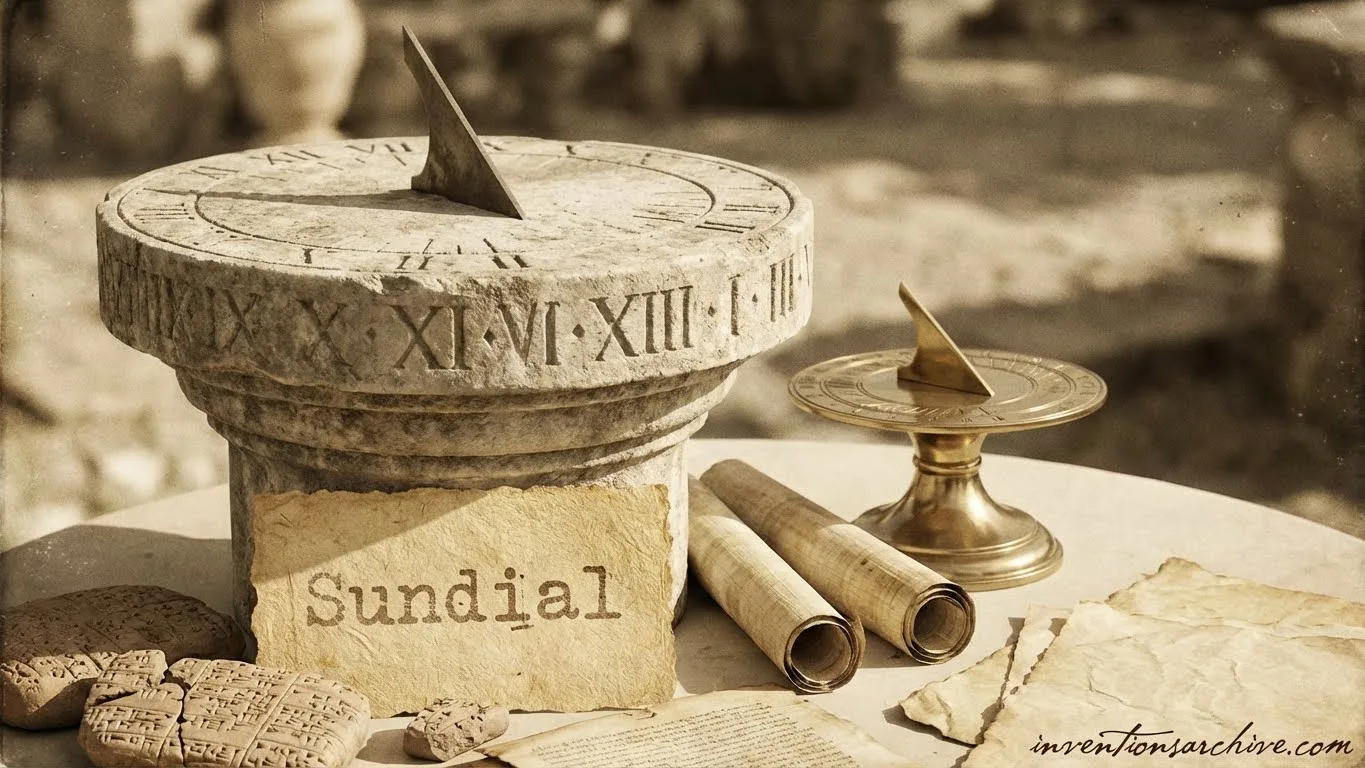
| Invention Name | Sundial |
|---|---|
| Short Definition | Sun-shadow time indicator using hour lines |
| Approximate Date / Period | c. 1500 BCE (Approximate)Details |
| Geography | Ancient Egypt; later Mediterranean and beyond |
| Inventor / Source Culture | Anonymous; early Egyptian practice |
| Category | Timekeeping; Astronomy; Measurement |
| Importance |
|
| Need / Reason It Emerged | Daytime scheduling; rituals; work cycles |
| How It Works | Gnomon casts shadow; shadow crosses hour lines |
| Material / Technology Basis | Stone, wood, metal; geometry; local latitude |
| First Known Uses | Public and sacred spaces; civil timekeeping |
| Hour System Used | Unequal hours or equal 24-hour schemesDetails |
| Spread Route | Egypt → Greece/Rome → Islamic world → Europe → global |
| Derived Developments | Dialling methods; solar-time tables; clock checking |
| Effect Areas | Education, science, architecture, civic life |
| Key Principle | Sun’s apparent motion ≈ 15° per hourDetails |
| Solar-Time Differences | Equation Of Time; longitude offset (≈4 min/degree)Details |
| Debates / Different Views | “Earliest” claims vary by evidence and definition |
| Precursors + Successors | Shadow stick → water clocks → mechanical clocks |
| Types Influenced | Horizontal, Vertical, Equatorial, Ring, Scaphe, Analemmatic |
Table Of Contents
Sundials look simple. Still, a good one is a precise solar instrument. It turns the Sun’s daily motion into readable time using geometry, location, and carefully placed hour lines.
What A Sundial Is
Core Parts
- Dial: the surface that carries hour lines
- Gnomon: the shadow-caster (often a slanted edge called a style)
- Nodus: a point or aperture that makes a small spot of light instead of a sharp shadow edge
What It Measures
A sundial shows local apparent solar time. That is the Sun-based time at one place. It can be displayed as equal hour lines or as unequal hours where hour length changes with the season.
The most important design fact is location. A dial is tuned to a latitude and a direction reference, so the shadow crosses the right hour marks as the Sun moves.
Early Evidence and Timeline
The story of the sundial starts early. Surviving descriptions and examples reach back to around 1500 BCE. From there, designs spread and diversified as people learned to mark hours with better geometry.
- Ancient Period: early Egyptian practice and growing Mediterranean use; public and practical timekeeping
- Classical Era: larger civic dials and portable forms; clearer hour systems
- Islamic World: strong mathematical interest in solar observations and time determination
- 16th–18th Centuries: rapid variety in Europe; many ingenious portable dials
- 19th Century: sundials remain useful as an external check for mechanical clocks
How Sundials Work
At heart, a sundial follows Earth’s rotation. The Sun appears to sweep across the sky at a steady pace. If the gnomon is aligned with Earth’s axis, its shadow moves in a regular way across the hour lines.
A Simple Mental Model
- The Sun’s apparent path advances about 15° per hour in the sky.
- The shadow on a well-aligned dial advances at the same hourly rate.
- The shape of the hour lines depends on latitude and dial orientation.
Many historic dials also carry extra markings. You may see calendar cues, seasonal paths, or guides that relate the dial to solar noon. Those markings are not decoration. They turn a sundial into a compact map of the Sun’s yearly behavior.
Sundial Types and Variations
“Sundial” is a family name. Some designs read time from the Sun’s direction, others from its altitude. Surfaces can be flat, curved, or even ring-shaped. The common thread is the same: a shadow (or a tiny light spot) meets hour lines.
| Type | Typical Surface | Common Setting | What Stands Out |
|---|---|---|---|
| Horizontal | Flat plate | Gardens, courtyards | Hour lines fan out from the gnomon base |
| Vertical | Wall face | Buildings, civic walls | Designed for a specific wall direction and latitude |
| Equatorial | Plate aligned to Earth’s equator | Educational displays | Hour spacing is naturally even in angle |
| Polar | Plane parallel to Earth’s axis | Specialty dials | Emphasizes axis alignment over ornament |
| Ring Dial | Thin ring | Portable use | Uses a small opening to project a sun image |
| Scaphe Dial | Concave bowl | Historic instruments | Hour marks on an inner cup surface, often altitude-based |
| Shepherd’s Dial | Cylindrical/pillar form | Field and travel | Compact, practical, designed for daylight use |
| Analemmatic | Elliptical layout | Parks and plazas | A moving gnomon position can reflect seasons |
Hour Lines and Hour Styles
Not every dial assumes modern clock hours. Many historic systems used unequal hours, where daylight was split into twelve parts that stretched in summer and tightened in winter. Other dials adopted equal hours that divide the day into 24. The line layout tells you which tradition the maker chose.
Solar Time and Clock Time
A sundial tracks the real Sun. Clocks track a smooth, averaged day. The mismatch is normal. One part comes from Earth’s orbit and tilt. That seasonal difference is the Equation Of Time. Another part comes from location: longitude shifts local solar time by about 4 minutes per degree of longitude.
Related articles: Mechanical Bell Tower [Medieval Inventions Series], Hourglass [Medieval Inventions Series]
Why A Sundial Can Differ From A Watch
- Equation Of Time: seasonal fast/slow shift versus a mean-day clock
- Longitude Offset: local solar noon happens earlier or later depending on east/west position
- Dial Design: a dial is made for a specific latitude and orientation
This difference does not make a sundial “wrong.” It means it is faithful to solar reality. In many eras, that was the point: solar time was a public reference when mechanical time was still developing.
Materials and Design Logic
A well-made sundial is a blend of craft and math. The materials can be humble or luxurious. The logic stays strict. The gnomon must be steady. The hour lines must match the local sky geometry. Small errors can shift time marks in noticeable ways.
Common Materials
- Stone: durable public dials
- Metal: engraved portable instruments
- Wood: practical, lighter forms
Design Choices
- Plane vs curved surfaces
- Shadow edge vs pinhole image
- Equal vs unequal hours
Where Sundials Still Matter
Modern life runs on atomic and network time, yet the sundial keeps its place. It is a clear teaching tool for Earth’s rotation and the Sun’s path. It is also a valued feature in architecture, where a dial can make time visible in a calm, public way.
In museums and observatories, historic dials carry another message. They show how measurement moved from direct observation to standardized systems. A single shadow can connect astronomy, design, and daily routine.
FAQ
Do Sundials Work Without Direct Sunlight?
A sundial needs a clear shadow or a visible sun image. Under heavy cloud, the reading fades because the Sun’s direction is not sharply defined.
Why Can A Sundial Differ From A Clock By Several Minutes?
Two main reasons: the Equation Of Time shifts solar time through the year, and longitude shifts local solar time within a time zone. A dial is true to its location.
What Is The Gnomon?
The gnomon is the part that creates the shadow. On many dials, the working edge is a slanted style so the shadow movement matches Earth’s axis geometry.
What Are Unequal Hours?
Unequal hours divide daylight into twelve parts, so a “hour” is longer in summer and shorter in winter. Dials with temporal hour lines reflect that seasonal rhythm.
Can A Sundial Be Accurate?
Yes, within the limits of shadow sharpness, careful construction, and correct placement. Many historic communities trusted sundials as a stable daylight reference, especially before high-precision clocks became common.