
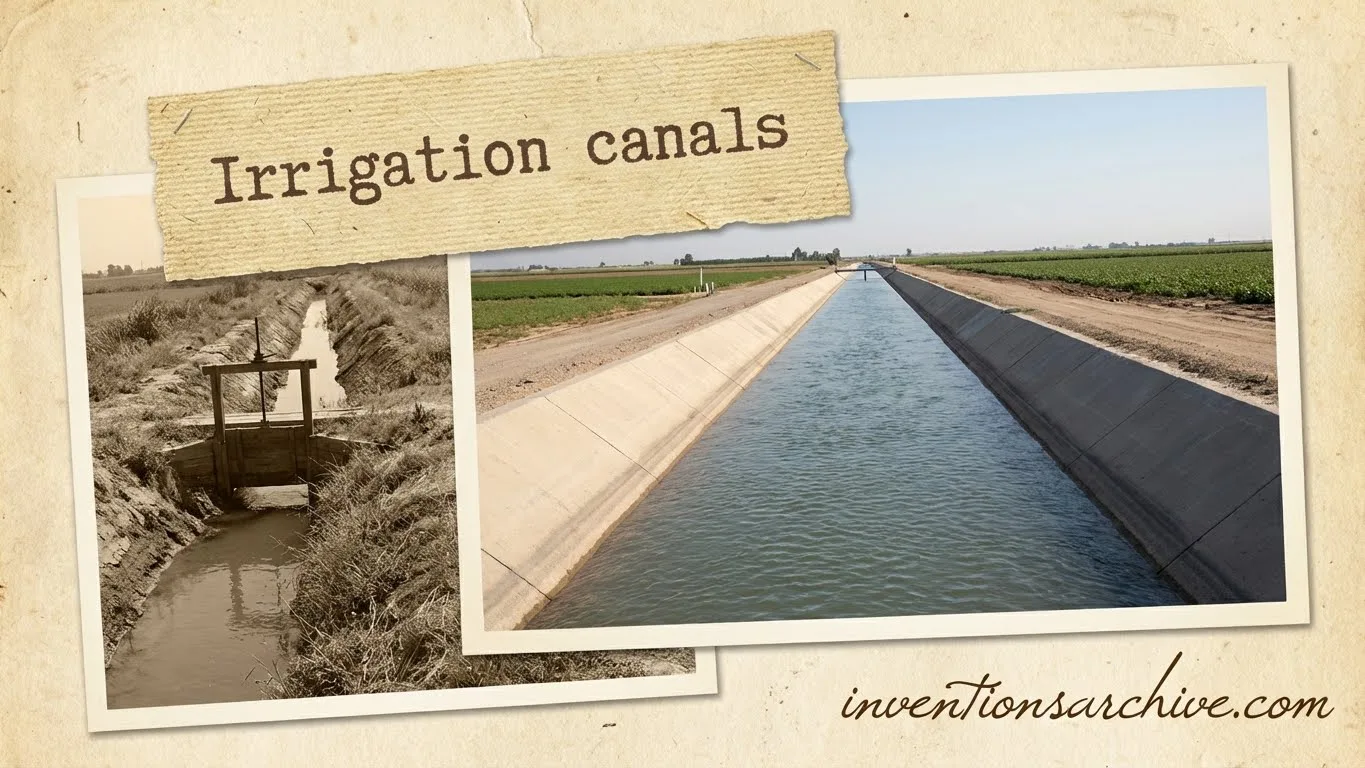
| Invention Name | Irrigation canals |
|---|---|
| Short Definition | Artificial open channels used to move water from rivers, reservoirs, springs, or other sources to farmland. |
| Approximate Date / Period | By around 6000 BCE in parts of the Mesopotamian plain and nearby regions Approximate |
| Evidence Status | Based on crop remains, traces of canals, settlement patterns, written records, and later archaeological mapping Based on surviving evidence |
| Geography | Early evidence is associated with Mesopotamia and the Iranian Plateau; canal irrigation later appears in many river valleys and dry farming regions. |
| Inventor / Source Culture | Anonymous and collective; no single inventor can be identified Attribution varies |
| Category | Agriculture, water management, civil engineering, food production |
| Main Problem Solved | Moving water to fields when rainfall was too low, too seasonal, or too unreliable for crops. |
| How It Works | Water is diverted into a controlled channel and moved by slope, gravity, gates, ditches, or later lifting devices. |
| Materials / Technical Basis | Earth-cut channels, levees, embankments, clay-lined sections, stone or brick works, sluices, gates, and later masonry or concrete lining. |
| Early Uses | Cereal farming, garden irrigation, floodwater control, settlement support, and sometimes transport or drinking-water supply. |
| Development Path | Floodwater use → dug channels → managed canal networks → lined canals and gates → modern irrigation districts and automated canals |
| Related Inventions | Levee, sluice gate, water lift, shaduf, qanat, aqueduct, reservoir, drainage canal |
| Surviving Evidence | Canal traces, ancient levees, cuneiform records, field systems, museum objects, aerial survey, remote sensing, and archaeological sediment studies. |
| Modern Descendants | Lined irrigation canals, canal gates, distribution networks, pumping stations, drip-fed canal systems, and canal automation. |
| Why It Matters | It made farming more reliable in dry regions and helped support larger settlements, specialized labor, and planned water management. |
What Irrigation Canals Are
An irrigation canal is a human-made channel that carries water toward fields. It may be a simple earth ditch, a large main canal, a smaller branch canal, or a carefully lined channel with gates and measuring points. The basic idea is simple: water that would otherwise remain in a river, floodplain, pond, reservoir, or spring is guided toward land where crops need moisture.
The Food and Agriculture Organization describes open canals, channels, and ditches as open waterways that carry water from one place to another, with larger canals supplying one or more farms and smaller field ditches moving water from the farm entrance to fields.[b] That definition still fits ancient canals, even though early systems used earth banks and local materials instead of modern concrete, metal gates, or sensors.
The invention is best understood as controlled water movement. It joined several ideas:
- digging a channel lower than the surrounding ground;
- using slope so water could flow by gravity;
- raising banks to stop overflow;
- opening or blocking parts of the channel to direct water;
- maintaining the canal after silt, plants, or flood damage built up.
That last point is often missed. An irrigation canal was not only an object. It was also a maintenance system. Without cleaning, repair, and fair water sharing, even a well-built canal could fail.
How Its Origin Is Traced
The origin of irrigation canals is traced through indirect and direct evidence. Early canals were often made of earth, so they did not survive like stone buildings or metal tools. Archaeologists look for signs in the landscape: old channel lines, raised levees, soil changes, ancient fields, crop remains, and settlement locations near water routes.
Written evidence comes later. In Mesopotamia, tablets and administrative records show that canal labor, water management, and canal cleaning were organized activities. Research from the Institute for the Study of Ancient Cultures notes that irrigation should not be treated as the single cause of early states; its role varied across places, and ancient water management involved different social arrangements.[c]
The Problem Irrigation Canals Answered
Canals answered a practical farming problem: crops need water at the right time, but nature does not always deliver it where or when people need it.
Before canals, farmers relied more directly on rainfall, natural floods, damp soils after flood retreat, hand-carried water, small basins, or fields close to rivers. These methods could work, but they limited where crops could grow. They also left farming exposed to dry seasons, shifting river channels, or uneven floodwater.
Irrigation canals changed the relationship between farmland and water. Fields no longer had to sit only beside the riverbank. Water could be guided across a wider area. This made it possible to support more predictable grain production, gardens, orchards, and settlement life in regions where rain alone was not enough.
| Before the Invention | What Changed After It |
|---|---|
| Farmers depended heavily on rainfall, natural floods, or fields very close to water. | Water could be guided toward selected fields beyond the immediate river edge. |
| Floodwater could arrive unevenly, too early, too late, or in damaging amounts. | Channels, banks, and later gates gave communities more control over timing and direction. |
| Dry-season farming was harder in many low-rainfall regions. | Stored, diverted, or seasonally managed water allowed longer and more reliable growing periods. |
| Farm size and crop choices were limited by local moisture. | More land could be brought into cultivation, especially for cereals, gardens, and orchards. |
| Water movement was often local and small scale. | Canal networks connected rivers, fields, villages, estates, and sometimes transport routes. |
How Irrigation Canals Worked in Simple Terms
A basic irrigation canal used a slope. Water entered the canal from a river, stream, reservoir, spring, or flood basin. The channel then carried water downhill or across gently sloping land. Smaller branches distributed water to fields.
The main parts usually included:
- Water source: a river, seasonal flood, reservoir, spring, or diverted stream.
- Main canal: the larger channel that carried water over distance.
- Branch canals: smaller channels leading to fields or gardens.
- Banks and levees: raised sides that kept water inside the channel.
- Control points: simple openings, barriers, gates, or later engineered structures.
- Drainage paths: channels that removed excess water and reduced damage to soil.
In practice, irrigation canals needed judgment. Too little water left crops dry. Too much water could harm soil, wash away banks, or create salinity problems in dry climates. The canal was useful because it made water more available, but it also created the need for regular water management.
Earlier Ideas and Tools Before Canals
Irrigation canals grew from simpler forms of water use. People first learned to farm near reliable moisture. Then they learned to trap, delay, guide, lift, or spread water.
Earlier or related methods included:
- Floodplain farming: planting in soil made wet and fertile by seasonal flooding.
- Small ditches: short channels cut from natural water sources to nearby plots.
- Basins and embankments: low walls that held floodwater long enough to soak soil.
- Water lifting tools: devices such as the shaduf, used later to raise water from canals or rivers.
- Reservoirs and tanks: stored water that could be released when needed.
These were not separate from canal history. They were part of the same long experiment: how to make water useful without waiting passively for weather or flood cycles.
Development Path From Early Channels to Modern Systems
The development of irrigation canals was not a straight line. Different regions solved different water problems. Some focused on flood basins, some on river diversion, some on underground channels, and some on large canal networks tied to states or estates.
| Stage | Form | What Changed |
|---|---|---|
| Earlier Water Use | Floodplain farming and small seasonal ditches | People used natural wet soils and short water paths near rivers. |
| Early Canal Irrigation | Earth-cut channels and field ditches | Water could be moved to selected fields with more control. |
| Organized Networks | Main canals, branch canals, levees, and work crews | Larger areas could be served, but maintenance and allocation became more complex. |
| Improved Forms | Gates, lined sections, aqueduct-fed canals, reservoirs, and lifting devices | Flow control improved, and water could reach harder locations. |
| Modern Descendants | Lined canals, measured outlets, pumping stations, and automated controls | Modern systems focus on reliability, measurement, reduced losses, and planned delivery. |
Materials, Mechanism, and Technical Principle
The earliest canals used the simplest available materials: soil, clay, reeds, stone, timber, and labor. Their main mechanism was gravity. A canal worked only if the water surface and the land slope allowed flow. Too steep, and the channel could erode. Too flat, and water might stagnate or drop sediment.
Canal builders had to understand the land, even without modern instruments. They needed to notice:
- where floodwater naturally moved;
- which soils held water and which collapsed;
- where silt gathered;
- how high the banks had to be;
- which fields should receive water first;
- how excess water would leave the system.
Over time, the technology gained more parts. Gates regulated flow. Stone, brick, or concrete helped protect weak sections. Aqueducts carried water across gaps or uneven land. Reservoirs held water for release. In modern irrigation, measuring structures and sensors can track water levels, but the old principle remains: move water by a controlled path.
Early Uses in Farming and Settlement Life
The first and most obvious use was agriculture. Canal water supported cereals such as barley and wheat, garden crops, fruit trees, and fodder. In dry regions, this could change how much food a community produced and how stable its harvests were.
Canals also shaped settlement. Villages and towns grew near water routes. Fields were organized around channel access. Work schedules included digging, cleaning, bank repair, and distribution. In some Mesopotamian settings, canals also served transportation and drinking-water needs alongside irrigation, showing that a canal could be part of a wider water landscape rather than a farm tool only.
Surviving museum evidence can show how water-control works entered public art and royal landscapes. A Neo-Assyrian gypsum wall relief fragment in the British Museum, dated to 645–635 BCE, includes a wooded hill or parkland at Nineveh with irrigation canals fed from an aqueduct.[d] This is later than the earliest canal irrigation, but it gives a clear material example of how managed canals appeared in ancient engineered landscapes.
Related articles: Pound Lock [Medieval Inventions Series], Nilometer [Ancient Inventions Series]
How Canals Spread and Changed Over Time
Irrigation canals spread because the problem they solved was common. Many farming regions had water nearby but not always in the right place. Canal systems therefore appeared in different forms across Mesopotamia, Egypt, the Iranian Plateau, South Asia, China, Central Asia, North Africa, the Mediterranean world, and the Americas.
In the Nile Valley, farmers used floodwater, wet soils, canals, and lifting devices. British Museum material on farming in the Nile Valley notes that from the New Kingdom period, roughly 1500–1070 BCE, farmers used the shaduf to lift water from rivers or canals for cereals, vegetables, and fruit trees.[e] The shaduf did not replace canals. It extended what canals and river edges could do.
In the American Southwest, the Hohokam built extensive canal systems along the Salt and Gila rivers. The National Park Service describes Hohokam culture as existing from the first years AD through about AD 1450 and notes that they created the largest and most complex irrigation systems in the New World north of Peru.[f]
South Asia also developed strong water-management traditions. A peer-reviewed article in Hydrology and Earth System Sciences describes the Harappan civilization as having advanced water management, including reservoirs, wells, channels, and drainage systems, with Dholavira known for reservoirs and channels in a dry landscape.[g] This matters because canal history should not be reduced to one region only.
Main Types and Variations
Not every irrigation canal had the same purpose or shape. Some were short field ditches. Others were large main canals that fed many smaller branches. Some were temporary seasonal cuts. Others were long-lived systems repaired for centuries.
| Type or Variation | Typical Form | Main Use |
|---|---|---|
| Main Canal | Large channel leading from a river, reservoir, or major source | Moves water toward a farming area or settlement zone. |
| Branch Canal | Smaller channel connected to a main canal | Distributes water to groups of fields or villages. |
| Field Ditch | Small local channel near cultivated land | Carries water into individual plots or crop rows. |
| Flood Canal | Seasonal channel using high river water or floodwater | Spreads water during a flood period and supports basin-style farming. |
| Drainage Canal | Channel that removes extra water | Prevents waterlogging and helps protect soil and fields. |
| Lined Canal | Channel lined with clay, stone, brick, concrete, or modern materials | Reduces seepage and protects weak canal walls. |
| Controlled Canal | Canal with gates, sluices, measuring points, or modern sensors | Improves timing, flow control, and water allocation. |
What Changed Because of Irrigation Canals
Irrigation canals changed farming most directly. They made water delivery more predictable in places where rain could not be trusted. This did not remove risk, but it gave farmers more control over planting, crop choice, and field location.
The effects reached beyond crops:
- Agriculture: more land could support cereals, gardens, orchards, and fodder.
- Settlements: villages and towns could grow around planned water routes.
- Labor: canal digging and cleaning created seasonal work and shared duties.
- Measurement: water depth, flow, field size, and timing became practical concerns.
- Law and administration: water sharing, repair duties, and damage from neglected canals needed rules.
- Later engineering: reservoirs, aqueducts, sluice gates, pumps, and canal automation all built on older canal principles.
Common Misunderstandings
Short explanations often make irrigation canals sound simpler than they were. The invention was practical, but its history is layered.
Not a Single-Inventor Story
No reliable evidence names one inventor of irrigation canals. The technology grew from repeated local solutions to water movement.
Oldest Evidence Is Not the First Use
The earliest dated traces show what has survived and been studied. Earlier small channels may have disappeared.
Canals Were Not Only for Watering Crops
In some regions, canals also shaped settlement, transport, drainage, gardens, and access to drinking water.
More Water Was Not Always Better
Good irrigation needed balance. Too much water could harm soil, damage banks, or leave salt behind in dry climates.
Related Inventions and Later Developments
Irrigation canals sit inside a wider history of water-control technology. These related inventions and systems help place the canal in context:
- Levees — raised banks used to contain water and guide flood movement.
- Sluice gates — control points that regulate canal flow.
- Reservoirs — storage systems that hold water before release.
- Shaduf — a lever-based water-lifting device used with rivers and canals.
- Qanat — an underground water channel used in dry regions.
- Aqueducts — structures that move water across gaps, valleys, or uneven land.
- Drainage canals — channels that remove excess water from fields or settlements.
- Modern canal automation — controlled gates, sensors, and monitoring systems used in large irrigation networks.
Frequently Asked Questions
Who Invented Irrigation Canals?
No single inventor is known. Irrigation canals were developed by farming communities over long periods in regions where moving water to fields solved a practical need.
Where Were the Earliest Irrigation Canals Used?
Some of the earliest known evidence comes from the Mesopotamian plain and nearby parts of Iran and Iraq, where traces of canals and crop evidence suggest irrigation by around 6000 BCE. Similar water-management solutions later appeared in many other regions.
How Did Ancient Irrigation Canals Work?
Most ancient irrigation canals worked by gravity. Water entered a channel from a river, flood basin, spring, or reservoir and moved through main and smaller channels toward fields.
Were Irrigation Canals Only Used for Farming?
Farming was the main use, but canals could also support settlement planning, garden irrigation, drainage, transport, and access to water in some historical settings.
What Modern Technologies Came From Irrigation Canals?
Modern descendants include lined irrigation canals, controlled gates, pumping stations, reservoir-fed networks, canal measurement systems, and automated water-delivery infrastructure.
Sources and Verification
- [a] Expedition Magazine | Adaptation and Change — Used to verify early Near Eastern irrigation evidence around 6000 BCE, canal expansion, and the wider role of canals in Mesopotamian life. (Reliable because it is a Penn Museum institutional publication by archaeology scholars.)
- [b] CHAPTER 5 – IRRIGATION SYSTEM — Used to verify the technical definition of open canals, channels, ditches, and their role in conveyance and distribution systems. (Reliable because it is a Food and Agriculture Organization technical training source.)
- [c] IRRIGATION IN EARLY STATES — Used to verify that ancient irrigation varied across societies and should not be treated as the sole cause of early state formation. (Reliable because it is an academic volume from the University of Chicago’s Institute for the Study of Ancient Cultures.)
- [d] wall panel; relief | British Museum — Used to verify the Neo-Assyrian relief fragment dated 645–635 BCE that depicts irrigation canals fed from an aqueduct near Nineveh. (Reliable because it is an official British Museum collection record.)
- [e] Farming in the Nile Valley — Google Arts & Culture — Used to verify British Museum information about Nile Valley farming, New Kingdom shaduf use, and lifting water from rivers or canals. (Reliable because the story is based on British Museum educational collection material.)
- [f] Hohokam Culture (U.S. National Park Service) — Used to verify the Hohokam period and their extensive canal systems along the Salt and Gila rivers. (Reliable because it is an official U.S. National Park Service educational source.)
- [g] HESS – Hydrology and water resources management in ancient India — Used to verify Harappan and ancient Indian water-management evidence, including reservoirs, channels, wells, and hydraulic structures. (Reliable because it is a peer-reviewed academic journal article published by Copernicus Publications.)