
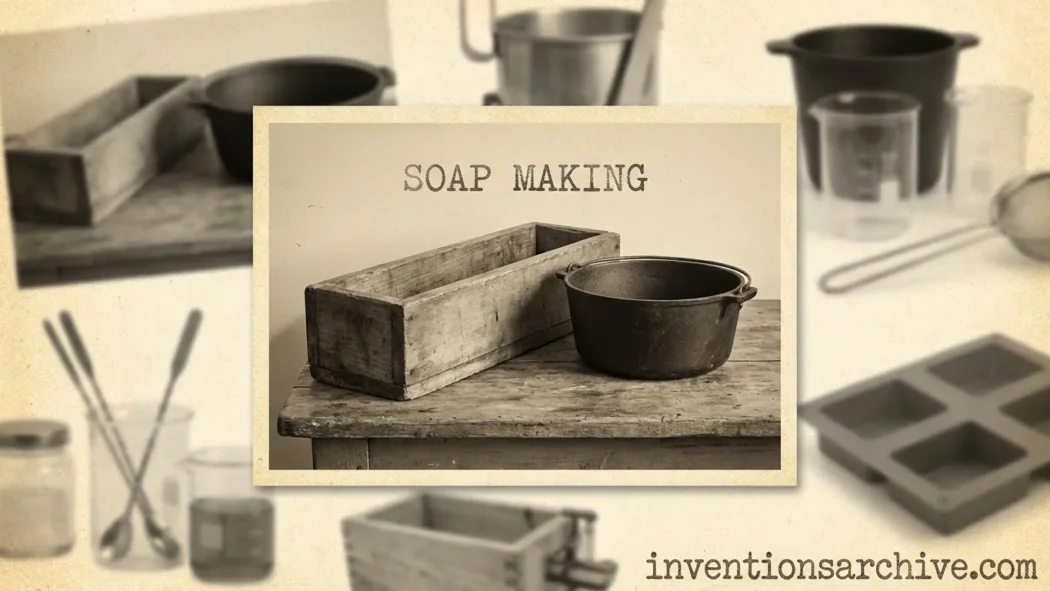
| Invention Name | Soap Making |
|---|---|
| Short Definition | A method for turning fats and alkalis into cleansing agents that lift oils and dirt in water. |
| Approximate Date / Era | Bronze Age Approximate |
| Geography | Ancient Mesopotamia; later Mediterranean and wider regions |
| Inventor / Source Culture | Anonymous / collective |
| Category | Hygiene; chemistry; household technology |
| Importance |
Grease removal in water Foundation for routine cleaning at scale |
| Need / Reason It Emerged | Cleaning oils; preparing fibers; reducing grime buildup |
| How It Works | Surfactant molecules form micelles that carry oils into water |
| Materials / Technology Basis | Fats/oils; alkaline salts; controlled heating; mixing |
| Early Uses | Textile cleaning; household washing |
| Spread Route | Mesopotamia → Mediterranean centers → wider trade networks |
| Derived Developments | Industrial soapworks; standardized quality testing; modern cleansers |
| Impact Areas | Public hygiene; textiles; trade; chemical science |
| Debates / Different Views | “First soap” varies by definition: soap-like mixtures vs finished soaps |
| Predecessors + Successors | Abrasives and ash-water washing → refined soaps; syndet cleansers; liquid cleansers |
| Key Cultures and Centers | Sumerian records; Mediterranean soap centers; European guild traditions |
| Varieties Influenced | Hard soap; soft soap; olive-oil styles; tallow-based styles; liquid soap; flakes |
Soap making is one of those quiet inventions that reshaped ordinary life. It turned messy, oily problems into something water could carry away. The idea sounds simple, yet the chemistry behind saponification and the everyday impact of cleaning are anything but small.
Table of Contents
What Soap Making Is
At its core, soap is a family of molecules created when fats or oils react with an alkali. Many modern body cleansers are synthetic detergent products, even if the label still uses the word “soap.” Details
- Soap making is the broader invention: the know-how, tools, and processes for producing reliable cleansing materials.
- Soap (in the strict chemical sense) relies on fatty-acid salts for its cleaning action.
- Detergents are engineered surfactants that often lather well in more water conditions.
Early Evidence and Timeline
Soap did not appear as a single “eureka” moment. It grew out of repeated contact with alkaline washes, oils, and fibers. Accounts linked to cuneiform tablets describe early directions for making soap solutions by boiling fats and oils with alkali, pointing to a long craft tradition rather than a single named inventor. Details
| Period | What Changes | Why It Matters |
|---|---|---|
| Ancient era | Soap-like alkaline-fat mixtures for cleaning | First workable chemistry for lifting oils |
| Medieval craft | Guild knowledge; regional oils and ash alkalis | Consistency and recognizable local styles |
| Early modern trade | Soap as a commercial good | Scaling from household use to markets |
| Industrial era | Large kettles, controlled inputs, standardized batches | Mass availability and predictable quality |
Why “First Soap” Is Hard To Pin Down
The word soap can mean different things across time. Some early materials cleaned effectively but did not match later expectations for a finished bar. That gap in definitions explains why timelines often use approximate language and focus on evidence, not a single date.
How Soap Making Works
The Molecule Shape
Soap molecules are two-sided. One end is hydrophilic (comfortable in water). The other is hydrophobic (drawn to oils). In water, they gather into micelles that hide oily material inside. Details
The Core Reaction
Saponification is the transformation that produces soap from fats/oils and an alkaline input. The outcome is a set of fatty-acid salts that behave as surfactants, often alongside naturally formed glycerol. No recipe is needed to understand the invention: the key leap is creating a reliable surfactant from common materials.
Soap’s cleaning action depends on interfaces: the boundary between water and oil. Water alone struggles with grease because oil does not mix with it. Soap bridges that gap. The result is not magic; it is organized chemistry that keeps oily dirt suspended long enough to be rinsed away.
What Affects Performance
- Water hardness can reduce lather and create deposits, because minerals react with soap.
- Oil choice changes the balance between firmness, lather feel, and cleansing strength.
- Additives can shift texture and scent, while the cleansing mechanism still depends on surfactants.
Soap Types and Variations
The invention quickly branched. Different regions used different oils, ash sources, and later purified alkalis. Those choices created recognizable soap families and modern product categories that still matter today.
Related articles: Soapstone Mold Casting [Medieval Inventions Series]
| Type | Typical Form | Defining Trait | Common Use Context |
|---|---|---|---|
| Hard Soap | Bars | Firm, longer-lasting | Hands, body, general washing |
| Soft Soap | Pastes, gels, liquids | More soluble in water | Household cleaning, specialty uses |
| Olive-Oil Styles | Bars | Mild feel for many users | Personal cleansing traditions |
| Tallow-Based Styles | Bars | Creamier lather in many formulations | Legacy and modern manufacturing |
| Syndet Bars | “Beauty bars” | Detergent-based, not true soap | Skin-cleansing products marketed as soap |
Named Traditions and Recognizable Formats
- Castile is commonly associated with olive-oil-based traditions and a restrained ingredient profile.
- Marseille-style often refers to Mediterranean soap heritage and large-kettle methods.
- Liquid cleansers can be true soap or detergent-based; the label may not tell the full story.
- Soap flakes and powders emerged as practical formats for dissolving quickly in wash water.
From Craft to Industry
Scaling soap making demanded control. Large batches exposed small chemistry problems: inconsistent alkali strength, variable fats, and changes in water quality. Over time, soapworks developed repeatable production steps and measurable quality checks, so a bar behaved the same from one batch to the next.
What Industry Standardized
- Input consistency: predictable oils and alkalis, fewer impurities.
- Batch control: temperature and mixing managed for uniform reaction.
- Product testing: pH and stability checks to keep performance steady.
- Format engineering: milling, stamping, and packaging for transport and storage.
Soap Making and Related Technologies
Soap manufacturing sits in the same family as other surface-chemistry technologies. The same idea—an amphiphilic molecule managing oil-water boundaries—supports many modern cleansers. Still, true soap remains distinct because its cleaning action depends on the fatty-acid salts formed in saponification, not a synthetic surfactant package.
Why Soap Matters in Daily Life
Soap’s importance is practical and constant. Public health guidance highlights that soap outperforms water alone because surfactants lift soil and microbes from skin, and people scrub more thoroughly when soap is present. Details
Everyday Value
- Household cleaning without complex tools
- Fabric preparation and stain removal support
- Routine hygiene with familiar materials
Why It Endures
- Simple chemistry, strong results
- Many formats for different needs
- Scales from household to global supply chains
FAQ
Is Soap Making A Single Invention Or A Collection Of Techniques?
It is best understood as a collection of techniques. The core discovery is the creation of surfactant molecules from fats and alkali, while cultures refined methods for consistency, storage, and trade.
What Is Saponification In Plain Terms?
Saponification is the chemical change that turns fats/oils into soap molecules when an alkaline input is involved. Those molecules then form micelles in water and lift oils into suspension.
Why Do Some Products Say “Beauty Bar” Instead Of Soap?
Many “beauty bars” rely on synthetic detergents rather than true soap chemistry. They can still cleanse well, but their main cleaning agents are not necessarily fatty-acid salts.
Is Liquid Soap Always Made From The Same Chemistry As Bar Soap?
No. Some liquid products are based on true soap, while others are detergent-based. Both may feel similar in use, yet their formulation and behavior in different water conditions can differ.
Why Does Soap Sometimes Leave A Film In Some Water?
In water with high mineral content, soap can form less-soluble compounds that appear as deposits. Detergent-based cleansers are often designed to reduce that effect, while true soap may show it more clearly.