
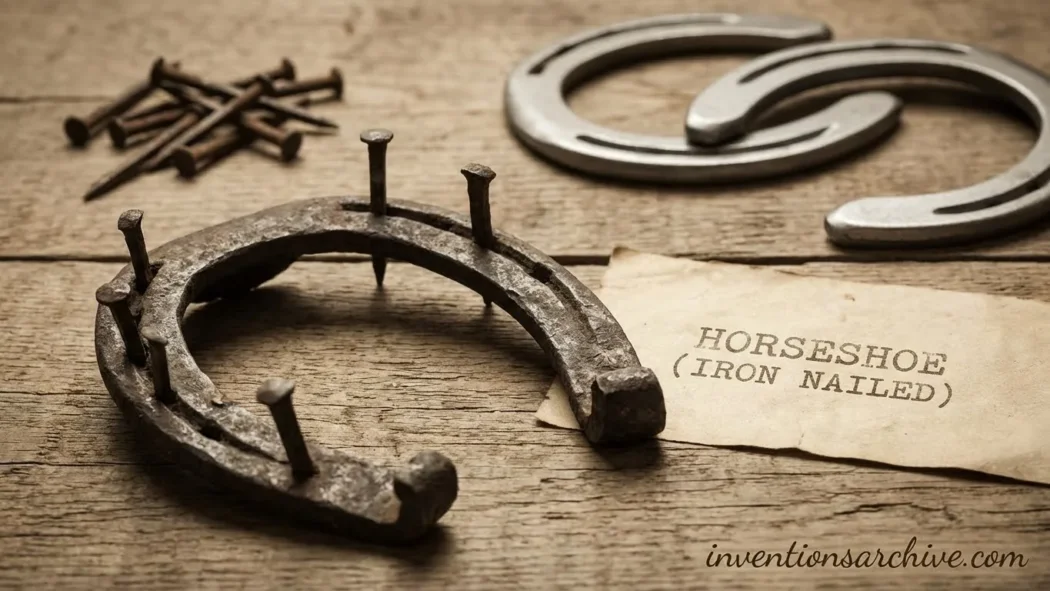
| Invention Name | Iron Nailed Horseshoe |
|---|---|
| Short Definition | A shaped iron shoe fixed to a horse’s hoof wall with purpose-made nails to reduce wear and support work on demanding surfaces. |
| Approximate Date or Period | Late 9th century AD for one of the earliest securely dated English examples; wider origins remain Debated |
| Evidence Status | Based on surviving evidence Archaeological finds confirm medieval use, but do not identify the absolute first shoe. |
| Geography | Medieval Europe, with clear archaeological evidence in England and later regional forms across Europe. |
| Inventor or Source Culture | Anonymous / collective craft development; no verified single inventor. |
| Category | Transport, agriculture, animal care, metallurgy, manufacturing |
| Main Problem Solved | Excessive hoof wear, loss of traction, and reduced working endurance on hard, wet, stony, or abrasive ground. |
| Simple Working Principle | The iron shoe becomes the ground-contact wear surface and is held against the hoof by nails placed through sound hoof wall. |
| Material and Technology Basis | Forged iron, punched nail holes, purpose-made horseshoe nails, skilled hoof trimming and fitting. |
| Early Use | Working horses used for riding, carrying, traction, farm work, and movement over maintained roads or rough ground. |
| Why It Mattered |
|
| Development Path | Removable hoof covering → nailed iron shoe → specialized forged forms → machine-made and modern therapeutic shoes |
| Surviving Evidence | Medieval iron shoes, loose horseshoe nails, excavated fragments, museum objects, typological studies, and later patent models. |
| Related Inventions | Hipposandal, horseshoe nail, hoof boot, stirrup, saddle, wagon tire, horseshoe-making machine |
| Modern Descendants | Steel and aluminium shoes, racing plates, bar shoes, heart-bar shoes, glue-on shoes, hoof boots, and composite hoof protection. |
| Attribution Debate | Attribution varies Roman, Celtic, Frankish, and later medieval claims must be separated from securely dated finds. |
What the Iron Nailed Horseshoe Is
An iron nailed horseshoe is a replaceable wear plate shaped to the bearing edge of a horse’s hoof. Its familiar open form follows the toe, quarters, and heels while leaving much of the sole and central frog uncovered. The shoe protects the lower edge of the hoof wall from being worn away faster than it can grow.
The attachment system is as important as the iron. Purpose-made nails pass through holes in the shoe and through sound hoof wall. The projecting ends are turned down into smooth clenches that help retain the shoe. Modern farriery guidance also stresses that shoe size, weight, shape, nail position, and the horse’s work must be considered together. [d]
A nailed shoe is therefore not merely a bent strip of metal. It is a fitted system involving the hoof, the shoe, the nail holes, the nails, and the skill of the farrier.
The Problem It Answered
Hoof Wear under Repeated Work
A horse’s hoof grows continuously, yet the lower wall also wears with every step. On suitable ground, growth and wear may remain balanced. Repeated work on stone roads, packed yards, rocky routes, or abrasive soil can remove horn faster than it is replaced.
Once the bearing edge becomes too worn, chipped, or uneven, the animal may lose comfort and stable contact with the ground. The nailed iron shoe answered this by placing a durable, renewable surface between the hoof and the terrain.
Retention Was the Main Change
Earlier removable coverings could protect a hoof for limited periods, but straps, plates, and temporary fittings added bulk and could shift. The nailed shoe stayed with the hoof during ordinary movement until wear, hoof growth, or maintenance required replacement.
This made hoof protection more practical for regular transport, traction, and farm work. It also created a repeating service cycle: inspect the foot, trim excess growth, fit the shoe, then renew the work as the hoof grew.
Earlier Hoof Protection
The most securely documented predecessor is the Roman hipposandal. It was an iron sole or partial sole held to the hoof by a fastening arrangement. Surviving examples vary in shape, size, openings, hooks, and tread features. Their removable construction resembles a hoof boot more than a modern nailed horseshoe.
Organic hoof coverings made from leather, fibre, or other perishable materials are often mentioned in broad histories. Such materials rarely survive well, and written descriptions may be hard to connect to a precise object type. They should be treated as part of the wider history of hoof care rather than as a proven single line leading directly to the medieval nailed shoe.
The change from a removable covering to a nailed rim demanded two kinds of knowledge: ironworking precise enough to form a light, durable shoe and hoof knowledge precise enough to place nails without harming sensitive tissue.
How the Nailed Shoe Worked
The Metal Took the Wear
The shoe met the ground before the lower hoof wall did. Iron wore down more slowly than hoof horn on many working surfaces, so the shoe could absorb repeated abrasion while the hoof continued to grow above it.
The Nails Held a Fitted Shape
Nail heads seated in the shoe’s holes. The shanks passed through the outer wall and emerged higher on the hoof, where clenches retained them. The nail pattern distributed attachment around the front and side portions of the hoof rather than relying on a strap around the limb.
The Open Center Preserved Hoof Contact
The common open shoe protected the wall while leaving the center of the foot largely uncovered. This reduced unnecessary metal, limited weight, and allowed the sole and frog to retain their own relationship with the ground, depending on the shoe’s form and fit.
How the Origin Is Traced
Historians cannot identify a workshop where the first nailed horseshoe was made. Iron corrodes, worn shoes were reusable scrap, and loose finds may enter later soil layers. A horseshoe discovered at an old site is not automatically as old as the site’s earliest occupation.
Dating relies on excavation context, associated material, shoe shape, nail-hole form, edge shape, heel features, and wear. Archaeologists compare these details with securely dated examples. Even then, the result may identify a period or type rather than an exact year.
Claims that assign the invention to one ancient people often go beyond the surviving evidence. The more careful view is that the nailed horseshoe emerged through collective craft knowledge and became archaeologically visible in early medieval Europe.
Development from Removable Protection to Modern Shoes
| Stage | Form | What Changed |
|---|---|---|
| Earlier Protection | Removable covering or hipposandal | Protected the hoof temporarily through straps, hooks, or enclosing parts. |
| Early Nailed Shoe | Forged iron crescent with punched nail holes | Fixed the wear surface directly to the hoof wall for continuing use. |
| Medieval Refinement | Regional shoe shapes, varied nail holes, heels, calkins, and fullering | Adapted grip, weight, wear, and fit to animals and working surfaces. |
| Industrial Production | Machine-made shoes and standardized blanks | Raised output while leaving final sizing and fitting to the farrier. |
| Modern Descendants | Steel, aluminium, bar, therapeutic, glue-on, and composite systems | Expanded material choice and allowed more specialized hoof support. |
Before and After the Nailed Horseshoe
| Before the Invention | What Changed after It |
|---|---|
| Bare hooves carried the full wear of repeated movement. | A replaceable iron rim absorbed much of the surface abrasion. |
| Temporary coverings could shift, loosen, or add a bulky sole. | Nails retained a fitted shoe during regular work. |
| Hoof protection was less suited to repeated travel on demanding ground. | Working horses could be maintained for more regular road, traction, and carrying duties. |
| Protective equipment was not always tailored to hoof growth. | Shoeing became a recurring craft linked to trimming, fitting, inspection, and replacement. |
| Each protective form depended heavily on local materials and fastening methods. | Forged shoes and nails became recognizable products that could be made in repeatable sizes and patterns. |
| Support for damaged hooves was limited to improvised coverings. | Later shoe forms altered support, traction, weight distribution, and protection for specific needs. |
Main Forms and Variations
The open-heel iron shoe became the best-known form, but farriers altered the basic design to suit different hooves, animals, surfaces, and kinds of work. A 19th-century European nailless shoe in The Metropolitan Museum of Art used articulated iron parts, a screw, and a likely padded lining for a draught horse whose hoof wall was too damaged to accept ordinary nails. [e]
| Type or Variation | Main Feature | Historical or Practical Role |
|---|---|---|
| Plain Open-Heel Shoe | U-shaped iron or steel rim with open heels | General protection for ordinary riding, traction, and work. |
| Fullered or Creased Shoe | Groove along the ground surface containing nail holes | Seats nail heads and can change weight, grip, and wear pattern. |
| Calkined Shoe | Raised heel projections or turned-down ends | Added purchase on selected surfaces; forms vary by period and region. |
| Bar Shoe | Metal joins the two heels | Creates a closed support structure for selected hoof conditions or work. |
| Heart-Bar Shoe | Central extension toward the frog | Specialized support used under professional farriery and veterinary direction. |
| Racing Plate | Lighter shoe, often aluminium in modern use | Reduces shoe weight for racing while retaining hoof protection. |
| Nailless Articulated Shoe | Mechanical closure rather than nails | Temporary protection when the hoof wall cannot safely hold ordinary nails. |
| Modern Composite or Glue-On Shoe | Polymer, composite, adhesive, or mixed-material construction | Offers alternatives to traditional iron or steel attachment. |
Specialized shoes were not merely theoretical designs. A preserved horseshoe associated with the racehorse Phar Lap has seven nail holes, a toe clip, grooves, and red rubber inserts. The museum record also describes a separate supportive bar shoe made after the horse developed a hoof crack, showing how farriers adapted the basic form to a particular foot and task. [f]
Craft, Standardization and Machine Production
For centuries, horseshoes were forged in local workshops. The maker had to judge the animal’s size, hoof shape, expected work, available iron, and local ground. A worn shoe could be repaired, reshaped, or returned to the scrap supply.
Industrial machinery changed the production stage. Henry Burden developed machines in Troy, New York, that formed horseshoes at high speed. The Albany Institute of History & Art records an 1843 patent, a later patent model connected with Patent No. 17,665, and machinery capable of producing sixty shoes per minute. [g]
Machine production did not remove the farrier from the system. It supplied repeatable shoes or blanks in multiple sizes. The final shoe still had to be selected, shaped, and fitted to a living hoof. The invention’s industrial phase therefore divided the work into factory production and individual fitting.
What Changed in Daily Work
Transport and Carrying
Horses moving riders, messages, packs, carts, and coaches could receive a renewed ground-contact surface instead of relying only on the natural hoof. This was especially useful where daily routes included stone, packed earth, yard paving, or uneven roads.
Agriculture and Haulage
Traction animals worked under load and often repeated the same paths through farmyards, roads, fields, and market spaces. Shoeing helped manage wear and allowed shoe forms to be adjusted for local footing and the animal’s task.
Farriery as a Specialized Craft
The nailed shoe made hoof care inseparable from metal fitting. Farriers needed practical knowledge of hoof growth, limb balance, forging, nail placement, movement, and wear. The craft developed alongside blacksmithing but remained focused on the living horse.
Manufacturing and Standard Sizes
Machine-made shoes created repeatable products that could be shipped, stored, and fitted locally. Standard sizes reduced the time needed to form every shoe from straight bar, while handmade shoes remained useful when ordinary patterns did not suit the foot.
Later Supportive and Therapeutic Designs
The basic nailed rim became a platform for clips, bars, pads, inserts, traction devices, lighter metals, and other adjustments. These descendants show that the horseshoe evolved from simple wear protection into a family of fitted hoof-support systems.
Common Misunderstandings
“The Romans Invented the Nailed Horseshoe”
Roman iron hipposandals are securely documented. They were removable coverings. They show an earlier solution to hoof protection, but they do not by themselves prove that Roman farriers used the familiar medieval nail-on system.
“One Known Inventor Created It”
No verified inventor is recorded. The shoe is better understood as a collective craft development shaped by ironworking, horse care, road conditions, and repeated workshop improvement.
“The Oldest Surviving Find Must Be the First Ever Made”
Archaeology records survival, discovery, and context. Earlier shoes may have rusted away, been reforged, or remain undiscovered. A secure early find marks the earliest evidence presently known in that evidence set, not an absolute first use.
“The Nails Are Driven into Living Flesh”
Proper shoeing places nails through sound hoof wall. The comparison with a human nail is useful only in a limited sense: the hoof is a more complex weight-bearing structure, and poor placement can reach sensitive tissue.
“Every Horse Needs an Iron Shoe”
Shoeing depends on hoof condition, workload, terrain, movement, and management. Some horses work without shoes and receive regular trimming. Others use steel, aluminium, glue-on systems, boots, or specialized support.
Related Inventions
- Hipposandal: removable Roman iron hoof protection and an important predecessor.
- Horseshoe Nail: tapered fastener designed to seat in the shoe and pass through hoof wall.
- Hoof Boot: removable modern descendant of strapped hoof protection.
- Saddle and Saddle Tree: riding technologies that shaped how horses carried people and loads.
- Stirrup: rider-support equipment that developed within the same broader equestrian technology history.
- Wagon Tire: another replaceable iron wear surface used in animal-powered transport.
- Horseshoe-Making Machine: industrial equipment that produced repeatable shoe forms at high output.
Frequently Asked Questions
Who invented the iron nailed horseshoe?
No verified individual inventor is known. Archaeological evidence points to an anonymous, collective development within early medieval European farriery and ironworking.
When did nailed horseshoes first appear?
One of the earliest securely attested English examples comes from a late 9th-century context at Winchester. Claims for earlier nailed shoes exist, but their dating or interpretation is debated.
Did Roman horses wear iron shoes?
Roman-period animals sometimes used iron hipposandals, which were removable hoof coverings. They differed from the later U-shaped shoe retained by nails through the hoof wall.
How does a nailed horseshoe stay attached?
Purpose-made nails hold the fitted shoe against sound hoof wall. Their ends emerge through the outer wall and are formed into smooth clenches by a trained farrier.
Why is the common horseshoe open in the center?
The common form follows the hoof’s bearing edge while leaving much of the sole and frog uncovered. This limits weight and metal use, though specialized shoes may include bars, pads, or central support.
Are all horseshoes made of iron?
No. Forged iron and steel dominate much of the historical record, while modern shoes may use steel, aluminium, polymers, composites, rubber elements, or adhesive attachment systems.
Does every working horse need horseshoes?
No. The decision depends on hoof quality, terrain, workload, movement, wear, and professional assessment. Some working horses remain unshod, while others need fitted protection or support.
Sources and Verification
- [a] Horseshoes – Finds Recording Guides — Used to verify the late 9th-century Winchester evidence and the archaeological dating of early-medieval horseshoes. (Reliable because it is an institutional archaeological recording guide from the Portable Antiquities Scheme.)
- [b] British Museum: Hipposandal — Used to verify the 1st–2nd-century Romano-British removable iron hoof covering. (Reliable because it is a direct British Museum collection record.)
- [c] British Museum: Medieval Horse-Shoe — Used to verify a surviving medieval iron horseshoe with three nails still present. (Reliable because it is a direct British Museum archaeological object record.)
- [d] The Well Shod Horse — Used to verify nail placement in sound hoof wall, clenches, shoe fit, and the relationship between shoe choice and the horse’s work. (Reliable because it is published by the Worshipful Company of Farriers.)
- [e] Nailless Horseshoe — Used to verify a 19th-century articulated iron shoe designed for a hoof wall too damaged for ordinary nails. (Reliable because it is a direct Metropolitan Museum of Art collection record.)
- [f] Horseshoe – Phar Lap, Agua Caliente, 1932 — Used to verify nail holes, a toe clip, grooves, rubber inserts, and a documented supportive bar-shoe response to a cracked hoof. (Reliable because it is a direct Museums Victoria collection record.)
- [g] Burden Iron Works — Used to verify Henry Burden’s horseshoe-machine patents, preserved patent model, and high-output industrial production. (Reliable because it is an official Albany Institute of History & Art exhibition page.)

