
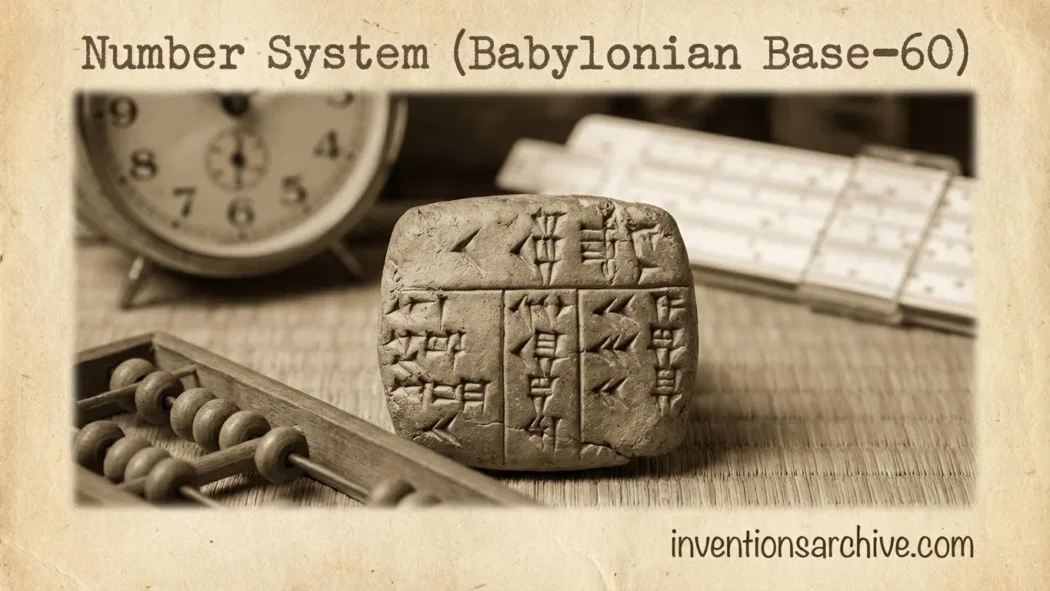
| Invention Name | Babylonian Base-60 Number System |
|---|---|
| Short Definition | A positional number system that used powers of 60 and cuneiform signs to write quantities, fractions, tables, and calculations. |
| Approximate Date / Period | 3rd millennium BCE roots; Old Babylonian mathematical use widely attested around 1900–1600 BCE Based on surviving evidence |
| Geography | Mesopotamia, especially Babylonia in the region of modern Iraq |
| Inventor / Source Culture | Anonymous / collective scribal tradition; inherited from earlier Sumerian and Akkadian numerical practices |
| Category | Measurement, mathematics, education, accounting, astronomy |
| Main Problem Solved | Writing large numbers and fractions in a compact way for records, measures, tables, and calculation |
| How It Worked | Signs from 1 to 59 were grouped in places; each place could represent units, sixties, 3,600s, or fractions of 60 depending on position |
| Material / Technology Base | Clay tablets, reed stylus, cuneiform wedge signs |
| Evidence Status | Confirmed for surviving mathematical tablets; Attribution varies for the earliest origin |
| Surviving Evidence | Mathematical clay tablets such as YBC 7289 and Plimpton 322; cuneiform records; later scholarly catalogues |
| Development Path | Counting and metrology → sexagesimal notation → positional base-60 calculation → astronomy, time, and angle measurement |
| Related Inventions | Cuneiform writing, clay tablet records, metrology systems, reciprocal tables, astronomical tables, angle measurement |
| Modern Descendants | 60 minutes in an hour, 60 seconds in a minute, 360 degrees in a circle, geographic coordinates, astronomical notation |
| Why It Matters | It made fraction-friendly calculation practical long before modern decimal notation became standard. |
The Babylonian base-60 number system, also called the sexagesimal system, was one of the most useful numerical inventions of the ancient world. It allowed Mesopotamian scribes to write whole numbers, fractions, multiplication tables, reciprocal tables, and geometric calculations with a compact notation that worked well on clay tablets. Its traces still appear whenever a clock shows 60 minutes, a minute divides into 60 seconds, or a circle is measured in 360 degrees.
What the System Is
The system was based on the number 60. In a modern decimal number, each position is worth ten times the position to its right. In Babylonian mathematical notation, each place could be worth sixty times the place to its right.
A number such as 1, 24, 51, 10 in modern sexagesimal transcription can mean:
- 1 whole unit,
- 24 sixtieths,
- 51 parts of 3,600,
- 10 parts of 216,000.
This is why the system was strong for fractions. Many common divisions work neatly in base 60 because 60 can be divided by 2, 3, 4, 5, 6, 10, 12, 15, 20, and 30. A fraction such as one-third becomes 20 sixtieths, while one-quarter becomes 15 sixtieths. That made many scribal calculations cleaner than they would be in a smaller or less divisible base.
French Ministry of Culture material on Babylon notes that Mesopotamian sexagesimal notation was used from the 3rd millennium BCE and that the legacy survives in the division of time and the 360-degree circle. [b]
How It Worked in Simple Terms
The written system did not need 60 separate symbols. That is a common modern misunderstanding. Scribes built the numbers from 1 to 59 by combining two basic cuneiform signs:
- a vertical wedge for one,
- a corner or chevron-like wedge for ten.
Inside one place, these signs were additive. For example, a group could represent 23 by combining two ten-signs and three unit-signs. Once the count reached 60, the next position began.
The same sign could therefore stand for 1, 60, 3,600, or a fraction, depending on where it appeared. That made the system positional, but not identical to the later decimal place-value system used today. Early Babylonian notation did not have a full zero symbol that worked the way modern zero does.
The Problem It Answered
Ancient Mesopotamian administration needed numbers constantly. Scribes recorded grain, land, labor, silver, bricks, rations, weights, and measures. They also trained in mathematics for survey work, accounting, architecture, and scholarly calculation.
The base-60 system answered several practical needs:
- It kept many fractions short.
- It supported tables of reciprocals, squares, and other values.
- It allowed large values to be written with place-value logic.
- It worked well with metrology, where units were often divided into regular parts.
- It supported astronomy and angle measurement in later scholarly traditions.
The system was not only a way to “count.” It was a calculation tool. Its value came from how easily it handled division, especially in scribal contexts where exact shares and measured quantities mattered.
Before and After
| Before the System | What Changed After It |
|---|---|
| Counting and measuring relied on older sign systems, tally-like records, and local metrological conventions. | Scribes could use a compact positional notation for calculations involving large numbers and fractions. |
| Fractions and unit conversions could require special symbols or context-specific methods. | Many common fractions became simple sexagesimal values, such as 30 for one-half and 20 for one-third. |
| Administrative records could show quantities, but advanced calculation needed stronger notation. | Mathematical tablets could record tables, geometric problems, reciprocal pairs, and square-root approximations. |
| Earlier systems did not combine base 60 with the same level of positional mathematical use. | Old Babylonian scribes developed a notation that supported education, measurement, and technical calculation. |
| Time and angle divisions were not yet tied to the later familiar sexagesimal pattern. | The 60-minute hour, 60-second minute, and 360-degree circle preserved sexagesimal habits in later traditions. |
Earlier Ideas and Development Path
The Babylonian system did not appear from nowhere. It grew from older Mesopotamian number practices. Sumerian and Akkadian cultures already used numerical and metrological systems before the Old Babylonian period. What became especially important in Babylonian mathematics was the combination of base 60 with a place-value structure.
| Stage | Form | What Changed |
|---|---|---|
| Earlier Tool | Counting tokens, metrological signs, administrative records | Numbers served trade, storage, rations, labor, and land management. |
| Inherited Base | Sumerian and Akkadian numerical traditions | Base-60 habits became part of Mesopotamian record keeping and measurement. |
| Invention Form | Babylonian positional sexagesimal notation | Numbers could be arranged by place value, making calculation more flexible. |
| Improved Use | Reciprocal tables, square tables, geometric exercises | Scribal schools and mathematical tablets used base 60 for structured calculation. |
| Modern Descendant | Time, angles, coordinates, astronomy | Sexagesimal divisions survived even after decimal notation became common. |
MacTutor, a history of mathematics archive at the University of St Andrews, describes the Babylonian system as inheriting base-60 elements from earlier Sumerian and Akkadian systems while making a major advance through positional notation. It also notes that explanations for why 60 became the base remain partly uncertain. [c]
Main Materials and Technical Principle
The material side of the system was simple: clay and a stylus. A scribe pressed wedge-shaped marks into a damp clay tablet. Once dried, the tablet could preserve school exercises, tables, accounts, or scholarly calculations for a very long time.
The technical principle was more subtle. The system joined two ideas:
- Additive signs inside each place: values from 1 to 59 were built from unit and ten signs.
- Place value between groups: the same group could represent different magnitudes depending on its position.
This created a powerful but sometimes ambiguous notation. Without a fully modern zero and without a fixed written point like a decimal point, the value of a number often depended on the problem, tablet layout, or known unit of measure.
Surviving Tablets and What They Show
YBC 7289 and the Square Root of 2
One famous Old Babylonian tablet, YBC 7289, is held in the Yale Babylonian Collection and catalogued by the Cuneiform Digital Library Initiative. It shows a square and a sexagesimal approximation for the square root of 2, recorded as 1.24.51.10 in modern transcription. CDLI gives the modern comparison as 1.41421296 versus 1.41421356. [d]
This tablet matters because it shows that base-60 notation was not merely used for ordinary counting. It could carry very accurate numerical work in geometry. It also gives a clear example of why sexagesimal fractions were useful: they could express some values with remarkable compactness.
Plimpton 322 and Mathematical Tables
Plimpton 322 is another famous Old Babylonian mathematical tablet. CDLI identifies it as a clay mathematical table from Larsa, dated to the Old Babylonian period around 1900–1600 BCE and now held by Columbia University’s Rare Book and Manuscript Library. [e]
Modern scholars continue to discuss the exact purpose of Plimpton 322. A careful article from the Mathematical Association of America explains that many of the numbers on the tablet have terminating sexagesimal representations, while their decimal translations may look less neat. That is an important point: base 60 was not a weaker version of base 10. In some calculations, it gave scribes exact-looking numerical forms that decimal notation does not reproduce as neatly. [f]
Early Uses in Daily and Scholarly Work
Babylonian base-60 notation belonged to a scribal world. It was used by trained writers, administrators, and students rather than by every person in daily speech. Its practical settings included:
- land and field measurement, where area calculations mattered;
- grain, silver, and ration records, where quantities had to be divided and compared;
- scribal education, where students copied tables and solved set problems;
- geometry, especially problems involving squares, rectangles, diagonals, and areas;
- astronomy and time reckoning, where cycles and divisions were central.
Old Babylonian area tablets show how sexagesimal notation could appear in geometry. A Mathematical Association of America discussion of an Old Babylonian area calculation explains values such as 2;20 and 5;03 20 in sexagesimal notation, showing how scribes expressed whole units and fractions in one written system. [g]
Main Types and Variations
| Type or Variation | Main Use | Important Detail |
|---|---|---|
| Administrative Sexagesimal Values | Rations, goods, weights, measures, land records | Connected to practical metrology and record keeping. |
| Mathematical Place-Value Notation | Tables, school exercises, calculation | Used positions based on powers of 60. |
| Sexagesimal Fractions | Division, reciprocals, geometry | Made common fractions easier to express than many decimal equivalents. |
| Reciprocal Tables | Division by multiplication | Useful because many numbers have clean reciprocals in base 60. |
| Astronomical Sexagesimal Notation | Time, angles, celestial calculations | Helped preserve base-60 habits in later Greek, Islamic, and European science. |
| Later Placeholder Use | Clarifying empty positions | A placeholder appeared in later Mesopotamian usage, but it was not the same as full modern zero. |
What Changed Because of It
The base-60 system changed what scribes could write and calculate. It supported a more compact style of arithmetic than a purely additive system. It also made multiplication and division tables more useful, because tables could be reused across many problems.
The most visible long-term changes were not limited to ancient tablets. The system shaped later habits in:
- timekeeping, through 60 minutes and 60 seconds;
- geometry, through the 360-degree circle;
- astronomy, where sexagesimal notation stayed useful for angles and cycles;
- geographic coordinates, where degrees, minutes, and seconds remained standard for a long period;
- mathematical education, because surviving tablets show an organized scribal culture of numerical training.
The system’s lasting value came from a simple fact: 60 divides well. That property made it convenient for halves, thirds, quarters, fifths, sixths, tenths, twelfths, and other common shares.
Common Misunderstandings
It Was Not Invented by One Named Person
The system came from a long scribal tradition. It is safer to speak of Mesopotamian development and Babylonian mathematical use than a single inventor.
Base 60 Did Not Require 60 Symbols
Babylonian scribes built the values from 1 to 59 with repeated unit and ten signs. The base was in the place value, not in a set of 60 digit shapes.
It Was Not Just a Clock System
Modern timekeeping preserves part of the legacy, but the original system also served accounting, metrology, mathematical tables, geometry, and astronomy.
Its Lack of Modern Zero Matters
The notation was positional, yet early forms lacked a full modern zero. Context often helped readers decide the intended magnitude.
Related Inventions and Later Developments
- Cuneiform writing: the writing system that allowed numerical signs to be pressed into clay.
- Clay tablet record keeping: the durable medium that preserved many mathematical examples.
- Metrology systems: weight, length, area, and capacity measures that gave base-60 calculation practical value.
- Reciprocal tables: calculation aids that made division easier in scribal mathematics.
- Geometric calculation tablets: school and scholarly texts dealing with squares, rectangles, areas, and diagonals.
- Astronomical tables: later technical records that helped carry sexagesimal notation into time and angle measurement.
- Decimal place-value numerals: a later number system with a full zero, different base, and wider modern use.
Frequently Asked Questions
Why Did the Babylonians Use Base 60?
The exact origin is not fully certain. Base 60 was useful because it has many divisors, which made fractions and unit conversions easier. It also grew from earlier Mesopotamian numerical and metrological traditions rather than a single recorded decision.
Was the Babylonian Base-60 System Positional?
Yes. In mathematical use, the value of a group of signs depended on its position. A sign group could represent units, sixties, 3,600s, or sexagesimal fractions. The system was positional, but early forms did not use a full modern zero.
Did Babylonian Numerals Have a Zero?
Early Babylonian notation did not have a zero that worked like modern zero. Later Mesopotamian notation used placeholder signs in some contexts, but that was not the same as a full zero digit used in every position.
Where Do We Still Use Babylonian Base-60 Ideas Today?
The clearest survivals are time and angles: 60 seconds in a minute, 60 minutes in an hour, and 360 degrees in a circle. Sexagesimal notation also influenced astronomy and geographic coordinate systems.
What Are the Most Famous Surviving Babylonian Mathematical Tablets?
Two often discussed examples are YBC 7289, which records a very accurate sexagesimal approximation connected with the square root of 2, and Plimpton 322, a mathematical table from the Old Babylonian period.
Sources and Verification
- [a] Mesopotamian Mathematics | Orient Cunéiforme — Used to verify the base-60 structure, two-sign notation, positional ambiguity, and absence of early full zero. (Reliable because it is an institutional archaeology and cultural heritage source.)
- [b] Système Sexagésimal | Babylon — Used to verify the Mesopotamian use of base 60 from the 3rd millennium BCE and its legacy in time and angle divisions. (Reliable because it is a French Ministry of Culture archaeology resource.)
- [c] Babylonian Numerals – MacTutor History of Mathematics — Used to verify the inherited Sumerian and Akkadian background, positional character, and uncertainty around the origin of base 60. (Reliable because it is a university-hosted history of mathematics archive.)
- [d] MCT 042 YBC 07289 (P255048) – Cuneiform Digital Library Initiative — Used to verify the YBC 7289 tablet, its Old Babylonian period, collection, and square-root-of-2 sexagesimal value. (Reliable because CDLI is a specialist institutional cuneiform catalogue.)
- [e] MCT 038, Plimpton 322 (P254790) – Cuneiform Digital Library Initiative — Used to verify Plimpton 322 as an Old Babylonian clay mathematical tablet from Larsa in Columbia University’s collection. (Reliable because CDLI is a specialist institutional cuneiform catalogue.)
- [f] Mathematical Overview of Plimpton 322 | Mathematical Association of America — Used to verify the point that many Plimpton 322 values terminate in sexagesimal notation even when their decimal forms are less neat. (Reliable because it is an educational article from a professional mathematical association.)
- [g] Mathematical Treasure: Old Babylonian Area Calculation | Mathematical Association of America — Used to verify examples of Old Babylonian sexagesimal notation in geometric area calculation. (Reliable because it is a professional mathematical association publication.)