
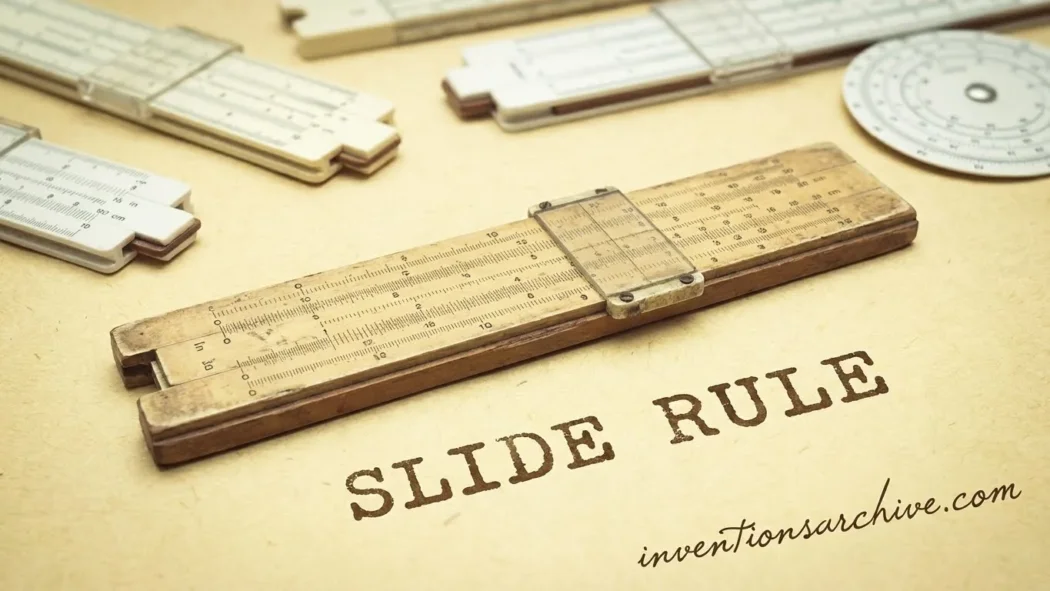
| Invention Name | Slide Rule |
|---|---|
| Short Definition | Handheld analog calculator using logarithmic scales for fast computation |
| Approximate Date / Period | Early 1620s Approximate Details |
| Geography | England (early design); later global use |
| Inventor / Source Culture | William Oughtred (early slide rule); built on logarithmic mathematics |
| Category | Computation • Engineering Tools • Mathematics |
| Importance | • Portable precision calculation • Core tool in technical education and engineering work |
| Need / Origin Driver | Faster complex arithmetic without long written steps |
| How It Works | Sliding logarithmic scales (add lengths → multiply values) |
| Material / Tech Base | Logarithms • Engraved/printed scales • Cursor/indicator |
| Early Use Contexts | Navigation • Astronomy • Surveying • Engineering |
| Spread Route | Britain → Europe → worldwide industry and schools |
| Derived Developments | Mannheim layouts • Duplex rules • Circular/cylindrical forms • Specialty scales |
| Impact Areas | Engineering • Education • Navigation • Industry • Science |
| Debates / Different Views | Priority and “first” vary by early design style |
| Precursors + Successors | Log tables → slide rules → mechanical calculators → electronic calculators |
| Key People / Traditions | John Napier • Edmund Gunter • William Oughtred • instrument makers |
| Influenced Variations | Linear • Circular • Cylindrical • Duplex • Log-log • Aviation-style circular computers |
A slide rule is a compact calculation instrument that turns hard arithmetic into quick reading. Instead of writing many steps, it uses logarithmic scales to produce reliable approximations fast. For centuries it served as a practical bridge between pure math and real-world work in engineering, navigation, and science.
Table of Contents
What a Slide Rule Is
A slide rule looks like a ruler, yet its purpose is calculation, not measurement. It is often described as a simple analog computer: numbers are read from scales, and relationships are revealed by alignment rather than by writing out arithmetic. That made it ideal when speed mattered and a reasonable approximation was enough.
Most slide rules support a surprisingly broad set of operations. The exact menu depends on the scales printed on the body and on the slide, plus the cursor. Common capabilities include:
- Multiplication and division
- Powers and roots
- Logarithms and exponentiation (on advanced rules)
- Trigonometry (sine, cosine, tangent) on many technical models
Why It Feels Fast
The key idea is that the slide rule trades long arithmetic for alignment. A user reads values where scales line up, then keeps track of magnitude (the decimal place) with context and estimation. That habit encouraged practical thinking and avoided false precision.
Early Evidence and Timeline
The slide rule belongs to a longer story about making math usable at the workbench. A major turning point came when logarithms entered print, making it possible to replace repeated multiplication with simpler steps and tables. In 1614, John Napier’s publication of logarithms is widely recognized as a catalyst for faster calculation Details.
From there, instrument makers and mathematicians turned the idea into a handheld tool. A simple timeline helps frame the evolution without forcing a single “first” claim:
- 1614 — Logarithms published; calculation speed improves
- 1620s — Early slide rule designs appear; circular and linear approaches develop
- 18th–19th centuries — Wider use in industry and technical education
- 20th century — Specialized scales spread (aviation, electrical, scientific)
- Late 20th century — Electronic calculators become dominant for everyday work
How a Slide Rule Works
A slide rule is built on a neat mapping: distances along a logarithmic scale represent numbers in a way that turns multiplication into addition of lengths. When two matching log scales slide past each other, the spacing does the math. Classic manuals describe how adding or subtracting logarithmic distances yields multiplication or division outcomes Details.
Core Motion
The stock (fixed body) and the slide (moving strip) carry scales that match in style. A transparent cursor helps transfer a reading from one scale to another without losing position.
What Gets Read
Numbers are read where markings align. Many results come from relative positions, so the decimal point is tracked by magnitude sense rather than printed output. It feels closer to estimation than to exact arithmetic.
Why Results Are Approximate
Markings have finite spacing. Many readings depend on the eye estimating between ticks, so typical use favors meaningful precision over excessive digits. That matches real measurements, where inputs already have limits.
Scales and What They Mean
Slide rule scales are a compact language. Letters vary by manufacturer, yet many models share a familiar core. On a typical technical rule, C and D handle day-to-day multiplication and division, while additional scales add powers, roots, and trigonometry.
| Scale | Common Meaning | Typical Use |
|---|---|---|
| C / D | Primary log scales | Multiplication • Division • Ratios |
| A / B | Squared scale relationship | Squares • Square roots (via pairing with C/D) |
| K | Cubed scale relationship | Cubes • Cube roots |
| CI | Inverted C scale | Reciprocals • Faster division patterns |
| S / T | Trigonometric scales | Sines • Tangents (common in engineering rules) |
| L | Linear log scale | Reading logarithms directly |
| LL | Log-log family | Exponentials • Powers with fractional exponents |
Special-purpose slide rules often add field-specific scales. Aviation circular computers, for example, emphasize time–speed–distance and fuel planning, while electrical rules may include unit conversions and component relationships. The guiding idea stays the same: put the right scales in front of the user at the moment of need.
Types and Variations
“Slide rule” is a family name. Over time, makers explored different shapes to improve readability, extend effective scale length, and support specialized domains. Despite the variety, the basic anatomy remains consistent: stock, slide, and a cursor (often called an indicator) Details.
Related articles: Umbrella [Ancient Inventions Series], Abacus [Ancient Inventions Series]
| Type | What Stands Out | Why It Existed |
|---|---|---|
| Linear | Classic straight body | Portable, quick, easy to learn |
| Duplex | Scales on both sides | More functions without making the rule longer |
| Circular | Disk or ring format | Longer effective scale in a compact form |
| Cylindrical | Wrapped scale around a cylinder | Very long scale length for finer readings |
| Specialty | Domain-specific scales | Fast repeated calculations in a single field |
The “Mannheim” Name
Many collectors and catalogs use Mannheim as a shorthand for a common layout of scales and parts. It is less about a single object and more about a widely recognized design pattern that shaped many practical rules.
Materials and Craft
Slide rules were built to be handled daily. Makers favored stable cores and crisp markings because the tool lives or dies by legibility. Many classic models used wood or bamboo cores with a smooth facing, while later designs introduced plastics and aluminum for durability and thinner profiles.
The cursor is a quiet hero. A clear window and a fine hairline make it easier to keep a position while shifting between scales. Some designs add magnification or stronger framing to improve precision without changing the underlying math.
Where Slide Rules Shined
Slide rules became trusted because they matched the rhythm of real work. They produced answers fast, and their style naturally encouraged sanity checks. When numbers come from alignment rather than typed digits, obvious mismatches feel easier to spot.
- Engineering — design calculations, ratios, scaling, practical approximations
- Surveying and construction — quick conversions and field math
- Aviation — circular computation for time, speed, distance, fuel relationships
- Education — learning logarithms, scale reading, estimation habits
They also appear in stories of high-stakes problem solving in science. NASA’s resources note that Katherine Johnson and other early space-program “human computers” worked with a slide rule and a pencil while calculating orbital trajectories Details. The tool fit the era’s blend of mathematics, careful checking, and disciplined approximation.
Accuracy and Limits
A slide rule excels at useful accuracy. Its readings are constrained by scale length, tick spacing, and the ability to estimate between marks. This makes it naturally aligned with measurements and engineering inputs, where perfect precision rarely exists. Many experienced users valued that the device emphasized reasonable certainty over decorative digits.
Its biggest mental requirement is tracking order of magnitude. Because the scales show significant digits but not the decimal point, context decides whether the result represents, for example, 3.2 or 32. That is not a flaw so much as a different calculation culture—one that rewards estimation and common sense.
Why It Stayed Relevant for So Long
Even as desk calculators emerged, the slide rule stayed popular because it was portable, quick, and durable. A U.S. Geological Survey museum description notes that slide rules were later largely supplanted by electronic calculators in the 1980s—a shift driven by convenience and cost as much as by capability.
FAQ
Is a slide rule an analog computer?
Yes. A slide rule represents numbers through physical distance on logarithmic scales. Alignment and reading produce results, which is a classic analog approach.
Why does a slide rule not show the decimal point?
The scales focus on significant digits. Magnitude is inferred from context, units, and estimation. This keeps attention on meaningful precision rather than on extra digits that may not be justified.
What is the “Mannheim” type?
“Mannheim” often refers to a widely used layout and parts arrangement found on many linear rules. The U.S. Geological Survey description highlights the shared anatomy—stock, slide, and cursor—that makes the family recognizable.
Did slide rules play a role in early spaceflight work?
Yes. NASA notes that Katherine Johnson and other early “human computers” worked with a slide rule and a pencil while calculating orbital trajectories, reflecting the era’s practical calculation discipline.
What makes a slide rule valuable today?
Its value is often educational and historical. The slide rule teaches scale reading, estimation, and the meaning behind logarithms. Collectors also appreciate well-made examples as artifacts of engineering culture.