
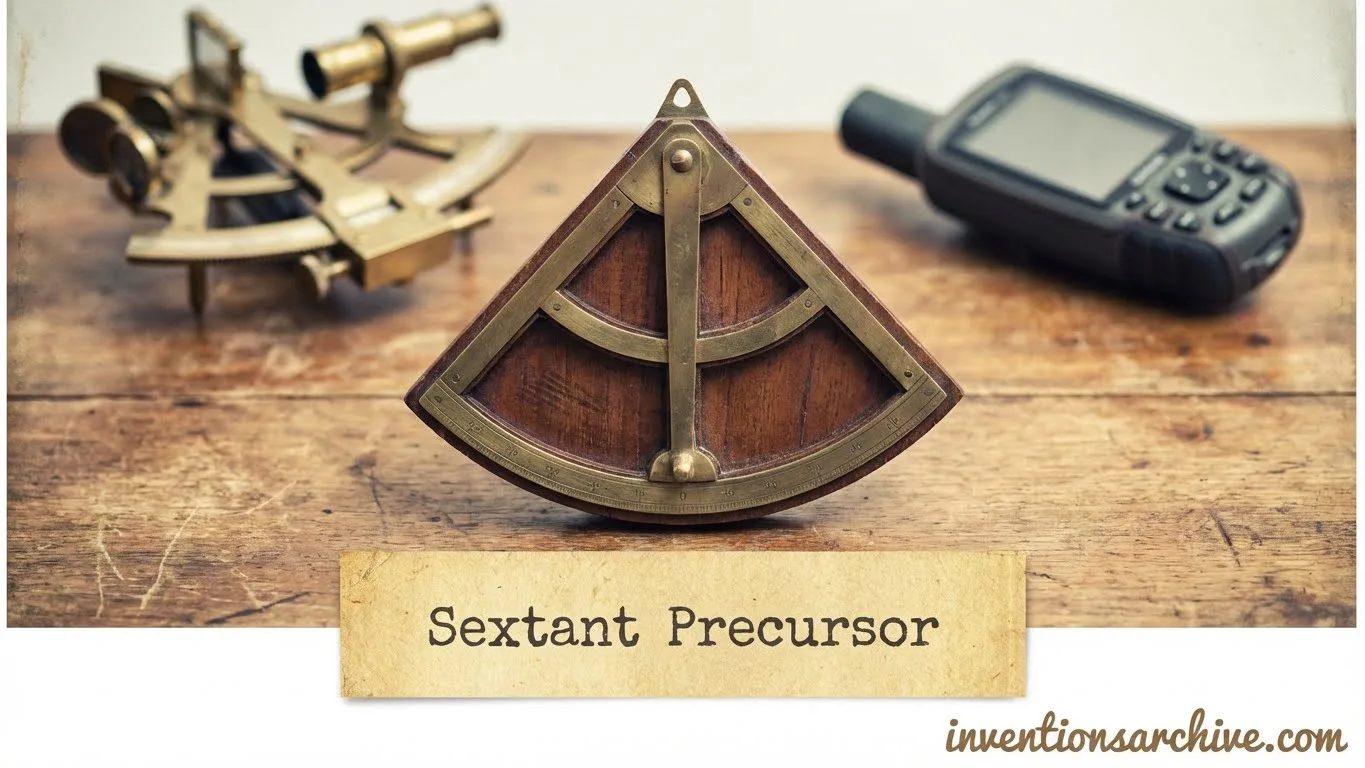
| Invention Name | Octant (Reflecting Quadrant) |
|---|---|
| Short Definition | Mirror-based sea instrument for measuring celestial altitude; direct sextant forerunner |
| Approximate Date / Period | c. 1730 (Approximate) Details |
| Geography | England; British America (Philadelphia) |
| Inventor / Source Culture | John Hadley; Thomas Godfrey |
| Category | Navigation; Astronomical Instruments |
| Importance |
|
| Need / Reason It Emerged | Safer, steadier altitude readings at sea |
| How It Works | Two mirrors; angle doubled; reading on graduated arc |
| Material / Technology Basis | Optical reflection; graduated scale; vernier |
| First Use Context | Open-sea latitude finding; nautical almanac use |
| Spread Route | Atlantic shipping networks; instrument makers’ trade |
| Derived Developments | Sextant; improved long-range celestial navigation |
| Impact Areas | Mapping; trade routes; education; science |
| Discussions / Differing Views | Priority credit shared; independent development |
| Predecessors + Successors | Kamal, mariner’s astrolabe, cross-staff, backstaff → octant → sextant |
| Key People / Cultures | European instrument makers; Indian Ocean navigators |
| Influenced Variations | Reflecting quadrant forms; sextant families |
Sextant precursors are the quiet backbone of celestial navigation. Each one solved the same hard problem: reading a reliable angle between the horizon and a bright body in the sky. The sextant did not appear out of nowhere; it grew from earlier tools that improved accuracy, reduced strain, and made measurements easier to repeat on a moving deck.
Table Of Contents
What Came Before the Sextant
A sextant belongs to a long line of angle-measuring instruments. The earliest were simple, portable, and built around sight lines. Later tools added shadows, plumb lines, and finally mirrors. That last step—reflection—turned a hard observation into a clean, repeatable reading, which is why the octant is usually treated as the closest sextant precursor.
Why These Precursors Matter
- Accuracy improved by removing guesswork and aligning images in one view.
- Repeatability mattered as much as precision; stable methods built confidence.
- Each design shaped the vocabulary of navigation: altitude, horizon, index, scale.
Core Idea: Measuring An Angle At Sea
The shared goal is simple: measure the altitude of the Sun or a star—its height above the horizon. That single angle, paired with known sky data, points to latitude. The sextant refined the method, yet the logic is older than the instrument.
Words You Will See
- Horizon: the reference line for altitude
- Index: the moving pointer or arm on many devices
- Graduated scale: marked arc for reading angles
- Reflection: optical trick that doubles an angle in mirror tools
Early Tools Without Mirrors
Kamal
The kamal is a small, traditional tool tied to star altitude. It was widely used around the Indian Ocean to support latitude finding, often by referencing Polaris and other circumpolar stars Details. Its value is elegance: minimal parts, a direct connection between the sky and a measured angle.
- Strength: extremely portable; fast to align with a chosen star.
- Limit: best suited to regions where the reference star sits at workable heights.
Mariner’s Astrolabe
The mariner’s astrolabe is heavier than its land-based relatives, built to hang in a steady plane and resist wind. It was used to determine latitude from the height of the Pole Star or the Sun, with design choices that help it stay calmer in open air Details.
What This Tool Added
- Weight as a feature, not a flaw.
- Cut-outs that reduce the push of wind.
- A clear, readable degree scale around the rim.
Quadrant and Cross-Staff Family
Before mirror instruments dominated, sailors relied on tools that turned geometry into a visible reading. A quadrant often pairs an arc with a hanging reference like a plumb line. A cross-staff uses a sliding crosspiece to match a sightline to the horizon and a celestial target. These devices shaped the language of altitude and scale, even when their practical use demanded calm hands and clear light.
Backstaff and Safer Sun Sightings
The backstaff changed the tone of solar observation. Instead of facing the Sun directly, the measurement is taken through a shadow-based approach, making the experience more comfortable while still focused on altitude. Museum records describe the instrument’s role and the broader family of backstaff designs, including the well-known Davis quadrant Details.
- What It Solved: reduced glare during Sun observations.
- What It Required: steady alignment of shadow and reference.
- Why It Matters: it prepared users for reading angles as a routine practice.
The Reflecting Breakthrough: Octant
The octant is the most direct sextant precursor. It combines a compact frame with two mirrors, letting the observer compare the horizon and a celestial object in a single view. This reflected layout also doubles the measured angle, so a 45° arc can read up to 90°, a key reason the design became so influential Details.
Why Mirrors Changed Everything
- One sight picture instead of switching between views.
- Shorter frame with a larger effective angle range.
- Cleaner repeatability when conditions allow careful reading.
What The Octant Still Could Not Do
- Limited arc compared with a sextant.
- Fine accuracy depends on instrument quality and stable observation.
- Some advanced observations benefit from a wider angle range.
From Octant To Sextant
The move from octant to sextant is a measured expansion, not a reinvention. A sextant uses a larger arc and keeps the same reflecting principle, widening the range of angles that can be read with confidence. That extra reach supports more flexible celestial work, while preserving the familiar logic of horizon plus sky target, read on a scale.
Related articles: Mariner’s Astrolabe [Medieval Inventions Series], Cross-staff (Navigation) [Ancient Inventions Series]
A Simple Line Of Descent
- Direct sighting tools (kamal, staff, quadrant): geometry in the hand.
- Shadow methods (backstaff): comfort and practicality for solar altitude.
- Mirror instruments (octant → sextant): precision becomes the norm.
Instrument Types and Variations
Kamal Variations
Historical descriptions show the kamal as a family rather than a single fixed pattern. Text traditions describe different plate sets and knot spacing, all aimed at the same stellar altitude reading. The shared identity is the portable plate and line, tuned to recognizable reference stars.
Astrolabe Forms
The mariner’s astrolabe is a simplified cousin of the broader astrolabe tradition. Its sea-focused form emphasizes stability, readable marks, and a clear way to align sights. In practice, it sits in the same conceptual lane as later tools: altitude becomes a number, and that number anchors position.
Backstaff Variants
The word backstaff covers more than one design approach. Some versions emphasize shadow casting; others refine arcs and scales. Across these forms, the aim stays consistent: make the Sun’s position readable without direct glare, while keeping the angle tied to the horizon.
Octant Families
Octants appear as reflecting quadrants, with small differences in frame materials, sighting arrangements, and reading scales. What matters is the mirror geometry: the instrument compresses a large effective measurement into a compact arc, which is the signature idea carried forward into the sextant.
Comparison Table
| Instrument | Main Measurement | Big Advantage | Main Limitation | Typical Era |
|---|---|---|---|---|
| Kamal | Star altitude | Ultra-portable | Region-dependent | Medieval–Early Modern |
| Mariner’s Astrolabe | Sun/Star altitude | Wind-tolerant weight | Deck motion affects reading | Early Modern |
| Backstaff | Sun altitude (shadow) | More comfortable solar work | Shadow alignment demands care | Early Modern |
| Octant | Altitude via mirrors | Angle doubled; compact | Narrower range than sextant | 18th century |
| Sextant | Wider angle range | Flexible celestial work | Quality and handling matter | 18th–20th century |
FAQ About Sextant Precursors
What Is The Closest Precursor To The Sextant?
The closest match is the octant (also called a reflecting quadrant). It uses the same mirror principle as a sextant, only with a smaller arc and a narrower practical range.
Why Did Mirrors Matter In Navigation Instruments?
Mirrors let the observer compare the horizon and a celestial body in one view. That single sight picture supports more consistent angle readings.
How Did The Backstaff Fit Into This Story?
The backstaff made solar observations more comfortable by relying on shadow rather than direct glare. It kept attention on altitude while improving practicality.
Was The Kamal Used For The Same Goal As The Sextant?
Yes, in spirit. The kamal supports latitude work by relating a reference star’s height to a measured angle. It is simpler, but the navigation logic is familiar.
Do These Instruments Share A Single “Family Tree”?
They share a common purpose: turning the sky into a usable number. Some lines are direct, like octant → sextant. Others are parallel traditions that shaped techniques and expectations around measurement.