
| Invention Name | Cross-staff; also called Jacob’s staff, fore-staff, ballastella, or balestriglia in related forms |
|---|---|
| Short Definition | A graduated staff with a sliding crosspiece used to measure the altitude of the Sun, a star, or another visible object above the horizon. |
| Approximate Date / Period | Described in Europe by about 1342 Based on surviving evidence; used at sea mainly from the 16th century |
| Geography | Medieval Europe for the written description; wider maritime use in Portugal, Spain, England, the Netherlands, and other seafaring regions |
| Inventor / Source Culture | Often linked to Levi ben Gerson / Gersonides for the detailed medieval description; earlier angle-measuring ideas and related tools existed Attribution varies |
| Category | Navigation; astronomy; measurement; surveying |
| Main Problem Solved | Helped navigators estimate latitude by measuring the altitude of Polaris or the Sun above the horizon. |
| How It Worked | A sliding vane was moved along a marked staff until one edge aligned with the horizon and the other with a celestial body. |
| Material / Technical Basis | Wood or similar rigid material; graduated scale; sliding vane; angular measurement based on geometry and sight alignment |
| Early Uses | Astronomy, surveying, altitude measurement, and later marine navigation |
| Evidence Status | Written descriptions, museum objects, and surviving navigational instruments Based on surviving evidence |
| Surviving Evidence | Royal Museums Greenwich holds a pre-1703 wooden cross-staff recovered from the wreck of the Stirling Castle. |
| Development Path | Earlier angle-measuring tools → Jacob’s staff / cross-staff → maritime fore-staff → backstaff, octant, sextant |
| Related Inventions | Kamal, astrolabe, quadrant, backstaff, octant, sextant |
| Modern Descendants | Sextant, optical surveying instruments, celestial navigation practice, and angular measurement tools |
| Why It Matters | It made angular measurement more portable and helped sailors connect sky observations with position at sea. |
What the Cross-Staff Is
The cross-staff was a hand-held instrument for measuring angles and altitudes. In navigation, its most important job was to measure the angle between the horizon and a celestial body, usually the Sun or Polaris. That angle helped a navigator estimate latitude.
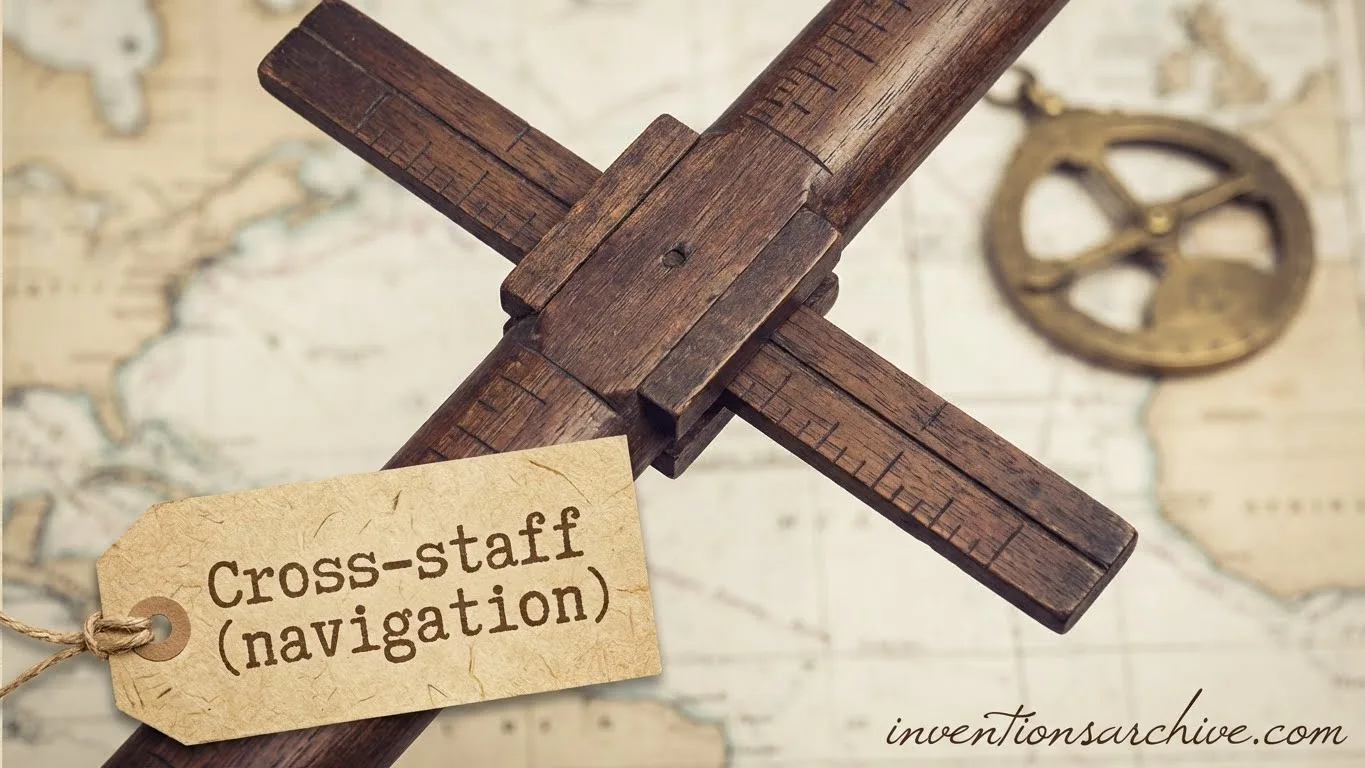
The instrument looked simple: a long main staff, marked with scales, and a shorter crosspiece that could slide along it. The crosspiece is often called a vane or transom. By moving the vane, the observer could bring the horizon and the celestial body into visual alignment.
This made the cross-staff different from a chart, compass, or clock. It did not point the way by itself. It gave the navigator a measured angle, and that angle then had to be interpreted with tables, experience, and other navigational knowledge.
How Its Origin Is Traced
The cross-staff belongs to a longer history of angle-measuring devices. Earlier astronomy used tools for measuring celestial positions, and practical surveying used geometry to estimate height and distance. The cross-staff carried that mathematical idea into a more compact instrument.
Museo Galileo connects the medieval Jacob’s staff to the extension of older angle-measuring principles and describes a related navigational model, the balestriglia, as a smaller form used to determine latitude from the altitude of the Sun or another celestial body on the horizon.[b]
The name can cause confusion. Jacob’s staff may refer to related astronomical or surveying forms, while cross-staff is often used for the navigational version. Some languages and regions used names such as ballastella, balestilha, or balestriglia. These words do not always point to exactly the same object, but they belong to the same family of sliding-staff angle instruments.
The Problem It Answered
Before reliable electronic instruments, sailors needed a way to connect the sky with their position on Earth. Latitude could be estimated from celestial altitude, especially the height of Polaris in the Northern Hemisphere or the Sun at noon with the right tables.
The problem was not only knowing which star to use. The larger problem was measurement. A navigator needed a tool that could be used on a moving vessel, held by hand, and read with enough consistency to support a practical estimate.
The cross-staff answered that need by offering a portable measuring line between the horizon and the sky. It did not remove uncertainty. Weather, sea motion, glare, poor scales, and user skill still mattered. Yet it gave sailors a workable method at a time when ocean navigation depended on repeated observations rather than a single perfect instrument.
| Before the Cross-Staff | What Changed After It |
|---|---|
| Latitude estimates depended on older instruments, memorized rules, coastal sailing, and less portable methods. | A navigator could use a hand-held staff to measure the altitude of a celestial body above the horizon. |
| Some angle-measuring tools were better suited to astronomy, surveying, or fixed observation. | The cross-staff adapted geometric measurement for shipboard use, even with practical limits. |
| Measuring the Sun or stars at sea required difficult observation and interpretation. | The sliding vane and marked staff gave a repeatable way to turn a sighting into a readable angle. |
| Navigation relied heavily on experience, dead reckoning, and visible land when available. | Celestial altitude became more directly useful for open-sea latitude estimation. |
| Earlier tools did not fully solve the problem of portability, simplicity, and usable angular reading together. | Later instruments, especially the backstaff and sextant, improved on the same need for accurate altitude measurement. |
How the Instrument Worked
The cross-staff worked through line of sight. The observer held one end of the main staff near the eye and moved the crosspiece until its lower edge appeared to meet the horizon while its upper edge appeared to meet the Sun or a star.
The position of the crosspiece on the main staff gave the angle. On some forms, the scale was marked for direct reading. On others, the reading depended on mathematical tables. NASA’s educational archive explains the geometric basis with the tangent relationship between the half-angle, the crosspiece distance, and the distance along the staff.[c]
In simple terms, the instrument turned a visual alignment into a measured angle. The farther the vane had to slide from the eye, the smaller the angle appeared. The closer it came, the larger the angle appeared. This made the staff a practical bridge between geometry and navigation.
Main Parts
- Main staff: the long marked rule held near the observer’s eye.
- Sliding vane or transom: the crosspiece moved along the staff to match the horizon and celestial body.
- Scales: markings used to read or calculate the measured angle.
- Sighting edges or vanes: the parts used for visual alignment.
Early Use at Sea
The cross-staff became especially important in marine navigation during the 16th century. The Mariners’ Museum describes it as a navigational tool used to measure the angle between the horizon and a celestial body, allowing navigators to determine latitude and direction. Its article also notes that it became more widely used in the 16th century and remained in use into the 17th and 18th centuries.[d]
Its value came from a practical match between instrument and task. A ship’s officer did not need a fixed observatory. The staff could be carried, aimed, adjusted, and read on deck. It belonged to the working kit of navigation, not only to theoretical astronomy.
Still, it had a serious weakness. To observe the Sun, the user often faced toward it. This could be uncomfortable and unsafe for the eyes. It also made accurate observation harder, especially when glare, clouds, or the movement of the vessel interfered with the sighting.
Materials, Scales, and Surviving Objects
Most cross-staffs were made from wood or similar rigid materials. The staff needed to be straight, stable, and marked with scales. The crosspieces had to slide but still hold their position once aligned.
A surviving example at Royal Museums Greenwich shows how detailed these instruments could be. The museum describes an incomplete wooden staff with four vanes, scales for altitude and complement, and a maximum reading accuracy of 10 arcminutes on each side. That object was recovered from the wreck of the Stirling Castle, which went aground during the Great Storm of 1703, and is dated before 1703.[e]
This surviving object matters because it shows the cross-staff as a real working instrument, not only as a drawing in a book. It had marked scales, separate vanes, physical wear, and a shipwreck context. Those details help historians understand how navigational theory reached the deck of a ship.
Development Path
The cross-staff did not appear in isolation. It came from older angle-measuring ideas, became a working navigation instrument, and then gave way to designs that solved some of its practical problems.
| Stage | Form | What Changed |
|---|---|---|
| Earlier Idea or Tool | Geometric angle measurement, diopter-like instruments, kamal, astrolabe, quadrant | People already used sighting, geometry, and celestial altitude, but tools varied by region and purpose. |
| Medieval Staff Instrument | Jacob’s staff / early cross-staff | A sliding crosspiece on a graduated staff made angle measurement portable and readable. |
| Maritime Form | Fore-staff, ballastella, balestriglia | The instrument was adapted for measuring the altitude of the Sun or stars above the sea horizon. |
| Improved Form | Backstaff / Davis quadrant | Shadow-based observation reduced the need to face the Sun directly. |
| Modern Descendant | Octant and sextant | Reflecting instruments allowed more precise angular measurement and became standard in celestial navigation. |
Main Types and Variations
The cross-staff family includes several related forms. Some were used mainly by astronomers. Others were adapted for navigation or surveying. The names overlap, so the difference is often about use, scale, and form rather than a completely separate invention.
| Type or Related Form | Main Use or Feature |
|---|---|
| Jacob’s Staff | General angle-measuring staff associated with medieval astronomy and surveying. |
| Cross-Staff / Fore-Staff | Maritime form used to measure altitude above the horizon for latitude estimation. |
| Balestriglia / Ballastella | Smaller navigational form with a long rule and interchangeable vanes. |
| Radius Astronomicus | Astronomical version used for measuring angular separation between celestial bodies. |
| Surveying Staff Forms | Related measuring tools used in land measurement, though not always identical to the marine cross-staff. |
| Backstaff | Later instrument that measured solar altitude with the observer’s back to the Sun. |
What Changed Because of It
The cross-staff helped make celestial measurement more practical at sea. Its effect was not sudden or perfect. It did not remove the need for skilled navigation. It did make a measured link between horizon, sky, and position easier to repeat.
Its influence can be seen in several areas:
- Navigation: it supported latitude estimation during long-distance voyages.
- Astronomy: it carried older angular measurement methods into a portable staff form.
- Instrument design: it showed both the value and the limits of direct sighting.
- Training: it helped navigators learn the relationship between celestial altitude and position.
- Later invention: it pushed demand for instruments that were safer and easier to read.
The cross-staff’s weakness was also part of its legacy. Looking toward the Sun was a problem. Later instruments addressed this by using shadows or mirrors. The backstaff, octant, and sextant did not erase the cross-staff’s importance; they answered the same measurement problem with better optical and practical solutions.
Common Misunderstandings
It Was Not Only a Sailor’s Tool
The cross-staff is famous in navigation, but its background also includes astronomy and surveying. Its marine use was one stage in a wider measurement tradition.
The Earliest Evidence Is Not Always the First Use
A written description from around 1342 is strong evidence, but it does not prove that no earlier related instrument existed. Historians separate surviving evidence from absolute first use.
It Did Not Give Longitude by Itself
The cross-staff was mainly useful for measuring altitude and estimating latitude. Longitude at sea remained a much harder problem until later timekeeping and astronomical methods improved.
Later Instruments Did Not Make It Useless Overnight
Newer tools gradually reduced its use. Mariners often kept older instruments in practice while learning or adopting newer ones.
Related Inventions
The cross-staff belongs to a wider chain of measuring and navigation tools:
- Kamal: a simple altitude-measuring navigation aid associated with Indian Ocean and Arab navigation traditions.
- Astrolabe: an older astronomical and navigational instrument for measuring celestial positions.
- Quadrant: a quarter-circle instrument used to measure altitude and angles.
- Backstaff: a later instrument that allowed Sun observations with the user’s back toward the Sun.
- Octant: a reflecting instrument that improved angular measurement at sea.
- Sextant: the later precision instrument most closely associated with celestial navigation.
Why the Backstaff Replaced It
The cross-staff’s biggest practical problem was solar observation. When measuring the Sun, the observer faced toward glare. That made readings difficult and could harm eyesight.
The backstaff answered this problem by using the Sun’s shadow. The Royal Ontario Museum describes the Davis quadrant or backstaff as an instrument that allowed the observer to avoid looking directly at the Sun while measuring, and notes that it became a standard navigational instrument for British seamen for a long period.[f]
This change shows how instrument history often works. A later invention does not simply “replace” an earlier one because it is newer. It replaces it because it solves a specific weakness. In this case, safer and more convenient solar observation mattered as much as the measurement itself.
Frequently Asked Questions
What was the cross-staff used for in navigation?
The cross-staff was used to measure the altitude of the Sun, Polaris, or another celestial body above the horizon. That measurement helped navigators estimate latitude at sea.
Who invented the cross-staff?
The cross-staff is often linked to Levi ben Gerson, or Gersonides, because of a detailed medieval description from around 1342. Earlier angle-measuring ideas existed, so a careful answer should treat the invention as part of a longer measurement tradition.
Is a cross-staff the same as a Jacob’s staff?
The names overlap, but they are not always used in exactly the same way. Jacob’s staff can refer to broader astronomical and surveying instruments, while cross-staff often refers to the navigational form used to measure celestial altitude.
Why did navigators stop using the cross-staff?
Navigators gradually moved to instruments such as the backstaff, octant, and sextant because they were safer or more accurate for practical observations. The cross-staff’s direct Sun sighting was a major weakness.
Did the cross-staff measure latitude directly?
No. It measured an angle, usually the altitude of a celestial body above the horizon. Navigators then used that angle with tables, charts, and observation methods to estimate latitude.
Sources and Verification
- [a] Epact: Scientific Instruments of Medieval and Renaissance Europe — Used to verify the definition of the cross-staff, its description around 1342, its link with Levi ben Gerson, and its use for astronomy, surveying, and navigation. (Reliable because it is an institutional scientific instrument resource from Oxford.)
- [b] Museo Galileo – In depth – Cross-staff — Used to verify the Jacob’s staff, balestriglia, radius astronomicus, sliding rule structure, and angle-measuring principle. (Reliable because it is a museum of the history of science with a dedicated instrument catalogue.)
- [c] The Cross Staff — Used to verify the basic geometric principle of the cross-staff and its use by astronomers and navigators for angular measurement. (Reliable because it is an educational science archive hosted by NASA Goddard Space Flight Center.)
- [d] Cross-Staff – Ages of Exploration — Used to verify the cross-staff’s navigational role, its measurement of celestial altitude, and its wider use during the age of ocean navigation. (Reliable because it is a museum educational resource focused on maritime exploration.)
- [e] Cross-staff | Royal Museums Greenwich — Used to verify the surviving pre-1703 cross-staff object, its vanes, scales, accuracy note, measurements, and recovery from the wreck of the Stirling Castle. (Reliable because it is an official museum collection record from Royal Museums Greenwich.)
- [f] Davis Quadrant or Backstaff – Works – eMuseum — Used to verify why the Davis quadrant or backstaff improved solar observation by avoiding direct sighting of the Sun. (Reliable because it is an official Royal Ontario Museum collection record.)