
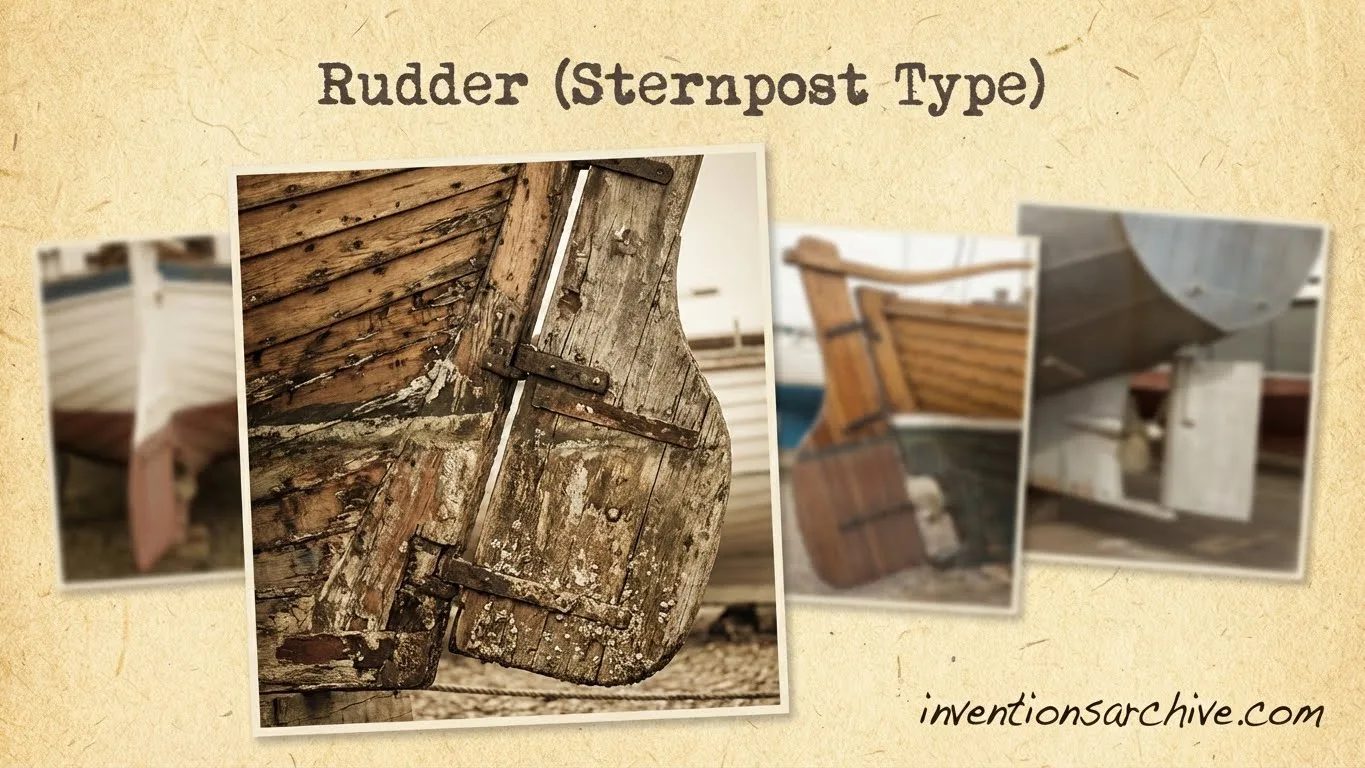
| Invention Name | Sternpost Rudder (sternpost type) |
|---|---|
| Short Definition | Centerline steering blade hinged to a ship’s sternpost |
| Approximate Date / Period | 1st century CE Approximate Details |
| Geography | China (early use); later Northern Europe and beyond |
| Inventor / Source Culture | Anonymous / collective (shipbuilders) |
| Category | Maritime navigation / ship steering |
| Importance |
|
| Need / Why It Emerged | Steer bigger ships with less crew strain |
| How It Works | Angled blade creates pressure difference → stern yaws sideways Details |
| Materials / Tech Basis | Timber blade; metal straps; hinge fittings (later steel) |
| First Common Uses | Harbors, rivers, coastal routes; later open-sea sailing |
| Spread Route | China → long-distance seafaring networks; later medieval Europe Approximate Details |
| Derived Developments | Balanced rudders; improved steering gear; deeper, more efficient hulls |
| Impact Areas | Trade, exploration, ship design, port logistics, maritime safety |
| Debates / Different Views | Independent invention vs. technology diffusion (timing varies) |
| Predecessors + Successors | Steering oar (side/quarter) → sternpost rudder → modern high-lift designs |
| Key Cultures / Eras | Early Chinese shipbuilding; medieval European shipyards |
| Influenced Variations | Transom-hung, skeg-hung, semi-balanced, lifting/kick-up |
| Core Hardware Terms | Pintles + gudgeons (hinge pair) Details |
A sternpost rudder is the moment ship steering became centered, predictable, and scalable. Instead of pushing a big boat around with a side-mounted steering oar, builders placed a broad rudder blade on the ship’s centerline, hinged to the sternpost. That single change reshaped how hulls were built, how ships behaved in waves, and how confidently they could move through tight channels and busy harbors.
Table of Contents
What the Sternpost Rudder Is
The Core Idea
A sternpost rudder places the steering surface directly behind the hull, aligned with the ship’s centerline. The blade pivots on a vertical line near the stern, so small changes at the helm can guide a large vessel with fine control.
- Sternpost: the strong vertical timber or frame at the back of many traditional hulls
- Rudder blade: the broad plate that meets the flow of water
- Hinges: fittings that let the blade swing while staying firmly attached
What Makes It “Sternpost Type”
The phrase sternpost type points to the classic arrangement: the rudder is hung on the sternpost itself, not floating freely under the hull. That structural link matters. It turns the stern into a steering backbone that can carry larger blades and stronger forces.
This is different from a spade rudder (common on many modern yachts), which pivots on its own stock without being physically attached along a sternpost. Both steer, yet the load paths and the typical ship structures are not the same.
Early Evidence and Timeline
- Early Chinese use is often described as dating to the first century CE, including a stern-mounted rudder that could be raised and lowered for shallow water navigation.
- In medieval Northern Europe, builders increasingly replaced the side steering oar with a stern rudder fixed to a straighter stern structure, supporting bigger ships and steadier handling.
- By later centuries, refinements focused on efficiency: better hinge fittings, stronger stocks, and shapes that reduced the effort required at the helm.
Two ideas travel through this history: control and scale. A steering oar can guide small craft, yet it becomes awkward when a hull grows heavier and a stern sits deeper in the water. A sternpost rudder moves the steering surface to a stable centerline position, where structure and leverage can grow along with ship size.
How It Works
The Water-Flow Story
A rudder steers by creating an uneven push in the water. When the blade turns, one side sees faster flow and lower pressure while the other side sees higher pressure. That pressure difference produces a sideways force on the stern, and the ship’s bow begins to swing into a new heading. The effect can feel almost like lifting sideways rather than simply “pushing” water.
At typical sailing and powered speeds, the rudder works best when it meets a clean, steady flow. Hull shape, keel form, and propeller wash can all change what the blade “feels.” This is why a sternpost rudder benefits from being placed where the ship’s structure naturally funnels water toward the stern.
Why the Helm Feels “Lighter” Over Time
As rudder designs matured, builders learned that shifting some blade area ahead of the pivot axis can reduce steering effort. That idea appears in balanced and semi-balanced rudders, where the water’s force is shared on both sides of the turning line. The ship still turns, yet the helm needs less brute strength and less mechanical advantage.
- Unbalanced: most area behind pivot, higher load
- Semi-balanced: small area ahead of pivot, reduced load
- Balanced: more area ahead of pivot, even lighter load
Main Parts and Materials
The sternpost rudder is simple in silhouette, yet its reliability comes from the way each part handles load, wear, and water movement. The classic setup is easy to recognize: a broad blade behind the stern and a line of strong hinge fittings that keep it aligned.
| Element | What It Does | Common Forms |
|---|---|---|
| Sternpost | Transfers steering forces into the hull | Timber post; framed stern structure |
| Rudder blade | Creates sideways force in the flow | Planked wood; later metal plate |
| Rudder stock | Connects blade to steering control | Wood head; later steel stock |
| Pintles + gudgeons | Hinge pair that supports weight and rotation | Iron straps; cast fittings; bushed bearings |
| Tiller / helm link | Turns the stock | Tiller arm; later mechanical/hydraulic gear |
A Note on Durability
Historic rudders often combined wood for buoyancy and resilience with metal for edge protection and hinge strength. In later eras, all-metal rudders offered consistent shape and easier integration with advanced steering gear. The goal stayed the same: keep a controlled pivot under heavy, repetitive forces.
Types and Variations
The sternpost rudder has a recognizable “family,” shaped by hull depth, water conditions, and steering loads. Some variations change the mounting; others change the blade geometry. Each aims to keep turning power while reducing stress and drag.
Mounting Variations
- Sternpost-hung: the classic hinge line along the sternpost
- Transom-hung: common on smaller boats; mounted on the flat stern surface
- Skeg-hung: supported by a fixed fin (skeg) below, adding strength and protection
- Lifting / kick-up: can move up in shallow areas, reducing bottom strike risk
Blade-Shape Variations
- Unbalanced: simple, sturdy, higher helm load
- Semi-balanced: easier steering, common on many working designs
- Balanced: reduced effort, often paired with more complex structure
- High-lift concepts: added features to improve turning force at lower angles
Sternpost Rudder vs. Steering Oar
A steering oar is quick to understand and easy to mount, yet it is off-center. That asymmetry can introduce uneven forces and awkward leverage as ships grow. The sternpost rudder is a centerline solution, so it pairs naturally with deeper keels, stronger stern frames, and long voyages where consistent handling matters.
Why It Mattered
The sternpost rudder did not just improve turning. It opened room for better hull architecture. When steering became more dependable, builders could push toward larger ships, steadier sailing, and more efficient port operations. A rudder that stayed aligned, survived heavy loads, and responded predictably made voyages feel less like improvisation and more like repeatable engineering.
Design Freedom
- Stronger sterns that carry steering loads cleanly
- Deeper drafts and more stable tracking at sea
- Bigger cargo capacity without losing maneuverability
Everyday Practical Gains
- Smoother turns in harbors and channels
- Less strain on crews compared with large steering oars
- More predictable response in variable winds and currents
A Quiet Breakthrough: Raising and Lowering
Some early descriptions highlight a sternpost rudder that could be raised or lowered depending on water depth. That detail matters for real-world navigation. Shallow rivers and crowded approaches demand a steering system that can remain effective without risking damage. This kind of adaptability fits the sternpost rudder’s broader story: steering control that stays useful across changing conditions.
How Steering Control Evolved Around It
The sternpost rudder encouraged better control systems because it provided a reliable pivot. A small boat can be steered by a simple tiller. As ships became larger, the same turning moment demanded more leverage, then stronger linkages, then powered assistance. The rudder stayed recognizable, while the control chain became more sophisticated.
- Tiller: direct manual lever for turning the stock
- Mechanical linkage: intermediate arms and gear to multiply force
- Powered steering: hydraulic or electrical actuation for very large rudders
Why This Matters for Understanding Ships
When a ship turns, it is not just “the rudder doing the work.” The hull, keel, and overall balance of underwater surfaces decide how easily that turn begins and how steadily it completes. The sternpost rudder became influential because it sits at a strategic place in that system. It is a control surface that works with the ship’s natural tracking, turning the stern into a responsive partner rather than a stubborn anchor.
FAQs
What is the main advantage of a sternpost rudder over a steering oar?
The key advantage is centerline control. A sternpost rudder sits behind the hull on the ship’s centerline, so it scales better as ships grow larger. Steering becomes more predictable and less physically demanding.
Why do some sternpost rudders use pintles and gudgeons?
Pintles and gudgeons form a hinge pair that supports the rudder while letting it rotate smoothly. This setup spreads loads along the sternpost and helps keep the blade aligned, improving durability and control.
Are balanced rudders still “sternpost rudders”?
They can be. “Balanced” describes how the blade area is distributed around the pivot axis. A rudder may be sternpost-hung and also semi-balanced, combining structural tradition with reduced steering effort.
Did the sternpost rudder appear in one place or multiple places?
Historical accounts describe early use in China and later widespread adoption in Europe, with timing that varies by evidence and interpretation. Many discussions focus on whether this reflects diffusion through seafaring networks or separate development.
What makes the sternpost rudder an “evergreen” design idea?
The concept stays relevant because it is a clean solution: a strong, hinged blade at the stern that converts small helm inputs into controlled turning forces. Materials and steering gear can change, yet the flow-control principle remains timeless.